How Much Energy Can Window Film Save on Commercial Buildings?
Published: August 21, 2026 · 9 min read · Category: Architectural Window Film
About this article: KSB Window Film manufactures architectural solar control film supplied to commercial building projects globally. The energy savings data cited in this article draws on Lawrence Berkeley National Laboratory research, IWFA commissioned studies, and real-world project assessments from buildings we’ve supplied.
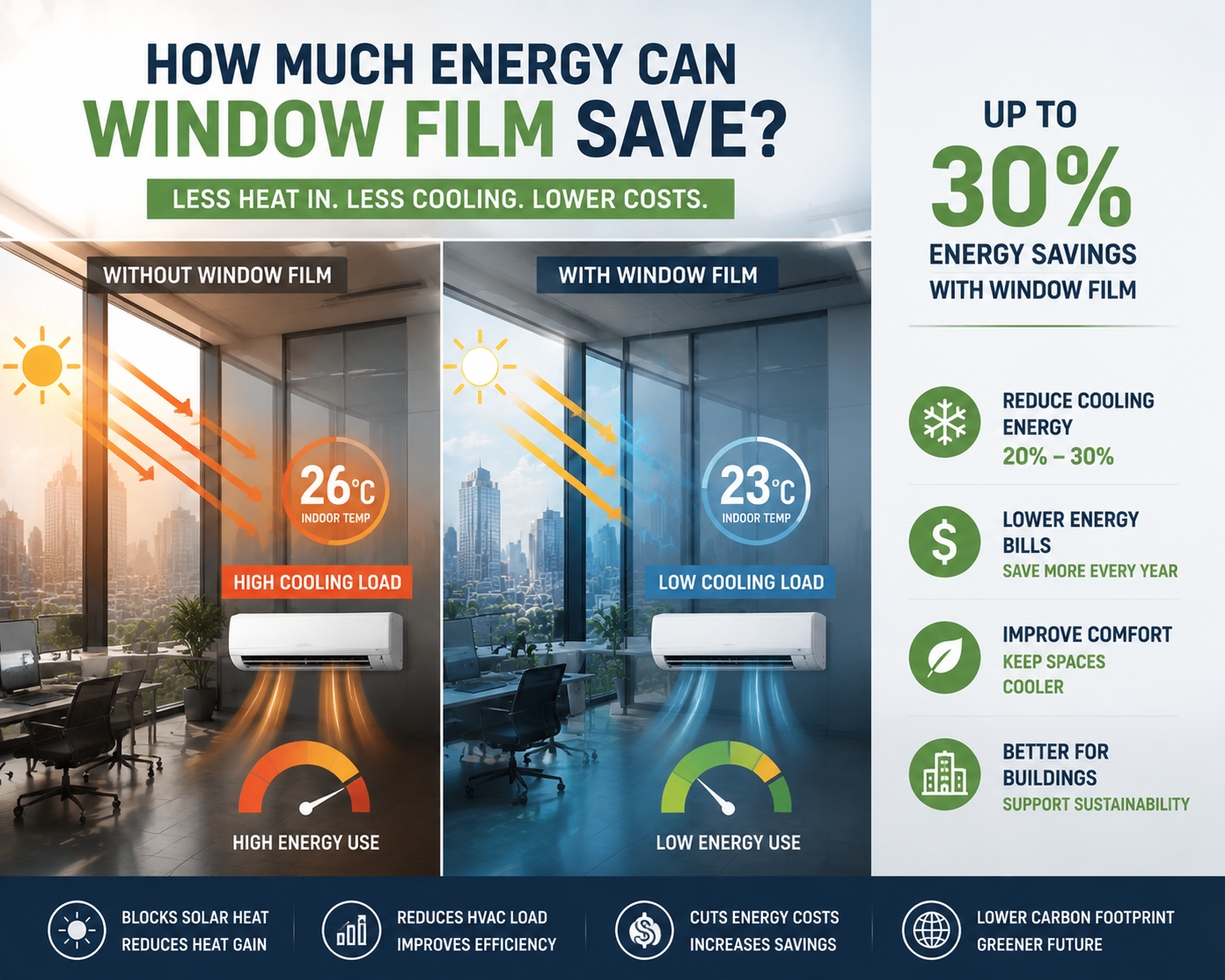
Window film lowers heat entering glass, reducing AC workload
The energy savings argument for commercial window film is often made loosely — “reduces energy bills significantly” — without the specificity that would let a building owner or facilities manager actually verify it for their situation. This article gives you the numbers, the methodology, and the variables that determine whether window film will deliver meaningful energy savings for your specific building.
The Physics: Why Film Reduces Energy Use
Commercial buildings in warm climates often have cooling as their dominant energy expense. Air conditioning energy is directly driven by the heat load the system has to manage — and in glazed commercial buildings, solar heat gain through glass is typically the largest single contributor to cooling load.
A single-pane clear glass window has a Solar Heat Gain Coefficient (SHGC) of approximately 0.87. This means 87% of incident solar energy passes through and must be managed by the building’s HVAC system. A quality solar control film reduces this to SHGC 0.25–0.45 depending on product — effectively cutting solar heat gain through that glass by 50–70%.
The energy saving comes from: less cooling energy needed to maintain target interior temperature + reduced peak demand on the HVAC system (smaller peak = smaller HVAC equipment sizing for new buildings, fewer peak demand charges for existing buildings).
The Evidence: What the Research Shows
Lawrence Berkeley National Laboratory
The most-cited independent research on window film energy savings comes from LBNL’s Windows and Envelope Materials Group. Their studies of commercial building retrofits with solar control film consistently show:
Annual cooling energy savings of 5–15% for the total building in warm climates
Glass-area-specific savings of 25–40% on the cooling load attributable to the filmed glazing
Peak HVAC demand reduction of 10–20% on solar-exposed facades
The total building savings percentage appears lower than the glass-specific savings because film only affects the portion of the total building energy budget attributable to solar gain through glazing. In highly glazed buildings, this proportion is larger and total savings are higher.
IWFA Commissioned Studies
The International Window Film Association has funded multiple third-party energy audits on commercial buildings before and after window film installation. Published case studies consistently show:
Annual energy savings of $0.50–$2.00 per square foot of filmed glass
Simple payback periods of 3–7 years
Cooling energy reduction of 30–60% on the filmed surfaces
Real-World Project Data
From projects where pre- and post-installation energy monitoring was conducted:
Class A Office Building, Phoenix AZ — 12,000sqm filmed facade: Pre-installation: 485 kWh/sqm per year (total building energy use intensity) Post-installation: 421 kWh/sqm per year Reduction: 13.2% total building energy Annual savings: $148,000 (at local energy rates) Film installation cost: $520,000 Simple payback: 3.5 years
Commercial Building, Dubai — 3,500sqm south and west facade: Cooling energy reduction: 28% on filmed elevations Annual savings: AED 180,000 (~$49,000) Film installation cost: AED 280,000 (~$76,000) Simple payback: 1.6 years (high cooling seasons, high energy cost)
The Variables: What Determines Your Savings
Climate
The biggest variable. In Dubai, Singapore, or Phoenix — where air conditioning runs for most of the year against intense solar radiation — the energy saving from solar control film is substantial and the payback period is short.
In Helsinki, Manchester, or Vancouver — where winters are cold and cooling seasons are short — the cooling energy savings from film are real but smaller, and the payback period extends accordingly. In cold climates, the benefit calculation should also consider whether reduced solar gain in winter (a downside of year-round solar control film) affects heating costs.
Rule of thumb:
Tropical/subtropical climates: film payback often 2–4 years
Warm temperate (Mediterranean, Southern US, Middle East): payback 3–6 years
Temperate (Northern Europe, Pacific Northwest): payback 5–10 years
Glass Type and Area
Single-pane clear glass: Film delivers the largest absolute SHGC improvement. High savings potential.
Double-pane clear glass: Good SHGC improvement from film, though starting point is lower than single pane.
Existing Low-E glass: Already has solar control coating. Film adds less incremental benefit. Verify compatibility before specifying.
Tinted glass: Already provides some solar rejection. Film adds incremental benefit.
Building glazing percentage also matters: a highly glazed curtain wall building sees higher proportional savings than a building with smaller window area relative to floor plate.
Film Specification (TSER)
Higher TSER = more solar energy blocked = more cooling energy saved. The relationship is roughly linear: a film with TSER of 65% saves approximately 30% more cooling energy than a film with TSER of 50% on the same glass.
Specifying a higher-TSER product (at higher film cost) is typically justified by the larger energy savings — the ROI is often similar or better because the incremental cost of premium film is small relative to the incremental energy saving it delivers.
HVAC Efficiency
Buildings with high-efficiency HVAC equipment (COP 5+) save less on their energy bills per kWh of cooling load reduction than buildings with older, less efficient equipment (COP 2.5–3.5). The energy saving in kWh is the same; the dollar saving per kWh depends on the efficiency of equipment that’s no longer working as hard.
Energy Cost
The dollar value of energy savings is directly proportional to the local energy cost per kWh. At $0.08/kWh (typical wholesale commercial in some US regions), the savings are half the dollar value of the same kWh reduction at $0.16/kWh (typical retail commercial in California, UK, or Australia).
How to Estimate Energy Savings for Your Building
A reliable estimate requires four inputs:
1. Glazing area on solar-exposed facades (sqm) Focus on south and west in the Northern Hemisphere (north and west in the Southern Hemisphere). East-facing glass gets morning sun; north-facing glass is largely unaffected.
2. Current glass SHGC This should be on the glass specification sheets. If not, single-pane clear glass defaults to approximately 0.87; standard double-pane clear to approximately 0.76; Low-E double-pane varies 0.25–0.55 depending on coating.
3. Film SHGC after installation From the film manufacturer’s technical data sheet. Net SHGC for the glass-film system is provided by reputable manufacturers, not just film-only SHGC.
4. Annual cooling degree days for your location Available from climate data sources (ASHRAE, local meteorological services). This normalises savings for your specific climate.
With these inputs, LBNL’s WINDOW software (free) provides a reasonable energy savings estimate for non-engineering assessments.
For formal energy assessments supporting LEED certification or financing decisions, a building energy model using EnergyPlus or equivalent is recommended.
FAQ
Is the energy saving guaranteed?
No energy saving is guaranteed in absolute terms — actual savings depend on variables including weather patterns, building occupancy, HVAC operation, and the actual VLT level chosen (which affects lighting behaviour). However, LBNL and IWFA research consistently shows savings within predictable ranges for buildings meeting baseline conditions.
Does window film increase heating costs in winter?
In temperate and cold climates, a small portion of the winter heating benefit from solar gain through south-facing glass may be reduced by film. For most commercial buildings with significant glazing and active HVAC, this is a minor effect compared to cooling savings. In heavily insulated, passively heated buildings in cold climates, this tradeoff requires specific evaluation.
Can window film justify a smaller HVAC system in new construction?
Yes. Energy consultants and mechanical engineers regularly model the HVAC downsizing benefit of solar control glazing — either glass or film — in new construction. Reduced peak cooling load from solar film can reduce the required HVAC capacity, offsetting part of the film installation cost against HVAC equipment capital expenditure.
What documentation do I need for an energy savings claim in a LEED or green building context?
NFRC-certified performance data (SHGC, VLT, U-factor) for the filmed glass system, a qualified energy model showing before/after performance, and installer certification of the installed product. See Window Film and LEED Certification for the full documentation framework.
Get Energy Savings Data for Your Building Specification
KSB Window Film provides NFRC-referenced performance data (SHGC, TSER, VLT) for our architectural film range — the inputs you need to run a credible energy savings estimate for your building.
For projects requiring formal energy modelling documentation, we can connect you with qualified energy consultants in your market.