Published: July 14 , 2026 · 8 min read · Category: Window Film Guide
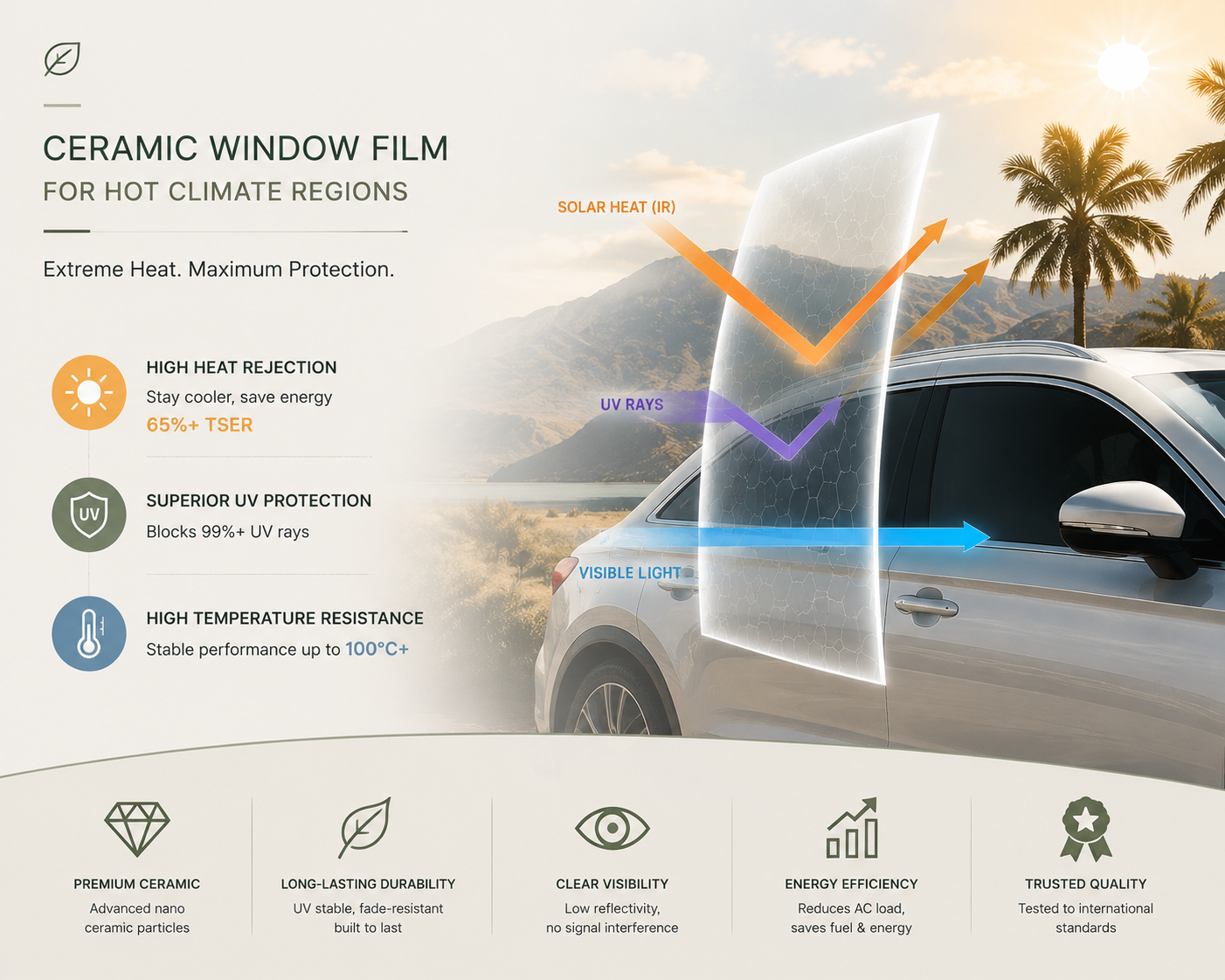
Window film is useful everywhere, but it earns its cost most decisively in hot climates. In a place where summer temperatures regularly exceed 35°C, where UV intensity is among the highest in the world, and where a car parked in direct sun for two hours can reach interior temperatures that make it physically dangerous to touch the steering wheel — the performance difference between window film tiers stops being theoretical and becomes something you experience every day.
This guide is specifically for buyers in high-solar-load environments: the Middle East, Southeast Asia, South Asia, Australia, North Africa, and the southern and southwestern United States. The requirements here are different from a temperate climate, and the film selection criteria need to reflect that.
What “Hot Climate” Actually Demands from a Film
The physical stresses on window film are more intense in hot climates:
Higher UV load. UV index in tropical and subtropical regions frequently reaches 11–13 (extreme). Accumulated UV exposure on window film over a year is multiples of what a film in a Northern European climate experiences. Films that hold up under low-UV conditions can yellow, delaminate, or lose performance faster in high-UV environments.
Wider temperature extremes. A car parked in direct sun in the UAE or Australia can see glass surface temperatures exceed 85°C. Interior temperatures can hit 60–70°C. The film’s adhesive chemistry, PET base stability, and top coat formulation all need to be rated for sustained high-temperature exposure.
Higher solar intensity. The solar irradiance at ground level in tropical regions is higher than at higher latitudes. More energy is arriving per square meter — the film’s heat rejection capability is tested harder.
Year-round exposure. In temperate climates, high solar stress is seasonal. In tropical regions, high UV and heat exposure is 12 months a year. The effective UV and heat dose accumulated per year is dramatically higher.
What to Prioritize in Film Selection for Hot Climates
TSER: The Primary Criterion
Total Solar Energy Rejected is the number to optimize for hot climate applications. In a market where summer temperatures are extreme, the difference between 55% TSER and 70% TSER is not marginal — it’s felt every time you get into the car.
Target TSER of 65%+ for automotive film in hot climates at your chosen VLT. For building applications, a higher target is appropriate — large glass areas in a commercial building in a hot climate can represent significant cooling energy costs.
Full-Spectrum IR Rejection
As discussed in IR Rejection Explained, the full-spectrum IR measurement matters far more than the single-wavelength headline. In hot climate applications, push suppliers specifically for full-spectrum IR data to NFRC or ISO 9050 standards. Don’t accept single-wavelength claims.
A quality hot-climate ceramic film should achieve 80%+ full-spectrum IR rejection in the near-infrared range.
UV Stability: Longer Warranty, Verified Test Data
UV degradation is accelerated in high-UV environments. A film warranted for 10 years in Germany is not necessarily warranted for 10 years in Dubai. Check whether the manufacturer offers differentiated warranty terms for high-UV markets or whether they’ve specifically tested for high-UV accelerated aging.
Ask for ASTM G154 or ISO 4892 accelerated UV aging test results. These tests simulate prolonged UV exposure in a controlled environment. The performance retention after testing tells you how the film will hold up over years of real-world exposure.
High-Temperature Adhesive Stability
At 85°C glass surface temperature, adhesive quality becomes critical. Cheap adhesives can soften, creep, or delaminate under sustained high-temperature exposure. Ask specifically whether the adhesive has been tested for performance at elevated temperatures — good products are rated to 100°C or above on the adhesive specification.
Product Characteristics to Look For
The best performing nano ceramic films for hot climates share several characteristics:
Cesium tungsten oxide (CTO) or titanium nitride ceramic compounds. CTO in particular has strong near-IR selective absorption that makes it highly effective in the wavelengths where solar IR intensity peaks. Several manufacturers producing specifically for Middle East and Southeast Asian markets use CTO-based formulations.
Dual-layer TPE or multi-layer PET construction. More complex film constructions provide better dimensional stability at high temperatures and more UV protection for the adhesive layer.
Premium adhesive rated for extended high-temperature exposure. Specified to 100°C or above, with UV-stable formulation that won’t discolor over years of heat cycling.
UV-stabilized top coat. The exposed surface of the film receives the highest UV dose. Top coats with HALS (Hindered Amine Light Stabilizers) maintain their optical properties and scratch resistance longer under sustained UV.
Specific Supplier Considerations for Hot Climate Sourcing
Chinese manufacturers have extensive experience supplying to hot climate markets — the Middle East, Southeast Asia, and South Asian markets are major recipients of Chinese-manufactured window film. The manufacturers in these export channels have adapted their products for hot climate requirements in ways that manufacturers primarily serving temperate markets haven’t needed to.
When requesting samples and evaluating suppliers, specify your climate context explicitly. A good supplier will adjust their product recommendation based on your end market’s conditions. A supplier who recommends the same product regardless of climate hasn’t really engaged with your requirements.
Key questions for hot climate sourcing:
- What is your warranty term for installations in Middle East / Southeast Asia / [your market]?
- Do you have accelerated UV aging test data to ASTM G154?
- What temperature range is your adhesive rated for?
- Do you have reference installations in [specific hot climate market]?
For verified manufacturers with hot-climate track records, see Top Ceramic Window Film Manufacturers in China (2026).
Recommended VLT Range for Hot Climates
This is the tension: darker film blocks more visible light (and proportionally more total solar energy), but in most markets there are legal VLT limits for automotive windows, and for building glass there may be daylighting requirements.
For automotive applications in hot climates:
- Front windshield: legal VLT requirements in most jurisdictions prevent film or require high-VLT (70%+) film. A high-quality ceramic at 70%+ VLT still delivers meaningful TSER benefit.
- Front side windows: typically 30–50% VLT depending on local regulations
- Rear windows: often 5–35% VLT, sometimes unrestricted
For building applications in hot climates:
- 20–40% VLT is common in commercial facades where solar control is a priority
- 40–60% VLT in spaces where daylighting and occupant view are also priorities
Regardless of the VLT chosen, specify ceramic over carbon or dyed for maximum heat rejection at any given VLT level.
FAQ
Does nano ceramic film actually keep a car significantly cooler in extreme heat?
Yes, measurably. Studies and field tests in high-solar-load environments have shown interior temperature reductions of 10–20°C compared to unfilmed glass under equivalent direct-sun conditions. The A/C benefit is significant — some data suggests 20–30% reduction in cooling energy needed to achieve the same cabin temperature, which has a direct fuel efficiency or EV range impact.
How often does window film need to be replaced in very hot climates?
For premium ceramic film, 7–10 years is achievable in most hot climate markets with proper installation and maintenance. Budget or dyed film may show visible degradation (yellowing, delamination) in 3–5 years in extreme UV/heat conditions. Warranty terms for the specific product in your market are the best indicator.
Is architectural window film on buildings worth it in hot climates?
Significantly so. In markets like the UAE, Saudi Arabia, and Singapore, window film on commercial buildings is often specified for energy efficiency compliance. The cooling energy reduction from high-TSER film on south- and west-facing glazing can be substantial — referenced in ASHRAE and local green building standards.
Can I use the same ceramic film for both car and building windows?
No — automotive and architectural ceramic films are different products with different adhesive systems, installation requirements, and regulatory profiles. Use products designed for each application type.
Does tint darkness affect how well it blocks heat in a hot climate?
Less than most people assume when using quality ceramic film. A quality 50% VLT ceramic can outperform a 20% VLT carbon on TSER. In hot climates, prioritize TSER at whatever VLT is legal and acceptable — don’t assume darker is better.
Further Reading
On this site:
- IR Rejection Explained: What Does It Really Mean? — Understanding the heat rejection spec that matters most
- How Nano Ceramic Window Film Blocks Heat — The physics of heat rejection
- Top Ceramic Window Film Manufacturers in China (2026) — Verified suppliers with hot climate export experience
- What Certifications Should a Window Film Manufacturer Have? — Verifying accelerated aging test data
- How to Import Window Film from China: Complete Buyer’s Guide — Sourcing process for hot climate markets
External:
- ASHRAE 90.1 Solar Heat Gain — Building energy code standards for solar control in hot climates
- UAE ESMA Window Film Standards — Regulatory requirements for window film in UAE and GCC
- ASTM G154 Accelerated UV Testing — Test standard for UV exposure resistance in films
- Lawrence Berkeley National Laboratory — Hot Climate Glazing Research — Technical research on glazing performance in high-solar environments
Get a Free Sample or Quote
Looking for a reliable window film supplier? Contact us today for fast response and professional support.