PPF Factory vs Trading Company: What’s the Difference?
Published: June 23, 2026 · 7 min read · Category: PPF Sourcing
About this article: KSB Window Film is a PPF manufacturer, not a trading company. We’ve written this guide honestly because buyers who don’t understand the distinction make sourcing decisions they later regret — and that’s bad for everyone in the supply chain.
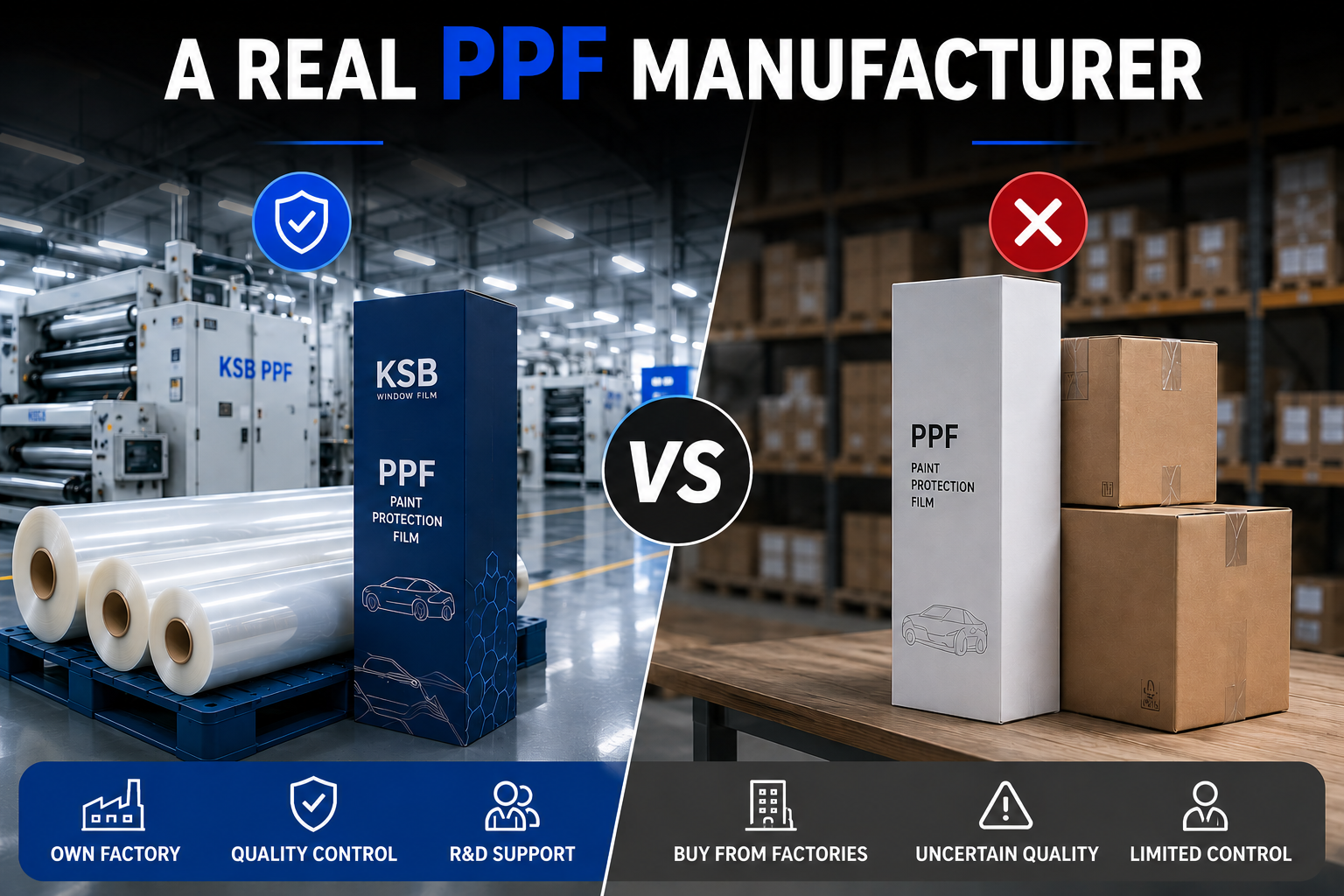
Comparison between a real PPF manufacturer with factory production capability and a trading company warehouse model.
In PPF sourcing from China, the factory vs. trading company distinction matters more than in many other product categories — because PPF quality is difficult to assess without production transparency, and trading companies by definition have limited visibility into the production they’re sourcing.
What Each Actually Is
A PPF factory manufactures TPU film in-house. At minimum, a genuine factory has: TPU base film production or documented long-term supply, precision coating equipment for top coat application, adhesive lamination capability, a QC lab, and production staff. The factory knows why a batch went wrong because they made it.
A trading company buys finished or semi-finished product from factories and resells it. They add branding, packaging, documentation support, and account management. They don’t make anything. When something goes wrong with a production batch, they find out when you do.
The middle category — converters — buy TPU base film from upstream suppliers and apply their own top coat and adhesive lamination. They partially manufacture; they don’t produce the base film. Many mid-tier Chinese PPF suppliers are converters.
Why It Matters for PPF Specifically
Accountability in quality failures. When a batch of PPF underperforms — self-healing is slower than spec, haze is elevated, adhesive lifts at edges — a factory can trace the failure to specific production parameters. A trading company can’t. They can escalate to their factory supplier, but the investigation and corrective action happen at the factory level, not theirs.
OEM development capability. Custom formulation — specifying your own TPU grade, top coat chemistry, adhesive profile — requires working directly with the people who make the product. A trading company cannot develop a custom formulation on your behalf. They can source a formula from a factory that develops it, but you’re removed from the development process by a layer.
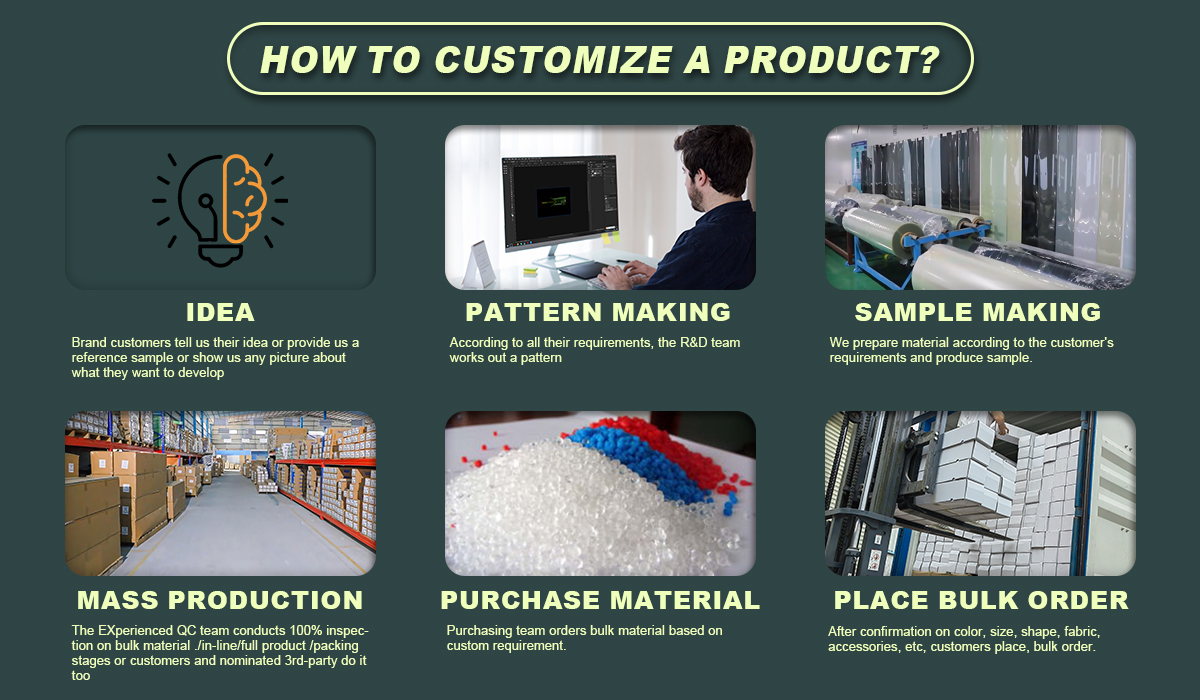
Clear step-by-step OEM customization process including idea confirmation, pattern making, sample production, material purchasing, and mass production.
Pricing at scale. Trading companies add margin to the factory price. At low volumes, this margin is worth paying for the services they provide (account management, documentation, lower MOQ). At higher volumes, the margin compounds into a meaningful cost differential. Direct factory relationships almost always win on pricing at 500+ rolls/month.
Quality consistency. Trading companies may rotate their factory supply — buying from whichever factory offers the best price at a given time. If they switch factories between your orders, your product changes. A direct factory relationship guarantees continuity of production.
When a Trading Company Makes Sense
You’re starting out. Trading companies handle complexity that new importers aren’t equipped for — freight, customs, compliance documentation. The premium you pay covers real services.
You need a wide product range at low volume per SKU. No single PPF factory does everything well. A trading company with a curated supplier network can source gloss PPF, matte PPF, and PPF-adjacent products from different factories under one account relationship.
You need fast replenishment. Trading companies often hold finished goods inventory. Direct factory orders go into production scheduling. If stock-out risk is a bigger concern than unit economics, a trading company’s inventory access has value.
When to Go Direct to the Factory
Volume justifies it. Once you’re consistently moving 300–500+ rolls per month of a SKU, the economics of direct relationships become compelling. Even a 12% cost reduction at that volume is real money annually.
OEM is the objective. There’s no path to genuine OEM PPF development that doesn’t involve a direct factory relationship.
Accountability is non-negotiable. For premium vehicle applications, installers covering high-value paint on luxury and exotic vehicles demand consistent, traceable quality. Direct factory relationships with batch documentation are the only way to deliver this consistently.
How to Tell Which You’re Dealing With
Ask for the factory address and look it up. A genuine manufacturer’s address is in an industrial zone with recognisable manufacturing-scale infrastructure on satellite imagery. A trading company’s address is typically in a commercial office building.
Ask for a factory video walkthrough — live. Not pre-recorded marketing content. A live walkthrough where you can ask to see specific equipment. A factory shows you their production floor. A trading company either declines, sends promotional video, or shows you a partner factory they don’t own.
Check the business license scope. In China, the registered business scope lists manufacturing (生产/制造) separately from trading (贸易/销售). Request the business license. The scope tells you which category they’re registered in.
Use Panjiva or ImportGenius to search their export records. A factory doing significant PPF export has shipping records from their registered address.
FAQ
Can a trading company produce consistent quality?
Yes, if they have long-term, exclusive relationships with quality factories and strong QC processes on incoming goods. The best trading companies are effectively supply chain managers with significant sourcing expertise. The worst are pure arbitrageurs with minimal quality commitment.
Is a converter better or worse than a trading company?
A converter is typically better for quality and OEM capability than a pure trading company, but less capable than a full-line manufacturer. Converters control at least part of the production process — the top coat and adhesive application — which gives them more accountability for the finished product than a trading company has.
Why do some factories present as trading companies?
Sometimes it’s simpler export documentation. Sometimes factories have a separate trading entity for international sales. A company presenting as a trading company may actually source from its own affiliated factory. The only way to know is to visit.
KSB Window Film is a manufacturer. We have production equipment, a QC lab, batch records, and the ability to develop and produce to specification. Our export team can show you our facility — live, any time.