Safety and Security Window Film for Government Buildings and Embassies
Published: September 1, 2026 · 9 min read · Category: Safety & Security Film
About this article: KSB Window Film manufactures heavy-duty safety and security film for institutional applications. Government and embassy specifications represent the most demanding end of the safety film category — this guide addresses the specific standards, procurement frameworks, and technical requirements that apply.
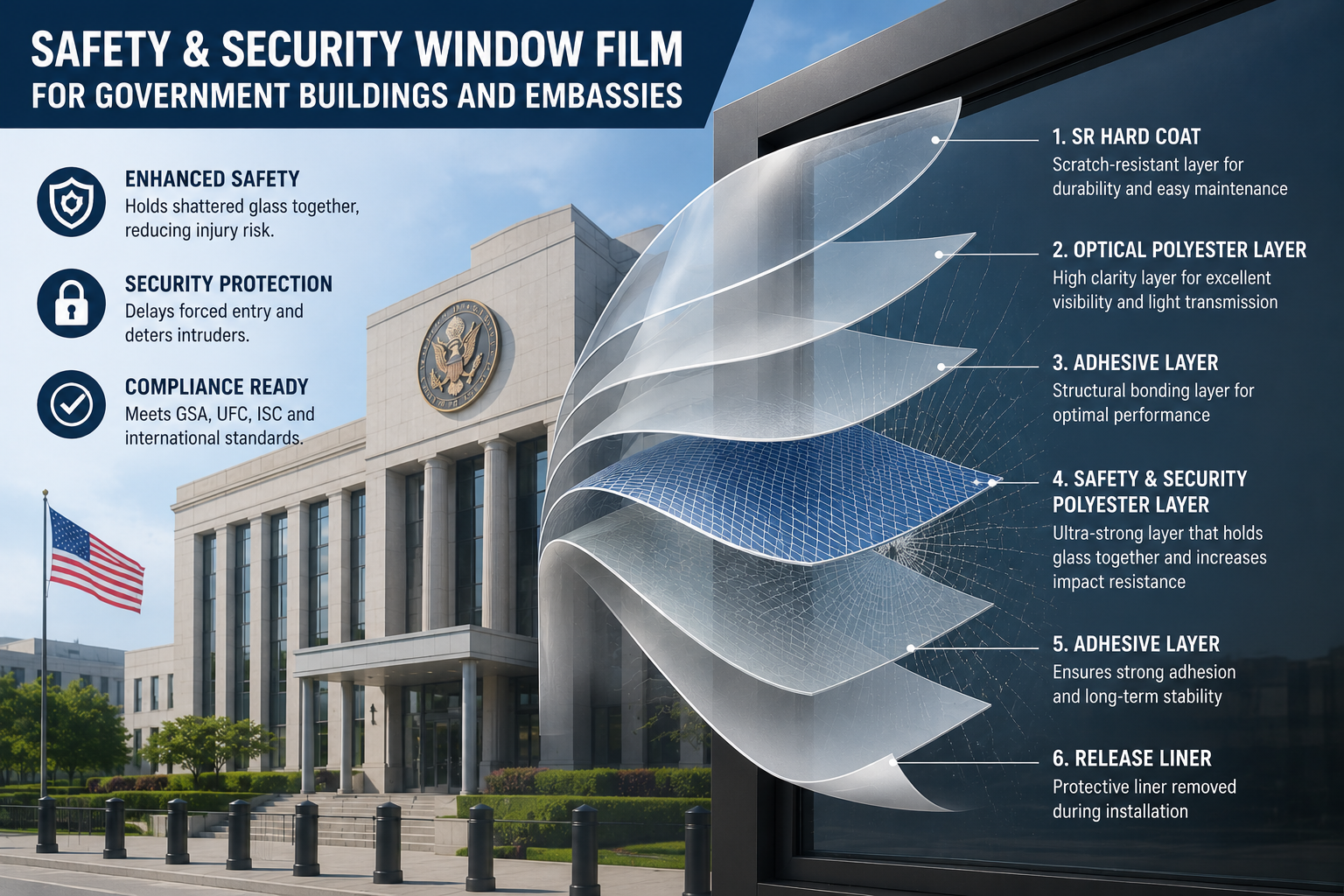
Multi-layer government security window film structure designed for blast mitigation, fragment retention, and forced-entry delay.
Government buildings and embassies occupy a distinct position in the security glazing landscape. The threat profile is different from retail or commercial security — more likely to involve planned attacks, explosive devices, or coordinated forced entry than opportunistic smash-and-grab. The regulatory environment is different — mandatory compliance with government-specific standards, procurement through formal frameworks, and documentation requirements that exceed commercial specification. And the stakes are different — consequences of glazing failure in a blast or attack event can include casualties among staff, diplomatic personnel, and members of the public.
This guide covers the specific standards, products, and specification considerations for government and diplomatic facility glazing protection.
The Threat Environment
Government buildings and embassies face a threat spectrum that includes:
Explosive blast: Vehicle-borne IEDs (VBIEDs), person-borne devices, and standoff explosive attacks. The blast pressure wave shatters glazing at significant distance from the detonation point. Fragment scatter from unprotected glazing is consistently the primary injury mechanism at these distances.
Ballistic attack: Direct firearms attack on building glazing. Safety film does not provide ballistic resistance — this threat requires ballistic-rated glazing systems (separate product category from safety film).
Forced entry: Coordinated forced entry attempts targeting building perimeters. Security film provides delay; the delay must be adequate for the building’s response capability.
Civil unrest and protest: Improvised projectile attack on building glazing. Film fragment retention protects occupants from glass injury during these events without necessarily providing full forced entry resistance.
Improvised attacks: Vehicles used as weapons against building glazing (ram attacks). This threat category requires engineering-grade structural glazing systems — safety film alone is insufficient for vehicle impact.
The Regulatory Framework: US Government
GSA PBS-P100 (General Services Administration Facilities Standards): The primary standard governing security in US federal buildings. Section 8 covers physical security including glazing requirements. Film systems must be tested and documented under GSA framework.
UFC 4-010-01 (Unified Facilities Criteria — DoD Minimum Antiterrorism Standards): Department of Defence standard. Governs glazing protection at all DoD facilities. Specifies glazing performance by standoff distance and building occupancy category. Window film is one of the approved protective glazing approaches.
ISC Security Standards (Interagency Security Committee): Governs non-DoD federal agencies. The ISC standards reference UFC 4-010-01 for physical security but apply to civilian federal agencies (courts, administration buildings, federal offices).
State Department OBO Standards: The Bureau of Overseas Buildings Operations governs embassy and diplomatic facility construction and security globally. OBO standards for blast protection are among the most stringent in the world.
Key principle across all US government standards: blast film must be part of a system — film + structural frame attachment + adequate frame structure. The film alone does not constitute a compliant blast protection solution.
The Regulatory Framework: UK and European Government
UK Government Security Classifications: UK government buildings are classified by their security requirement under the Government Security Classifications policy. Physical security requirements (including glazing) are specified in standards maintained by the Cabinet Office National Security Secretariat.
CPNI (Centre for the Protection of National Infrastructure): The UK’s authority on protective security for national infrastructure. CPNI provides guidance on glazing security that references LPS 1270 (forced entry) and blast-rated glazing standards. CPNI-approved products and installers are required for the highest-classification facilities.
LPS 1270 PASS:2019: Loss Prevention Standard for forced entry — widely referenced in UK government and commercial high-security specifications. Class A4 (10-minute attack resistance) is the standard for the most sensitive locations.
NATO STANAG Standards: For NATO military facilities, STANAG (Standardization Agreement) standards govern blast and physical security. These are referenced in military construction specifications across NATO member countries.
Product Specifications for Government Applications
Standard Government Building (Non-Critical, Public Areas)
Specification: 8–10 mil security film with wet-glazed frame attachment.
This provides adequate protection against civil unrest, improvised projectile attack, and opportunistic forced entry in publicly accessible government buildings (post offices, benefits offices, public counters, courts).
Standard: LPS 1270 A2, or EN 12600 Class B1 with frame attachment.
Critical Infrastructure and High-Security Buildings
Specification: 12–15 mil blast film with structural wet-glaze and mechanical frame attachment system.
For buildings with elevated threat profiles — intelligence agencies, defence facilities, secure government communications, critical infrastructure control centres.
Standard: GSA/UFC compliance required for US facilities. LPS 1270 A4 for UK/European highest-security applications.
Embassy and Diplomatic Facilities
Specification: Film is typically one component of a designed protective glazing system. The complete system may include:
Laminated glass (preferred for highest-threat applications)
Film on remaining annealed or tempered glass
Structural frame attachment engineered to transmit blast loads to the building structure
Standoff barriers to increase the distance between threat and glazing
For new embassy construction, laminated glass with blast-engineered frames is the preferred solution. Film is more commonly used in retrofit applications where the existing glass cannot be replaced without extensive construction works.
Standard: State Department OBO standards for US embassies; equivalent national standards for other countries.
Procurement Frameworks
US Federal Government
US government procurement of window film is subject to FAR (Federal Acquisition Regulations) and agency-specific procurement rules. For GSA-managed facilities, supply is through:
GSA Schedule (Multiple Award Schedules): Pre-qualified suppliers with negotiated rates. Window film installers and manufacturers supplying government projects typically need to be registered on the relevant schedule.
Agency-specific contracts: DOD facilities may procure through AFWERX, NAVFAC, or equivalent acquisition channels.
International suppliers (including Chinese manufacturers like KSB) can supply film product through US-based certified installers who manage the government procurement relationship.
UK Government
Crown Commercial Service (CCS): Pre-tendered frameworks covering facilities management and security products. Film installation through CCS-registered contractors.
CPNI Pre-Qualification: For the highest-classified facilities, contractors must be CPNI pre-qualified. Film product must be certified to applicable standards.
Documentation Requirements
Government projects require more extensive documentation than commercial:
Product certification: The specific film product must be certified to the applicable standard (LPS 1270 class, GSA compliance, EN 12600). Certification must cover the specific product in the specific installed configuration.
Installer certification: Government security projects require installation by certified contractors — CPNI-approved for UK high-security, typically security-cleared for US government and embassy projects.
Installation record: Photographic record of installation, including frame attachment detail, covering all protected areas. Required for building security records.
As-built specification: The installed specification must match the designed specification and be documented as such.
Periodic re-certification: Some government standards require periodic re-inspection and re-certification of film installations to confirm continued performance compliance.
What Safety Film Cannot Do in Government Applications
Being clear about the limitations is as important as describing the capabilities:
Film does not provide ballistic protection. Any glazing application where direct firearms attack is a credible threat requires ballistic-rated laminated glass or polycarbonate systems. Security film on standard glass is not a substitute.
Film on its own does not meet blast standards. Film must be part of a designed system with structural frame attachment to meet GSA, UFC, or equivalent blast standards.
Film cannot compensate for inadequate frame structure. If the window frame is not structurally adequate to receive and transmit blast loads, even correctly specified film will not provide compliant blast protection.
Film is not appropriate for ram-attack scenarios. Vehicle-borne attacks require structural barriers (bollards, reinforced walls, engineered glazing systems) — not film.
FAQ
Can Chinese-manufactured film meet US government GSA standards?
Yes — product performance standards are technology and origin-neutral. A film product that meets the performance requirements of GSA standards, tested at a recognised laboratory, and installed by a qualified contractor can be used in US government facilities regardless of where the film was manufactured. The compliance burden is on the product test certification, not the country of origin.
Is embassy glazing always blast-rated glass rather than film?
New construction embassies (particularly US OBO-designed facilities) typically specify laminated blast-resistant glass as the primary glazing. Film is more commonly used in retrofit programmes for existing diplomatic facilities where full glazing replacement is not feasible or cost-effective. Film and laminated glass are used in the same building for different areas based on threat exposure and replacement feasibility.
How often should government security film be re-inspected?
Typically annually, with additional inspection following any incident (blast event, civil unrest, attempted forced entry, severe storm). Re-certification against the original specification standard is recommended every 5 years or per the requirements of the applicable government standard.
Heavy-Security Film for Government and Diplomatic Applications
KSB Window Film manufactures 12 mil and 15 mil safety film for government and institutional security applications, with the technical documentation required for formal security specifications. We work with qualified security installers and consultants on government and diplomatic facility projects.