Window Film for Schools and Educational Buildings: A Facilities Manager’s Guide
Published: September 1 2026 · 8 min read · Category: Architectural Window Film
About this article: KSB Window Film supplies safety, solar control, and security film to educational building projects. Schools present a distinct specification context — this guide is written for facilities managers and estates teams managing educational building portfolios.
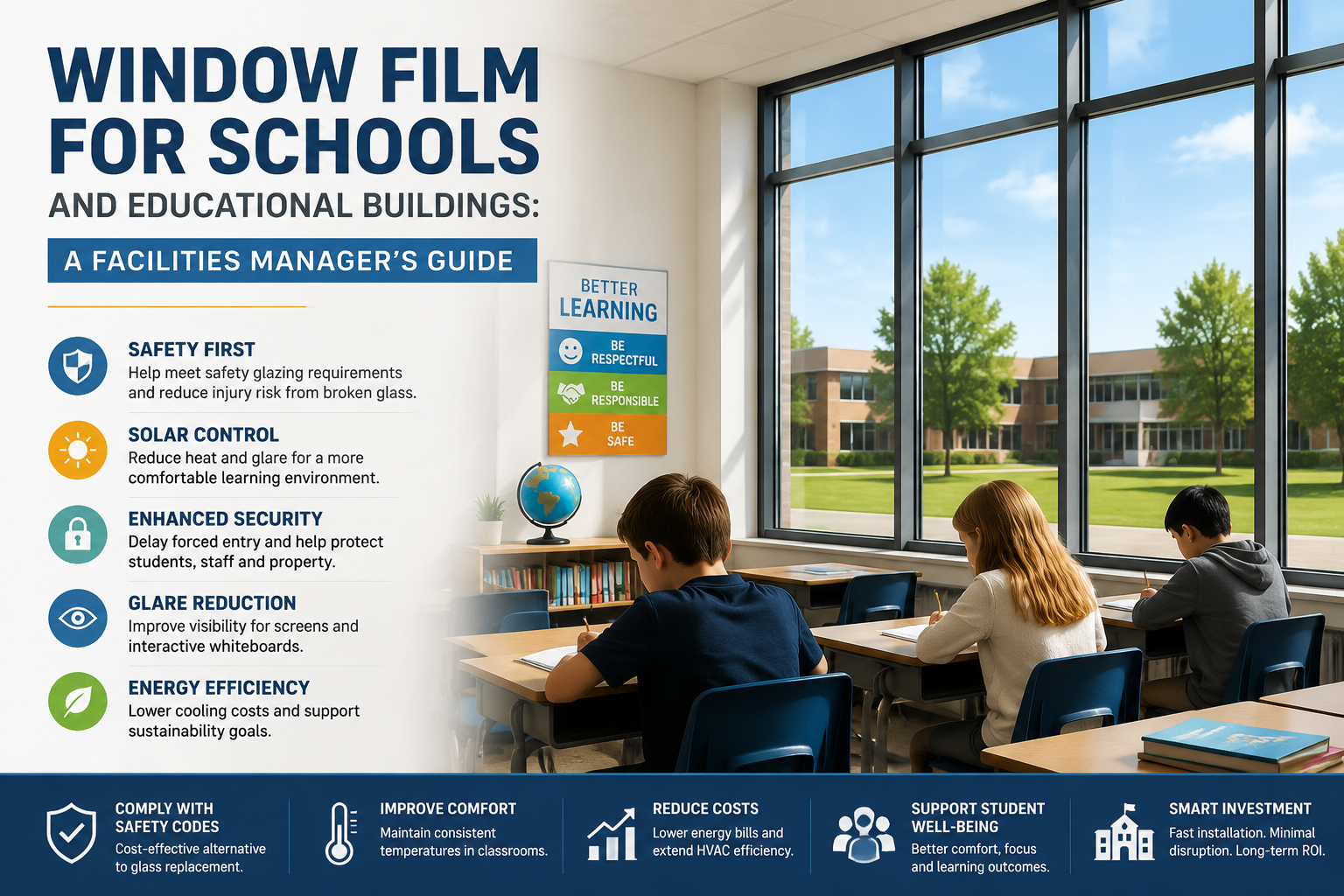
Window film installed on school windows helps reduce heat gain, improve classroom comfort, and enhance safety without replacing existing glass.
Schools are one of the most multi-layered window film applications: safety code compliance, solar control for student comfort and concentration, forced entry security, and glare management for interactive whiteboards and screens are all legitimate requirements that can exist simultaneously in the same building.
The challenge for facilities managers is that each requirement points toward a different product type — and the budget envelope for school capital works rarely accommodates a separate product for each problem. Understanding where products overlap and where the priorities should be ordered matters for getting the specification right.
Safety Film: The Code Compliance Priority
Many existing school buildings have annealed glass in doors, sidelites, and low-level glazing that doesn’t meet current safety glazing codes. In most jurisdictions, glazing within 1,500mm of the floor, in and adjacent to doors, and in areas accessible to children is required to be safety-rated.
Replacing all non-compliant glass with tempered or laminated safety glass is expensive and disruptive. Safety film applied to existing annealed glass is a recognised compliance pathway in many building regulations, at a fraction of the replacement cost.
For facilities managers managing school portfolios: Safety film is typically the entry point — it resolves the liability and compliance issue while delivering secondary benefits (solar control, glare reduction) depending on product specification.
Product selection: 4–6 mil safety film for standard compliance locations. 8 mil security film for locations with higher forced entry risk (ground floor windows, vulnerable access points). For blast risk locations (if applicable), consult a security specialist.
Documentation: Safety film for building code compliance must be certified. EN 12600 (Europe), ANSI Z97.1 (US), or equivalent for your jurisdiction. Retain installation records and certifications for building records.
Solar Control: Student Comfort and Learning Performance
There’s a documented relationship between classroom thermal comfort and student concentration and performance. Classrooms that overheat in warm weather — a very common issue in schools with south and west-facing classrooms and older single-pane glazing — create conditions where learning is measurably compromised.
The energy cost argument is secondary in schools compared to the occupant performance argument. The primary case for solar control film in schools is student and staff comfort.
Common school solar control brief:
South and west classroom windows on upper floors (worst solar exposure)
Single-pane or older double-pane without effective solar control
Temperature complaints from teachers in specific classrooms
Poor concentration performance in affected rooms
Product recommendation: Mid-range to premium solar control at VLT 35–50%. Schools benefit from maintaining natural light quality — VLT below 30% in classrooms tends to require artificial lighting supplementation which defeats some of the purpose. Nano ceramic at VLT 40% on problematic facades typically resolves overheating while maintaining a bright, naturally lit classroom environment.
Security Film: Managing Forced Entry Risk
School security has received increasing attention over the last decade. Ground-floor windows represent a primary forced entry point, and security film significantly delays glass penetration even without replacing the glass.
8–12 mil security film with mechanical frame attachment on ground-floor accessible windows adds 60–180+ seconds of forced entry resistance compared to unprotected glass. This delay is the primary value in security applications — it provides time for alarms to activate and security response to arrive.
Specification note: Security film alone (without frame attachment) holds glass fragments together but can be pushed inward as a unit if the attacker punches through. Mechanical attachment to the frame (perimeter tape or fastened channels) prevents this. For genuine forced entry resistance, frame attachment is essential. Specify this explicitly — “security film with mechanical frame attachment” — not just the film.
Glare Management for Interactive Whiteboards and Screens
Modern classroom technology — interactive whiteboards, large display screens, projectors — is highly sensitive to window glare. A west-facing classroom with afternoon sun can make an interactive whiteboard unusable for the last 2 hours of the school day.
Solar control film at VLT 35–45% on the affected elevations resolves most whiteboard glare problems while maintaining daylight. Reflective film provides better glare reduction per VLT level but may be aesthetically inappropriate for primary school environments.
For classrooms with skylights or overhead glazing causing glare on screens from above, exterior film or interior film specifically rated for overhead application is required — the thermal dynamics of overhead glazing differ from vertical glazing.
Multi-Function Products: Safety + Solar in One
Dual-function safety and solar control film — combining fragment retention with solar rejection in a single product — is available and relevant for schools where both requirements apply to the same glazing.
These products typically achieve:
EN 12600 Class B or A safety rating
TSER 40–55%
VLT 30–50%
The solar performance is more modest than dedicated solar control film, and the safety rating is typically lower than dedicated security film. But for budget-constrained school projects where both requirements exist, a dual-function product applied once delivers both compliance and comfort improvement at lower total installed cost than two separate films.
Budget and Procurement Considerations for Schools
Phased Installation
Many school estates teams manage window film installation as a phased programme — prioritising by compliance risk (safety), then by comfort impact (hottest classrooms), then by security risk (most exposed ground floor windows).
A phased approach also allows pilot installations to demonstrate performance to headteachers and governors before larger programme commitment — useful in publicly funded institutions where governance requires evidence-based spend.
Procurement Routes
In the UK, schools can procure through frameworks (Crown Commercial Service, County Council frameworks) that provide pre-tendered pricing. In Australia, Department of Education procurement rules apply. In the US, state-level competitive bidding requirements govern school capital works.
KSB Window Film supplies through local film installers and distributors who understand the specific procurement frameworks in your market — not direct to end users in most cases.
FAQ
Does window film help with classroom acoustics?
Minimally. Thicker safety film (8 mil+) provides 2–3 dB sound reduction — too marginal for meaningful noise management. Acoustic glazing replacement or acoustic seals are the appropriate solution for noise problems. Film’s value in schools is thermal, safety, security, and glare — not acoustic.
Will window film darken classrooms enough to affect teaching?
At VLT 40%, classrooms retain a bright, naturally lit character. At VLT below 30%, artificial supplementation is typically needed. We recommend 35–45% VLT for most classroom specifications — enough solar control to resolve overheating without creating a dark environment. Pilot a single classroom with the target specification before whole-building commitment.
Is there a maintenance requirement after installation?
Clean with standard pH-neutral glass cleaners. Avoid abrasive tools. Periodic inspection of film edges (annually) catches any lifting early. No other maintenance required. Service life 10–15 years for quality interior film.
KSB Window Film supplies safety, solar control, and security film for educational building projects with the certification documentation required for public building compliance. Our technical team can advise on the right phased specification approach for your school estate’s specific compliance and comfort priorities.