Safety Film vs Laminated Glass: Cost, Performance, and When to Choose Each
Published: September 8, 2026 · 8 min read · Category: Safety & Security Film
About this article: KSB Window Film manufactures safety film, and we’ve worked on projects where the right answer was laminated glass instead. This comparison is written to help buyers make the right decision, not the one that sells more film.
Safety window film and laminated glass are two effective glazing protection solutions for improving building safety, security, and impact resistance.
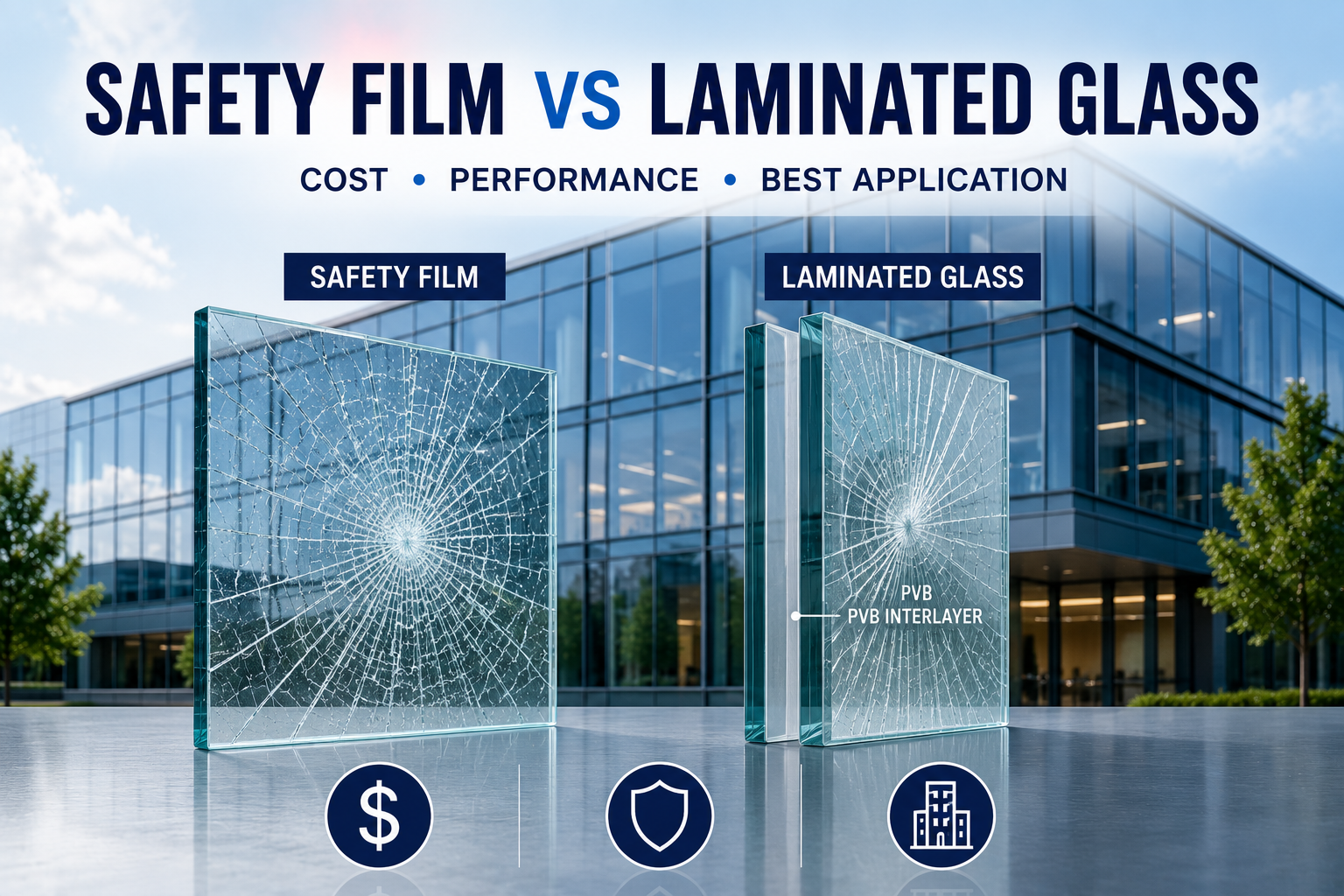
Safety film and laminated glass both address the same fundamental problem — preventing dangerous glass fragment scatter when glazing fails. They achieve this differently, perform differently in specific scenarios, and have very different installation economics. The choice between them is one of the most consequential decisions in commercial glazing safety specification.
How Each Works
Safety film is a polyester-based film applied to the surface of existing glass. The film’s adhesive and tensile strength hold broken glass fragments together in the film matrix after breakage. The glass still breaks — the film controls what happens to the fragments.
Laminated glass is a factory-made glass product with an interlayer (typically polyvinyl butyral — PVB, or for high-performance applications, SGP — SentryGlas Plus) bonded between two glass lites during manufacturing. When broken, the interlayer holds the fragments — both the shards from the outer lite and, in double-laminate constructions, from both lites.
Performance Comparison
Fragment Retention
Laminated glass is the superior product for fragment retention in most scenarios:
The interlayer bonds to the glass across the entire pane area (not just a surface film)
The bond between glass and interlayer is created at high temperature and pressure during manufacturing — structurally more robust than adhesive film bonding
Even when severely damaged, laminated glass typically maintains glass in a coherent structure longer than film on standard glass
Safety film provides meaningful fragment retention — adequate for most building safety compliance needs and for reducing glass injury risk substantially. Under extreme loading (blast, hurricane), film can separate from the glass more readily than a factory-bonded interlayer.
Practical verdict: For moderate threat environments (accidental breakage, limited forced entry), quality safety film provides functionally adequate fragment retention at much lower cost. For extreme loadings or highest-risk applications, laminated glass provides superior structural integrity.
Impact Resistance
Laminated glass has inherent impact resistance from the combined glass-interlayer-glass structure. SGP-interlayered laminated glass can absorb significant impact energy without break-through.
Safety film applied to standard glass doesn’t significantly improve the glass’s resistance to initial impact — the glass still breaks at essentially the same force. The film’s value is in what happens after the glass breaks, not in preventing breakage.
Practical verdict: If preventing glass breakage under impact is the requirement, laminated glass is the solution. Safety film is not appropriate for applications where impact resistance (as opposed to fragment retention) is the specification.
Forced Entry Resistance
Laminated glass with SGP interlayer provides genuinely excellent forced entry resistance — the interlayer is tough, elastic, and difficult to cut through. High-specification laminated glass can achieve LPS 1270 Class A3+ in appropriate constructions.
Security film with frame attachment provides LPS 1270 Class A1–A3 depending on specification. The film is less resistant to cutting than a structural SGP interlayer. At the highest forced entry resistance classes, laminated glass outperforms film.
Practical verdict: For LPS 1270 Class A3 and above, laminated glass replacement may outperform film on forced entry resistance. For Class A1–A2, security film with frame attachment is a cost-effective alternative.
Blast Resistance
Blast-rated laminated glass (with SGP interlayer, engineered frames) is the preferred solution for the highest blast threat environments — particularly for new construction where the glazing specification is made before installation.
Blast film with structural attachment on existing annealed glass provides meaningful blast mitigation for retrofit applications where full glass replacement is not feasible. For US government buildings, blast film is a GSA-approved blast protection approach.
Practical verdict: New construction at high blast threat levels: specify laminated glass. Retrofit of existing buildings: blast film is the most cost-effective compliant approach in most cases.
Cost Comparison
This is where safety film’s proposition becomes compelling for most buyers.
Safety film installed cost: $20–$60 per square meter (basic to security grade), including materials and labor for interior application.
Laminated glass replacement cost: $150–$400 per square meter for the glass units alone, plus installation labor, frame removal and reinstatement, sealants, and scaffolding for multi-storey buildings. Total installed cost: $250–$600+ per square meter.
The ratio: Laminated glass replacement typically costs 8–15× more than safety film installation for a comparable glass area.
On a 500sqm facade upgrade:
Safety film: $15,000–$30,000
Laminated glass replacement: $125,000–$300,000
For buildings where the primary driver is safety code compliance or standard commercial security (not extreme blast or highest forced entry resistance), safety film delivers the required performance at 10–15% of the laminated glass cost.
When to Choose Safety Film
The glass is structurally sound. If the glass is in good condition with no failed seals (IGU), no cracks, and no deterioration, film is appropriate.
The primary requirement is fragment retention for accidental safety. Film provides this effectively.
Budget constrains glass replacement. Film is the practical solution for most commercial and institutional buildings where full glazing replacement isn’t funded.
The building is occupied and cannot be vacated for glazing works. Film installation is minimally disruptive. Glass replacement requires significant works.
Retrofit of existing buildings. Film is the practical retrofit solution.
Forced entry resistance to LPS 1270 A1–A2 is required. Film with frame attachment achieves this at a fraction of laminated glass cost.
When to Choose Laminated Glass
The glass needs replacing anyway. Failed IGU seals, cracked glass, or physical deterioration makes replacement necessary regardless. If replacing, specify laminated.
Code requires laminated glass specifically. Some jurisdictions and specific applications (structural glass floors, overhead glazing, certain safety code requirements) mandate laminated glass — film is not a substitute.
Blast protection in new construction. Blast-laminated glass with engineered frames is the designed solution for new buildings in high blast-threat environments.
Highest forced entry resistance is required. LPS 1270 Class A3–A4 and above: laminated glass provides more robust performance than film at these classes.
Ballistic protection is needed. Film provides no ballistic resistance. Glass-clad polycarbonate or multi-layer laminated ballistic glass is required.
Acoustic performance improvement is needed. Laminated glass (particularly PVB-interlayer products) significantly improves acoustic performance. Film has negligible acoustic benefit.
The Hybrid Approach
On most commercial buildings, the right answer is both:
Safety film on the majority of glazing that is sound and needs safety compliance upgrade
Laminated glass replacement for glazing that is damaged, failing, or in code-required locations where film is not a permitted substitute
A building-wide safety upgrade programme that combines film treatment and targeted glass replacement is almost always more cost-effective than a whole-building glass replacement programme.
FAQ
Does safety film work as well as laminated glass for protecting against break-in?
For the most common commercial security applications (smash-and-grab, opportunistic forced entry), properly specified safety film with frame attachment achieves comparable practical deterrent effect to laminated glass at a fraction of the cost. For the most demanding applications (sustained professional attack), laminated glass with SGP interlayer provides more robust resistance.
Can I use safety film and then replace the glass later if needed?
Yes. Film can be removed cleanly from glass being replaced. Installing film now while planning a phased glass replacement programme is a sensible approach — the film provides protection during the interim period and its cost is justified by the risk reduction even if glass replacement follows.
KSB Window Film provides honest advice on whether film or glass replacement is the better solution for your specific project — and supplies the film where it’s the right answer, with the documentation to support the specification.