Reviewed by KSB PPF Product and Quality Control Team
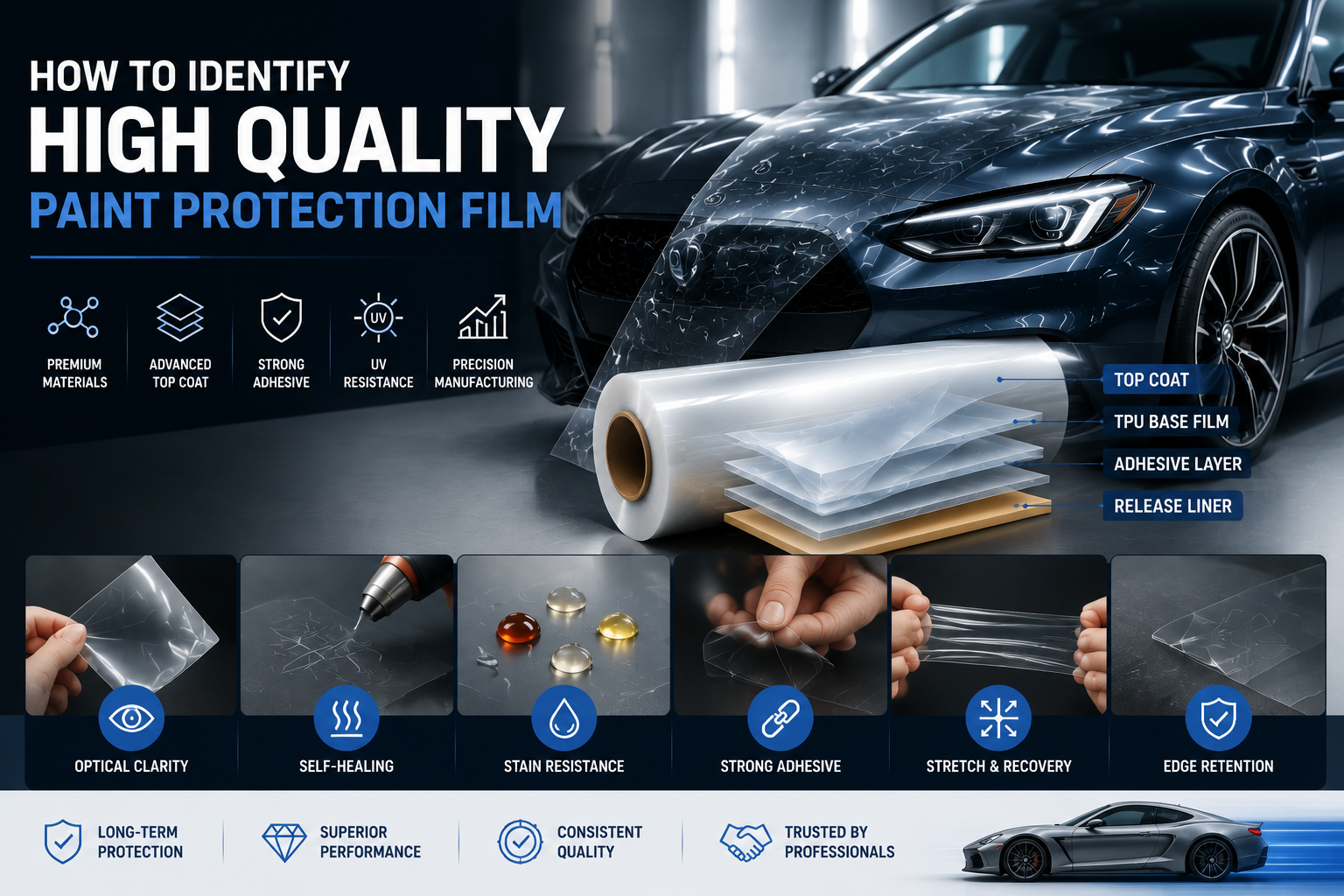
Sourcing paint protection film for your brand or distribution business involves more than comparing price per roll. Two films can look nearly identical in a product listing and perform very differently once they’re installed and exposed to real-world conditions.
The challenge is that most quality problems aren’t visible at the point of purchase. A film that yellows prematurely, lifts at the edges after six months, or leaves adhesive residue on removal looks fine in a box. By the time the problems surface, the product is already in your customers’ hands.
This guide covers how to evaluate PPF quality before committing to bulk quantities — what to look at, what to ask, and what the answers tell you about the product and the supplier.
Start With the Material Specification, Not the Marketing
Before you test a single sample, ask the supplier to explain the film’s construction. A supplier who knows their product can answer these questions without hesitation. One who can’t — or who responds with marketing language instead of technical details — is a supplier you should approach with caution.
The key questions:
What isocyanate chemistry does the TPU use — aliphatic or aromatic? This is the single most important question for any transparent outdoor PPF. Aliphatic isocyanate chemistry (HDI, H12MDI) resists UV-induced yellowing significantly better than aromatic alternatives (MDI, TDI). For a film that needs to stay optically clear on a vehicle for five to ten years, aliphatic TPU is standard in any serious product. Aromatic TPU will yellow — the only question is how quickly.
What is the soft segment chemistry of the TPU? Polycarbonate diol (PCDL) generally offers stronger hydrolysis resistance than conventional polyester or polycaprolactone (PCL)-based alternatives. This matters particularly in humid climates and for films carrying longer warranty periods. A supplier should be able to tell you whether their base TPU uses PCDL, PCL, polyether, or another polyol system.
What does the top coat formulation consist of? Self-healing performance, stain resistance, and scratch recovery all depend on the top coat. Ask whether self-healing is temperature-activated and at what range. A top coat that only heals at 60°C+ is not practically useful in most real-world conditions.
What adhesive system is used, and has it been tested for long-term removability? Adhesive quality affects installation, edge retention, and clean removal after years of service. Ask whether the supplier has removability data — how the adhesive behaves after 5 or 7 years of outdoor exposure.
What UV stabilizer package is incorporated, and at what loading levels? This is harder to verify without testing, but the question itself is useful. Suppliers who have thought seriously about long-term UV performance can discuss their stabilizer approach. Those who haven’t will give vague answers.
Physical Inspection: What to Look For Before You Test
When samples arrive, examine them before running any tests.
Optical clarity: Hold the film up to a neutral light source and look through it. High-quality film should be essentially colorless and free of haze, cloudiness, or visible contamination. Any milkiness or visible specks indicate either raw material inconsistency or process contamination during manufacturing.
Surface uniformity: Examine the top coat surface at an angle under a strong light. The surface should be smooth and consistent. Orange-peel texture, streaking, or visible coating lines suggest process inconsistency.
Thickness consistency: If you have access to a digital micrometer, measure thickness at multiple points across the sample — center, edges, and intermediate positions. Reputable suppliers specify thickness with a tolerance range. Significant variation across a single sample indicates manufacturing inconsistency that will cause problems during installation.
Liner quality: The release liner should peel away consistently without tearing, without leaving residue on the adhesive surface, and without requiring excessive force. Liner problems slow installers down and can contaminate the adhesive.
Adhesive appearance: After removing the liner, the adhesive surface should be clean, uniform, and free of bubbles or contamination. Any visible defects in the adhesive layer are a quality concern.
Hands-On Performance Tests
These tests don’t require lab equipment. They give you a practical sense of how the film will behave in service.
Stretch and Recovery
Stretch a sample section by hand — moderately, not to failure — and release it. Quality PPF should return to its original dimensions quickly and completely, with no permanent elongation. Elastic recovery is a function of both the TPU formulation and processing. Film that remains stretched after release will have installation problems, particularly on complex curves.
Apply the same stretch and check for whitening or haze development. Some lower-quality films will show stress whitening under elongation — a sign of inadequate formulation or processing.
Self-Healing Response
Make a controlled scratch on the top coat surface using a fingernail or a soft plastic edge. Apply heat using a heat gun at low setting, or place the sample in direct sun on a warm day. A functional self-healing top coat should close the scratch visibly within a short period at realistic temperatures. Note the temperature required and the completeness of recovery.
If the supplier claims ambient temperature self-healing, test it at room temperature without any heat application. The response — or lack of it — will tell you whether the claim is realistic.
Stain Resistance
Apply several common contaminants to the top coat surface: cooking oil, mustard, red wine, sunscreen, and ideally a bird dropping simulant if available. Leave for 24 to 48 hours without cleaning. Then clean with a mild soap solution and assess what residue remains. A quality top coat should clean completely or nearly completely. Permanent staining after short-term exposure indicates a weak top coat.
Adhesive Bond and Repositionability
Apply a sample to a clean painted test panel or glass surface, using light pressure only. Then try to lift and reposition it. Quality PPF adhesive should allow repositioning during installation without losing bond strength or leaving residue. Apply firm pressure and leave for 24 hours, then assess bond strength. The film should be well-adhered with no edge lifting.
Edge Retention
After firm application on a test panel, expose the sample to temperature cycling or a warm, humid environment for several days. Check whether edges remain bonded. Edge lifting is one of the most common field complaints with lower-quality films, and it often traces to adhesive quality rather than the TPU layer.
Clean Removal
After an adhesive bond test of at least several days, remove the film in a controlled manner — at approximately 90 degrees from the surface, at a moderate pace. The adhesive should release cleanly without leaving residue on the test surface. If adhesive transfers to the panel, that is a significant quality concern for any product carrying a removal warranty.
Documentation to Request From Any Serious Supplier
Hands-on testing tells you a lot, but it can’t replicate years of outdoor exposure in a few days. For that, you need supplier documentation.
Technical Data Sheet (TDS): Should specify thickness, tolerances, tensile strength, elongation at break, peel adhesion, and operating temperature range at minimum. If a supplier cannot provide a TDS, that’s a problem.
Accelerated Weathering Test Reports: Xenon arc testing to ISO 4892-2 or equivalent is the standard method for evaluating UV resistance and yellowing. Ask for test duration (2,000 hours minimum for a serious claim) and the yellowing index results. QUV testing results are also useful. If the supplier has no accelerated weathering data, their warranty claims are based on inference, not evidence.
Hydrolysis Resistance Data: For markets with high humidity or significant rainfall, ask for hydrolysis resistance testing results — typically conducted at elevated temperature and humidity (e.g. 70°C / 95% RH). PCDL-based films should show meaningful improvement over PCL-based films under these conditions. If the supplier claims strong hydrolysis resistance but has no test data, the claim is unverified.
Adhesive Peel Strength Data: Initial peel strength and aged peel strength (after heat or UV exposure) give you a picture of how the adhesive will behave in service. Ask for both.
Lot-to-Lot Consistency Records: A supplier with serious manufacturing quality control can show you acceptable variation ranges for their key properties and how they monitor them. This is less commonly offered but worth asking about if you’re planning significant volumes.
Red Flags in Supplier Communication
Some patterns in supplier responses are informative regardless of what they’re saying:
Vague answers to specific technical questions. If you ask whether the TPU uses aliphatic or aromatic isocyanate and the answer is “high quality TPU” or “premium grade,” the supplier either doesn’t know or doesn’t want to tell you. Neither is acceptable.
Warranty claims without supporting data. A 10-year warranty claim that isn’t backed by accelerated aging test reports is a marketing statement, not a performance guarantee. Ask what the warranty claim is based on.
Pressure to commit before testing. Any serious supplier will encourage you to test samples before placing a bulk order. Reluctance to provide samples, or pressure to skip testing, is a warning sign.
Inability to explain the film construction. A manufacturer who built the product should be able to describe each layer and what it does. A trading company reselling without technical knowledge of what they’re selling is a different risk profile.
Inconsistent samples across requests. If two sample requests from the same supplier produce films that look or feel different, that suggests manufacturing inconsistency — a significant problem for any brand-building exercise.
Building a Simple Evaluation Scorecard
When comparing multiple suppliers, a consistent framework helps. Consider scoring each supplier across these dimensions:
| Evaluation Area | What to Assess |
|---|---|
| Material specification transparency | Can they fully explain the film construction? |
| Optical clarity | Haze-free, colorless, no visible defects |
| Thickness consistency | Measured variation within stated tolerance |
| Self-healing performance | Temperature required, completeness of recovery |
| Stain resistance | Clean removal after 24–48 hour exposure |
| Adhesive quality | Bond strength, repositionability, clean removal |
| Edge retention | No lifting after temperature/humidity exposure |
| Technical documentation | TDS available, aging data available and credible |
| Communication quality | Technical answers, not just marketing responses |
A supplier who scores consistently well across these areas is worth paying more for. One who scores poorly on documentation and technical transparency but offers competitive pricing is likely cutting costs somewhere in the product.
Frequently Asked Questions
How can I tell if a PPF uses aliphatic or aromatic TPU without a lab test? The most reliable way is to ask the supplier directly and request supporting documentation. Aliphatic TPU is standard in quality PPF — a reputable manufacturer will confirm this without hesitation. You can also expose samples to accelerated UV conditions over several weeks and compare yellowing behavior, though this is a longer-term assessment.
Is a higher price always an indicator of better quality? Not automatically, but significant undercutting relative to comparable products usually reflects real compromises somewhere in the construction — cheaper raw materials, weaker stabilizer package, or lower manufacturing standards. Price alone isn’t a quality indicator, but consistent low pricing relative to the market is worth investigating.
What thickness should I specify for a quality PPF? 7.5 mil (approximately 190 microns) is a common standard for full-body automotive PPF. 6 mil is used for entry-level products; 8–10 mil for high-impact zone applications. Thickness alone doesn’t determine quality, but it’s a basic specification that should match your application and market expectations.
How many samples should I test before placing a bulk order? Test samples from at least two separate lots if possible, to get a sense of consistency. A single sample from one lot tells you what the best-case product looks like; multiple lots tell you whether that quality is reproducible.
What’s the most common quality problem found in lower-cost PPF? Edge lifting and premature yellowing are the most frequently reported field problems with lower-cost films. Edge lifting usually traces to adhesive quality. Yellowing traces to aromatic TPU or inadequate UV stabilization. Both are preventable with proper material specification.
Sourcing PPF for Your Brand or Distribution Network?
If you’re evaluating PPF suppliers for private label, OEM production, or wholesale distribution, we’re set up to support the process properly — samples, technical data sheets, accelerated aging reports, and a full explanation of our film construction.
Tell us your target market, thickness and finish requirements, warranty period, and estimated volume. We’ll recommend a suitable product and provide everything you need to make an informed sourcing decision.
Request PPF Samples | Get an OEM Quotation | Talk to a PPF Specialist
Reviewed by KSB PPF Product and Quality Control Team.
This article reflects general industry knowledge and KSB’s sourcing and manufacturing experience. Specific performance outcomes depend on film construction, installation conditions, and end-use environment.
Get a Free Sample or Quote
Looking for a reliable window film supplier? Contact us today for fast response and professional support.