The short answer is not automatically.
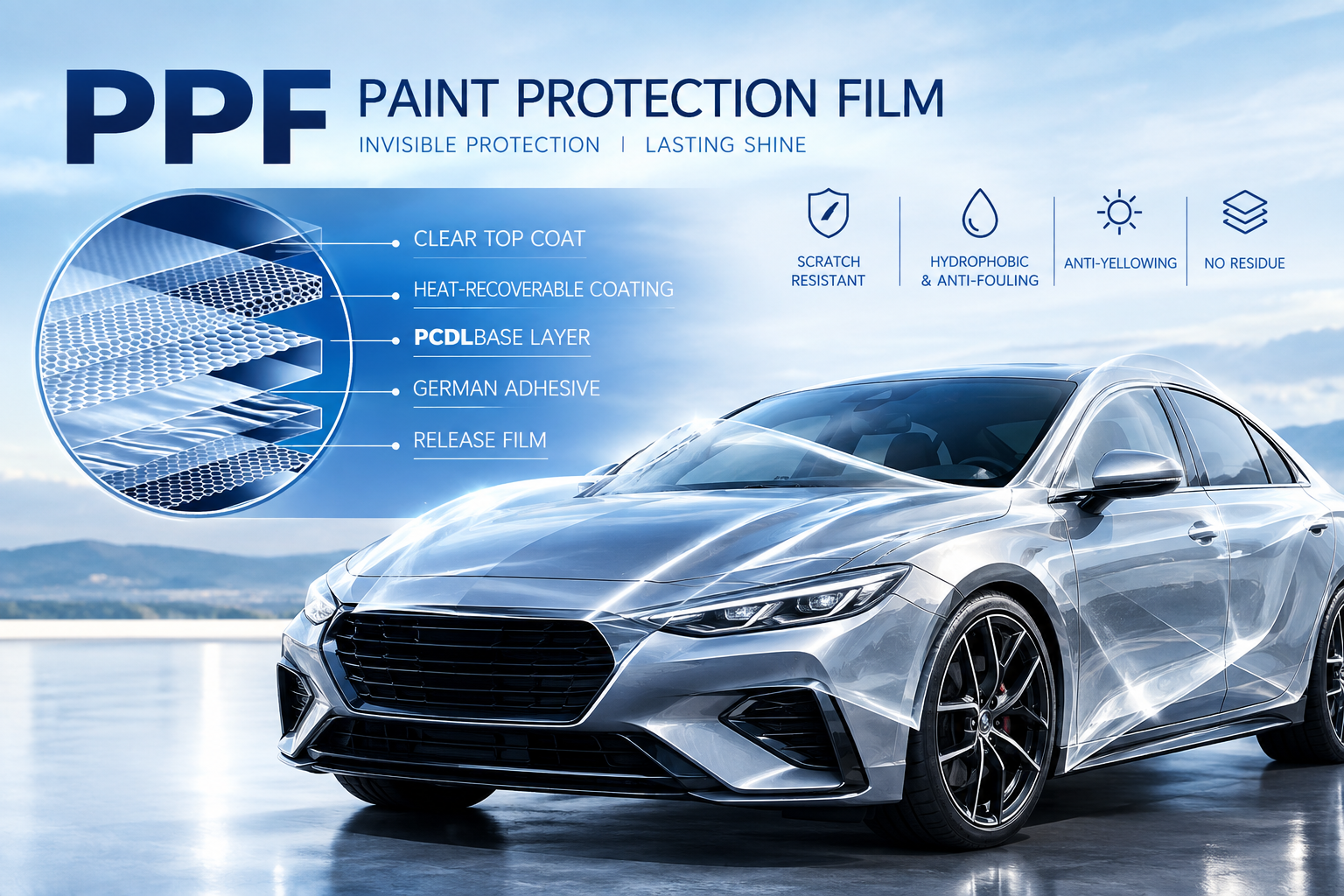
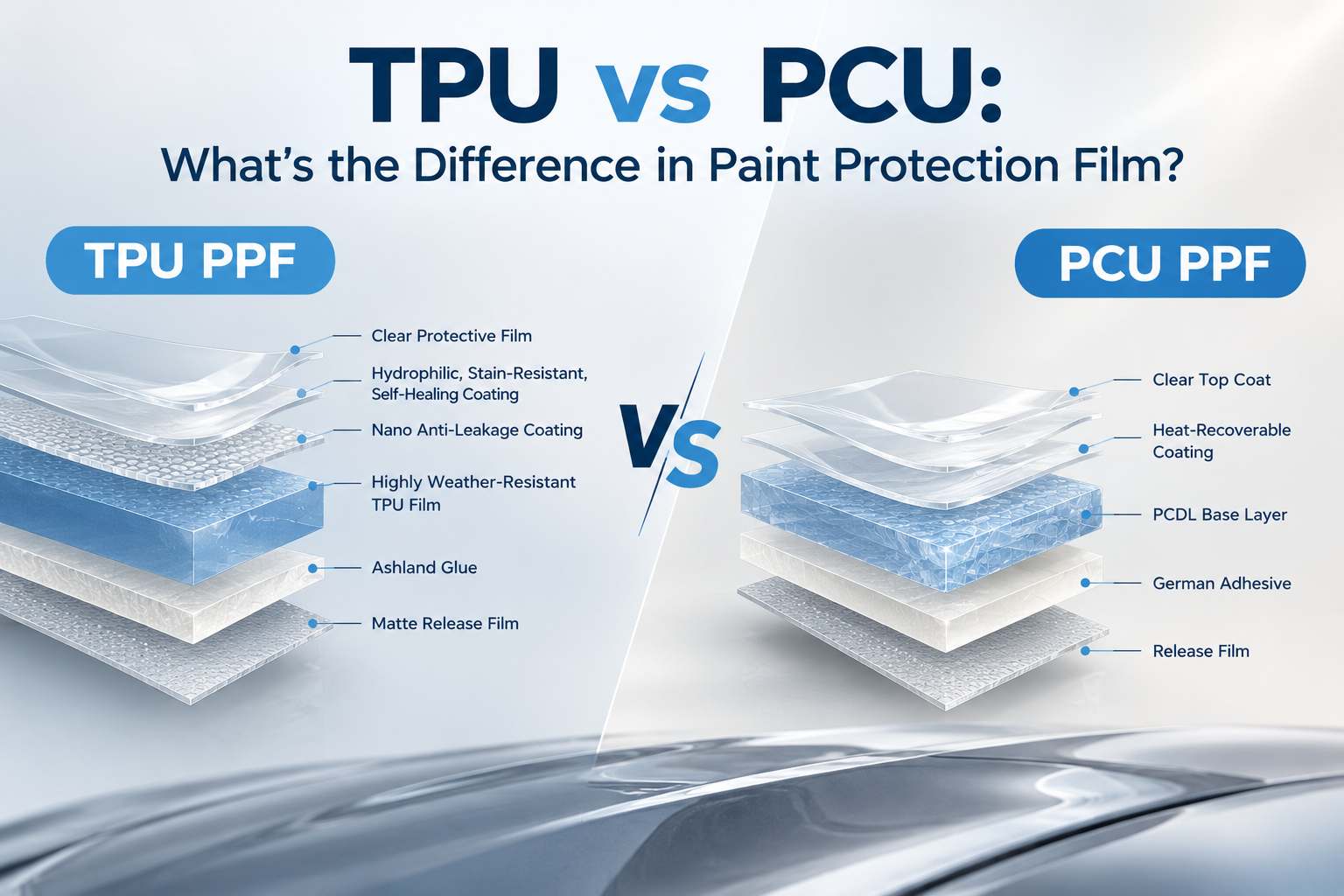
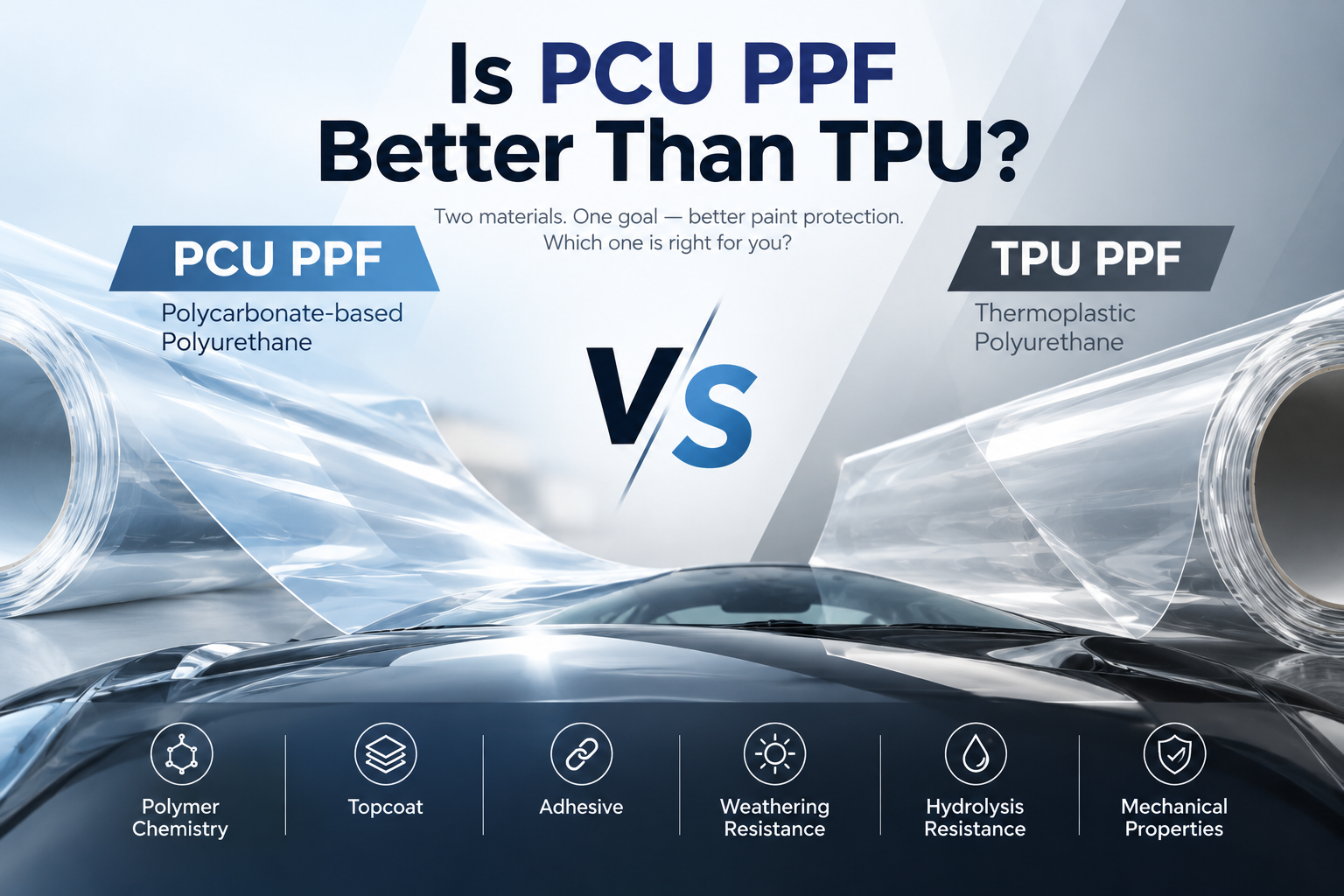
In the PPF market, PCU commonly refers to polycarbonate-based polyurethane, often associated with PCDL-based TPU. This chemistry can offer attractive hydrolysis and environmental-resistance properties. It is still part of the broader polyurethane family, and the material label describes only one part of a finished paint protection film.
For a distributor, importer, installer network, or private-label brand, a better comparison starts with the complete product. The seven factors below reveal far more than the words PCU or TPU on a sample box.
Factor 1 Polymer Chemistry
Begin by clarifying what the supplier means.
If the product is called PCU PPF, ask whether the base film is a PCDL-based thermoplastic polyurethane. If the product is called TPU PPF, ask which polyol chemistry is used: PCL, PCDL, conventional polyester, polyether, or another system.
Also confirm whether the polyurethane is designed for clear outdoor exposure. The isocyanate chemistry and stabilizer package affect light stability and should not be hidden behind the soft-segment name.
Useful questions include:
• What is the exact substrate chemistry?
• Is the polyurethane aliphatic or aromatic?
• Which production grade is used in the sample and in regular orders?
• Does the supplier have documentation supporting the material description?
PCDL-based TPU may be a strong choice for demanding moisture and weather exposure. The word PCU alone does not prove that the product uses a suitable or consistent formulation.
Factor 2 Topcoat
Customers interact with the topcoat every day. It affects scratch recovery, stain resistance, water behavior, surface feel, gloss retention, and resistance to cleaners.
When comparing products, ask the supplier to define each topcoat claim.
For self-healing, confirm the scratch method, recovery temperature, and time. For hydrophobicity, check whether the effect remains after abrasion and washing. For stain resistance, request a test panel showing the contaminants, contact time, cleaning method, and result.
Compare the films after aging as well as when new. A coating that performs well in a short demonstration may lose surface properties after repeated heat, UV, or chemical exposure.
The topcoat is one reason two PCDL-based films can deliver very different user experiences.
Factor 3 Adhesive
The adhesive determines whether the film installs predictably and remains stable on the vehicle.
Buyers should evaluate:
• Initial tack
• Repositioning window
• Anchor behavior
• Squeegee feel
• Lift lines and glue distortion
• Edge holding
• Adhesion after moisture has left
• Removal and residue under the stated conditions
An adhesive can be too aggressive or too weak for the intended installer. A high-tack system may help some edges but make complex panels difficult to reposition. Low initial tack may feel easy on a flat hood but create problems on stretched edges.
Peel strength should be compared using the same substrate, dwell time, angle, speed, and conditioning. A number without a test condition is not a reliable basis for selection.
Factor 4 Thickness Tensile Strength and Elongation
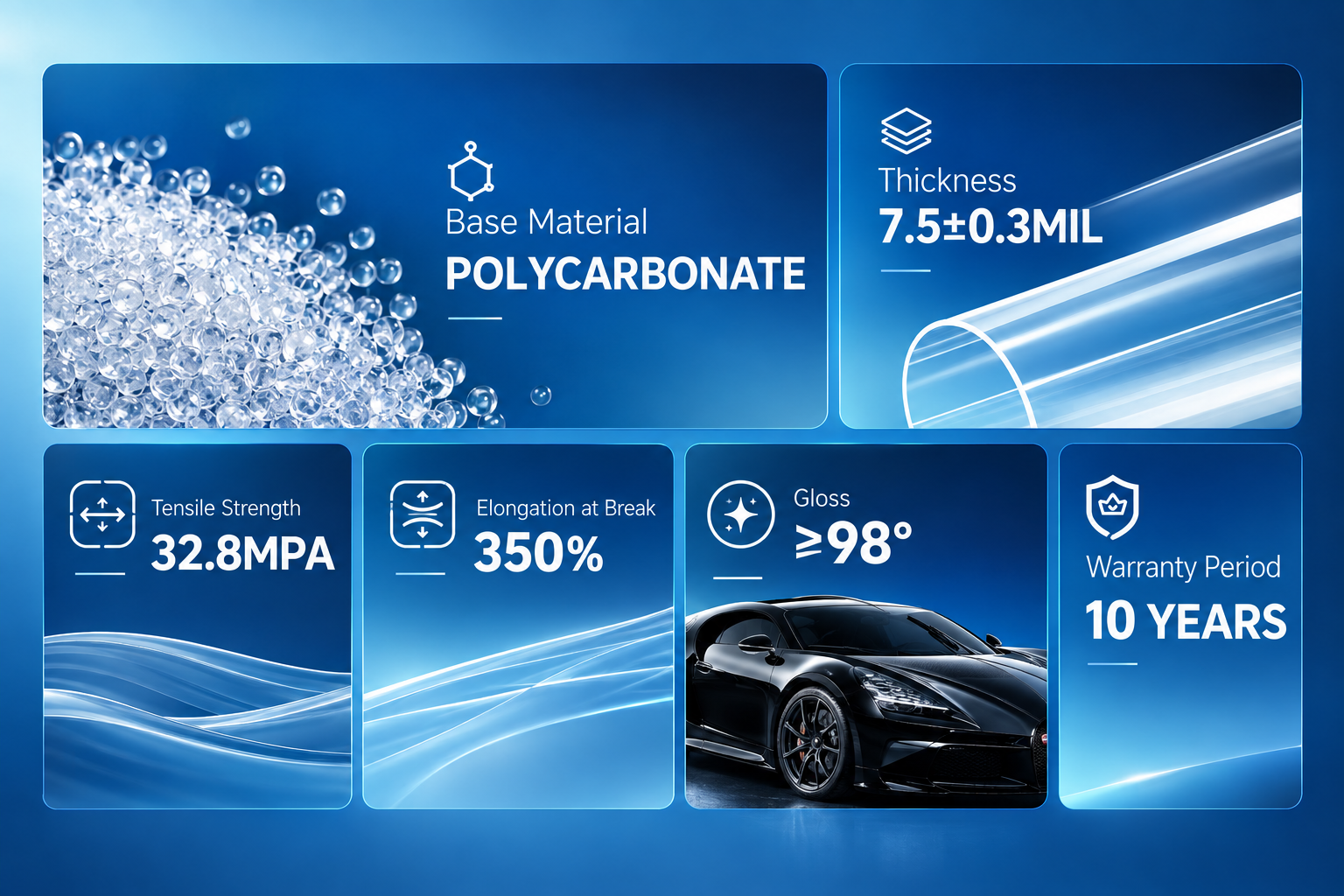
Mechanical data helps explain how the film may behave, but isolated values are easy to misread.
First, verify the thickness definition. Does it include the topcoat, TPU, and adhesive? Does it exclude the release liner and temporary protective film? Is the value nominal or a measured range?
Then compare tensile strength and elongation using the same test method. Ask whether results were measured in both machine and transverse directions.
Higher elongation is not automatically better. A film also needs suitable modulus, recovery, tear behavior, and dimensional stability. Excessive stretch during installation can thin the film, change gloss, or stress the adhesive.
The best evidence combines laboratory data with controlled installation on flat and compound-curve panels.
Factor 5 Yellowing and Weathering
Claims such as anti-yellowing, UV resistant, or 10-year durability need supporting conditions.
Ask whether the complete PPF was tested using xenon-arc exposure, fluorescent UV, outdoor exposure, or another method. Record the cycle, duration, irradiance, temperature, water spray or condensation, and measured results.
Useful before-and-after measurements include:
• Yellowness or color change
• Gloss
• Haze
• Tensile strength
• Elongation
• Topcoat recovery
• Adhesive peel
PCDL chemistry may help the substrate retain properties, but yellowing can also come from the polyurethane’s isocyanate chemistry, stabilizer package, topcoat, adhesive, or contamination.
Do not accept a direct conversion such as 1,000 test hours equals a fixed number of outdoor years unless the supplier can show a validated basis for that correlation.
Factor 6 Hydrolysis and Chemical Resistance
Hydrolysis resistance is a credible reason to investigate PCDL-based TPU. Polycarbonate polyols are widely used where polyurethane must tolerate water and humid aging.
The comparison still needs a defined test. Ask whether the report covers raw TPU or finished PPF and which properties were measured after exposure.
Chemical resistance should be evaluated separately. Test the complete film against contaminants and cleaners relevant to the market. A film sold in the Middle East may face high heat, strong UV, frequent washing, sand, and aggressive cleaning products. A film sold in a cold region may face road salt, freeze-thaw cycling, and winter chemicals.
One universal chemical test panel may not represent every market. Match the qualification program to the intended use.
Factor 7 Warranty and Test Conditions
A long warranty can be valuable, but the number of years is only the headline.
Read:
• Which defects are covered
• Whether yellowing has a defined threshold
• Whether gloss loss, cracking, bubbling, delamination, staining, or adhesive failure are included
• Which climates and vehicle uses qualify
• Whether certified installation is required
• Which cleaning and maintenance practices are required
• Whether labor, material, or both are covered
• How a claim is documented and resolved
A 10-year limited warranty and a 10-year proven outdoor lifespan are not the same statement. One is a commercial commitment under written conditions; the other would require field evidence over that period.
The test report should also match the product being purchased. Confirm product code, thickness, construction, batch or revision, test date, and specimen description.
A Buyer Comparison Sheet
Use the same scoring structure for every shortlisted film.
| Area | Evidence to request | Sample check |
| Polymer | Material declaration and TPU description | Confirm production sample matches stated construction |
| Topcoat | Scratch, stain, chemical, and aging data | Repeat recovery and stain tests |
| Adhesive | Peel conditions and adhesive specification | Reposition, anchor, edge, and removal trials |
| Mechanical | Thickness, tensile, elongation, and test method | Flat and compound-curve installation |
| Optical | Gloss, haze, and color data | Inspect over black and metallic paint |
| Aging | Weathering, humidity, heat, and retained properties | Review before-and-after specimens when available |
| Warranty | Full terms, exclusions, and remedy | Confirm terms match the target market and installer network |
Red Flags in PCU and TPU Claims
Be cautious when a supplier provides a precise superiority claim without a comparison basis.
Examples include:
• Three times better hydrolysis resistance without naming the reference material
• Fifteen-year lifespan based only on raw-resin literature
• Zero yellowing without a test method or color-change threshold
• German or USA material without traceable grade information
• Higher tensile strength presented as proof of easier installation
• A weathering certificate that identifies a different product code
These claims are not necessarily false. They are incomplete until the baseline, method, specimen, and result are clear.
So Which Film Is Better
PCDL-based polyurethane can provide a strong substrate platform for PPF, particularly where hydrolysis and long-term environmental resistance matter. That is a valid technical advantage to investigate.
The winning finished film is the one that meets the target product requirements across all seven areas. A well-designed PCDL-based PPF may outperform a conventional PCL-based product. A weak topcoat, poor adhesive, unstable optics, or inconsistent manufacturing can erase the material advantage.
For professional sourcing, select the complete construction rather than the loudest material name.
Frequently Asked Questions
Is PCU PPF stronger than TPU PPF
There is no universal answer. Strength depends on the exact TPU formulation, hard-segment ratio, thickness, processing, and test method. Compare product-specific tensile, elongation, modulus, tear, and aging-retention data.
Is PCU PPF more resistant to yellowing
PCDL-based chemistry may support environmental stability, but yellowing also depends on aliphatic polyurethane chemistry, stabilizers, topcoat, adhesive, manufacturing, and exposure. Review finished-film aging data.
Is PCU a completely different material from TPU
In common PPF usage, PCU often refers to polycarbonate-based polyurethane or PCDL-based TPU. It should not automatically be treated as a separate material family.
What is the best test before a bulk order
Combine document review with a controlled sample installation. Use the same panels, installer, solutions, temperatures, and evaluation period for each candidate.
Which specification matters most
No single specification is decisive. Buyers need a balanced result across substrate, topcoat, adhesive, mechanical behavior, optics, aging, consistency, and warranty.
Further Reading
On this site:
- TPU vs PCU: What’s the Difference in Paint Protection Film? — A broader comparison of TPU and PCU terminology in PPF
- Does PCU PPF Really Last Longer — Examines whether PCU chemistry can translate into longer service life
- What Is PCDL Based TPU — Explains the PCDL-based TPU chemistry used in some PPF substrates
- 6.5mil vs 7.5mil vs 8.5mil PPF: What’s the Difference? — How film thickness affects PPF performance and selection
- PPF Adhesive Explained: Why Glue Quality Matters — Why adhesive performance matters alongside substrate chemistry
Get a Free Sample or Quote
Looking for a reliable window film supplier? Contact us today for fast response and professional support.