Published: July 6, 2026 · 7 min read · Category: PPF Guide
About this article: KSB Window Film specifies and manages adhesive systems for our TPU PPF range. Adhesive questions from installers and distributors reveal how underappreciated this component is — and how significant its impact on installation experience and long-term performance actually is.
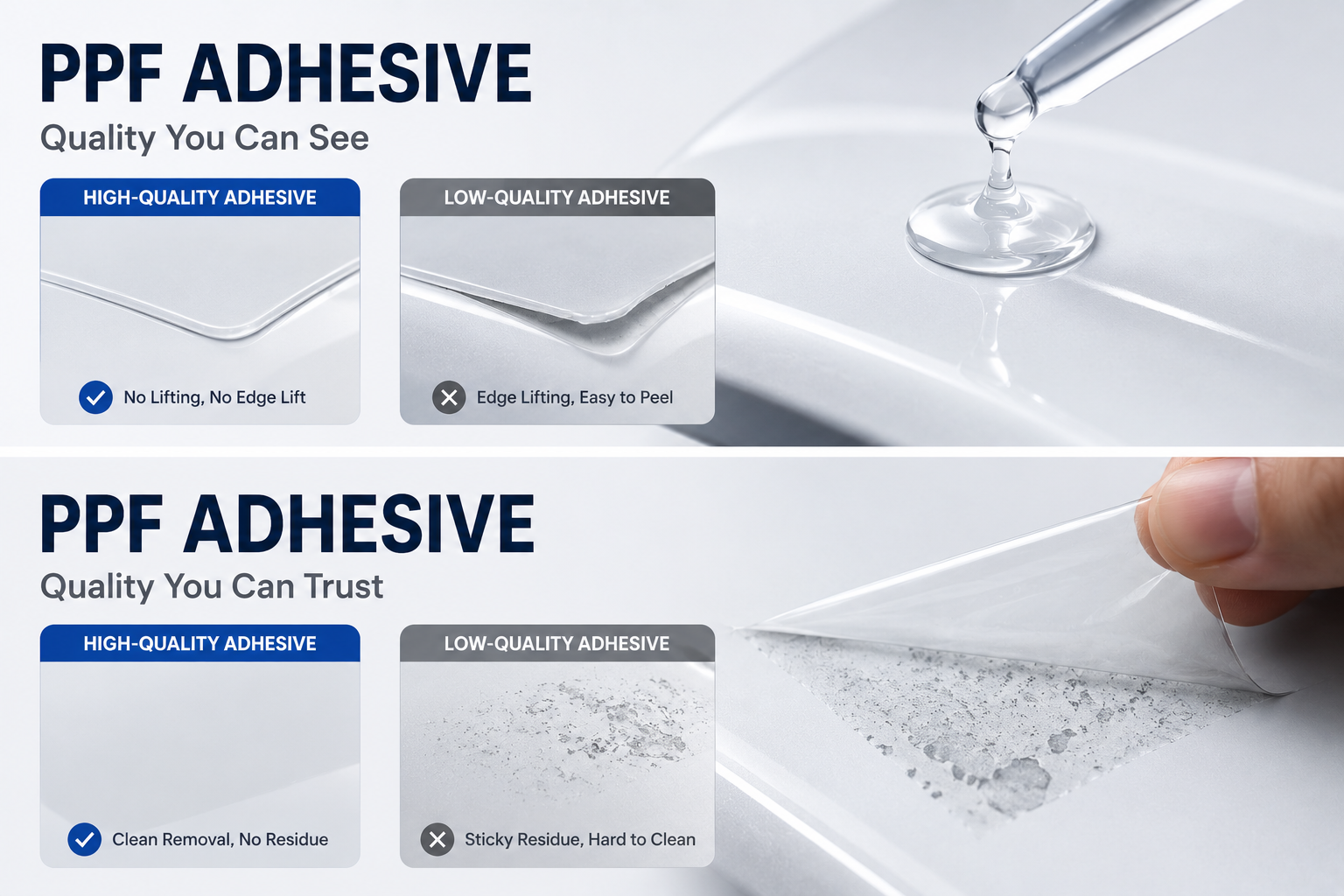
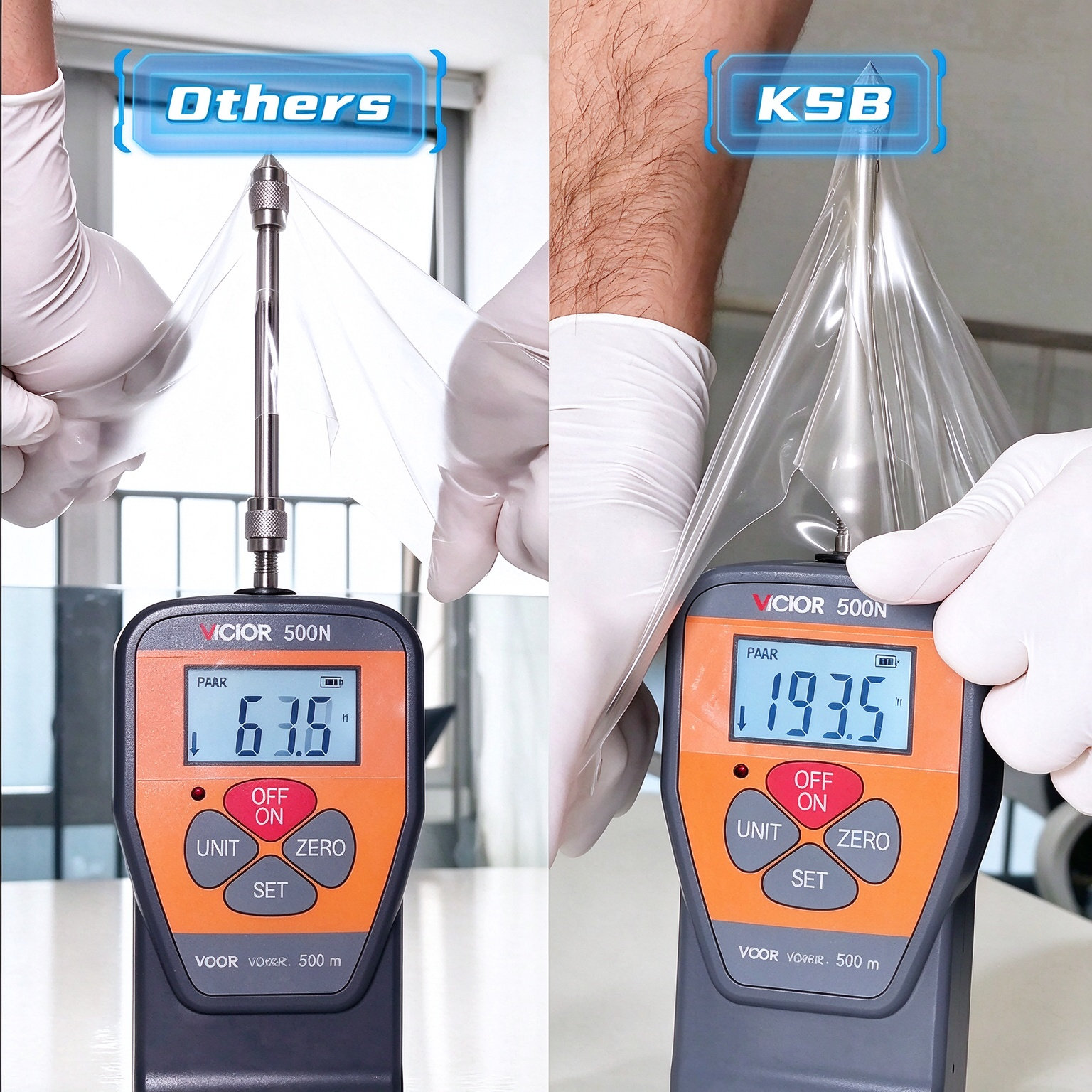
Comparison of poor and premium PPF adhesive performance showing edge lifting, adhesive residue, and stable bonding results.
When buyers evaluate PPF, they focus on the top coat — self-healing, haze, UV stability. When installers evaluate PPF, they often form their opinion based on the adhesive. A film that’s difficult to position, lifts at edges after a season, or leaves residue when removed — these are adhesive failures, not top coat failures. And they’re the ones that generate warranty claims and drive installers to switch brands.
This guide explains how PPF adhesive works, what quality looks like, and how to evaluate it in a sample.
What PPF Adhesive Is
PPF uses a pressure-sensitive adhesive (PSA) — an adhesive that forms a bond through contact pressure without requiring heat, solvent, or chemical reaction. PSAs are used everywhere from sticky notes to surgical tape to vehicle graphics, with formulations engineered for the specific requirements of each application.
For PPF, the adhesive is a critical system component that must simultaneously deliver:
Enough initial tack for positioning without immediate bonding
Sufficient long-term adhesion to hold the film flat in extreme temperature and UV conditions for 7–10 years
Clean removability at the end of the film’s service life
These requirements pull against each other. High-tack adhesives bond quickly and strongly — but can be difficult to position and may not release cleanly after years of service. Low-tack adhesives allow easy positioning — but may not hold adequately in high-heat, high-UV conditions.
Quality PPF adhesive achieves the balance. Budget PPF adhesive compromises on one or more of these requirements.
Acrylic PSA: The Standard for Premium PPF
Acrylic pressure-sensitive adhesives are the dominant system in premium PPF, used by quality manufacturers globally.
Why acrylic:
Excellent UV stability — acrylic chemistry doesn’t yellow or degrade under UV exposure the way rubber-based adhesives do
Wide temperature range: quality acrylic PSA maintains adhesion from -30°C to +100°C
Optical clarity: high-purity acrylic adhesives don’t discolour or haze over time
Good balance of initial tack and long-term adhesion
Clean removal after extended service life when formulated correctly
Some lower-cost PPF products use rubber-based PSA (natural or synthetic rubber). Rubber adhesives are cheaper and can provide good initial tack, but they have poorer UV and thermal stability — they haze, yellow, and can become brittle or “transfer” adhesive to the paint surface when the film is eventually removed.
The Four Performance Dimensions of PPF Adhesive
1. Initial Tack and Positionability
The first contact between the film and the paint during installation defines the installer’s experience. The adhesive must:
Allow the installer to position and reposition the film through a working time (typically several minutes in wet installation)
Hold position once the installer is satisfied without sliding or lifting
Progressively increase bond strength as the application solution evaporates
An adhesive with too much initial tack doesn’t allow repositioning — it becomes challenging on complex panels where multiple attempts are needed to achieve clean coverage without bubbles or creases. Too little tack and the film won’t stay put while the installer works on adjacent sections.
How to test it: Apply a sample to clean flat glass using a thin water solution. Can you reposition it after 60 seconds? After 2 minutes? The answer depends on your installation method but most professional installers want at least 60–90 seconds of positioning time.
2. Full Cure Adhesion
The final adhesion strength — achieved after the film has been on the vehicle for 24–72 hours as the adhesive cures completely — determines whether the film will stay put for 7+ years.
The industry standard measurement is peel adhesion (ASTM D3330): how much force per unit width is required to peel the film from a standard substrate at a standard angle. Premium PPF adhesive: 15–30 N/25mm. Inadequate adhesive: below 10 N/25mm.
Ask for peel adhesion data with sample orders. A manufacturer who can provide this number has tested their adhesive to standard. One who can’t probably hasn’t.
3. Temperature and UV Stability
Over a 7–10 year service life, PPF adhesive is subjected to:
Repeated thermal cycling from sub-zero winter temperatures to 80°C+ surface temperatures in direct summer sun
Sustained UV exposure from solar radiation
Chemical exposure from cleaning products, bird droppings, fuel, and road chemicals
Quality acrylic adhesive maintains its properties through these exposures without:
Softening in heat (which causes edge lifting when the vehicle is parked in hot sun)
Embrittlement in cold (which causes cracking at low temperatures)
UV degradation (which causes yellowing and eventual adhesive failure)
What to look for in documentation: Accelerated aging test data to ASTM G154 or equivalent, with adhesion measured before and after UV exposure. Adhesion retention above 80% after 1,000 hours of UV exposure indicates good UV stability.
4. Clean Removability
At end of life, the film should remove from the paint without:
Tearing the film (causing adhesive residue to remain on the paint)
Leaving adhesive residue on the paint surface
Damaging the paint underneath
Clean removal is partly a function of adhesive chemistry — acrylic PSA with appropriate release properties — and partly a function of how the film has aged. Premium adhesives are formulated to release cleanly after years of service. Budget adhesives can transfer or become difficult to remove.
How to test it: Age a sample on a painted surface for 3–6 months (ideally in direct sun). Then attempt removal. The ease of clean removal from an aged sample tells you far more about real service performance than a fresh sample.
How Adhesive Quality Shows Up in Installation Problems
Edge lifting: Almost always an adhesive issue — either insufficient adhesion (budget adhesive), inadequate edge contact during installation, or thermal cycling stress exceeding the adhesive’s recovery. Premium adhesive holds edges flat through repeated temperature cycles.
Installation residue (sticky edges): Adhesive oozing at the film edge during application — usually indicates over-soft adhesive or contamination at the edge from the installation solution. Premium adhesive formulations are designed to not ooze under installation pressure.
Difficult repositioning: Too-aggressive initial tack. Common in budget products where the adhesive achieves the installation bond quickly but doesn’t allow the working time installers need.
Yellow staining at adhesive layer: UV degradation of a non-UV-stable adhesive. Almost always a rubber-based or low-grade acrylic adhesive issue.
FAQ
Can the adhesive damage car paint when the film is removed?
Quality PPF adhesive on properly cured automotive paint does not damage the paint when removed correctly (heat assisted, slow pull, within reasonable service life). Damage from PPF removal is almost always either old film with degraded adhesive, improper removal technique (cold weather, fast pull), or paint that wasn’t fully cured before film application. Premium adhesive doesn’t transfer to paint under normal conditions.
Is there a way to test adhesive quality from a sample roll without lab equipment?
Practical field tests: apply to clean glass, let cure 48 hours, attempt peel at 90° and 180°. Note the force required and whether the adhesive remains on the glass after removal. Also: apply to a sample panel, put in direct sun for several hours on the hottest available day, then press the edges firmly. If they lift within hours of cooling, the adhesive’s thermal stability is inadequate.
Does adhesive thickness affect installation behavior?
Yes. Thicker adhesive layers tend to have more initial tack but can show more edge ooze. Thinner adhesive layers are cleaner at edges but may have lower peel adhesion. Standard PPF adhesive thickness: 25–35 microns. Outside this range in either direction typically indicates a non-standard formulation worth querying.
KSB’s Adhesive Is Specified, Tested, and Documented
KSB Window Film specifies acrylic PSA systems with documented peel adhesion data, temperature range ratings, and UV stability test results. Adhesive specification sheets are available on request alongside sample rolls.