Behind the Scenes: Inside a 10,000-Class Clean Room PPF Coating Line
Published: July 22, 2026 · 8 min read · Category: PPF Manufacturing
About this article: KSB Window Film has operated precision coating facilities for over 20 years. This guide takes B2B buyers through our clean room coating environment — explaining why controlled manufacturing conditions directly determine the optical quality of the finished film.
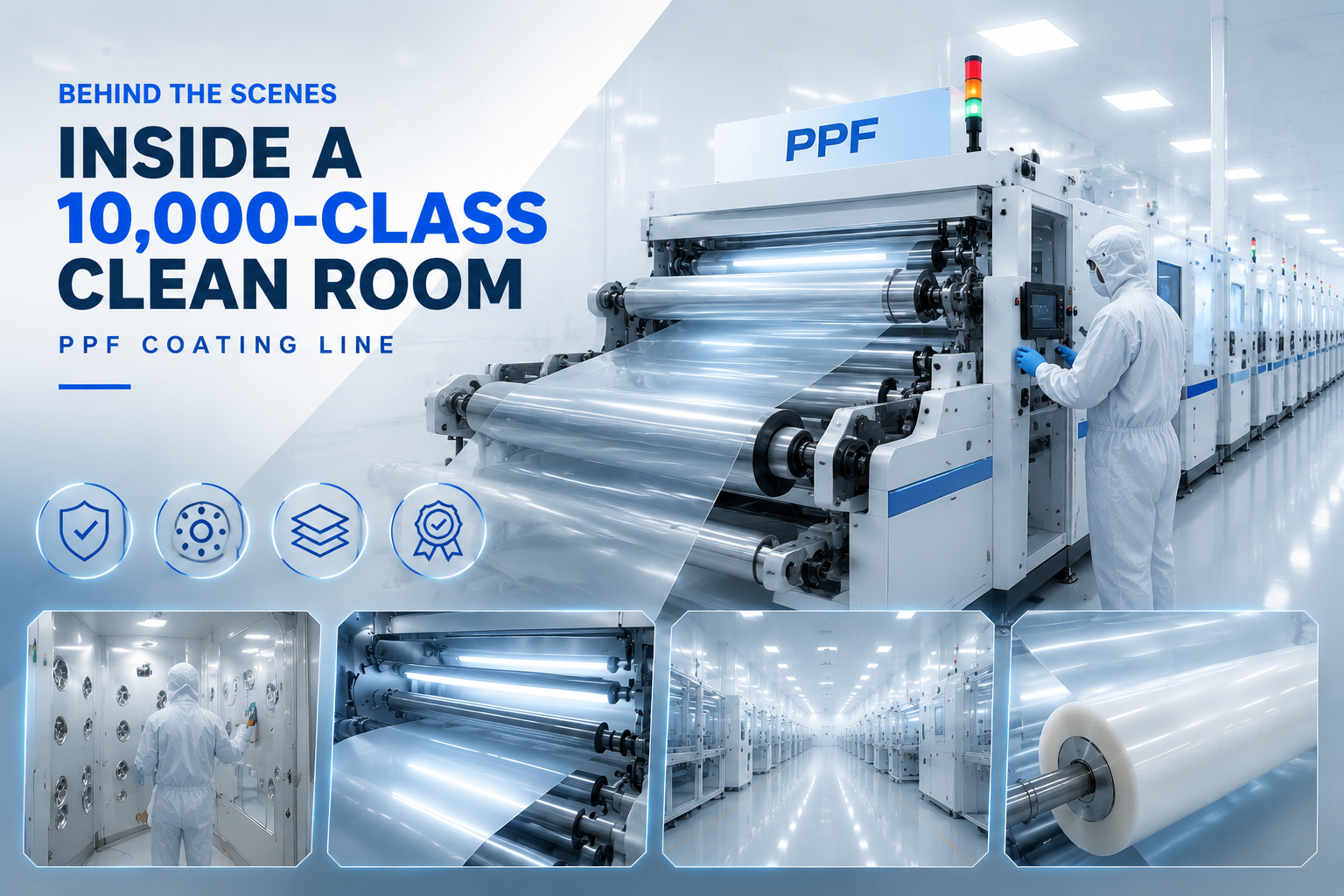
Inside a high-precision clean room PPF coating line ensuring defect-free film production
The difference between PPF that installs clean and PPF that’s full of gel specs, fisheyes, and particulate inclusions often has nothing to do with the raw materials and everything to do with where and how the film was coated. A premium aliphatic TPU compound coated in an uncontrolled environment produces an optically inferior product. A clean room coating operation with the same materials produces film you can install on a £200,000 Rolls-Royce without embarrassment.
This guide explains what a 10,000-class clean room is, why it matters for PPF, and what to ask any manufacturer about their coating environment.
What “ISO 7 / 10,000-Class Clean Room” Means
Clean room classification under ISO 14644-1 defines the maximum number of airborne particles per cubic metre at specific sizes:
ISO 7 (Class 10,000):
Maximum 352,000 particles ≥0.5 microns per cubic metre
Maximum 2,930 particles ≥5.0 microns per cubic metre
For context: a typical uncontrolled factory environment has millions of particles per cubic metre. A standard office has 200,000–1,000,000 particles per cubic metre. An ISO 7 clean room is dramatically cleaner than either.
Why particle count matters for PPF coating:
The wet coating layers on PPF — the top coat and adhesive — are applied as liquid films that flow and level before curing. During the time the coating is wet and mobile, any airborne particle that lands on the surface becomes incorporated into the coating as it cures. Particles above ~5 microns in diameter create defects visible to the naked eye under installation lighting:
Gel specs: Small raised bumps in the film surface — either coagulated coating material or incorporated particles
Fisheyes: Circular depressions caused by silicone or oil contamination preventing coating from flowing
Seeds: Incorporated particles of PET, dust, or coating residue
Any of these defects on installed PPF on a black or dark-coloured vehicle is immediately visible and creates a warranty claim.
The KSB Coating Environment: How We Control It
HVAC and Air Filtration System
KSB’s PPF coating room uses a positive-pressure HVAC system with:
HEPA filtration (H14 grade): Captures 99.995% of particles ≥0.3 microns before air enters the coating zone
Positive pressure relative to adjacent areas: Prevents unfiltered air from infiltrating the clean zone through doorways and seals
Air change rate: 20+ air changes per hour in the coating zone — continuously displacing and renewing the clean air environment
The clean room is monitored continuously by particle counters at multiple points. If particle count exceeds ISO 7 thresholds, coating is paused and the event is recorded.
Temperature and Humidity Control
Temperature: 22°C ±1°C in the coating zone. Temperature variation affects coating viscosity, which affects coat weight uniformity and flow/levelling behaviour.
Humidity: 50% RH ±5% in the coating zone. For moisture-cure or moisture-sensitive coating chemistries, humidity outside this range creates coating consistency problems.
Tight T&H control produces consistent coat weight and surface quality across every production run.
Gowning and Personnel Protocol
Personnel entering the clean room coating zone follow standard clean room gowning: lint-free coverall, clean room gloves, head cover, beard cover, and booties. Standard polyester clothing sheds thousands of fibres per minute — the primary particle source in uncontrolled coating environments.
Personnel are limited in the active coating zone during wet film application. Human activity is the largest variable particle source in clean rooms.
Equipment Maintenance Programme
Coating equipment — slot-die heads, web transport rollers, curing ovens — is cleaned per defined schedules. Coating head cleaning protocols specifically address the most common source of gel specs: partially cured coating material that forms on coating head edges and is intermittently deposited on the film surface.
The Defect Rate Difference
KSB tracks defect rates (number of gel specs or visible inclusions per 100sqm of finished film):
KSB clean room coating line: Average 0.3–0.8 defects per 100sqm Industry benchmark (controlled environment, not ISO 7): 3–8 defects per 100sqm Uncontrolled environment estimate: 15–40+ defects per 100sqm
For a typical PPF installation on a full bonnet (approximately 2.5sqm):
KSB film: approximately 0.01–0.02 visible defects per installation
Uncontrolled environment film: 0.5–1.0 visible defects per installation
The visual impact: on a black Porsche 911 bonnet, one gel spec is one customer complaint. Premium installers working in high-end markets cannot tolerate this defect rate from their film supplier.
What to Ask Any PPF Manufacturer About Their Coating Environment
“Is your coating process conducted in a classified clean room? What ISO class?” Any manufacturer who claims clean room manufacturing should be able to state the ISO classification (ISO 5, 6, or 7 for meaningful clean room environments). Vague answers like “clean room-like environment” or “dust-controlled room” without ISO classification don’t indicate genuine particle control.
“Can you show us your particle counter monitoring records?” A genuine clean room has continuous monitoring and records. A manufacturer who has this can produce the data quickly.
“What is your measured defect rate (gel specs per 100sqm)?” This is the customer-facing output of the clean room — ask for the actual defect rate rather than the clean room specification.
FAQ
Does clean room manufacturing significantly increase PPF cost?
Yes — clean room construction, HVAC infrastructure, filtration system maintenance, and gowning protocols add meaningful overhead to the manufacturing cost. This is one reason budget PPF can be produced at lower cost: eliminating the clean room reduces overhead substantially. The buyer pays for the clean room in reduced warranty claims and installer reputation protection.