Published: July 21, 2026 · 8 min read · Category: Industry Insights
About this article: KSB Window Film manufactures nano ceramic automotive film exported to professional installer networks across four continents. The trends in this article reflect what we’re seeing in product demand, installer conversations, and the specifications buyers are actually requesting.
2026 automotive window film market trends and next generation technology overview
The automotive window film market is in a more interesting place than it’s been in a while. Several forces are converging at once — the EV transition, a generational shift in vehicle design, tightening tint regulations in some markets and loosening in others, and a meaningful quality upgrade in what professional installers are defaulting to — and the combination is changing what buyers want, what installers stock, and what manufacturers invest in.
This article covers what’s actually moving in 2026, not what trade association forecasts say is emerging.
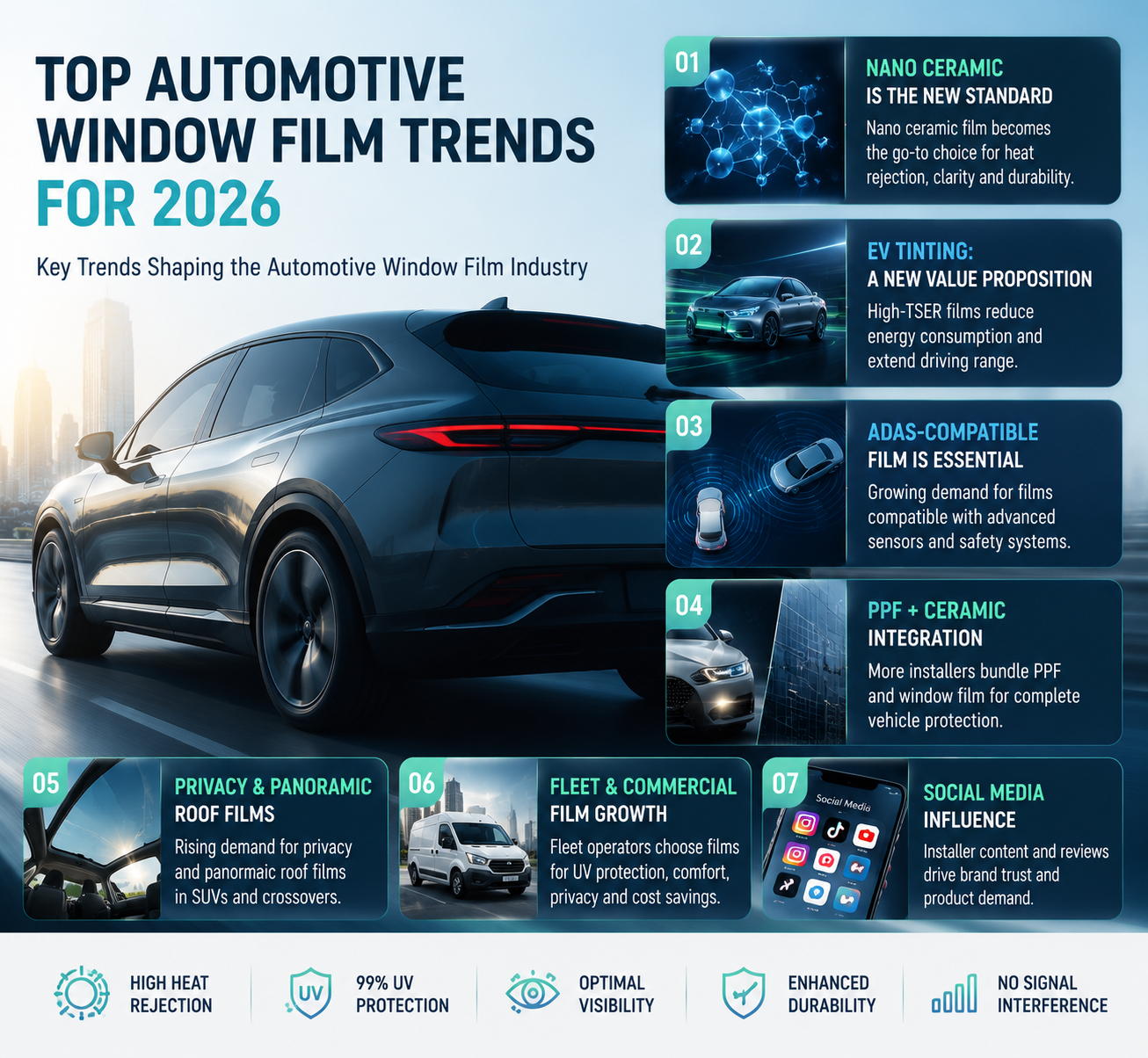
1. Nano Ceramic Is the New Standard, Not the Upgrade
A few years ago, the professional installer conversation was: “Would you like to upgrade to ceramic?” In most markets in 2026, that conversation has changed. Ceramic is the starting point. The question is which ceramic.
The driver: consumer education has caught up. Buyers researching window tint before an appointment encounter enough content about IR rejection, TSER, and signal transparency that they’re arriving with product preferences already formed. Installers who can only offer dyed and basic carbon find themselves defending a position rather than selling a service.
The practical market effect is a bifurcation: professional installer shops are moving upmarket toward ceramic and nano-ceramic while the budget tier has partially migrated to online direct-to-consumer DIY channels. This is good news for professional installers who stock quality ceramic — the value-add is clearer and the price sensitivity is lower. It’s challenging for shops that compete primarily on price.
2. EV Tinting: A New Value Proposition
Electric vehicles are fundamentally changing the economic case for window film. In an ICE vehicle, air conditioning runs essentially free — waste engine heat powers the A/C compressor with negligible fuel cost impact. In a BEV, air conditioning draws directly from the battery.
The numbers matter: high-TSER window film can reduce A/C energy consumption in a BEV by 20–40% under high-solar-load conditions. Depending on the vehicle, this translates to 10–30km of added range per full charge on a hot summer day. For EV owners in hot climates, that’s a real-world benefit that justifies premium film as a practical investment, not just an aesthetic one.
Professional installers who understand this argument and can communicate it with specific data — TSER numbers, estimated range impact, backed by studies from sources like Lawrence Berkeley National Laboratory — are converting EV owners at higher ticket prices than equivalent ICE vehicle jobs.
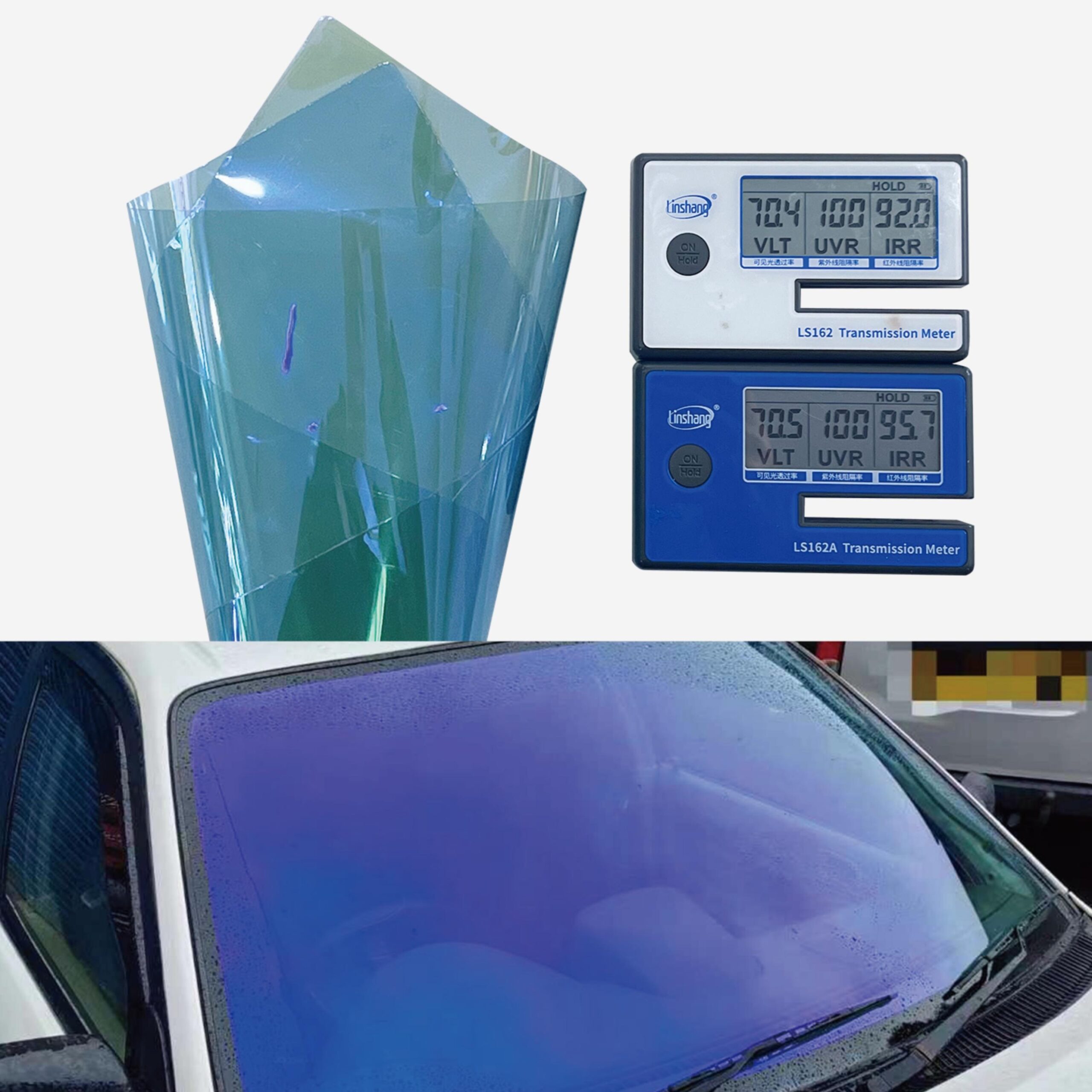
The product implication: film with the highest verifiable TSER at legal VLT levels has the clearest value story for EV applications. Premium nano ceramic at 70% VLT on front windows, combined with legal rear window tinting in the 15–35% VLT range, is becoming a common EV window film specification.
3. ADAS-Compatible Film Is a Growing Requirement
Advanced Driver Assistance Systems — radar, lidar, cameras, and sensor arrays embedded in and around the windshield — have become standard on most new vehicles. Film installers have had to navigate sensor compatibility for years, but the volume and variety of ADAS systems is increasing.
Most ceramic and carbon films are already compatible with radar and camera-based systems. The specific issues arise with:
Rain sensors (some films applied too close to the sensor can affect operation)
Front camera systems with heating elements (film over heated zones can delaminate)
Heads-up display windshields (film can interfere with HUD projection)
Professional installers are increasingly required to understand vehicle-specific ADAS configurations before quoting. Film manufacturers are responding with application guides that specify which panels can be filmed on specific vehicle models, and where cutouts or special installation techniques are required.
For distributors: the technical resource expectation from installer accounts is rising. Providing ADAS application guidance alongside product supply is becoming a service differentiator.
4. PPF + Ceramic Integration
Paint protection film and ceramic window film are being sold and specified together much more commonly than they were three years ago. The natural bundling: a customer who cares about protecting their vehicle from stone chips also cares about UV protection, heat management, and the interior. One shop, one installation appointment, full vehicle protection.
The trend has commercial implications for the film distribution market. Shops that carry both categories create a cross-selling flywheel that shops carrying only one category can’t match. Distributors who supply both PPF and window film to the same installer accounts have a relationship advantage over suppliers who can only address one category.
The technical alignment is also practical: both PPF and ceramic window film from quality manufacturers require proper paint preparation, clean installation environments, and similar installer skills. The operational overlap makes combined offering natural.
5. Privacy Film for Electric SUVs and Crossovers
The predominant new vehicle body style in most markets is the SUV or crossover, and these vehicles have disproportionately large rear window areas — panoramic roofs, large rear quarter windows, expansive rear glazing. The glass area exposed to solar loading per vehicle is significantly higher than it was in the era of sedans and hatchbacks.
For window film, this means:
Higher square footage per vehicle installation → higher revenue per job
More total solar heat load entering the vehicle → stronger value case for high-TSER ceramic
Panoramic roofs creating solar management challenges that conventional darker rear film doesn’t address
Panoramic roof tinting has become one of the fastest-growing installation sub-categories. The challenge: roof glass is typically lightly tinted from the factory, and legal VLT requirements for roof glass vary by market. The opportunity: a high-quality 35–50% VLT ceramic on a panoramic roof has a visibly dramatic thermal effect inside the vehicle.
6. Decorative and Privacy Films for Commercial Fleets
Fleet vehicle operators — delivery companies, utilities, corporate fleets — are specifying window film for functional rather than aesthetic reasons: UV protection for drivers on extended hours, heat management reducing A/C demand and fuel cost, and privacy film for commercial vehicles carrying valuable cargo.
This is a lower-profile but consistent volume opportunity for distributors and installers. Fleet accounts involve volume, repeat orders, and procurement processes rather than one-off retail sales. The win is harder than a retail customer, but the account value is higher and more predictable.
The product specification for fleet: typically practical rather than premium — quality carbon or mid-tier ceramic at legal VLTs, emphasis on durability and consistent batch quality across large volumes.
7. Social Media and the “Show” Factor
The professional window tinting industry has developed an unusually visible social media culture — Instagram, TikTok, and YouTube content from installers documenting installations, demonstrating thermal performance differences, and reviewing products has become a meaningful influence channel.
Ceramic window film brands that photograph well, perform demonstrably in side-by-side IR camera comparisons, and are carried by respected installer personalities have an influence advantage that’s disproportionate to their media spend. For distributors and brand builders, this matters: which installers you supply and what they say about your products on social media is a distribution channel as real as your sales team.
FAQ
Is nano ceramic window film actually worth the premium for a standard non-EV car?
In a hot climate where the car parks outdoors and you drive regularly in summer — yes, the difference is felt daily. In a mild climate or a garage-kept vehicle — the premium is harder to justify on thermal performance alone, though UV protection and longevity advantages apply regardless of climate.
Will ADAS systems affect whether I can tint my windshield?
Windshield regulations prohibit film on most of the driving area in most jurisdictions, so the question is usually about front side windows and the small windshield tint strip. For front side windows, quality ceramic film is generally compatible with camera and radar ADAS. Consult vehicle-specific guidance from your installer before any front window application on a new vehicle.
Are there films specifically designed for panoramic roofs?
Most quality ceramic automotive films work on flat glass roof panels. The specific challenges with panoramic roofs are curvature (some roof glass curves sharply at the edges), existing factory tint (which may limit how dark additional film can go while staying legal), and heat-resistant adhesive requirements (roof glass gets hotter in direct sun than side windows). Specify film from manufacturers with documented panoramic roof installation experience.
How does EV window film differ from film on a conventional car?
The film product itself is the same — the difference is in the value proposition and the specification priority. For EVs, TSER matters more than VLT because range extension depends on reducing heat load, which means choosing the highest-TSER film at whatever VLT is legal and acceptable. The installer conversation should be framed around range and efficiency rather than just comfort.
Is ceramic window film compatible with heated rear windows?
Yes, quality ceramic film is compatible with standard heated rear window (defrost) systems. The heating element is on the inside surface of the glass; the film is also applied to the inside surface. Professional installers apply film to work around the heating element bus bars at the edges rather than over them, which avoids adhesion issues. A properly installed film doesn’t interfere with defrost function.
Source Automotive Ceramic Film That’s Built for 2026 Requirements
KSB’s automotive nano ceramic range is verified by current SGS test reports — full-spectrum IR, TSER, UV blocking at every VLT. Our EV-application products are specifically tested for high-TSER performance at legal visible light transmission levels.
We supply professional installer distributors across the US, Europe, Middle East, and Southeast Asia with carbon, ceramic, and combination product lines.