Published: July 22 , 2026 · 8 min read · Category: Industry Insights
About this article: KSB Window Film operates production and QC infrastructure in Dongguan, China, including inline inspection systems. The observations in this article come from our own manufacturing experience and from evaluating supplier capabilities across the Chinese window film sector.
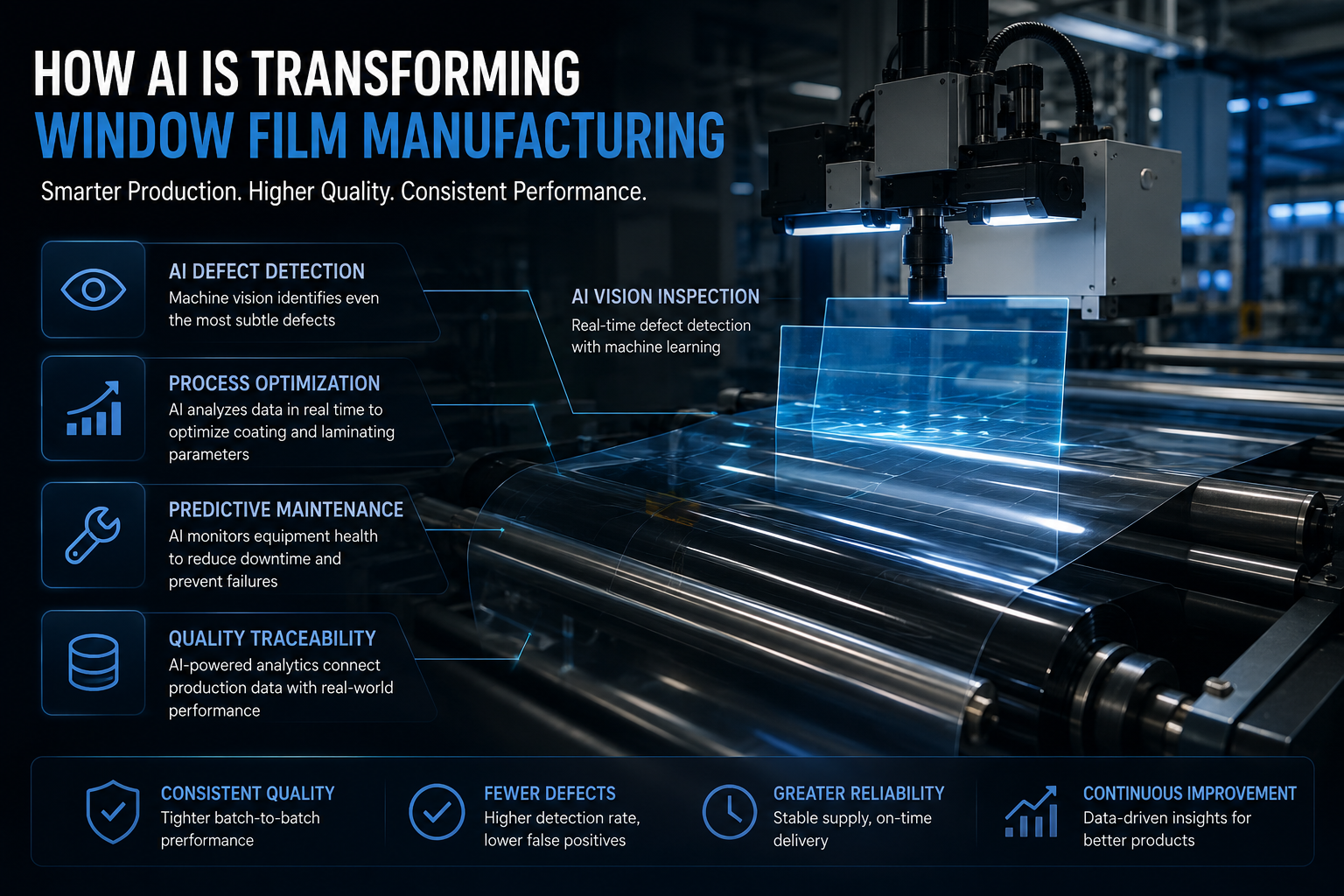
AI-driven quality control and defect detection system improving consistency and production efficiency in window film manufacturing
The phrase “AI is transforming [industry]” has been so overused that it triggers skepticism before the first sentence is finished. So let’s start with a ground-level question: what does AI actually do in a window film factory, and is it making a real difference to the product that arrives at your warehouse?
The honest answer: yes, in specific areas, meaningfully. And the areas where it matters most aren’t the flashy applications you’d expect from a technology headline — they’re the unglamorous process monitoring, defect detection, and quality control functions that determine whether a batch of film performs consistently across 10,000 square meters.
What AI Is Actually Being Used For in Film Manufacturing
Machine Vision for Defect Detection
The most impactful current application of AI in window film production is automated visual inspection using machine learning.
Traditional inline inspection in coating and lamination lines uses threshold-based detection: a camera looks for pixels that deviate from an expected brightness or contrast range. This catches obvious defects — large inclusions, major coating voids — but struggles with subtle defects: minor coating thickness variation, slight optical non-uniformity, early-stage delamination, or particle contamination below the threshold sensitivity.
Machine learning-based vision systems learn from labelled defect examples. Trained on thousands of images of known defect types at various severities, the model can detect subtle defects that rule-based systems miss — and, importantly, can distinguish between cosmetic imperfections that don’t affect performance and functional defects that do. The result: higher detection rates at lower false-positive rates, which means less product incorrectly flagged for rejection and more actual defects caught before they ship.
In ceramic film production, where ITO layer uniformity directly affects switching performance (for smart film) or optical clarity, and where nano particle dispersion uniformity affects heat rejection consistency, this kind of sensitive defect detection has direct product quality implications.
Process Parameter Optimization
Sputtering and coating processes involve multiple interacting variables: chamber pressure, gas flow rates, power levels, substrate speed, temperature, and others. Getting these parameters right for a given product specification requires balancing multiple performance objectives simultaneously — thickness uniformity, optical clarity, adhesion, cycle stability.
Historically, process engineers optimize these parameters through experience and iterative adjustment. Machine learning models trained on historical production data can identify parameter combinations that consistently produce better results — or predict when a parameter drift is likely to create quality problems before it’s visible in finished product.
This is genuinely useful in ceramic film production. The sputtering process for ceramic targets (titanium nitride, cesium tungsten oxide) is sensitive to parameter variation in ways that metallic sputtering is not — ceramic targets are more brittle, more prone to arcing, and more sensitive to chamber atmosphere composition. AI-assisted process monitoring reduces the frequency of runs that produce off-spec product.
Predictive Maintenance
Coating and lamination equipment failures are expensive — both in production downtime and in the product that was in process when the failure occurred. Predictive maintenance systems monitor equipment sensor data (vibration, temperature, power draw, vacuum levels) and identify patterns that precede failure events.
Manufacturers who’ve implemented predictive maintenance report meaningful reductions in unplanned downtime — the kind of downtime that creates backorders, delays shipments, and strains supplier relationships. For buyers dependent on predictable lead times, a manufacturer with functioning predictive maintenance is more reliable than one managing equipment reactively.
Quality Traceability and Batch Analytics
AI-enabled traceability systems link specific production parameters to specific finished product batches, then correlate those records with downstream quality data — lab measurements, customer complaints, field performance feedback.
Over time, a manufacturer operating this way builds a data asset: a detailed understanding of which production conditions produce which quality outcomes, which raw material batches correlate with which field performance levels, and which process changes have positive or negative effects on long-term product performance.
This is the kind of systematic quality improvement that separates manufacturers with improving products from those whose products stay the same quality indefinitely. For buyers making long-term supply decisions, asking whether a manufacturer operates any kind of production-to-performance data system is a legitimate evaluation question.
Machine learning in manufacturing is an enhancement to human expertise, not a replacement. The models work on the data they’re given, and understanding what the data means — what a particular defect pattern implies about upstream process conditions, why a particular parameter combination produces better results — still requires domain expertise. The factories performing best with AI tools are those that have combined the technology with strong engineering teams, not those that have tried to automate away the engineers.
Changing the Basic Production Process
AI doesn’t change how PET is extruded, how ceramic layers are sputtered, or how adhesive is laminated. The physics and chemistry of film production are the same. What changes is how well the process is monitored, how quickly problems are detected, and how effectively production data is used to improve future performance.
Guaranteeing Product Quality on Its Own
A manufacturer claiming that AI-powered quality control eliminates quality problems is overstating the case. AI-assisted inspection catches more defects than rule-based systems. It doesn’t prevent defects from occurring. The fundamental determinants of product quality — raw material consistency, process parameter control, facility cleanliness — remain the primary variables. AI makes a good quality system better; it doesn’t substitute for one.
What It Means for Buyers
The manufacturers who’ve invested seriously in AI-assisted production — typically larger operations with the capital and technical staff to implement and maintain these systems — produce more consistent product over time. The gap between first-order quality and tenth-order quality is smaller. Batch-to-batch variation on critical parameters (haze, TSER, IR rejection, adhesion strength) narrows.
For buyers who’ve experienced the frustrating pattern of a great first order followed by inconsistent subsequent orders, AI-assisted quality control is part of what makes that pattern less likely with better manufacturers.
It’s also worth noting that these capabilities are concentrated in better-equipped Chinese manufacturers at the moment — the same factories that have invested in magnetron sputtering lines, precision coating equipment, and QC labs. The technology investment required for meaningful AI implementation in manufacturing puts it out of reach for small-scale converters and trading companies. It’s another differentiator that separates genuine manufacturers from the broader supply chain noise.
FAQ
How can I tell if a manufacturer is actually using AI in quality control?
Ask specifically what automated inspection systems they use and how defect data is logged and used. Factories with real AI-assisted inspection can describe the system — what it detects, how alerts are handled, how defect data feeds back into process adjustment. Factories without it will give vague answers about “advanced quality control systems.”
Does AI-manufactured window film perform better than conventionally produced film?
The film’s performance comes from the materials and the coating process, not from how it was inspected. What AI quality control produces is more consistent performance — fewer batches where the product underperforms what the materials and process are capable of. Premium materials and processes still produce the performance ceiling; AI helps more of the production reach that ceiling rather than falling short of it.
Is this a competitive advantage that Chinese manufacturers have over Western ones?
Not exclusively — Western and Japanese manufacturers use similar technologies. The relevant observation is that the technology investment required creates a meaningful capability gap between large sophisticated Chinese manufacturers and small-scale converting operations or trading companies. Country of origin matters less than whether you’re dealing with a serious manufacturer or not.
Will AI eventually replace the need for third-party testing?
No. Third-party testing (SGS, Intertek) provides independent verification against recognized standards that is valuable precisely because it’s independent. AI in-line quality control provides continuous monitoring by the manufacturer. Both have different roles and neither substitutes for the other.
Want to See Our Quality Infrastructure in Action?
KSB Window Film uses inline optical inspection and real-time process monitoring as part of our standard production operation. If you’ve experienced inconsistent product from your current supplier, the difference is often traceable to whether their QC system catches problems before shipment — or after.
We welcome factory visits and can arrange third-party audits. Our batch records are available for any order we’ve shipped.