Reviewed by KSB PPF Product and Quality Control Team
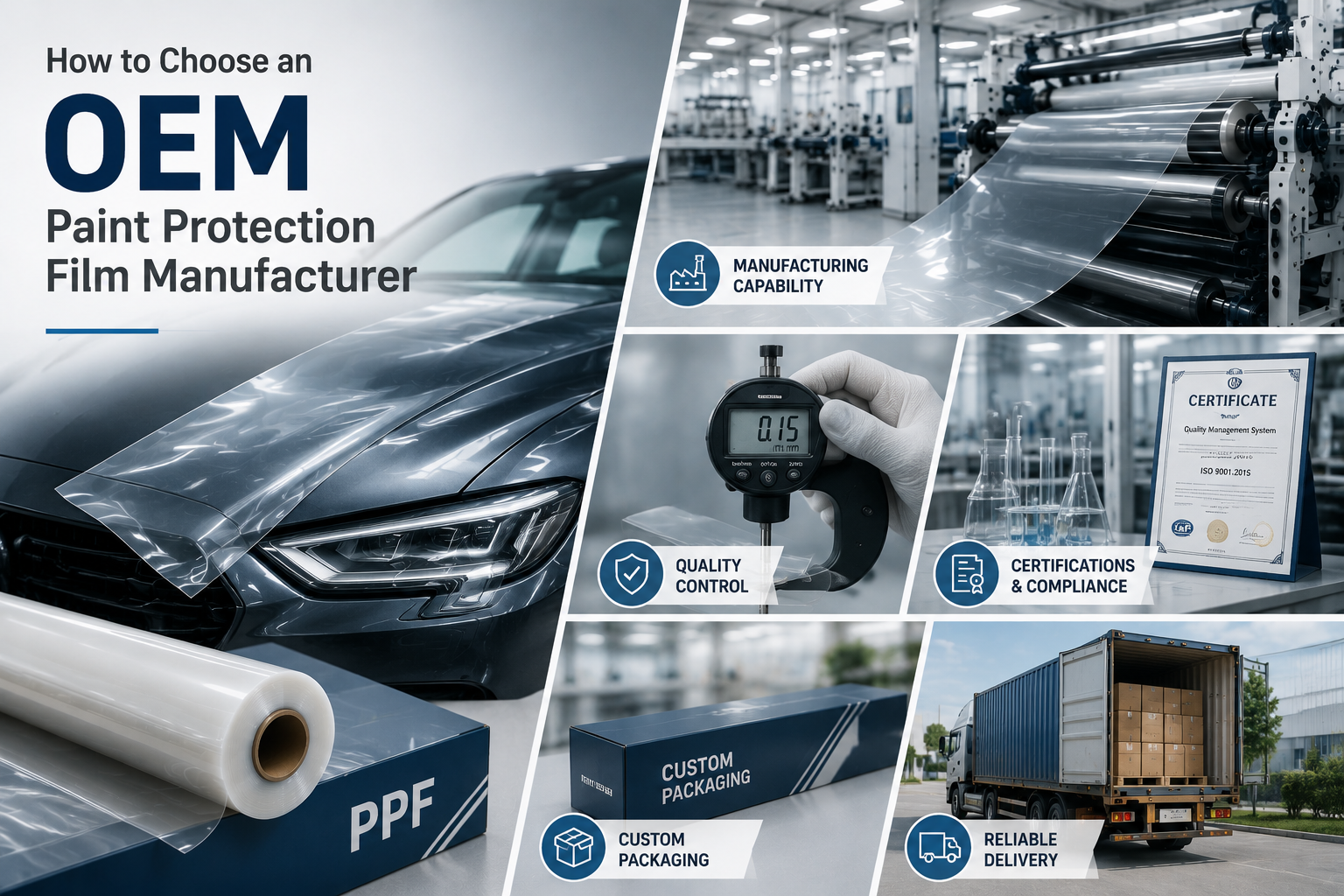
Finding a factory that can produce PPF is not the hard part. Finding one that can produce it consistently, support your brand properly, and grow with your business — that takes more work.
OEM paint protection film involves more than putting your logo on someone else’s roll. You’re attaching your brand name to a product that will be installed on customers’ vehicles, expected to perform for years, and in many cases backed by a warranty you’re personally responsible for. The manufacturer you choose directly affects whether that goes well or badly.
This guide covers what to look for, what to ask, and how to structure your evaluation before committing to an OEM partner.
Understand What “OEM” Actually Means in the PPF Industry
OEM in the PPF space can mean several different things depending on the supplier:
Private label on stock product: The manufacturer has a standard film construction and offers to package it under your brand. Fast to market, low minimum order quantity (MOQ), limited differentiation. Fine for market entry; limiting once you’re trying to build a distinct product line.
Semi-custom: You can specify certain parameters — thickness, finish (gloss/matte/satin), roll dimensions — within the manufacturer’s existing capabilities. Most established PPF manufacturers operate this way.
Fully custom formulation: You specify the material construction in detail — TPU chemistry, top coat performance requirements, adhesive system — and the manufacturer develops or sources to meet your spec. Higher MOQ, longer lead time, but genuine product differentiation.
Know which of these you actually need before approaching manufacturers. A brand in early market development typically doesn’t need fully custom formulation. A brand competing at the premium end of an established market probably does.
Manufacturing Capability: The Questions That Matter
Not every PPF manufacturer has equivalent capability. Before evaluating anything else, confirm the basics.
Do they manufacture the film themselves, or are they a trading company?
This distinction matters more than it might seem. A trading company resells film produced by someone else — sometimes from multiple sources depending on availability. That introduces inconsistency risk: the product you sample may not be from the same source as the product you receive in bulk. A manufacturer who controls their own production can trace quality issues, make adjustments, and guarantee consistency across lots.
Ask directly: where is the film produced, on what equipment, and can you visit the facility?
What casting process do they use?
TPU films for PPF are typically produced by solvent casting or hot-melt extrusion. Each method has tradeoffs in optical clarity, thickness consistency, and layer adhesion. The process itself isn’t necessarily a differentiator, but a manufacturer should be able to explain their process and why it suits PPF production. Vague answers suggest limited technical depth.
What thickness range and tolerances can they hold?
Thickness consistency across a roll affects installation quality. Ask for the stated thickness tolerance and whether they conduct inline measurement during production. A reputable manufacturer specifies tolerances (e.g. ±0.3 mil) and can document how they control them.
What film constructions do they offer?
A capable PPF manufacturer should be able to offer at minimum: standard gloss, matte finish, and varying thickness options. Ask about what variations they can accommodate within standard MOQ and what requires custom production runs.
Material Transparency: A Non-Negotiable Requirement
If a manufacturer cannot clearly explain the material construction of their film, that is a problem — not a minor gap, a fundamental one.
For any OEM relationship, you should be able to confirm:
- Isocyanate type: Aliphatic or aromatic TPU. For transparent outdoor PPF, aliphatic is the standard in quality products. A manufacturer using aromatic TPU for clear PPF and not disclosing it is selling you a product with known limitations.
- Soft segment chemistry: PCL, PCDL, polyether, or other polyol system. Each has different performance characteristics relevant to hydrolysis resistance and long-term durability.
- Top coat system: What provides the self-healing function, at what temperature range, and how the top coat is applied and cured.
- Adhesive specification: Type, peel strength (initial and aged), and whether removability data exists.
- UV stabilizer approach: Whether HALS and UV absorbers are incorporated, and at what loading levels.
A manufacturer who answers these questions clearly and completely is operating at a different level from one who responds with “premium quality TPU” and a specification sheet that lists only basic physical properties.
Quality Control: What Serious Manufacturers Do
Ask specifically about quality control procedures. The answers reveal how seriously the manufacturer approaches consistency.
Incoming material inspection: Do they test raw materials — TPU resin, adhesive, top coat chemistry — before use, or do they rely entirely on supplier certificates?
In-process monitoring: Is thickness measured inline during production? Are optical properties checked at defined intervals? Is the process documented and traceable?
Finished product testing: What tests are conducted on finished rolls before they ship? Peel adhesion, optical clarity, self-healing response, thickness — these should be routine, not occasional.
Lot traceability: Can they trace a specific production lot back to its raw material batches? This matters when a quality issue surfaces in the field and you need to determine scope.
Rejection rate and handling: What is their standard for rejecting a roll, and what happens to rejected material? A manufacturer who can’t answer this probably doesn’t have consistent standards.
Certifications and Testing Documentation
Certifications don’t guarantee quality, but their absence — or the absence of supporting test data — is informative.
ISO 9001: Indicates a documented quality management system. A baseline expectation for any serious manufacturer, not a differentiator.
Accelerated weathering test reports: Xenon arc testing to ISO 4892-2 or equivalent, with reported yellowing index results at meaningful test durations (1,000 hours minimum; 2,000+ hours for premium product claims). If a manufacturer claims a 10-year warranty but has no accelerated aging data to support it, that warranty is not well-founded.
Hydrolysis resistance testing: Relevant for humid market positioning. Test conditions and duration should be clearly stated.
RoHS / REACH compliance documentation: Required for many markets, particularly Europe. Confirm availability before assuming compliance.
Adhesive safety and removability data: Particularly relevant if your target market includes newer vehicle paint finishes that are sensitive to adhesive chemistry.
Ask for copies of actual test reports, not just certificates. A certificate says a test was done; the report tells you what the results were.
OEM Service Capability: Beyond the Film Itself
The film construction is one part of an OEM relationship. The service structure around it matters equally for brands building market presence.
Private label packaging: Can they produce branded boxes, labeled rolls, printed liners, and custom carton markings to your specification? What are the minimum quantities for custom packaging? What lead time is required for packaging changes?
Documentation support: Will they provide product data sheets in your brand name? Warranty documentation? Installation guides? These materials are part of your product offering to installers and distributors.
Sample program: Can they provide pre-production samples for your evaluation before committing to bulk production? Any serious OEM partner will support this.
Technical support: When your installers or distributors have questions about the product, who answers them? A manufacturer with genuine technical depth can support your channel. A trading company typically cannot.
Flexibility on roll specifications: Standard roll widths and lengths may not suit your market. Can the manufacturer accommodate different roll dimensions, and at what MOQ?
Supply Chain Reliability
An OEM partner who produces good product inconsistently is a serious business risk. Evaluate supply chain reliability before committing.
Production capacity: What is their current capacity, and what portion is already allocated to other customers? A manufacturer running at full capacity with no buffer is a risk if your volume grows or you need priority production.
Raw material sourcing: Where do they source key raw materials? Suppliers who depend on a single source for critical inputs — particularly imported speciality polyols — carry supply disruption risk. Ask how they handled supply disruptions in recent years.
Lead time consistency: What is their quoted production lead time, and how consistent is actual delivery against that? Ask for references or examples.
Minimum order quantities: Understand both the production MOQ and the minimum for custom packaging. Some manufacturers have low production MOQs but high minimums for branded packaging. Confirm both upfront.
Payment and sample terms: Established manufacturers will have standard terms. Unusual payment demands or reluctance to provide samples before large orders are warning signs.
How to Structure Your Manufacturer Evaluation
A structured approach avoids making decisions based on whoever gave the best sales presentation.
Step 1: Qualify on basics first. Confirm they manufacture their own film, can explain the construction, and have basic quality documentation. Filter out trading companies and suppliers who can’t answer technical questions. This step alone typically eliminates a significant portion of initial contacts.
Step 2: Request samples and technical documents. Evaluate the film physically and review the documentation. Compare optical clarity, self-healing, adhesive behavior, and aging test data across shortlisted suppliers. Use the same evaluation criteria for each.
Step 3: Ask for references. Speak with other brands or distributors who have an ongoing OEM relationship with the manufacturer. Ask specifically about consistency, communication during problems, and whether the product performs as represented.
Step 4: Discuss your specific requirements. Once you have a shortlist, present your full requirements: target market, thickness, finish, roll size, warranty period, packaging, estimated volume, and timeline. A manufacturer’s response to a detailed brief tells you more than their responses to general inquiries.
Step 5: Clarify terms before committing. Lead time, MOQ, payment terms, quality claim procedures, reorder process, and sample rights for quality disputes should all be clear before you place a first order. Surprises in these areas after you’ve committed are expensive.
Questions to Ask Any Prospective OEM PPF Manufacturer
Use this list as a starting point in supplier conversations:
- Do you manufacture the film yourself, or source it from a third party?
- What isocyanate chemistry does your TPU use — aliphatic or aromatic?
- What is the soft segment chemistry of the TPU base layer?
- Can you provide accelerated weathering test reports (xenon arc, 2,000+ hours)?
- What thickness tolerances can you hold, and how do you monitor this in production?
- What is your standard finished-product QC procedure before rolls ship?
- Can you provide lot traceability from finished product back to raw material batches?
- What are your MOQs for production and for custom packaging separately?
- Can you provide branded documentation (TDS, warranty card, installation guide) in our brand name?
- Who handles technical questions from our installers or distributors?
- What is your standard production lead time, and how consistent is actual delivery?
- Can we visit your production facility?
A manufacturer who welcomes these questions and answers them specifically is worth your continued attention. One who deflects, generalizes, or seems unfamiliar with standard technical terminology is not.
A Note on Price and What It Reflects
OEM pricing in the PPF market varies considerably. The gap between the lowest-cost option and a mid-market manufacturer almost always reflects real differences — in raw material specification, manufacturing investment, quality control infrastructure, or some combination of all three.
Brands that try to compete on price by sourcing the cheapest OEM product available typically find that quality problems in the field cost more than the savings on the purchase order. Warranty claims, installer dissatisfaction, and damage to brand reputation are difficult to quantify in advance but very real in practice.
This doesn’t mean the most expensive manufacturer is always the right choice. It means the evaluation should be based on demonstrated quality and capability, not on price alone.
Frequently Asked Questions
What is a realistic MOQ for OEM PPF with private label packaging? This varies by manufacturer. Some offer private label from relatively small initial quantities on standard film constructions. Custom formulations or fully custom packaging typically require higher MOQs. When you inquire, specify your target volume and packaging requirements to get an accurate answer.
How long does it typically take to go from first inquiry to first shipment? For private label on a standard film construction: 4–8 weeks from sample approval to first shipment is typical, depending on packaging production time. Custom formulations take longer. Get a timeline commitment in writing before planning your product launch.
Should I source from a manufacturer in my region or look at overseas suppliers? Both have tradeoffs. Overseas manufacturers (particularly in Asia) often offer more competitive pricing and wider product range. Regional manufacturers may offer shorter lead times, easier communication, and simpler logistics. The evaluation criteria in this guide apply regardless of geography.
What if a manufacturer won’t share their material specification? Treat it as disqualifying. You are building a product under your brand name. You need to know what’s in it — for quality assurance, for regulatory compliance in your target markets, and to defend your warranty claims if they’re challenged. A manufacturer unwilling to disclose basic material information is not a suitable OEM partner.
How do I protect my brand if there’s a quality problem after launch? Before placing bulk orders, establish in writing: what constitutes a quality claim, how claims are submitted, what the manufacturer’s liability is, and how replacement or refund is handled. This is easier to negotiate before you’re dependent on the supplier than after.
Looking for an OEM PPF Manufacturer?
If you’re building a PPF brand or expanding your product line, we’re set up to support the full OEM process — from material specification and sample evaluation through private label packaging and ongoing supply.
Tell us your target market, thickness and finish requirements, warranty period, estimated volume, and any packaging specifications. We’ll provide a product recommendation, samples, full technical documentation, and a quotation.
Request PPF Samples | Get an OEM Quotation | Talk to a PPF Specialist
Reviewed by KSB PPF Product and Quality Control Team.
This article reflects general industry knowledge and KSB’s experience in OEM PPF supply. Specific terms, capabilities and lead times vary by manufacturer and should be confirmed directly.
Get a Free Sample or Quote
Looking for a reliable window film supplier? Contact us today for fast response and professional support.