Types of Architectural Window Film Explained: Solar, Safety, Privacy, and Decorative
Published: August 18, 2026 · 9 min read · Category: Architectural Window Film
About this article: KSB Window Film produces all four categories of architectural window film discussed here — solar control, safety, privacy, and decorative — exported to commercial building projects across North America, Europe, the Middle East, and Southeast Asia. This guide reflects our direct manufacturing and specification experience.
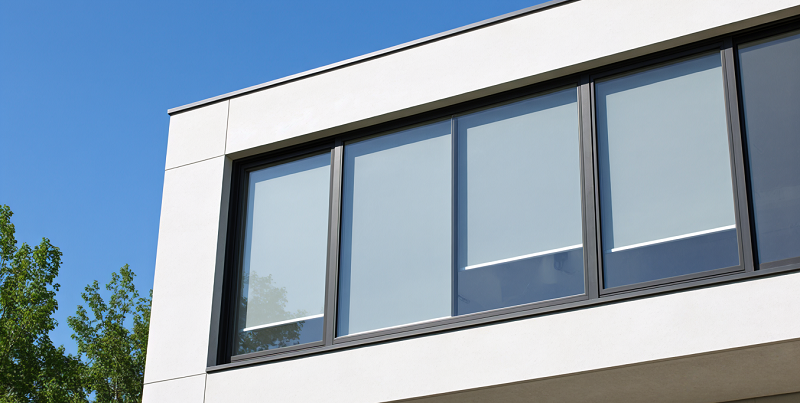
blocks outside view after pasting, hides indoor space, while bare glass allows direct outside sight.
“Window film” is used as a catch-all term that covers products with fundamentally different construction, performance characteristics, and appropriate applications. Specifying the wrong category for a problem is the most common mistake in architectural window film projects — solar control film won’t provide meaningful security, safety film won’t meaningfully improve glare, and decorative film won’t contribute to an energy audit.
This guide gives a clear, functional breakdown of each category, what it actually does, and how to match product type to building requirement.
Category 1: Solar Control Film
What It Does
Solar control film reduces the quantity of solar energy — specifically heat and UV — that enters a building through glazing. It operates on three mechanisms:
Absorption: The film’s coating layers absorb solar radiation and convert it to low-level heat that dissipates through the glass rather than entering the interior.
Reflection: Certain film types (particularly reflective and metalized films) reflect solar radiation back outward before it’s absorbed. Reflection is more energy-efficient than absorption because less heat is generated in the glass.
Selective transmission: Modern nano ceramic films use engineered nanoparticle coatings that selectively block infrared and UV wavelengths while passing visible light — achieving high solar rejection without necessarily darkening the space significantly.
Technology Tiers
Reflective / metalized film: High solar rejection achieved through metallic layers that reflect incoming radiation. Produces a mirror-like exterior appearance. Best TSER performance per VLT level, but aesthetically distinctive and may interfere with wireless signals in some configurations.
Neutral / low-reflectance film: Absorptive or hybrid coatings that reduce solar gain without strong exterior reflectance. More visually subtle than reflective film. Appropriate for buildings where appearance management is important.
Nano ceramic solar film: Non-metallic ceramic nanoparticle coatings achieving high TSER with neutral appearance and no signal interference. Premium tier with the best balance of performance and aesthetics. See What Is Nano Ceramic Window Film? for detail.
Spectrally selective film: Engineered to selectively target the infrared portion of the solar spectrum while maximizing visible light transmission. Achieves meaningful solar rejection at high VLT — useful in buildings where daylighting is a priority alongside solar control.
Key Performance Metrics
TSER: 40–80% depending on product and glass type. This is the primary energy performance indicator.
VLT: 10–70%+ depending on product. Specifying the right VLT requires balancing solar rejection against daylighting requirements.
SHGC: The glass system’s Solar Heat Gain Coefficient after film application. Target SHGC drives product selection in energy code compliance projects.
UV rejection: 99%+ for all quality solar control films regardless of VLT.
When to Specify
South- and west-facing glazing with high afternoon heat load, atriums and skylights, curtain wall buildings in warm climates, any building where cooling energy cost is a significant operational expense.
Category 2: Safety and Security Film
What It Does
Safety film does not prevent glass from breaking. What it does is control the aftermath of breakage — holding fragments together in the frame rather than allowing them to scatter. This has two distinct value propositions:
Injury prevention: Most glass-breakage injuries come from secondary fragment scatter — flying shards after a window breaks. Safety film holds the fragmented glass together, substantially reducing flying fragment injuries from accidental breakage, seismic events, and storm damage.
Forced entry delay: Security film (thicker than basic safety film, typically 8 mil+, often combined with frame attachment) significantly delays forced entry. An unprotected window can be cleared in 3–5 seconds. A properly installed security film installation on the same glass can take 60–180+ seconds to penetrate — long enough for alarms to activate and response to begin.
Blast mitigation: High-performance blast film (certified to GSA and Department of State standards) is specified on government buildings and critical infrastructure. The film holds glass together during blast overpressure events, preventing the high-velocity secondary fragment injuries that are the primary blast-related injury mechanism.
Product Tiers
Basic safety film (4–6 mil): Fragment retention in accidental breakage. Appropriate for code compliance upgrades and general occupant safety improvement.
Security film (8–12 mil): Forced entry resistance. Used in retail security applications, ground floor commercial glazing, and schools.
Blast film (12 mil+, mechanically attached): Bomb blast mitigation. Requires frame attachment (wet glaze or mechanical fastening) to prevent the intact glass-film unit being pushed inward. Government and high-security applications.
Key Certifications
EN 12600 (European standard), ANSI Z97.1 (US), GSA/DoS blast resistance standards. Safety film specified without relevant certifications should not be relied on for code compliance purposes.
Category 3: Privacy Film
What It Does
Privacy film restricts visual access through glass. Unlike smart/switchable film (PDLC), standard privacy film is a fixed product — it provides the same privacy level at all times.
Two main mechanisms:
Reflective one-way privacy: Highly reflective film provides one-way visibility: from the lighter side (typically outside, during daylight), visibility through the glass is blocked by the mirror effect. From the darker side (typically inside), visibility out is normal. Important limitation: the one-way effect reverses when internal lighting is brighter than external — at night, with interior lights on, the reflective privacy film provides no privacy from outside.
Diffusion film (frosted/etched effect): Diffuses light rather than reflecting it. Blocks clear visibility from both sides while allowing diffused light to pass through. Provides privacy regardless of relative lighting conditions — the most reliable option for conference rooms, healthcare environments, and interior partitions where privacy is consistent rather than lighting-dependent.
Product Options
Frosted film: Sandblasted glass effect. Available in varying degrees of translucency from lightly frosted to near-opaque. The most commonly specified privacy film for interior applications.
Patterned film: Etched, geometric, or custom graphic patterns. Often used decoratively as well as functionally.
White or black opaque film: Full opacity for applications requiring complete visual obstruction.
Micro-perforated / one-way vision film: Used on exterior windows and shopfronts where an image or graphic is visible from outside but visibility through the film is maintained from inside.
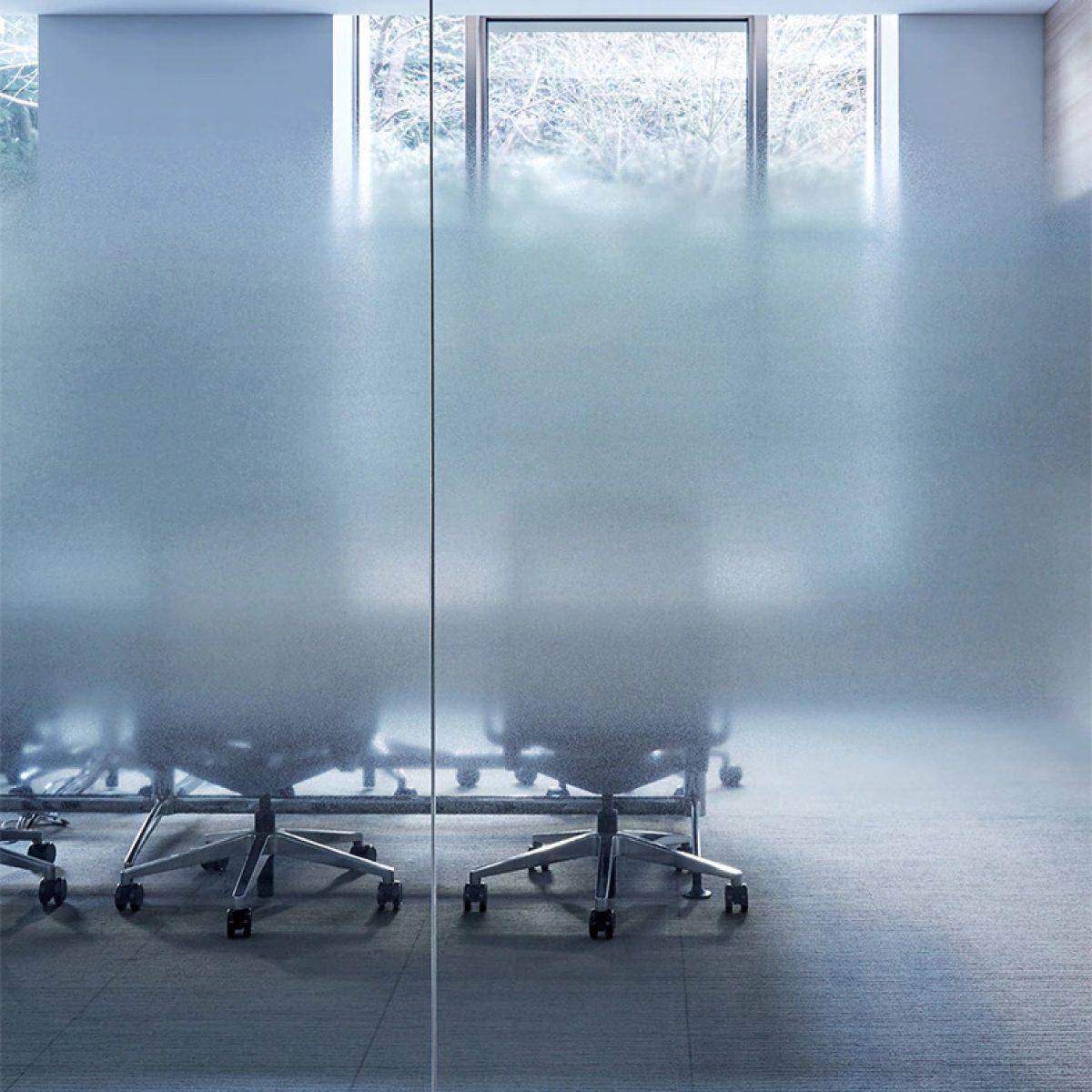
privacy protection while maintaining soft natural light
Category 4: Decorative Film
What It Does
Decorative film changes the visual appearance of glass for aesthetic, branding, or wayfinding purposes. Unlike the other three categories, the primary function is not performance-based — it’s appearance-based.
Common applications:
Manifestation: Building regulations and safety codes in many countries (including UK Building Regulations Part M, Australian BCA) require glazed surfaces at pedestrian level to be marked to prevent people walking into glass. Manifestation film — stripes, dots, frosted bands, or graphics at specified heights — fulfils this requirement in a way that’s also visually considered.
Brand graphics: Office fit-outs, retail spaces, and hospitality environments use decorative film to apply logos, patterns, and graphic elements to glass partitions and windows.
Privacy with aesthetics: Frosted or patterned decorative film often serves dual purposes — providing the visual privacy needed for an HR office while also contributing to the interior design character of the space.
Glass protection: Decorative film on exterior shopfront glass provides a degree of UV and abrasion protection alongside the aesthetic function.
Choosing the Right Category: A Decision Framework
Primary Requirement
Right Category
Reduce heat and A/C energy costs
Solar control film
Reduce glare on screens
Solar control film (neutral/low-reflectance)
Protect interior from UV fade
Solar control film (any tier)
Hold glass together if broken
Safety film
Slow forced entry
Security film (8+ mil)
Blast protection
Blast film with frame attachment
Privacy independent of lighting
Frosted/diffusion privacy film
Privacy in daytime only
Reflective one-way film
Mark glass for safety code
Decorative manifestation film
Apply brand or graphics to glass
Decorative film
Combined solar control + privacy
Dual-function solar/privacy film
FAQ
Can I get film that does solar control and privacy at the same time?
Yes. Reflective solar control film provides both solar rejection and daytime one-way privacy simultaneously. Tinted solar control films at lower VLTs also reduce visibility into the space. For guaranteed privacy regardless of lighting conditions, a frosted film combined with solar control would require two film layers — or specify an opaque solar control film that achieves both in one product.
Is safety film the same as laminated glass?
No. Laminated glass has an interlayer (typically PVB) factory-bonded between two glass panels during manufacturing. Safety film is a retrofit adhesive film applied to the surface of existing glass. Both hold glass fragments together. Laminated glass is structurally stronger and provides better long-term durability, but requires glass replacement. Safety film is applied to existing glass without replacement — a cost advantage when the glass is otherwise sound.
How do I know which film category a supplier is quoting?
Ask explicitly. Request the product datasheet and check what performance parameters are specified: TSER and SHGC are solar control metrics; impact resistance or blast rating are safety metrics; VLT with privacy description is privacy film. A film that doesn’t specify the primary performance parameters in its datasheet is a product without verified performance.
Can different film types be applied to the same building?
Yes — and in most commercial buildings, multiple categories are used. Solar control film on south and west facades, safety film on ground-floor entry glazing, privacy film on conference rooms and offices, and decorative film on reception and lobby glass all make sense in different locations within the same building.
KSB Window Film manufactures all four architectural film categories with technical data sheets and third-party certification documentation for each product. Our technical team can help you match product specification to building requirement.