Published: July 7, 2026 · 8 min read · Category: Window Film Guide
Carbon and nano ceramic are the two technologies that professional installers most often put in front of customers who want a serious, long-lasting window film. Both are signal-transparent. Both avoid the fading problems of dyed film. Both look clean and neutral on glass. In a lot of conversations, the choice comes down to this: how much are you willing to spend for how much thermal performance improvement?
The short version: nano ceramic is better at blocking heat. Carbon is better value for buyers who don’t need the absolute top tier. But that summary skips the details that actually matter when you’re choosing between two specific products, and this guide covers those.
What Each Technology Does
Carbon film works through carbon particles incorporated into the coating layers. Carbon absorbs solar radiation across a broad spectrum — particularly in the infrared range — and converts it to heat that dissipates through the glass rather than transmitting into the vehicle or room. Carbon is non-metallic and non-conductive, which means no signal interference. The carbon structure is also UV-stable, so the film doesn’t fade or shift color over years of sun exposure the way dyed film does.
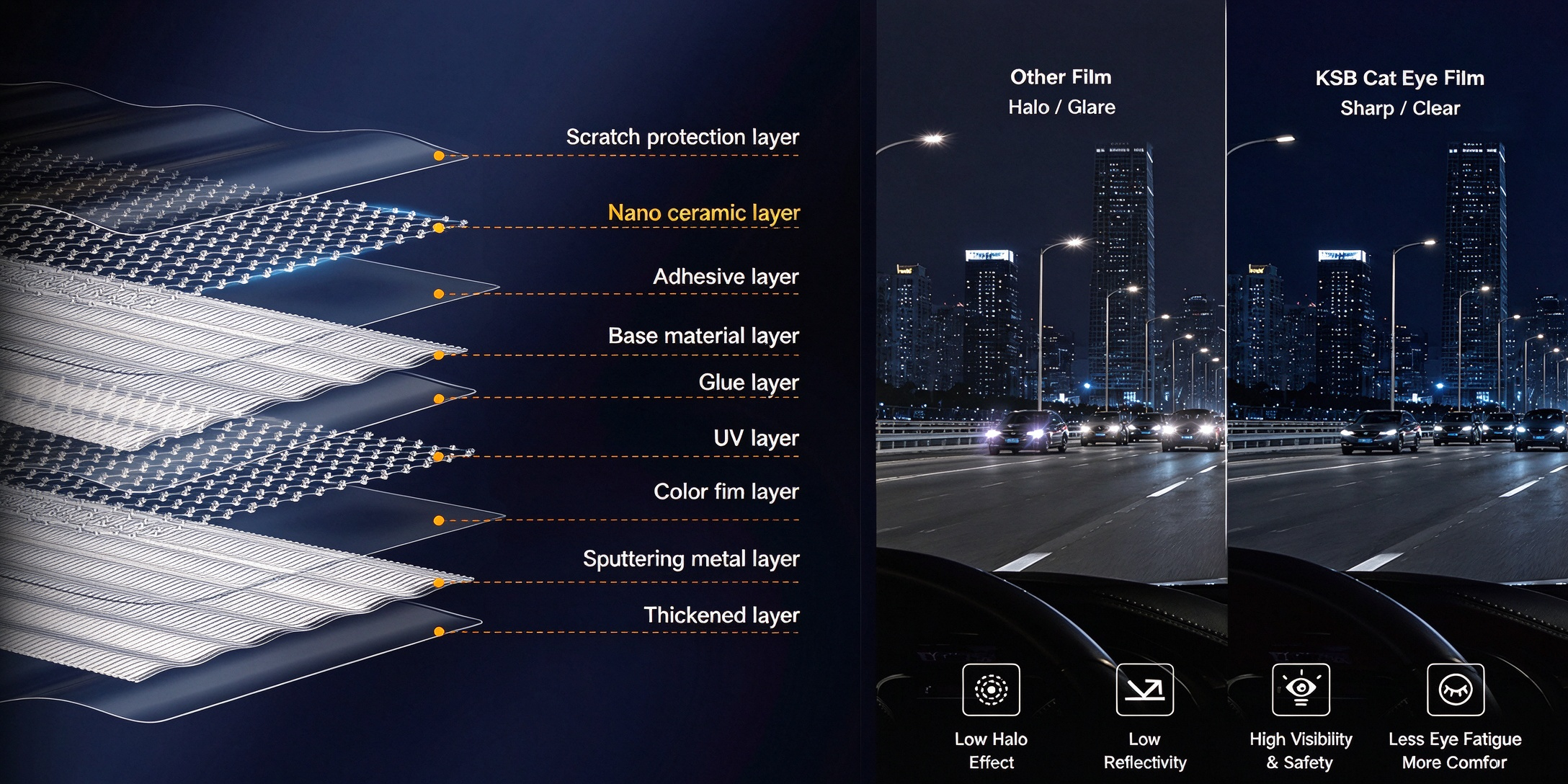
Nano ceramic film works through ceramic nanoparticles — typically titanium nitride, cesium tungsten oxide, or similar compounds — embedded in or coated onto the film layers. Ceramic materials have a higher intrinsic IR rejection capability than carbon at equivalent visible light transmission. The nano-scale particle sizing (5–100nm) allows the film to remain optically clear while still blocking significant infrared radiation.
The mechanism difference matters: carbon primarily absorbs IR and re-emits some as heat through the glass. Ceramic absorbs and also reflects a portion of IR outward before it reaches the glass. This combined absorption-reflection mechanism is part of why ceramic achieves higher total solar energy rejection at equivalent VLT levels.
Performance: Where the Gap Is Real
Heat Rejection
This is the meaningful difference between the two categories.
A quality carbon film at 35% VLT typically achieves 40–55% TSER (Total Solar Energy Rejected). A quality nano ceramic film at the same VLT typically achieves 55–70%+ TSER.
In practical terms: both films are meaningfully cooler than no film. But on a hot day in direct sun, the temperature difference between a carbon-filmed and a ceramic-filmed vehicle interior is measurable — often 5–10°C at peak. Over a summer of daily driving in a hot climate, that difference accumulates into a real quality-of-life and fuel-efficiency advantage.
In mild climates or primarily shaded/urban environments, the gap narrows. If your car lives mostly in covered parking and urban traffic, the heat rejection premium of ceramic is less frequently tested.
UV Blocking
Both carbon and ceramic films block UV effectively — typically 99%+ for quality products in both categories. This is one area where carbon and ceramic perform comparably. UV protection is not a reason to choose ceramic over carbon.
Signal Transparency
Both are signal-transparent. No interference with mobile, GPS, Wi-Fi, or toll systems. This is a point of equivalence — neither has an advantage.
Optical Clarity
Both produce clean, neutral appearances with no metallic sheen. Carbon film may have a very slight warmth to its tint; ceramic tends toward neutral grey. In most VLT ranges, neither reads as anything other than tinted glass.
Longevity
Carbon film has good long-term stability — the carbon structure doesn’t degrade under UV the way organic dyes do. Nano ceramic goes further: ceramic compounds are inorganic and essentially inert under UV, heat, and oxidation conditions. Premium ceramic films maintain their performance characteristics longer than carbon. The practical difference in everyday applications is often modest over 5–7 years, but becomes more apparent at 10+ years.
Price: The Clearest Difference
Carbon film is less expensive to manufacture than nano ceramic — the raw material costs are lower and the manufacturing process is less demanding. At the distribution and retail level, the price difference varies but typically runs 30–80% more for ceramic over equivalent carbon products.
For automotive installations, this commonly translates to $100–$300 more per full car job depending on vehicle size and market.
For some buyers — particularly those in mild climates, on a budget, or fitting out a vehicle they don’t plan to keep long — carbon delivers most of the relevant benefits (no signal interference, no fading, good UV protection, decent heat rejection) at a price point that’s easier to justify.
For buyers in hot climates who park outdoors, drive long distances, or simply want the best available option for a vehicle they’ll keep for years — the ceramic premium is consistently justified by the heat rejection advantage.
How to Choose
Choose carbon if:
- Budget is a significant consideration
- The climate is mild or the vehicle is primarily garage-kept
- The vehicle is short-term (lease, planning to sell within 2–3 years)
- You want a reliable step up from dyed film without the ceramic price
Choose nano ceramic if:
- You’re in a hot climate with significant sun exposure
- You want maximum heat rejection at the highest VLT (most relevant for front window applications where going dark isn’t an option)
- The vehicle is a longer-term keeper and you want best-in-class performance
- You’re building a premium product line and need the top-tier offering
FAQ
Is the heat rejection difference between carbon and ceramic actually noticeable in real life?
In direct summer sun in a genuinely hot climate — yes, noticeably. The difference is most obvious when getting into a parked car on a hot afternoon. In mild climates or primarily winter use, the difference is much less apparent. Whether the noticeability justifies the price premium is a judgment call that depends on how and where the vehicle is used.
Do carbon and ceramic films look different on the car?
Generally no — not in a way most people would notice. Both produce a clean, non-reflective tint. Some carbon films have a very slightly warmer cast; ceramics tend to neutral grey. Side by side in controlled conditions, a trained eye can see a difference. On an installed vehicle, the films are functionally indistinguishable in appearance.
Can I mix carbon on some windows and ceramic on others?
Technically yes. Some professional installers put ceramic on the front windows (where you want maximum heat rejection at legal VLT levels) and carbon on the darker rear windows (where the lower heat rejection is less critical at the already-dark VLT). The visual match between the two films at the same nominal VLT is close enough that the difference is usually imperceptible.
Which one lasts longer?
Both last well. Premium carbon film from reputable manufacturers is warranted 5–10 years and performs reliably through that period. Premium ceramic typically has similar or longer warranty periods and slightly better long-term stability of the ceramic compounds compared to carbon coatings. For most buyers, the practical difference over a 7-year ownership period is minor.
Is expensive carbon film better than cheap ceramic?
Often yes. A quality carbon film from a reputable manufacturer with verified test data outperforms a budget “nano ceramic” film with questionable ceramic content. The technology tier label matters less than the actual product quality behind it. Always evaluate test reports rather than relying on the category name.
Further Reading
On this site:
- What Is Nano Ceramic Window Film? — Full nano ceramic overview
- How Nano Ceramic Window Film Is Made — Production process context
- Why Do Window Film Prices Vary So Much? — Cost drivers behind the price gap
- What Certifications Should a Window Film Manufacturer Have? — Verifying the test reports for either technology
External:
- IWFA Window Film Standards — Industry test methodology for comparing performance across technology tiers
- NFRC Certified Products Directory — Independent performance verification for window film products
Get a Free Sample or Quote
Looking for a reliable window film supplier? Contact us today for fast response and professional support.