Aliphatic TPU vs Aromatic TPU PPF: Which Is Better?
Published: July 4, 2026 · 7 min read · Category: PPF Guide
About this article: KSB Window Film’s R&D team works directly with TPU compound specifications for our PPF range. The aliphatic vs. aromatic question is technically important and commercially misunderstood — this guide is based on our direct material experience.
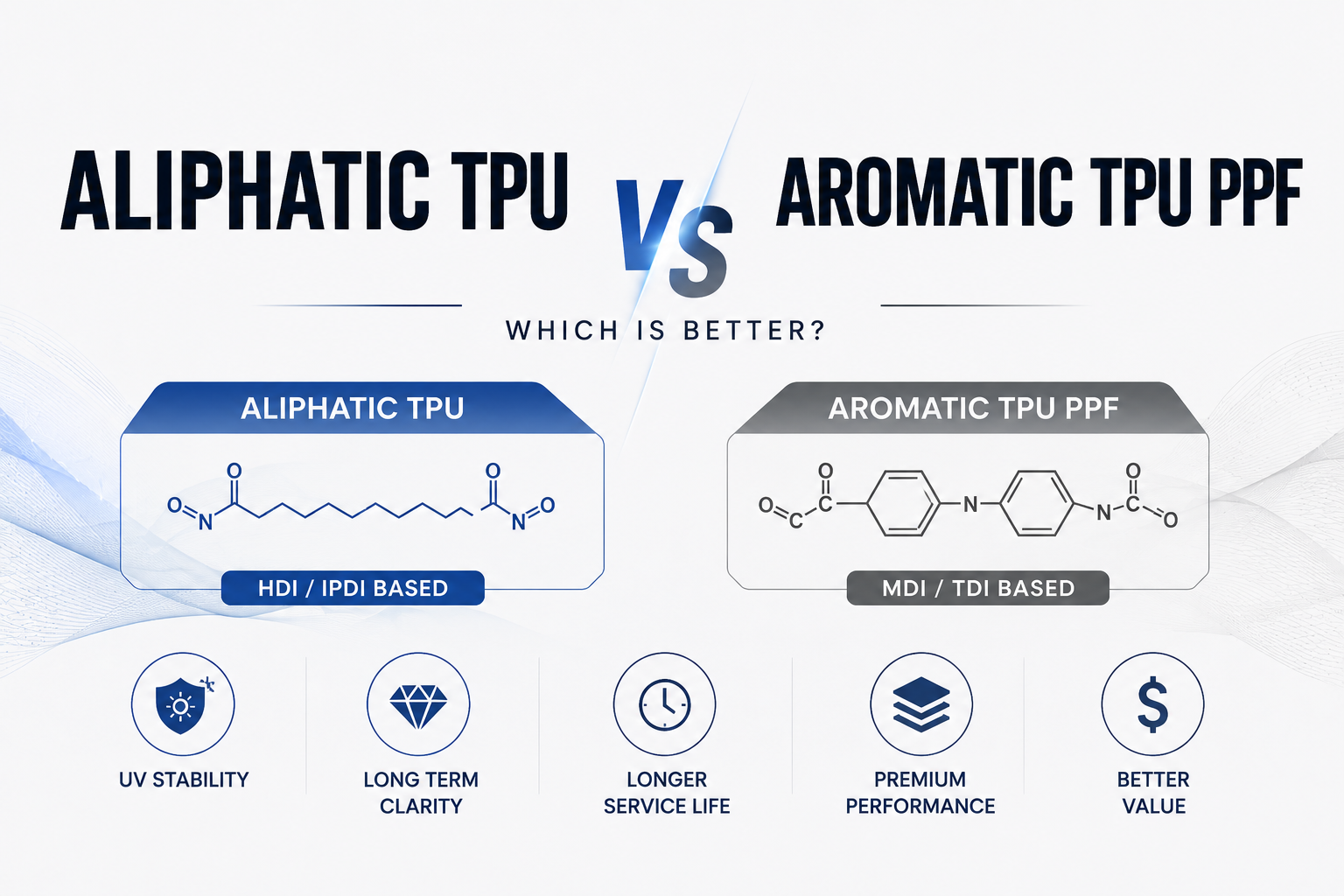
Comparison of aliphatic TPU and aromatic TPU used in paint protection film, highlighting UV stability and long-term clarity.
“Is this aliphatic or aromatic TPU?” is the question that separates buyers who’ve done material research from those who haven’t — but knowing which question to ask is only useful if you understand what the answer means. This guide explains the chemistry difference, why it matters for PPF performance, and when the distinction actually affects your buying decision.
The Chemistry in Plain Terms
Both aliphatic and aromatic describe the molecular structure of the diisocyanate component used in TPU synthesis. Diisocyanate is one of the two main chemical building blocks of polyurethane — the other being a polyol.
Aromatic TPU is produced from aromatic diisocyanates — specifically MDI (methylene diphenyl diisocyanate) or TDI (toluene diisocyanate). “Aromatic” refers to the benzene ring structure in these molecules.
Aliphatic TPU is produced from aliphatic diisocyanates — specifically HDI (hexamethylene diisocyanate) or IPDI (isophorone diisocyanate). No benzene rings.
The benzene ring structure in aromatic TPU is photochemically reactive — it absorbs UV radiation and undergoes a structural change (yellowing) as a result. Aliphatic diisocyanates don’t have this UV-reactive structure, so aliphatic TPU doesn’t yellow under UV exposure.
The Yellowing Difference: Why It Matters for PPF
When UV radiation hits an aromatic TPU film over time, the aromatic rings in the polymer structure break down and form chromophoric groups — molecular fragments that absorb visible light in the blue wavelengths. This selective absorption creates the characteristic yellow discolouration that installers and vehicle owners find unacceptable.
Aliphatic TPU doesn’t have this degradation pathway. Without the UV-reactive aromatic rings, the yellowing mechanism simply doesn’t exist. Aliphatic TPU-based PPF can maintain optical clarity for years longer than aromatic TPU under equivalent UV exposure.
For PPF applied to vehicle paint — which lives in direct sunlight and needs to remain optically clear for 7–10 years — this is not a minor technical distinction. It’s a service life determinant.
The Cost Difference
Aliphatic diisocyanates cost more to produce than aromatic alternatives. The cost premium at the raw material level for aliphatic vs. aromatic TPU compound is approximately 20–40%.
This flows through to finished film pricing. Premium PPF products — those genuinely intended for 7–10 year service life on quality vehicles — use aliphatic TPU. The higher material cost is part of why premium PPF costs more than budget alternatives.
Budget PPF products using aromatic TPU may perform similarly to aliphatic products for the first 1–2 years. The divergence appears at years 3–5+ as UV exposure accumulates and the yellowing progression becomes visible.
How to Verify Which Type Your Supplier Uses
Ask directly: “Is your TPU base film aliphatic or aromatic?” A manufacturer who knows their own product can answer immediately. One who hesitates or provides vague answers probably doesn’t know — which suggests they’re not controlling their material inputs carefully.
You can also request the TPU Safety Data Sheet (SDS) — the chemical components will indicate whether MDI/TDI (aromatic) or HDI/IPDI (aliphatic) diisocyanate was used in production.
Third-party verification: accelerated UV weathering tests (ASTM G154, ISO 4892) with a yellowing (YI — Yellowness Index) measurement after simulated UV exposure will show whether a film’s optical properties degrade under UV. A film maintaining YI below 2–3 after 1,000 hours of UV exposure is almost certainly aliphatic-based; significant yellowing at that exposure level indicates aromatic.
Is All Budget PPF Aromatic?
Not all, but budget-priced PPF is more likely to use aromatic TPU or aromatic-dominant blends. Some manufacturers use aromatic TPU for the base film and rely on UV stabilizer additives (HALS — Hindered Amine Light Stabilizers) to slow the yellowing process. This improves performance compared to unstabilised aromatic TPU but doesn’t match the intrinsic stability of aliphatic.
A more nuanced picture: some manufacturers blend aliphatic and aromatic components to achieve a cost-performance balance. The yellowing resistance of such blends depends on the ratio and the specific UV stabilizer package.
For buyers: if a manufacturer can’t tell you whether their TPU is aliphatic or aromatic, and can’t provide accelerated UV weathering data, you’re buying unknown long-term performance.
The Top Coat Question
One important clarification: in a complete PPF product, the top coat (the outermost layer) also contributes significantly to UV stability. Premium top coats formulated with aliphatic polyurethane chemistry and robust HALS stabilizer packages provide additional UV protection on top of the base TPU.
So a truly premium PPF product has:
Aliphatic TPU base film
Aliphatic polyurethane top coat formulation
High-concentration HALS UV stabilizers in both layers
This combination is what delivers 7–10 year service life in direct-sun environments. Budget products may have aromatic components in either or both layers.
FAQ
If a film claims “anti-yellowing,” is it aliphatic?
Not necessarily. “Anti-yellowing” can mean UV stabilizer additives in an aromatic TPU base — which slows yellowing but doesn’t eliminate it. True aliphatic TPU doesn’t yellow at all under normal service conditions. Ask whether the base TPU is aliphatic (HDI or IPDI-based), not just whether the product has “anti-yellowing” treatment.
Is the price difference between aliphatic and aromatic PPF significant for distributors?
At the roll level, the material cost difference between comparable aliphatic and aromatic products is roughly $8–$20/roll depending on tier. This translates to $0.50–$1.20/linear meter of installed film. For a full bonnet job using 3 linear meters, the material cost difference is $2–$4. Against an installed price of $300–$800 for the bonnet, this is a negligible price difference that doesn’t justify using inferior material.
Do UV blockers compensate for using aromatic TPU?
Partially. High-quality HALS stabilizers slow UV degradation in aromatic TPU significantly. But they don’t provide the fundamental chemical stability of aliphatic TPU. Think of it as slowing the yellowing clock rather than stopping it. For a 3-year product, HALS-treated aromatic may be adequate. For a 7–10 year service expectation, aliphatic is the only appropriate base.
KSB Window Film’s premium PPF uses aliphatic TPU base film with aliphatic polyurethane top coat — verified by our material Safety Data Sheets and accelerated UV weathering test results. We provide this documentation with sample orders.