Solar Control Window Film for West-Facing and South-Facing Windows
Published: August 26, 2026 · 7 min read · Category: Architectural Window Film
About this article: KSB Window Film manufactures solar control architectural film supplied to commercial and residential building projects globally. West and south-facing glazing specification is one of the most common technical enquiries we handle from building owners and facilities managers.
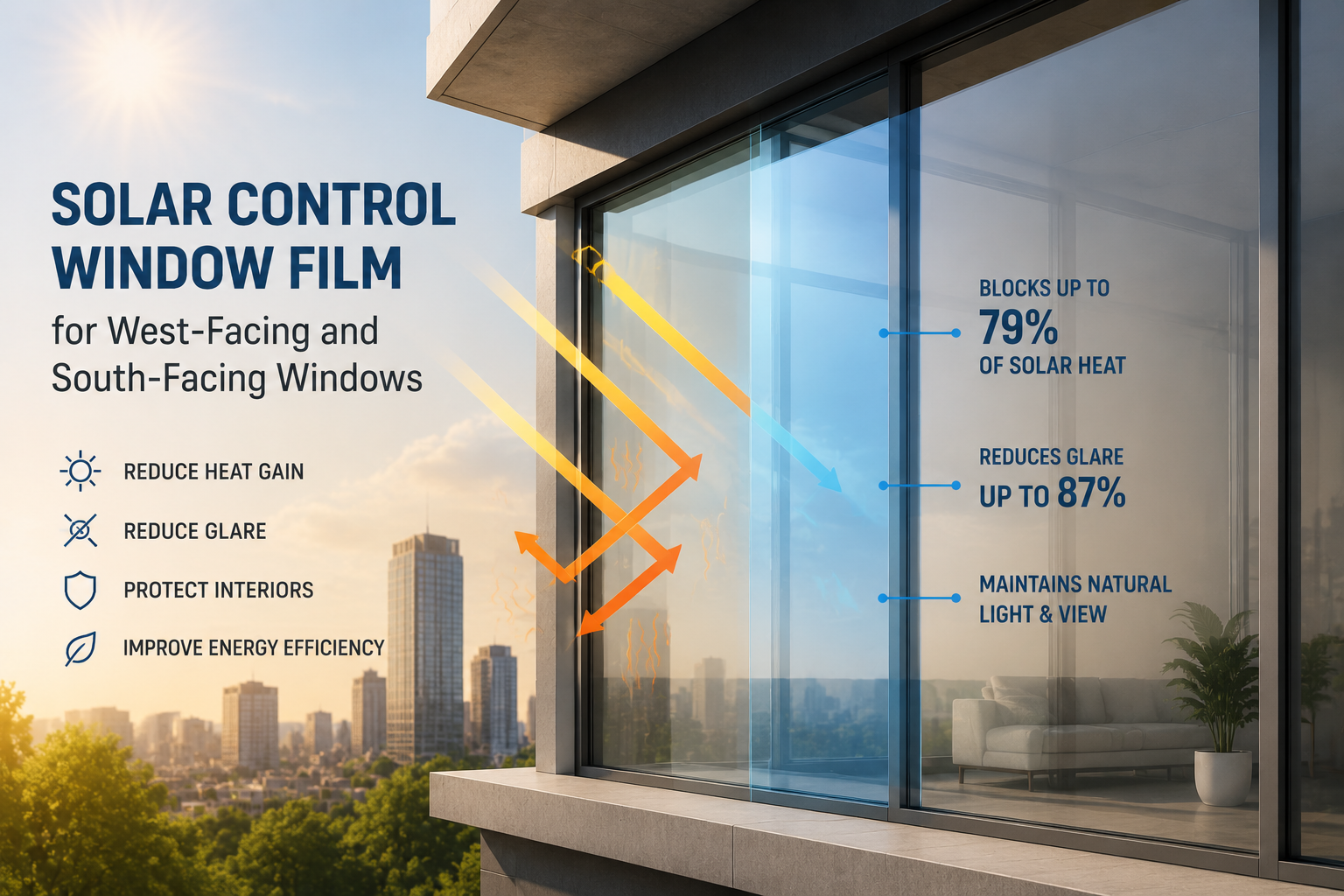
Commercial building window glass with solar control film reducing heat and glare while maintaining natural light
Not all windows face the same problem. A film that’s adequate on a north-facing elevation is under-specified for a west-facing elevation. A film that’s ideal in a temperate climate may be insufficient for the same orientation in a subtropical one. Orientation matters — and this guide explains why, and what it means for specification.
Why Orientation Determines the Specification
The solar heat gain through a window is determined by two factors: the solar irradiance arriving at that surface, and the SHGC of the glazing system. Irradiance varies with orientation.
South-facing glass (Northern Hemisphere): Receives direct sunlight for most of the day, with solar altitude varying through the year. In summer, the sun is high and south-facing windows receive relatively less direct radiation (high angle = smaller projected area). In winter and spring/autumn, the sun is lower and south-facing glass receives significant direct radiation at lower angles.
Peak issue times: year-round solar gain, with particular intensity in spring and autumn when the sun is lower and days are longer. The problem is consistent but not extreme at any single moment.
West-facing glass: Receives direct afternoon and evening sun at low angles. This creates the worst glare conditions in a building — low solar altitude means direct sun penetrates deep into the floor plate, hitting workstations and screens far from the window. The afternoon timing coincides with peak building occupation and peak outdoor temperatures. Solar heat gain accumulates through the day and the west elevation receives it at the hottest point.
West-facing glass is consistently identified as the highest-priority elevation for solar control film in occupied commercial buildings. If you’re prioritising which elevations to treat first, start west.
Performance Targets by Orientation
West-Facing Windows: Maximum Solar Rejection Priority
The brief for west-facing glass is straightforward: maximum solar rejection at the highest acceptable VLT. The low afternoon sun angle and high glare intensity means VLT cannot be high without leaving the glare problem unresolved.
Recommended specification:
TSER: 60%+ (70%+ preferred in hot climates)
VLT: 20–35% for severe glare management; 35–45% if supplemental artificial light is available and glare is moderate
Film technology: nano ceramic or reflective solar control
Interior or exterior: either works; exterior film provides slightly higher solar rejection
For buildings in the Middle East, Southeast Asia, or the southern US where western sun intensity is extreme — TSER 65–75% is the target. This requires premium nano ceramic or reflective film at 20–30% VLT.
South-Facing Windows (Northern Hemisphere): Balanced Solar and Daylight
South-facing glass receives more diffuse year-round solar gain than the aggressive direct-hit problem of west-facing glass. The specification can be more moderate.
Recommended specification:
TSER: 50–65%
VLT: 35–50%
Film technology: neutral solar control, spectrally selective, or nano ceramic
Spectrally selective film performs well on south-facing glass where the goal is managing heat gain while preserving natural light quality. The balanced solar-gain profile of south-facing windows (high summer angle = less direct heat; lower winter angle = some useful solar heating) also makes spectrally selective film more attractive on south elevations than west elevations.
North-Facing Windows (Northern Hemisphere):
In the Northern Hemisphere, north-facing glazing receives no direct sun. It admits diffuse sky light — good quality daylighting without glare. Solar heat gain through north-facing glass is minimal.
Recommendation: Usually no solar control film required unless the specific building has unusual conditions (highly reflective adjacent buildings, extreme diffuse sky brightness). Installing film on north-facing glass reduces natural light quality without meaningful energy or glare benefit.
Climate Multiplies the Orientation Effect
In temperate climates (London, Paris, Vancouver), the west-facing glare problem is real but the solar heat gain problem is moderate — cooling seasons are shorter and solar irradiance is lower.
In subtropical and tropical climates (Dubai, Singapore, Miami, Sydney), the same west-facing orientation combined with higher solar irradiance, longer cooling seasons, and more extreme afternoon temperatures produces a dramatically larger problem. The specification needs to reflect this.
Climate-adjusted specification for west-facing glass:
Climate
Recommended TSER
Recommended VLT
Tropical (Singapore, UAE)
70–80%
15–25%
Subtropical (Miami, Sydney)
65–75%
20–30%
Warm temperate (Southern Europe, California)
55–65%
30–40%
Temperate (Northern Europe, Pacific Northwest)
45–55%
35–50%
Zoning: Different Films for Different Elevations
The most technically sound approach to a multi-elevation building is to specify different film products for each orientation based on the specific solar exposure.
A common office building specification:
West elevation: High-performance nano ceramic or reflective film, TSER 65%, VLT 25%
South elevation: Mid-range neutral solar control, TSER 55%, VLT 40%
East elevation: Low-reflectance solar control, TSER 50%, VLT 45%
North elevation: No film, or minimal tint for visual uniformity only
This zoning approach involves managing multiple film products across one building and ensuring visual consistency from the exterior (films with different VLT on different elevations can produce a visual patchwork effect if not coordinated carefully). Most experienced film installers are familiar with zoned specification and can advise on product families that provide consistent exterior appearance across different VLT levels.
FAQ
If I can only film one elevation, which should it be?
West, in almost all cases. The combination of low-angle afternoon sun, peak heat accumulation, and peak occupation makes west-facing glass the highest-impact elevation for both energy savings and occupant comfort. Film on the west elevation reliably delivers the largest comfort and energy improvement.
Does the same film work on both interior and exterior surfaces?
No — interior and exterior film are different products. Most architectural film is interior-applied (easier installation, accessible without scaffolding). Exterior film requires products specifically rated for outdoor UV exposure and weathering, with different adhesive chemistry. If you’re specifying exterior application, confirm the product is rated for it. See Exterior vs Interior Architectural Window Film for the full comparison.
Will very dark film on west-facing windows make those offices too dark?
At VLT 25–30%, the offices will be noticeably darker than adjacent unfilmed spaces. This typically requires some artificial light supplementation in the afternoon. Most occupants accept this as the better alternative to unusable sun-drenched workstations. The practical test: if staff are already closing blinds completely on the west elevation, 25% VLT film provides more light than closed blinds while solving the same problem.
Can I phase the installation — west this year, south next year?
Yes. Phased installation by elevation is common and makes practical sense for budget management. West first delivers the highest ROI. South next. East and north rarely require film.
Specify the Right Film for Your Orientation and Climate
KSB Window Film’s solar control range covers the full spectrum from spectrally selective high-VLT products to premium nano ceramic high-rejection film. We can advise on the right specification for each elevation of your building based on your climate zone and performance objectives.