Window Film for Double-Glazed and Low-E Glass: What’s Compatible?
Published: August 27 2026 · 8 min read · Category: Architectural Window Film
About this article: Compatibility queries on double-glazed and Low-E glass are among the most technically complex questions we handle at KSB Window Film. This guide reflects our direct product experience and technical consultation with glazing engineers across our global distribution network.
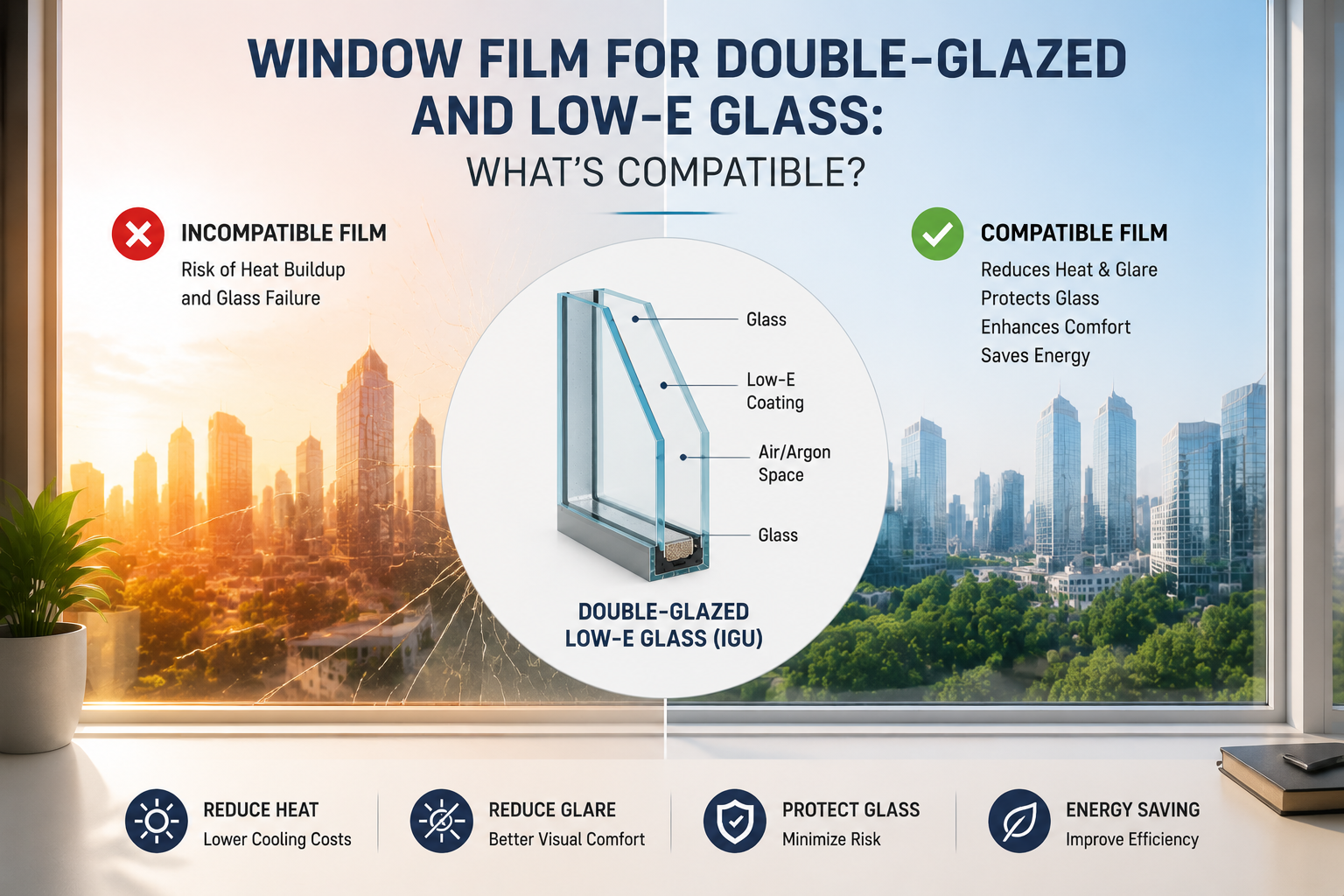
Double glazed and Low-E glass window film compatibility comparison for safe solar control installation
“Can I put film on my double-glazed windows?” is one of the most common questions in architectural window film specification, and it’s also one of the most important to get right — because applying the wrong film to a sealed double-glazed unit (IGU) can cause thermal stress cracking that destroys the glass unit and voids its warranty. Get it right, and film on double-glazed glass works well. Get it wrong, and you’re replacing glass.
This guide covers the compatibility questions and how to answer them for your specific glass specification.
Why Double-Glazed Glass Is Different
A single-glazed window and a double-glazed unit behave differently when solar film is applied.
In single glazing, film absorbs some solar energy and heats up slightly. This heat dissipates through the glass on both sides — inward and outward. The temperature differential across the glass is small.
In a double-glazed unit (IGU — Insulated Glass Unit), the two glass lites are separated by a sealed air or gas gap. When film is applied to the inner surface of the inner lite, the film’s heat absorption is partially trapped — it can’t dissipate outward through the sealed cavity as easily. This creates a higher temperature in the glass near the film layer.
The concern: this increased glass temperature creates thermal stress. If the center of the glass panel is significantly hotter than the edge (which sits in the frame and stays cooler), the differential thermal expansion can cause spontaneous thermal stress fracture — the glass cracks from the inside, not from any impact.
This is not a theoretical risk. It happens regularly when highly absorptive films are applied to double-glazed units without appropriate compatibility verification.
What Makes a Film Compatible With Double-Glazed Glass
The key variable is the film’s absorption factor (AF) — what proportion of solar energy the film absorbs versus reflects.
High-absorption films (such as heavily tinted dyed films or some metalized films) trap more heat in the glass. Low-absorption films (reflective films, low-absorptance ceramics) reflect a larger proportion of energy rather than absorbing it, generating less heat in the glass.
The thermal stress risk depends on:
The film’s absorption factor
The glass unit’s dimensions (larger panels have larger center-to-edge temperature differentials)
The glass type (tempered glass tolerates more thermal stress than annealed; heat-strengthened glass is intermediate)
Any existing glass coating (some Low-E coatings are on the inner surface of the outer lite — adding film increases the heat accumulation in the cavity)
Orientation and solar exposure
Rule of thumb:
Films with absorption factor below 40% on the air-gap-side lite: generally compatible with standard double-glazed units
Films with absorption factor 40–55%: borderline — requires manufacturer consultation and may need heat-strengthened or tempered glass
Films with absorption factor above 55%: high risk — typically only compatible with tempered glass units and requires explicit glass manufacturer approval
Most quality architectural film manufacturers specify their IGU compatibility rating. Request this from your supplier.
Low-E Glass: Additional Complexity
Low-E (Low Emissivity) glass has a metallic oxide coating on one of its surfaces that significantly reduces heat transmission. The position of this coating matters for film compatibility.
Low-E coating positions (standard designations):
Position 2 (inner face of outer lite): Most common in temperate climates (European standard). This is a “hard coat” or “soft coat” — the coating is on the surface facing the cavity.
Position 3 (outer face of inner lite): Common in US construction. The coating faces the cavity from the other side.
Compatibility issue: Low-E coatings already reduce the transmission of infrared radiation. Adding solar control film on the inner surface of the inner lite to a unit with a Low-E coating creates a situation where both surfaces are managing solar transmission. The incremental benefit of film is reduced (the Low-E coating is already doing some of the work), and the heat accumulation in the cavity can increase because less energy is transmitted through.
Critical check: If your building has Low-E double-glazed units, you must:
Identify the Low-E coating position (2 or 3)
Request film specifications from your supplier that are rated for Low-E compatible application
Ideally, obtain written compatibility confirmation from both the film manufacturer and the glass manufacturer
Applying film to Low-E glass without this verification is how expensive glass replacement bills happen.
Which Film Types Are Generally Compatible
Generally compatible with double-glazed units (including Low-E):
Reflective / low-absorption film with AF below 40%
Spectrally selective nano ceramic film (typically low absorption)
Some neutral low-VLT ceramic films
Borderline — verify case by case:
Mid-range neutral solar control films in the 30–50% VLT range
Carbon-series films on large glass panels
Generally not compatible without tempered glass:
Dyed and dark-absorptive films with AF above 50%
Heavily tinted single-technology films at VLT below 20%
The Glass Manufacturer Warranty Question
Most sealed double-glazed unit manufacturers include a warranty clause that voids the warranty if film is applied to the unit without their approval. This is legitimate — film application changes the thermal dynamics the unit was designed for.
The practical implication:
If the glass is still in warranty: Contact the glass manufacturer before specifying film. Request written approval for the specific film you’re planning to install on their glass type. Some manufacturers have specific approved film lists; others evaluate on a case-by-case basis.
If the glass is out of warranty: Manufacturer approval is still advisable to avoid liability if thermal stress cracking occurs post-installation, but it’s no longer a warranty issue.
KSB’s documentation: KSB Window Film provides compatibility documentation for our architectural range specifying which products are rated for standard double-glazed and Low-E applications. If you’re sourcing film from any manufacturer, request this documentation before specifying.
FAQ
Can I tell if my glass has a Low-E coating?
Yes. A simple test: hold a lit match or flame near the glass and look at the reflections. Standard glass produces four reflections (from the four glass surfaces in a double-glazed unit). A Low-E coating produces a slightly different color in one of the four reflections — typically orange or red-tinged versus white. More reliably: check the glass specification documentation, or ask your glazing contractor to check using a Low-E detector tool.
My building has mixed glass types — some double, some single. Can I use the same film on both?
If the film is rated for double-glazed application, it will work on single-glazed glass too (single glazing is a less demanding thermal environment). The reverse is not true — film rated only for single-glazed use should not be applied to double-glazed units. Clarify with your supplier whether their product is IGU-rated.
Is exterior film safer for double-glazed glass than interior film?
Yes, in principle. Exterior film allows heat to dissipate outward rather than into the cavity. However, exterior film has its own requirements — it must be rated for outdoor UV exposure and weathering, and exterior-applied film cannot be applied to most Low-E coatings (which are typically on interior glass surfaces). Exterior vs. interior specification involves tradeoffs beyond just thermal compatibility — see Exterior vs Interior Architectural Window Film for the full analysis.
What happens if thermal stress cracking occurs?
The glass cracks — typically from the edge inward, sometimes catastrophically for the full pane. It’s visually unmistakable. The IGU seal is destroyed, the unit needs replacement. Depending on your building height and the glass specification, replacement can run $300–$800+ per unit including scaffolding and installation. On a large facade, this is a significant cost that a compatibility check costing nothing would have prevented.
KSB Window Film provides written IGU and Low-E compatibility documentation for our architectural film range. If you have a specific glass specification and need confirmation before installing, our technical team can advise on product selection and provide the documentation your glazing contractor needs.