Window Film and LEED Certification: Which Credits Apply and How to Document
Published: September 8, 2026 · 8 min read · Category: Architectural Window Film
About this article: KSB Window Film provides NFRC-referenced performance documentation to support LEED and green building certification projects. We’ve supported specifications across LEED BD+C, LEED O+M, and BREEAM frameworks in multiple markets.
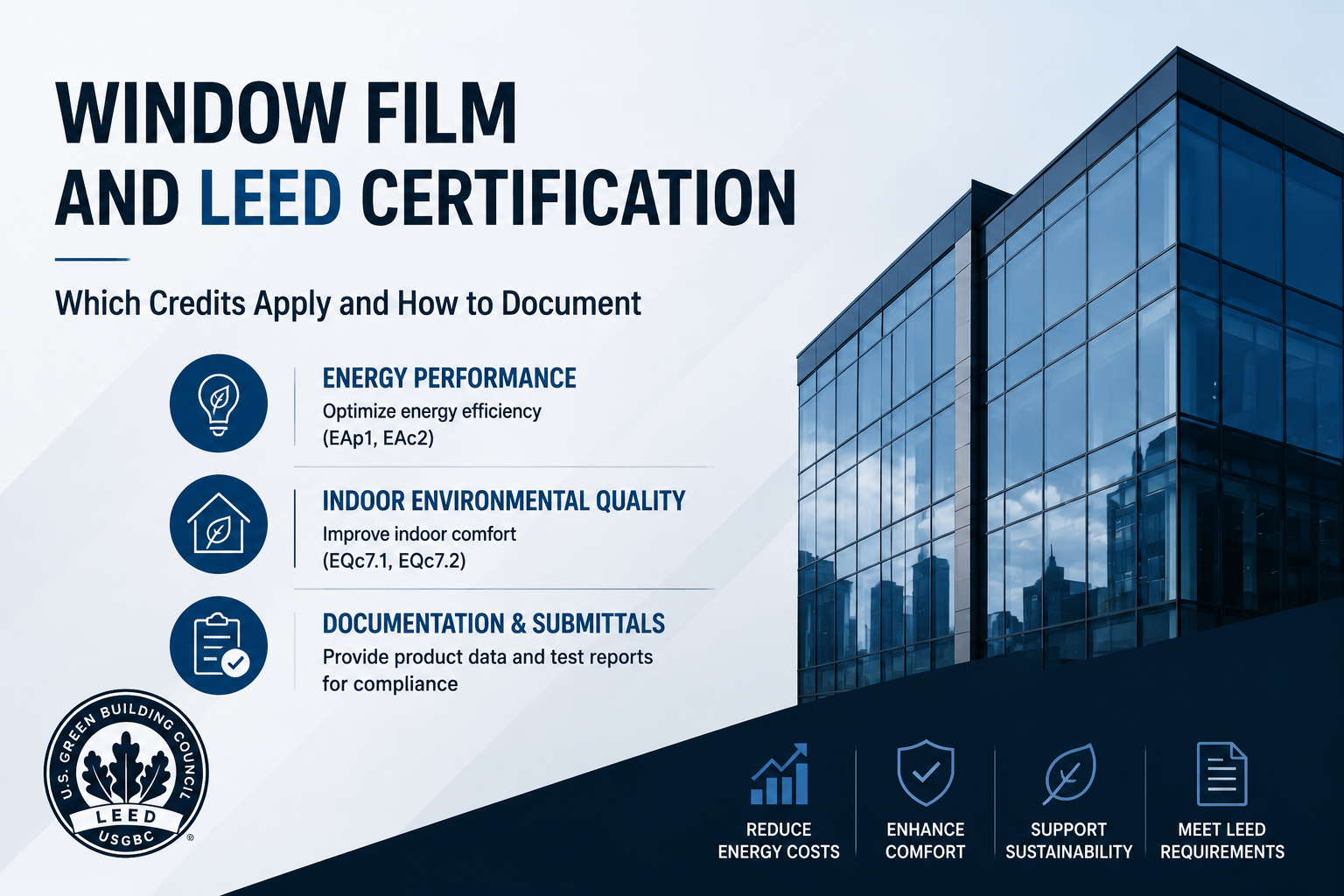
LEED credits supported by architectural window film.
LEED is increasingly relevant to commercial window film decisions — partly because more buildings are pursuing certification, and partly because the glazing performance improvements achievable from solar control film genuinely contribute to LEED credits in ways that building owners are starting to document and claim.
The practical question for a building owner or specifier isn’t whether window film can contribute to LEED — it can — but specifically which credits apply, what documentation is required, and whether the contribution is material enough to justify the additional specification effort.
This guide answers those questions directly.
The LEED Framework Relevant to Window Film
LEED has several rating systems. The two most relevant for window film are:
LEED BD+C (Building Design and Construction): For new buildings or major renovations. Film specified in new construction contributes to energy and indoor environment credits.
LEED O+M (Operations and Maintenance): For existing buildings under ongoing operation. Film retrofitted to an existing building can contribute to O+M credits — this is the more common scenario for commercial building owners adding film to an existing certified or certification-pursuing building.
Credit Category 1: Energy and Atmosphere — Optimise Energy Performance
What it is: LEED EA Credit “Optimize Energy Performance” awards points based on the percentage improvement in building energy performance compared to a baseline.
How window film contributes: Solar control film reduces solar heat gain coefficient (SHGC) of the glazing system, which directly reduces cooling energy consumption. This improvement is modelled in the building’s energy simulation (EnergyPlus, eQUEST, or similar) as part of the whole-building energy performance calculation.
What’s required:
NFRC-certified SHGC data for the film-glass system installed (not just the film alone)
Whole-building energy model showing pre- and post-film energy performance
Licensed energy modeller to run the simulation (this is a professional service — not a DIY calculation)
Contribution level: Window film is typically one of several energy improvement measures contributing to this credit. On buildings with significant glazing, it can contribute 1–3% building energy reduction — a meaningful contribution to a credit that awards points on a sliding scale.
Thermal Comfort (EQ Credit): LEED awards credit for achieving ASHRAE 55 thermal comfort conditions. Solar control film that reduces radiant heat asymmetry near glazing — the uncomfortable “warm side” feeling near sun-exposed glass — contributes to thermal comfort compliance. This requires thermal comfort analysis demonstrating compliance at representative measurement points.
Daylight (EQ Credit): Solar control film that maintains or improves useful daylight illuminance (UDI) while reducing glare — specifically spectrally selective film at high VLT that achieves solar rejection without significantly reducing daylight — can contribute to daylighting credits. This requires daylight simulation (using tools like Radiance or Daysim) showing compliance with UDI thresholds.
Glare Control (EQ Credit): Annual sunlight exposure (ASE) and spatial daylight autonomy (sDA) are the LEED metrics. Film that reduces ASE (excessive sun exposure on work surfaces) by reducing direct beam transmission contributes to glare control compliance.
Credit Category 3: Materials and Resources (LEED BD+C)
Envelope Performance: In some LEED BD+C frameworks, specifying solar control film as part of a building envelope performance strategy can contribute to materials efficiency credits if it reduces the need for other shade elements (external shading structures, motorised blinds systems). This is project-specific and requires a qualified LEED consultant to evaluate.
BREEAM: The European/UK Framework
BREEAM awards credits in categories that overlap with LEED but use different methodologies:
Energy (Ene 01): Energy efficiency improvement credits work similarly to LEED EA. Solar control film improving SHGC contributes to the building’s energy performance calculation.
Health and Wellbeing (Hea 01 — Visual Comfort): BREEAM requires adequate daylighting levels and glare control in occupied spaces. Film that manages glare while maintaining daylight quality (spectrally selective products) contributes to Hea 01 compliance.
The Documentation Package
For any LEED or BREEAM credit claim supported by window film, the documentation package typically includes:
1. Product Performance Data
NFRC simulation report or certified test report showing SHGC, VLT, U-factor for the glass-film system
The report must be for the specific film product installed on the specific glass type (not a generic range certificate)
KSB Window Film provides NFRC-referenced data for our architectural range at specified glass types
Radiant heat analysis at representative measurement points near glazing
Compliance demonstration against ASHRAE 55 thresholds
Is the Documentation Effort Worth It?
For a building that’s actively pursuing LEED certification: yes. The documentation process adds cost (primarily in energy modelling fees — $5,000–$15,000 for a commercial building), but window film’s energy contribution is real and the credits are legitimate.
For a building that isn’t pursuing formal certification: the energy savings are real regardless of documentation, and the LEED framework provides a useful structured approach to demonstrating ROI to building owners and boards.
FAQ
Can a LEED certification be upgraded (e.g., Silver to Gold) by adding window film to an existing certified building?
Through LEED O+M re-certification, yes. If an existing LEED-certified building undergoes performance improvement — including window film retrofit contributing to measurable energy reduction — the re-certification process can reflect this in an upgraded rating. This requires full re-certification documentation and is typically pursued when the building is up for performance review.
Does window film on its own get LEED points?
No — LEED credits are awarded for whole-building performance against thresholds, not for individual measures. Window film contributes to credit compliance; it doesn’t independently earn credits. The certification is based on total building performance across all categories.
What’s the NFRC certification process for window film?
NFRC certification involves computer simulation of the film-glass system using validated optical properties, conducted by a licensed NFRC simulation laboratory. The result is a Certified Products Directory entry showing SHGC, VLT, and U-factor for the specific film product on a specified glass type. Not all manufacturers pursue NFRC certification — it’s worth verifying. KSB Window Film maintains NFRC-referenced data for our architectural film range.
Get LEED-Ready Documentation for Your Film Project
KSB Window Film provides NFRC-referenced SHGC, VLT, and system performance data — the documentation inputs required for LEED energy and indoor quality credit submissions. We can connect you with qualified energy modellers in your market who provide the whole-building simulation component.