Published: July 23, 2026 · 8 min read · Category: Industry Insights
About this article: KSB Window Film holds ISO 14001 environmental management certification and can supply NFRC-referenced performance data to support green building specifications. The sustainability analysis here reflects both our own manufacturing practices and what institutional buyers are actually requesting from suppliers.
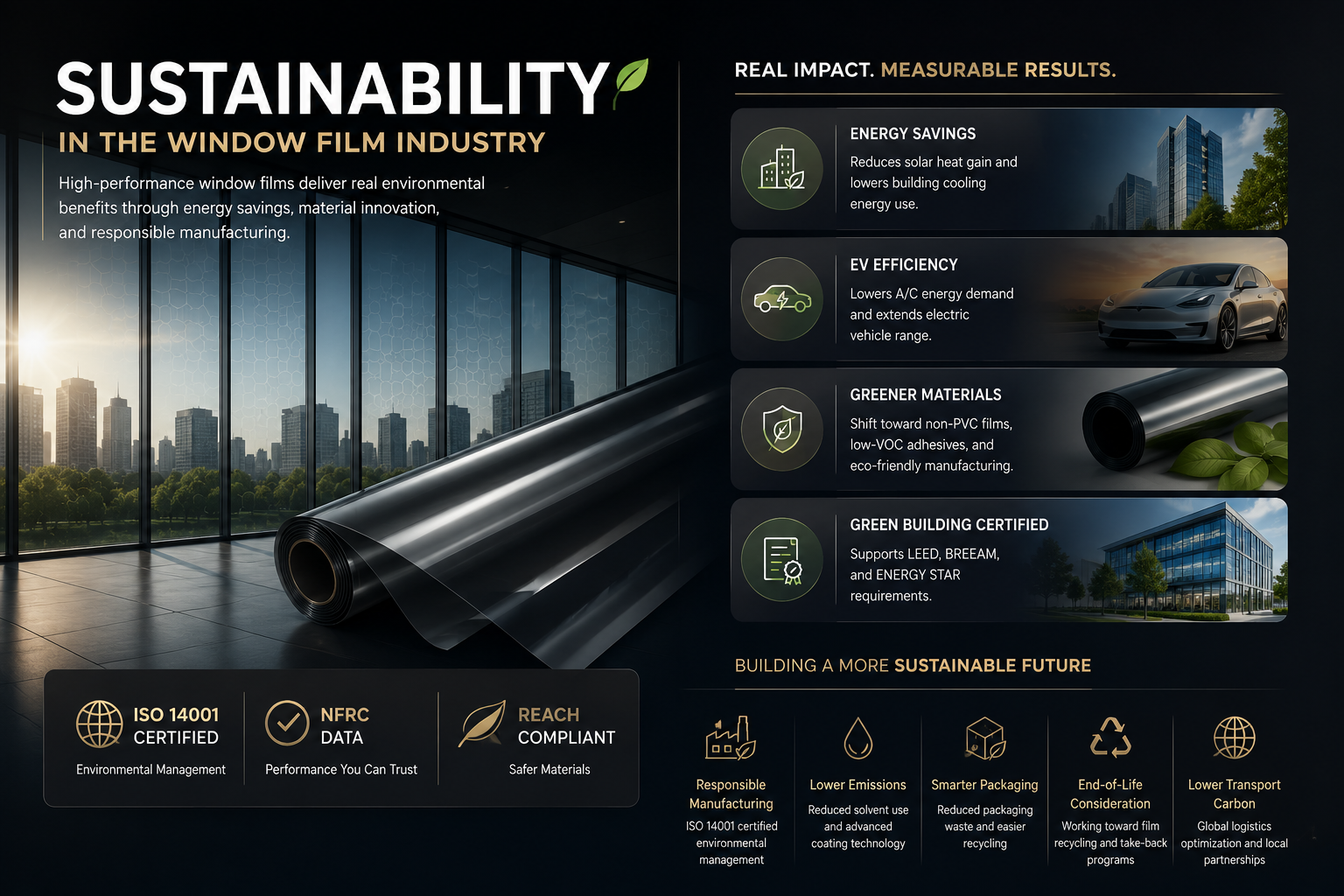
Professional sustainability infographic highlighting energy-saving window film technology, environmental certifications, and eco-friendly manufacturing practices
The window film industry has a legitimate sustainability story to tell and hasn’t told it very well. The conversation in most buyer interactions is still about heat rejection, VLT, and price — and the energy and emissions benefits of solar control film rarely make it into the room.
That’s starting to change, driven by two forces: institutional buyers who now require sustainability documentation as part of procurement processes, and a growing body of evidence that high-performance window film on buildings and vehicles does exactly what the sustainability pitch claims it does.
This article covers where the sustainability story is real, where it’s marketing, and what the industry is actually doing to improve its environmental footprint.
The Real Sustainability Argument for Solar Control Film
Energy Reduction in Buildings
The strongest sustainability case for window film is in commercial buildings. Windows are the most thermally inefficient element of a building envelope — the U-value of typical commercial glazing is 5–6 times worse than an insulated wall. In climates with significant cooling loads, solar heat gain through windows is a major driver of A/C energy consumption.
High-performance solar control film — particularly nano ceramic with TSER above 60% — reduces the solar heat gain through existing windows without replacing them. The energy saved in cooling load reduction over a year of operation is quantifiable, and the carbon emission savings from that energy reduction are real.
Studies from the International Window Film Association, Lawrence Berkeley National Laboratory, and independent engineering assessments consistently show payback periods of 3–7 years for commercial window film projects based on energy savings alone — before accounting for improved occupant comfort and UV protection of interior assets.
This is the argument that belongs in every commercial specification conversation. It’s also the argument that gets window film specified into green building frameworks like LEED and BREEAM, where improved glazing performance contributes to energy performance credits.
EV Range Extension
As covered in Top Automotive Window Film Trends for 2026, high-TSER film on electric vehicles reduces A/C energy demand, which extends range. For a fleet of commercial EVs, this is quantifiable in both kWh and carbon terms over a year of operation. This is a sustainability argument with numbers that procurement teams can put in a report.
Extending Building Asset Life
UV radiation degrades interior materials — furniture, flooring, artwork, retail merchandise. Film that blocks 99%+ UV extends the useful life of these materials. While harder to quantify in carbon terms, reducing the frequency of interior refurbishment has a real embodied carbon impact on building lifecycle assessments.
Where the Industry Needs to Improve
PVC Film Is Still Being Sold
PVC window film — the lower-quality alternative to TPU in PPF, and still present in some window film categories — has genuine environmental issues. PVC production involves chlorine chemistry, and PVC end-of-life disposal creates dioxin concerns in incineration. The industry’s shift toward PET-based and TPU-based products is an environmental positive, but PVC hasn’t disappeared from the market entirely.
Buyers asking sustainability questions should specifically ask about film base chemistry. PET (polyethylene terephthalate) is more recyclable and has a cleaner production chemistry than PVC. This is worth asking about in supplier conversations.
Adhesive Chemistry
The pressure-sensitive adhesives used in window film typically contain solvents and chemical crosslinkers. Premium manufacturers have been moving toward lower-VOC adhesive formulations, and some have adopted water-based adhesive systems. This is a genuine improvement in manufacturing environmental impact, though it’s rarely communicated in product marketing.
End-of-Life Film
Window film that’s removed from buildings or vehicles at end-of-service-life typically goes to landfill. The multi-layer laminate construction (PET + functional coatings + adhesive + release liner) makes separation for recycling technically difficult. Some manufacturers are beginning to develop take-back and recycling programs, particularly for large commercial project quantities. This remains an area where the industry has work to do.
Transport Carbon
The carbon footprint of shipping window film from Chinese manufacturers to global markets is meaningful. A container of window film from Guangdong to Rotterdam carries a shipping carbon cost that should appear in lifecycle assessments for building projects seeking LEED certification.
Local manufacturing sourcing reduces this footprint but comes with higher product cost. Some institutional buyers are beginning to apply country-of-manufacture carbon penalties in procurement scoring, which creates a modest advantage for locally produced film in regulated markets.
Green Building Certification and Window Film
Window film’s place in formal green building frameworks has been growing.
LEED (Leadership in Energy and Environmental Design): Window film can contribute to LEED credits under Energy and Atmosphere (improved energy performance from reduced solar gain) and Materials and Resources (extended life of existing materials). LEED documentation typically requires NFRC-certified performance data.
BREEAM (Building Research Establishment Environmental Assessment Method): Similar to LEED, BREEAM credits for energy efficiency and daylighting can be supported by window film specifications with appropriate performance documentation.
ENERGY STAR: The EPA’s ENERGY STAR program for commercial buildings includes window film in the toolkit for energy efficiency improvements.
For distributors targeting commercial building customers, the ability to provide NFRC certification, SHGC data, and LEED-ready documentation alongside product supply is a meaningful differentiator. Manufacturers who’ve invested in this certification infrastructure capture commercial specification projects that product-only suppliers miss.
What Manufacturers Are Actually Doing on Sustainability
ISO 14001 Environmental Management: A growing number of serious Chinese film manufacturers have pursued ISO 14001 alongside ISO 9001. The environmental management certification demonstrates systematic tracking and reduction of environmental impact in production — energy use, waste generation, chemical handling.
Reduced solvent use in production: Premium manufacturers have been reducing solvent-based coating processes in favor of UV-curable formulations that eliminate most solvent emissions. This is both an environmental and a regulatory compliance improvement (increasingly strict VOC regulations in China and elsewhere).
Energy efficiency in manufacturing: Magnetron sputtering and UV curing systems consume significant electricity. Manufacturers who’ve invested in energy monitoring and reduction programs can demonstrate a lower production carbon footprint — which matters to institutional buyers with Scope 3 emissions commitments.
Packaging reduction: Some manufacturers have reduced packaging weight and switched from mixed-material packaging to single-material options that are easier to recycle. Not glamorous, but cumulatively meaningful across millions of rolls shipped annually.
FAQ
Can window film installation genuinely contribute to building LEED certification?
Yes, specifically through the Energy and Atmosphere credit category for improved energy performance, and potentially through daylighting credits where film manages solar gain while maintaining visible light transmission. Documentation requirements include NFRC-certified SHGC data for the specific film installed.
Is there a significant carbon footprint difference between Chinese and locally manufactured window film?
Transport carbon from Chinese manufacturing to global markets is real and quantifiable. For a typical commercial project, the shipping carbon associated with Chinese-produced film might add 5–15% to the lifecycle carbon footprint compared to locally produced alternatives. This is meaningful in rigorous lifecycle assessments but not necessarily decision-changing compared to the embodied carbon of the glass being protected.
What should I ask a manufacturer about their environmental practices?
Specific questions: Do you have ISO 14001 certification? What are your VOC emission levels in coating operations? What is your adhesive formulation — solvent-based or UV-cured? Do you have a packaging reduction program? Can you provide an environmental product declaration (EPD) for your products? The answers reveal whether sustainability is substantive or marketing.
Does nano ceramic film have a different environmental footprint than carbon or dyed film?
The manufacturing energy intensity of nano ceramic is higher (sputtering processes consume significant electricity). The environmental payback through energy savings over the product’s service life is also higher. A full lifecycle assessment would need to compare manufacturing footprint against operational energy benefits — and for building applications with long service lives, the operational benefits typically dwarf the manufacturing footprint difference.
Get Sustainability Documentation That Supports Your Specifications
KSB Window Film can provide ISO 14001 certification, REACH compliance documentation, and NFRC-referenced energy performance data to support LEED, BREEAM, or institutional procurement requirements.
If your commercial or government buyer needs sustainability credentials alongside product performance specs, contact our export team — we have the documentation infrastructure in place.