Published: June 24, 2026 · 8 min read · Category: PPF Sourcing
About this article: KSB Window Film handles hundreds of PPF buyer enquiries annually across North America, Europe, the Middle East, and Asia-Pacific. The questions that separate buyers who build successful supply relationships from those who don’t are consistent — this guide documents them.
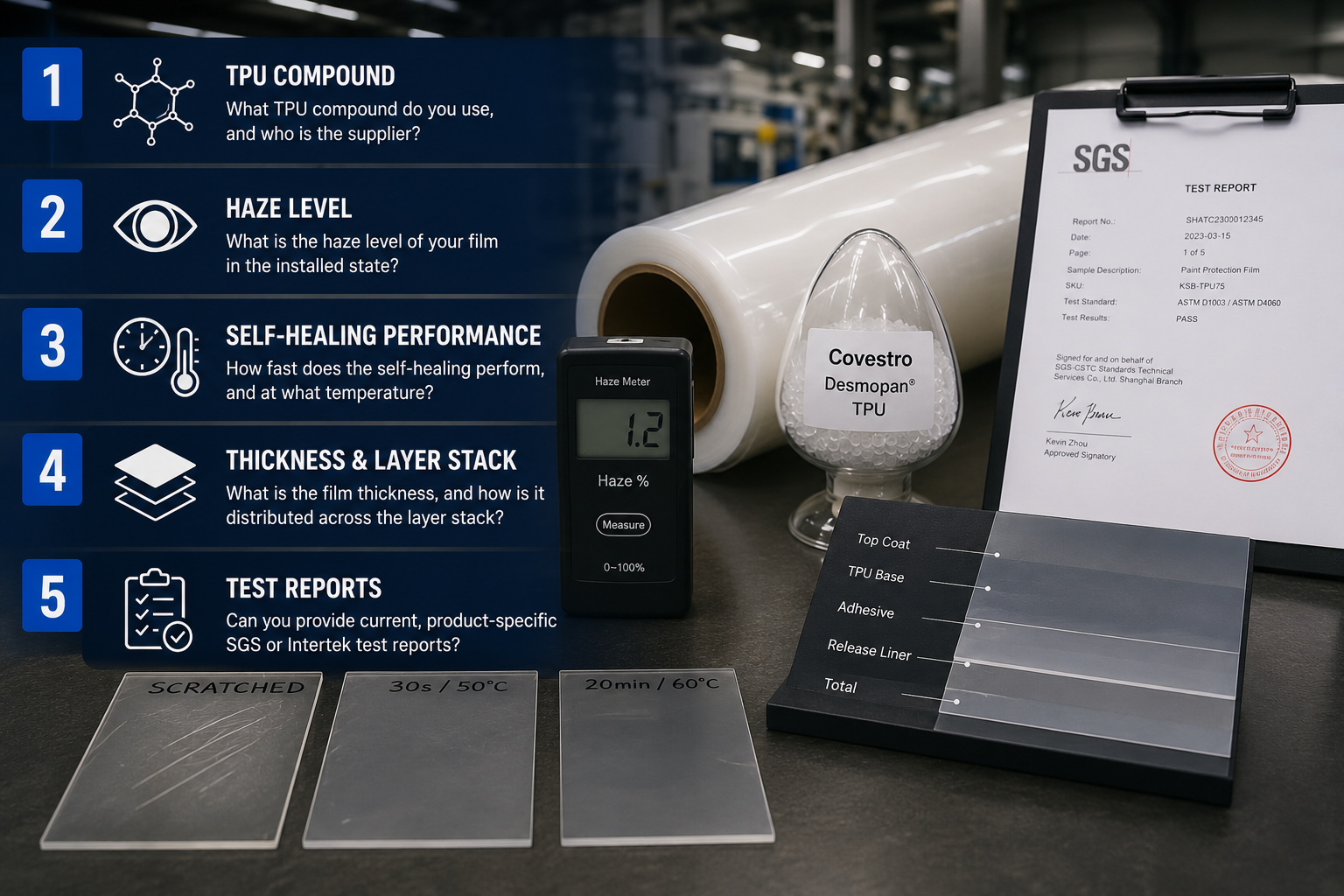
Professional PPF manufacturer quality inspection including TPU material verification, haze testing, self-healing evaluation, and SGS certification reports.
Good supplier conversations aren’t interrogations. They’re a structured way of surfacing the information that doesn’t appear in a product catalog — whether the factory can actually produce what they’re selling, whether they’ve shipped to your market before, and whether the relationship will hold when something goes wrong.
These are the questions worth asking. More importantly, this guide explains what specific answers you should expect — and which answers should give you pause.
About the Product
“What TPU compound do you use, and who is the supplier?”
The answer you want: a specific compound grade from a named supplier — Covestro, Huntsman, Lubrizol, or equivalent-quality domestic Chinese suppliers. The answer that should concern you: “high quality TPU” with no supplier name, or hesitation before a vague answer. A manufacturer who doesn’t know their own material inputs isn’t controlling their product quality.
“What is the haze level of your film in the installed state?”
The answer you want: a specific percentage backed by a test report. Premium film: below 1.5% haze. Acceptable mid-range: 2–4%. Above 5%: visibly hazy on installation — not appropriate for premium vehicle applications. Vague answers like “optically clear” without a number are not acceptable for a specification decision.
“How fast does the self-healing perform, and at what temperature?”
The answer you want: specific conditions — e.g., “fine fingernail scratches heal within 20 minutes in direct summer sun (60°C surface temperature)” or “full heal in 30 seconds with warm water at 50°C.” The answer that should concern you: “self-healing” with no temperature or time reference, or claims of healing at room temperature with no qualification (room temperature varies from 15°C to 35°C — an enormous performance range).
“What is the film thickness, and how is it distributed across the layer stack?”
Total thickness is commonly stated. What matters is how it’s distributed: how much is TPU base, how much is top coat, how much is adhesive. Two films both listed at 7.5 mil can have very different TPU content if one has a thick adhesive layer and thin TPU, and another has thin adhesive and thick TPU. Ask for the layer breakdown.
“Can you provide current, product-specific SGS or Intertek test reports?”
The answer you want: test reports dated within 12–18 months, naming the specific SKU, with the test standard referenced (not an internal methodology). The answer that should concern you: test reports for a different product in the series, undated reports, reports from unaccredited labs, or reports that don’t specify the test standard.
About the Manufacturing Process
“Can you show me your production facility — on a live video call or in person?”
A manufacturer with nothing to hide says yes without hesitation. What you’re looking for: production equipment (extruder, coating line, lamination line, slitting), a QC lab, and general facility organisation. See PPF Factory Audit Checklist for Importers and Distributors for what to look for specifically.
A supplier who declines, offers only pre-recorded video, or has multiple reasons why “now isn’t a good time” is telling you something.
“What is your incoming material inspection process for TPU and adhesive?”
The answer you want: specific tests run on each incoming batch — thickness, optical clarity, adhesive viscosity or peel strength — with documentation. The answer that concerns you: “we trust our suppliers” without any verification process.
“Can you provide batch records for a recent production run?”
A manufacturer with a functioning quality system can pull batch records within minutes — raw material lot numbers, process parameters, QC test results for the run. One who can’t either doesn’t have records or doesn’t want you to see them.
About Commercial Terms
“What is your standard payment term for first-time buyers, and how does it change with relationship history?”
Standard: 30% deposit, 70% before shipment. This is reasonable and appropriate. Some manufacturers offer 50/50. Better terms (net-30 after delivery) become available after track record is established. A manufacturer requiring 100% advance for all orders, with no path to improved terms, is either dealing with a lot of disputes or doesn’t have confidence in their own product.
“What is your MOQ for the specific SKU I’m interested in, and is that different for custom or branded product?”
Get the actual number, not a range. And understand that MOQ for stock product vs. OEM development vs. private label packaging may all be different. See What Is the MOQ for OEM PPF Orders? for a detailed breakdown.
“What happens if the product doesn’t match spec when I receive it?”
The answer you want: a clear process — documentation requirements, response timeline, resolution options (replacement, credit, partial refund). The answer that concerns you: vague assurances that “this never happens,” deflection to quality control claims, or no clear process.
About Export and Market Compliance
“Have you shipped to [your target market] before? Can you walk me through the documentation for that market?”
A manufacturer with genuine export experience to your market answers fluently — CE marking documentation for EU, FTC labeling for US, ESMA for UAE, and so on. One who’s never shipped there will either give incorrect information or ask you to tell them what’s required.
“What HS code do you ship PPF under, and are you familiar with the current import duty situation for that code in [your market]?”
Relevant for US buyers especially (Section 301 tariffs affect Chinese goods including PPF). A manufacturer who understands the tariff environment your orders will face is a more capable logistics partner than one who doesn’t.
About the Relationship
“Can you give me references from buyers in similar markets who I can contact?”
Not testimonials — actual buyer contact details. Most established exporters have clients who’ll take a reference call. A manufacturer who can’t or won’t provide references either doesn’t have satisfied long-term clients or doesn’t trust the quality of those relationships.
“Who is my day-to-day contact after the sale is made?”
The sales rep who closes the deal is rarely the person managing your orders, answering quality questions, and tracking your shipments. Meet the account manager who will actually service your account. How responsive they are in the evaluation process predicts how responsive they’ll be when you have an urgent issue.
FAQ
What if a manufacturer refuses to answer some of these questions?
Take it seriously. Legitimate manufacturers may have good reasons for protecting specific formulation details, but they shouldn’t have any reason to decline questions about their TPU supplier, their test reports, or their quality process. Refusals in those areas indicate something worth knowing.
Should I ask these questions via email or on a call?
Both. Emailed questions get documented answers you can refer back to. Call conversations reveal how quickly and confidently the person responds — hesitation and deflection are harder to hide in spoken conversation than in prepared written answers.
Can I ask these questions through an agent or intermediary?
Yes, but verify through direct channels too. An agent who filters your questions or provides answers without direct factory confirmation is a layer of opacity you don’t need.
Ask KSB These Questions — We’ll Answer All of Them
KSB Window Film gives straightforward answers to every question in this guide. TPU supplier, test reports, batch records, references, export documentation for your market — all available.