Published: June 16, 2026 · 9 min read · Category: Sourcing Guide
A factory that looks good on paper and performs well on the first order is not the same as a factory that will still be delivering consistent quality on your 20th order, two years from now.
The audit process is how you tell the difference — not perfectly, and not without judgment, but systematically enough that you’re not flying blind when you place a container order.
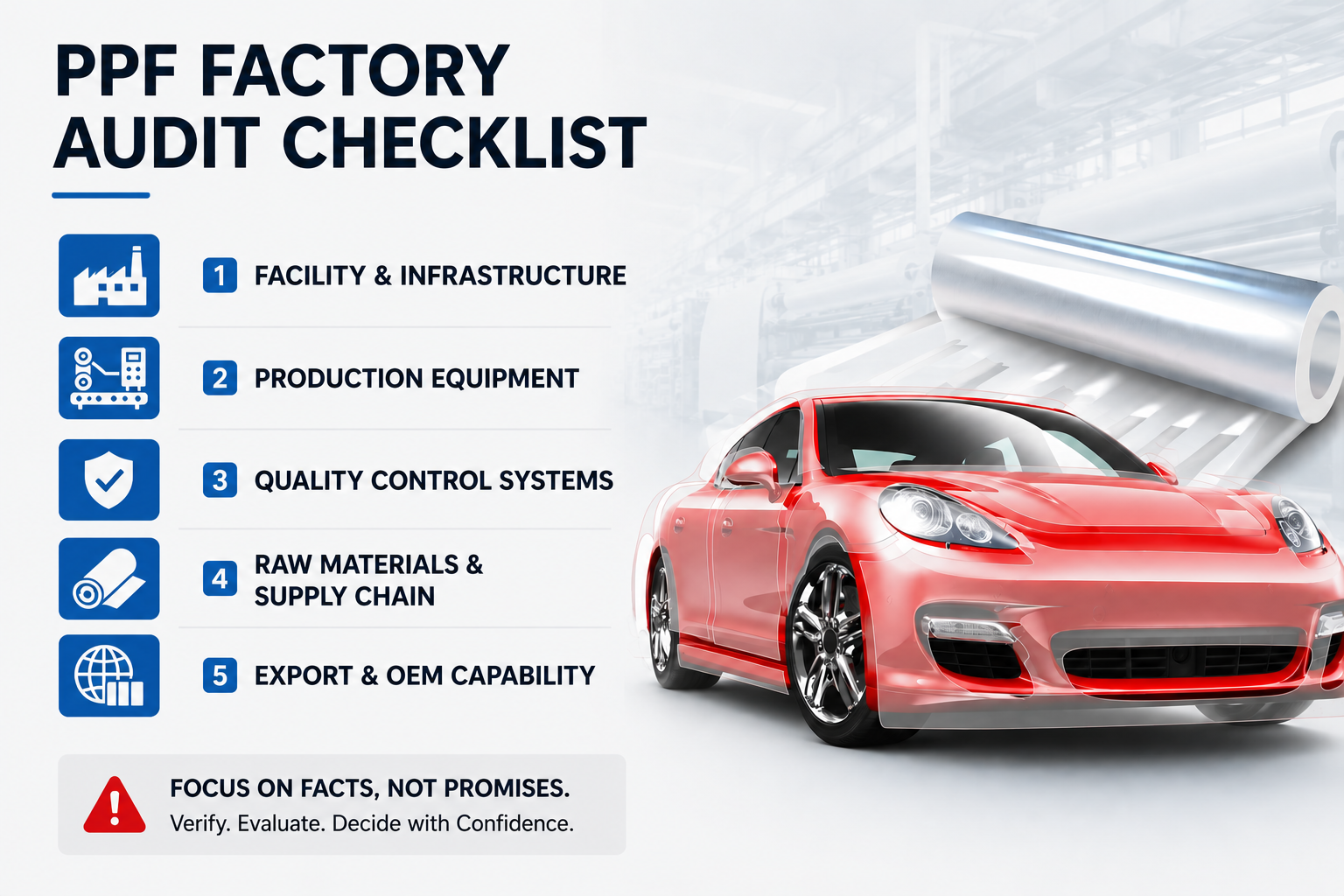
This checklist is built specifically for PPF buyers evaluating Chinese manufacturers. It covers the questions that matter and explains why each one matters — so you’re having a real conversation at the factory, not working through a bureaucratic tick-list.
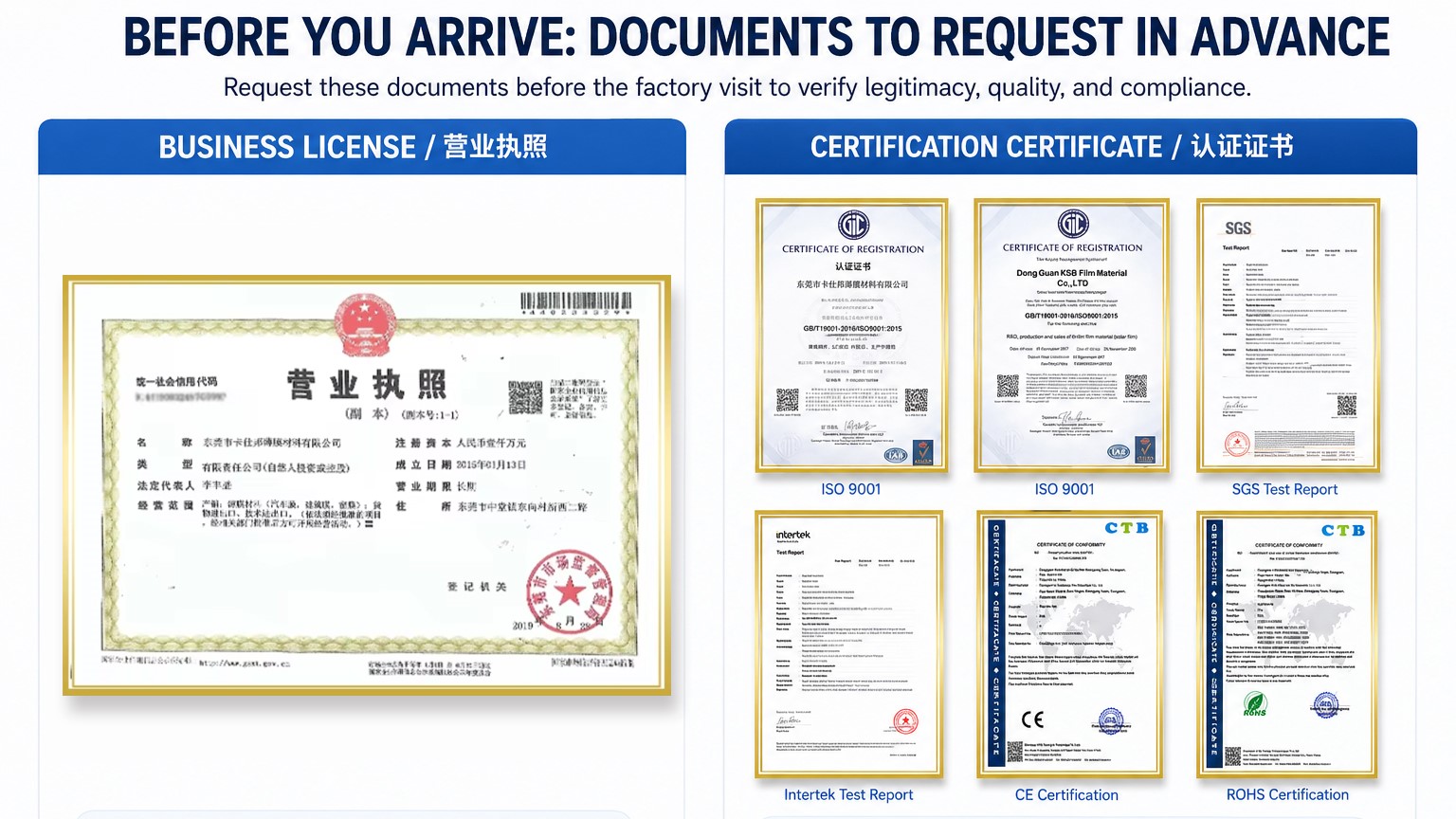
Before You Arrive: Documents to Request in Advance
Requesting documents before the visit serves two purposes. It tells you what to focus on when you arrive, and the quality of what you receive tells you something about how organized the operation actually is.
Request these before the visit:
Business license (营业执照): Verify that the registered business scope includes manufacturing (生产/制造/加工) rather than just trading (贸易/销售). A factory whose business license only covers trading is, legally, a trading company. Also check the registration date — how long have they been operating under this registration?
ISO 9001 certificate: Note the issuing certification body (CB), the certificate number, the scope statement, and the expiry date. Verify the CB is IAF-accredited before the visit (iaf.nu). Verify the certificate number on the CB’s website. A certificate that can’t be independently verified is worthless.
SGS or Intertek test reports for the specific products you’re considering: Product-specific, dated within the last 18 months, with methodology specified. If they send you a generic range certificate or a report from 2021, ask for the current product-specific version. The test report is the primary evidence that the product performs as claimed.
Material safety data sheets (MSDS/SDS): For TPU compound, adhesive, and top coat materials. These confirm the material classes being used and provide a baseline for compliance assessments in regulated markets.
Section 1: Facility and Infrastructure
The physical facility tells you whether the claimed production capability is plausible before you’ve asked a single question.
1.1 Does the facility footprint match the claimed production volume?
A manufacturer claiming to produce 500,000 square meters of PPF per month needs warehouse space for raw material storage, a production floor with coating and lamination lines, finished goods storage, and QC lab space — at minimum, several thousand square meters. A 1,000 sqm building cannot house all of this. If the facility is dramatically undersized for the stated capacity, the numbers are wrong somewhere.
1.2 Is the facility in an appropriate industrial location?
Manufacturing operations require industrial infrastructure: three-phase power, industrial water access, loading docks for inbound raw materials and outbound finished goods, adequate ceiling height for roll handling. A facility in a commercial office building or a light industrial unit that doesn’t fit this profile is not a serious manufacturer.
1.3 Is raw material storage visible and organized?
Look for TPU pellets or film rolls in clearly labeled, organized storage conditions. Climate control for TPU raw material storage is a positive sign — TPU is hygroscopic and requires controlled humidity storage to prevent moisture-related defects during processing. Disorganized or unconditioned storage suggests less attention to process quality.
Section 2: Production Equipment
This section is where you confirm whether the factory can actually make what it claims to make.
2.1 For manufacturers claiming to produce TPU base film: is there extrusion equipment?
A cast film extrusion line for TPU is unmistakable — an extruder barrel (typically 1–3 meters long), a flat die, a polished casting drum, and a series of takeoff rollers. This equipment cannot be hidden or faked. If a manufacturer claims to produce TPU film but there’s no extrusion equipment, they’re sourcing base film from elsewhere. This isn’t necessarily disqualifying, but it changes what you’re dealing with.
2.2 Is there precision top coat coating equipment?
Look for slot-die coaters or equivalent precision coating heads with associated delivery systems (pumps, metering systems), drying or curing equipment (UV lamps or thermal ovens downstream of the coating head), and web tension control systems. Ask the production manager to walk you through the coating line and explain the process. Competence in answering questions about their own equipment indicates genuine operational knowledge.
2.3 Is there adhesive lamination equipment?
Nip roller lamination systems for applying adhesive or laminating film layers. Confirm whether adhesive is applied by direct coating or transfer lamination — both are valid, but the answer tells you about their process.
2.4 What is the clean room or clean environment status of the coating area?
PPF production is contamination-sensitive. Dust particles embedded in the top coat or adhesive create visible inclusions in the finished film — and optical defects are immediately apparent in an installed PPF product. A factory with no controlled environment around the coating operation is producing film in conditions that allow contamination. Ask about their contamination control practices specifically.
2.5 Is there slitting equipment?
Precision slitting lines with appropriate blade management. Ask how often blades are replaced and how edge quality is verified. Ragged slit edges are a common complaint about budget PPF and a direct indicator of inadequate slitting maintenance.
Section 3: Quality Control Systems
A production line without QC is a line that produces whatever it produces and hopes for the best.
3.1 Is there an in-house QC laboratory?
The QC lab should contain functional testing equipment, not just product displays. For PPF, relevant equipment includes:
- Haze meter (optical clarity testing)
- Spectrophotometer (transmittance measurement)
- Adhesion/peel strength testing equipment
- Environmental chamber for accelerated aging (thermal cycling, UV exposure)
- Self-healing test setup (controlled scratch application and heat recovery assessment)
Ask the QC manager to demonstrate testing on a current production sample. A functioning lab where staff can run tests is different from a lab that exists for factory visits.
3.2 Are there incoming inspection procedures and records?
Request to see incoming inspection records for recent raw material deliveries — TPU pellets or base film, adhesive, top coat materials. What parameters are checked? What happens when incoming material fails spec? Is there a quarantine area for non-conforming material?
3.3 Are there in-process monitoring and control systems?
During production, what is being monitored and how frequently? Inline optical inspection systems, tension monitoring, UV cure energy monitoring. If all QC happens at the end of the line, they’re sorting defects rather than preventing them.
3.4 Can they produce batch records for specific historical production lots?
Ask them to pull the production records for a recent shipment — any shipment. The records should show: which raw material lots were used, what process parameters were run, what in-process measurements were taken, what finished goods testing results were achieved. A factory with a functioning documentation system can do this within minutes. One that can’t is either not documenting or not organized enough to retrieve records.
3.5 How is non-conforming product handled?
Ask to see a recent Non-Conformance Report (NCR) — documentation of a quality failure and what was done about it. Every factory with real production has quality failures. A factory that claims zero failures either isn’t testing seriously or isn’t being honest. An NCR that includes root cause analysis and corrective action is evidence of a functioning quality system.
Section 4: Raw Materials and Supply Chain
4.1 Who is the TPU compound or base film supplier?
A manufacturer using Covestro, Huntsman, Lubrizol, or equivalent documented-grade TPU is making a deliberate quality decision. One using unspecified domestic TPU cannot provide the same performance consistency. Get a specific answer — brand name and grade if possible.
4.2 Who is the adhesive supplier?
Similarly, quality adhesive compounds come from recognized suppliers. If the factory can’t name their adhesive source, they may be using whatever is cheapest at the time, which creates batch-to-batch variability in installation behavior.
4.3 What are the top coat raw material sources?
Top coat chemistry is legitimately proprietary, but the factory should be able to describe the general chemistry class (polyurethane, acrylic-urethane) and confirm they source from consistent, named suppliers rather than spot-buying on price.
Section 5: Export Capability and Track Record
5.1 Which markets are they currently exporting to?
A manufacturer with active exports to your target market (US, EU, Australia, Middle East) has navigated the compliance requirements, documentation needs, and logistics for that lane. First-time exporters to your market are a higher-risk proposition.
5.2 Can they show recent export documentation?
A bill of lading, packing list, or export declaration from a recent shipment confirms they’re actually shipping product, not just presenting capabilities. Ask to see documentation from a recent overseas order (with buyer identity redacted if needed).
5.3 Do they understand the regulatory requirements for your target market?
Ask specifically about the documentation requirements for your market — REACH compliance for EU, FTC labeling requirements for US, ESMA for UAE, etc. A manufacturer with genuine export experience to your market will answer fluently. One who’s never shipped there will give vague or incorrect answers.
Section 6: OEM and Commercial Capability
6.1 What is their OEM program structure?
If you’re planning to source under your own brand, understand the program: minimum volumes per SKU, exclusivity terms, development timeline for custom specifications, packaging options, and how they handle brand asset management.
6.2 Can you speak to their account manager or export sales team directly?
The person managing your account post-order is more important to the day-to-day relationship than the factory owner who hosts the audit visit. If you’re planning a significant sourcing relationship, meeting the actual account manager during the visit is a worthwhile investment.
6.3 Can they provide references from international buyers in similar markets?
Ask for contact details for two or three existing international clients — not testimonials, actual references you can call. The willingness to provide them, and the quality of what those references say, tells you a lot about how the factory performs outside the controlled environment of an audit visit.
Red Flags Summary
Audit red flags that should give you serious pause:
- Business scope covers only trading, not manufacturing — regardless of what they tell you
- No extrusion equipment for a manufacturer claiming to produce TPU base film
- No coating or lamination equipment visible on the production floor
- QC lab with no functional testing equipment, or equipment that staff can’t demonstrate
- Unable to produce batch records for recent production
- Incoming material stored without climate control, or without labeling/traceability
- Zero Non-Conformance Reports in recent history
- Unable to name their TPU or adhesive suppliers specifically
- No export documentation for claimed international sales
- Reluctance to answer specific process questions — deflection or redirection rather than operational detail
A factory with two or three of these flags has given you clear reasons to keep looking.
FAQ
1. What documents should I request before auditing a PPF factory?
You should request the business license, ISO 9001 certificate, SGS or Intertek test reports, and SDS/MSDS documents before visiting the factory.
2. How can I verify if a PPF factory is a real manufacturer?
Check whether the factory has TPU extrusion lines, coating equipment, lamination machines, and a functional QC laboratory instead of only packaging or trading facilities.
3. Why is TPU supplier information important in a PPF factory audit?
The TPU supplier directly affects film clarity, durability, yellowing resistance, and self-healing performance. Premium TPU suppliers usually provide more stable quality.
4. What quality control equipment should a professional PPF factory have?
A reliable PPF factory should have haze meters, spectrophotometers, peel strength testers, UV aging chambers, and self-healing testing equipment.
5. What are the biggest red flags during a PPF factory audit?
Major warning signs include no extrusion equipment, poor raw material storage, missing batch records, fake certifications, unclear TPU sources, and lack of export documentation.
Planning a factory visit and want a second set of eyes on your evaluation? Contact us — we help importers and distributors assess PPF manufacturers against consistent, practical criteria before they commit.
Further Reading
On this site:
- Best Paint Protection Film Manufacturer in China (2026 Guide) — Manufacturer shortlist to evaluate against this checklist
- How to Verify a Window Film Factory Before Placing an Order — Comprehensive pre-visit verification methodology
- How Paint Protection Film Is Manufactured — Understanding production equipment before the factory visit
- What Certifications Should a Window Film Manufacturer Have? — Certification verification framework directly applicable to PPF
- Window Film Factory Audit Checklist — Parallel checklist for window film manufacturer audits
External:
- SGS Factory Audit Services — Commission a third-party audit if you can’t visit in person
- Bureau Veritas Supplier Audits — Alternative third-party audit service widely used for China supply chain
- QIMA Factory Audits — Tech-enabled audit platform with China operations
- IAF Accreditation Database — Verify ISO certification body accreditation before the visit
- China Enterprise Credit System — Official business registration lookup for pre-visit document verification
Get a Free Sample or Quote
Looking for a reliable window film supplier? Contact us today for fast response and professional support.