Published: June 2026 · 13 min read · Category: Smart Film
About this article: KSB Window Film makes PDLC smart film for architectural and specialist use. We export to installers and distributors in 60+ countries. Smart film is one of the most genuinely interesting products in the glazing world — and one of the most misunderstood. This guide covers both sides honestly.
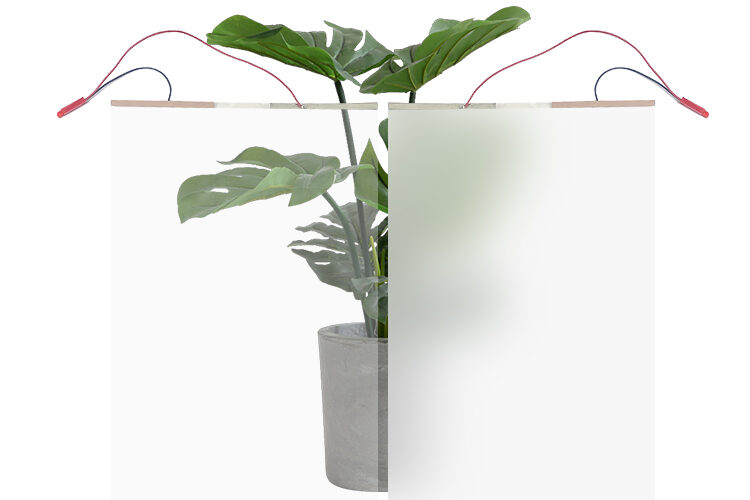
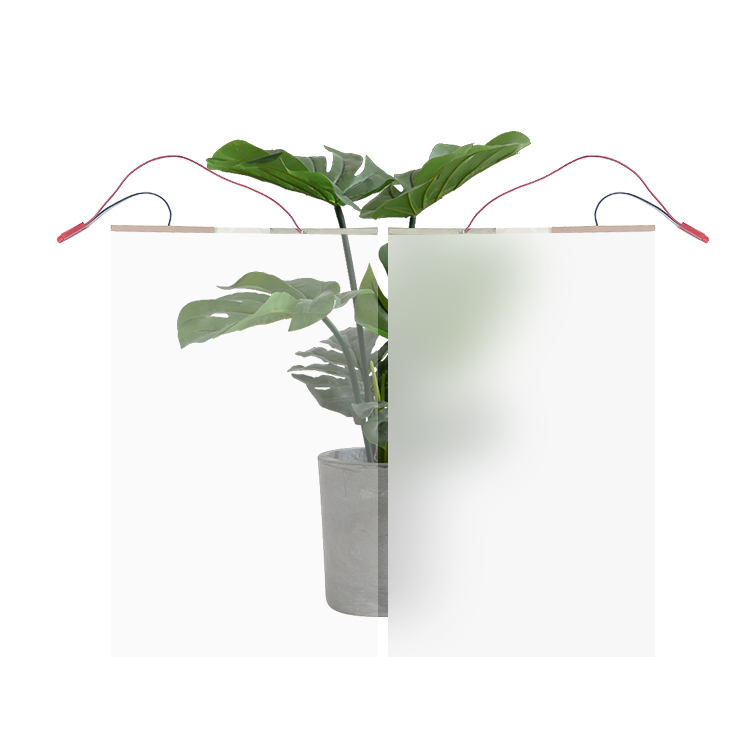
clean white appearance with instant privacy control
Most people encounter smart film the same way. Someone touches a switch. A frosted white wall goes clear in an instant. It looks like a magic trick.
That reaction is completely reasonable. But there’s a gap between “this looks incredible” and “this is right for my project.” This guide closes that gap. We cover how the technology works, where it genuinely earns its cost, and where it falls short — so you make the right specification decision rather than an impressive-looking one.
The Basic Idea
Smart film — also called switchable film, privacy film, or PDLC film — changes from opaque to transparent when you apply electricity.
Power off: the glass looks white and private. Power on: the glass goes clear. Cut the power: it returns to white.
That’s the core of it. The technology behind it is more interesting than that summary suggests, but that’s the product.
How PDLC Works
PDLC stands for Polymer Dispersed Liquid Crystal. Understanding the name helps.
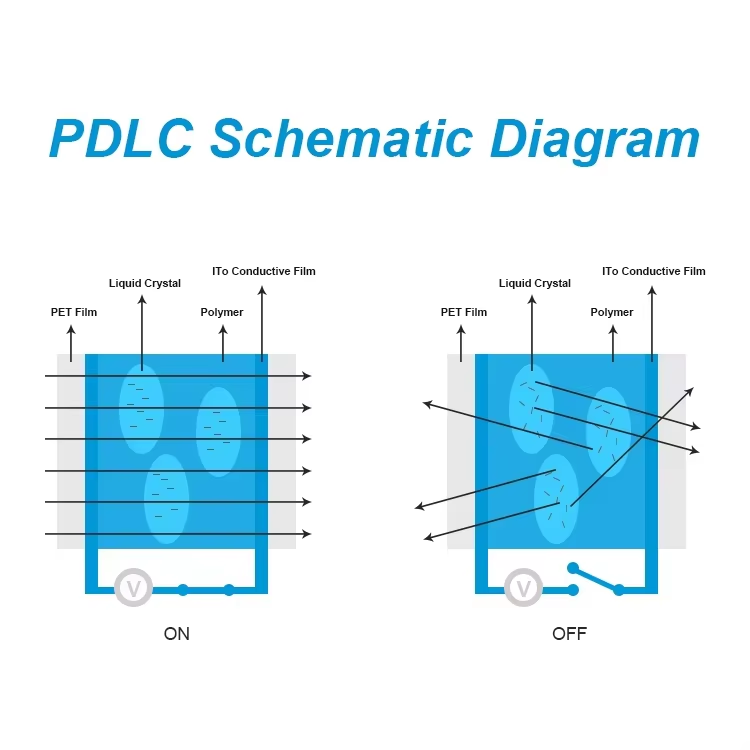
The film contains tiny liquid crystal droplets. These droplets sit inside a polymer layer, sandwiched between two sheets of transparent conductive coating (called ITO — indium tin oxide).
Without power, the droplets are random. Light hits them and scatters in every direction. From outside, the glass looks white and opaque. You can’t see through it clearly.
With power, the droplets line up. An AC electrical field runs through the ITO layers. The liquid crystal droplets align with it. Now light passes straight through. The glass goes clear.
The switch happens in milliseconds. It feels instant — the same as flicking a light switch.
One important detail: the film needs continuous power to stay transparent. The moment you cut power, it returns to opaque. This is deliberate for most applications. Privacy is the default. If power fails, the space stays private — not visible.
PDLC vs. the Other Technologies
Smart film isn’t just one technology. Four main types exist. Each suits a different job.
PDLC — The Most Common
Best for: instant privacy on demand, projection screens, healthcare, conference rooms.
This is what most people mean when they say “smart film.” It switches fast (milliseconds), creates a genuinely white opaque state, and can be applied to existing glass as a retrofit film. It’s the most affordable option.
The trade-off: it’s binary. Either fully clear or fully opaque — no in-between.
Electrochromic — The Dimmer
Best for: glare control, solar management, aircraft windows, luxury vehicles.
Electrochromic glass tints gradually rather than switching sharply. You can stop at 20% tint, 50% tint, or full clear — like a dimmer switch for a window. The transition takes 1–3 minutes, not milliseconds.
It doesn’t go opaque white, so it’s not a privacy product. And it can’t be retrofitted to existing glass — it needs to be built into the glass unit at the factory. Much more expensive than PDLC.
SPD — The In-Between
Best for: museums, commercial solar control, premium automotive.
SPD (Suspended Particle Device) film darkens rather than going opaque. It’s adjustable like electrochromic, but faster (seconds, not minutes). In its off state, it blocks light rather than scattering it — so the glass looks dark, not white.
Useful where you want controlled darkness rather than privacy. Trickier to install than PDLC, and somewhat fragile.
Thermochromic — No Electricity Needed
Best for: skylights, conservatories, passive solar management.
Thermochromic film changes state based on temperature, not electricity. No wiring, no switch, no controller. When solar heat builds up, the film tints automatically to reduce heat gain.
The problem: you can’t choose when it switches. The tinting temperature is fixed by the material’s chemistry. It provides solar control; it doesn’t provide privacy.
Bottom line: For most retrofit projects and privacy applications, PDLC is the answer. The other technologies have specific niches where they’re better — but they’re not competitors to PDLC for most buyers.
What’s Inside Smart Film
A PDLC smart film is a multilayer stack. From outside to inside:
Hard coat — scratch-resistant surface layer
PET substrate — clear polyester film for structural support
ITO layer — transparent conductive coating (first electrode)
PDLC active layer — the liquid crystal/polymer layer (15–30 microns thick)
ITO layer — second electrode
PET substrate — second support layer
PSA adhesive — bonds to the glass
Release liner — removed during installation
Total thickness: 0.35–0.55mm. About the same as quality automotive window tint. Flexible enough to apply to gently curved surfaces.
The electrical connection runs along the film edge to a driver unit outside the glass. This is what generates the AC field that controls the switching.
Technical Specs: What to Ask For
These are the numbers that separate good film from mediocre film.
VLT in transparent state: How much light passes through when the film is on. Quality PDLC achieves 70–80% VLT. Clear glass is typically 88–90%. There’s always some reduction — any supplier claiming 90%+ VLT for PDLC deserves scrutiny.
Haze in transparent state: This one is critical, and most buyers forget to ask. Even when switched to clear, PDLC introduces some haze — a slight milkiness from the ITO and film layers. Budget products: 8–12% haze. You’ll notice it. Premium PDLC: below 4% haze. Specify this maximum and get it confirmed in writing.
VLT in opaque state: Even when “opaque,” PDLC still transmits 50–75% of total light — it just scatters it. The glass looks white. You can’t see shapes or details through it. But a lit room behind opaque PDLC glows visibly from outside at night. For privacy it works perfectly. For blackout it doesn’t.
Operating voltage: Standard PDLC runs at 48–110V AC, 50–60Hz. Lower voltage (48V) is safer and easier to integrate with building systems. Many countries have stricter installation rules for anything above 50V. Confirm your local regulations before specifying.
Power draw: 3–5 watts per square metre when on. Very low. A 10m² smart glass installation draws about the same as a standard light bulb.
Service life: Quality PDLC switches 100,000+ times before performance drops. Practical service life: 10–15 years. The ITO layer is the most vulnerable part — physical damage or UV degradation shortens this.
Where Smart Film Actually Makes Sense
Smart film costs real money. A 2m² panel installed professionally: $1,200–$2,500 including film, controller, and electrical work. Compare that to a motorised blind at $300–$600.
For smart film to win, the application has to need something a blind can’t provide.
Conference rooms in corporate offices. Glass walls go clear when the room is empty and open. One switch makes them private when a sensitive meeting starts. Clean aesthetic, instant switching, no mechanism visible. Law firms, banks, and consultancies often treat this as standard for meeting rooms.
Hospital patient areas. Nurses need to switch from open-plan to private without using their hands. PDLC works with foot switches, voice controls, and occupancy sensors. The operational efficiency in healthcare settings justifies the cost premium easily.
Retail window displays with rear projection. The same glass that’s clear during the day becomes a projection screen when switched opaque. Hotels use this for lobby feature walls. Retailers use it for interactive window displays. No other product delivers both functions from one glass surface.
Private banking suites, luxury hotel rooms, premium spa facilities. The “magic wall” effect carries a premium experience that curtains and blinds simply don’t. In contexts where the experience is the product, smart film earns its cost.
Where it doesn’t make sense: Anywhere a blind or frosted film would do the job at a third of the cost. Smart film isn’t a better blind. It’s a different product entirely. If the space just needs to be private, frosted film is right. If it needs to be sometimes private and sometimes open — with a switch — that’s when PDLC makes sense.
The Electrical Work Nobody Talks About
This is where smart film projects most often go over budget.
Every PDLC panel needs:
A driver/controller unit
Power supply to the driver
Cabling from the driver to the film edge
A switching mechanism (wall switch, occupancy sensor, phone app, building management system)
In new construction, this is easy. Electricians plan the cable runs during the build. Controllers go in accessible locations. The whole system is designed together.
In an existing building, it’s harder. Cable runs to glass panels often mean visible conduit or disruptive wall chasing. Controllers need somewhere to live. The switching interface needs to be installed where it’s usable.
Rough cost guide for the electrical side alone:
Scenario
Typical cost
Single panel, simple wall switch
$300–$600
Multiple panels, independent zones
$800–$1,500
Full building automation system
$1,500–$4,000+
These vary a lot by market and building complexity — but the pattern holds: electrical integration often costs more than the film itself for complex multi-panel installations. Budget for it from the start.
Self-Adhesive Film vs. Interlayer Glass
There are two ways PDLC gets into a building:
Self-adhesive film (the retrofit option): Applied to existing glass like window tint. This is how most projects are installed. Faster, cheaper, no glass replacement needed. At end of life, the film can be removed and replaced.
The limits: any imperfection in the existing glass shows through the film. The edge electrical connections need careful management for appearance. Application quality matters — bubbles or dust trapped during installation ruin the look.
Interlayer (built into laminated glass): The PDLC film is laminated between two glass panels at the factory. Better optical clarity. Cleaner aesthetics — no visible edges or connections. Better physical protection for the PDLC layer.
The limits: expensive, long lead times, and if the PDLC fails the whole glass unit needs replacing. Only practical in new construction or when glass is being replaced anyway.
For most retrofit projects: self-adhesive film. For new construction where the detail matters: interlayer is worth the premium.
Automotive Smart Film: Promising, But Limited
The idea of car windows that switch from clear to private captures imaginations. The reality is more constrained.
The technical problems: PDLC needs AC power. Cars run on 12V DC — you need an inverter. The film must work from -40°C to +85°C in direct sun. Road vibration stresses the electrical connections over years of use.
The regulatory problem: primary vision windows can’t have switchable opacity in any major market. Front side windows and the windscreen must meet minimum VLT requirements. Switchable opacity isn’t permitted there, full stop.
What PDLC can legally do in vehicles:
Panoramic sunroof
Rear windows in limousines (where the driver sees via other mirrors)
Partition windows in coaches and minibuses
For mainstream automotive solar control, SPD is actually a better technology — it dims rather than switches, making it suitable for glare management without blocking the driver’s view.
What Smart Film Can’t Do
In the interest of selling the right product rather than the impressive-sounding one:
It doesn’t control heat. PDLC has almost no effect on TSER or solar heat gain. If heat rejection is the goal, solar control film is the right product.
It doesn’t achieve blackout. The opaque state still passes 50–75% of total light, diffused. A bright room behind PDLC at night glows from outside. For genuine blackout, combine PDLC with a separate blackout layer.
It doesn’t block sound. Adding film to glass doesn’t meaningfully reduce acoustic transmission. If sound privacy is needed, the glazing system itself needs acoustic specification.
It doesn’t last indefinitely. Quality PDLC lasts 10–15 years. The ITO layer can develop faults from physical damage or incorrect installation. Build replacement into long-term facility planning.
Six Questions to Ask Any Smart Film Supplier
These separate the credible manufacturers from everyone else.
“What is the haze value in the on state?” Anything above 6% will be visibly milky. Quality film specifies below 4%.
“What is VLT in both states, and how is it measured?” Both need to be documented with test methodology.
“What is the rated operating voltage and frequency?” Confirm compatibility with your electrical system and local codes.
“What are the installation temperature limits?” Matters for both installation day and long-term climate performance.
“How is the edge electrical connection made — factory or field?” Factory connections are more reliable than site-applied conductive tape.
“Are your controller/driver units CE marked?” In EU/UK markets, the driver falls under the Low Voltage Directive. Unmarked drivers create compliance problems.
Cost Reference (2026, Installed)
These are realistic budgets, not best-case scenarios.
Application
Film area
Film + driver
Electrical work
Total
Single conference room panel (1.5m × 0.8m)
1.2m²
$600–$1,000
$400–$700
$1,000–$1,700
Full conference room wall (3m × 2.4m)
7.2m²
$2,500–$4,500
$800–$1,500
$3,300–$6,000
Hospital patient bay (4 × 2m² panels)
8m²
$2,800–$5,000
$1,200–$2,000
$4,000–$7,000
Retail display window (5m × 2m)
10m²
$3,500–$6,000
$1,000–$2,000
$4,500–$8,000
Film at wholesale (ex-works China): $45–$90/m² depending on spec and volume. Add 30–50% for landed cost in Western markets.
FAQ
Can smart film be cut to size on-site?
Yes, with a sharp blade. But the cut edge exposes the liquid crystal layer — seal it immediately with edge sealant. Better option: have the manufacturer cut to your specified dimensions before shipping.
What happens if part of the film stops switching?
A patch that stays opaque usually means a damaged ITO layer (from physical impact) or a localised delamination event. Small areas sometimes can be repaired. Larger failures need film replacement.
Can it be applied to double-glazed units?
Yes — to the interior face of the inner pane. Route the electrical connection through or around the frame. Plan this before installation, not after.
Is the opaque state genuinely private?
At normal distances and light levels: yes. You can’t distinguish shapes or details through quality opaque PDLC. Very bright light behind it creates a visible glow — it doesn’t achieve true blackout, but it achieves genuine privacy.
KSB Window Film manufactures PDLC smart film for architectural and specialist use. CE-marked drivers, haze below 4% in the on state, complete technical documentation. We supply at wholesale to distributors, system integrators, and glazing contractors.