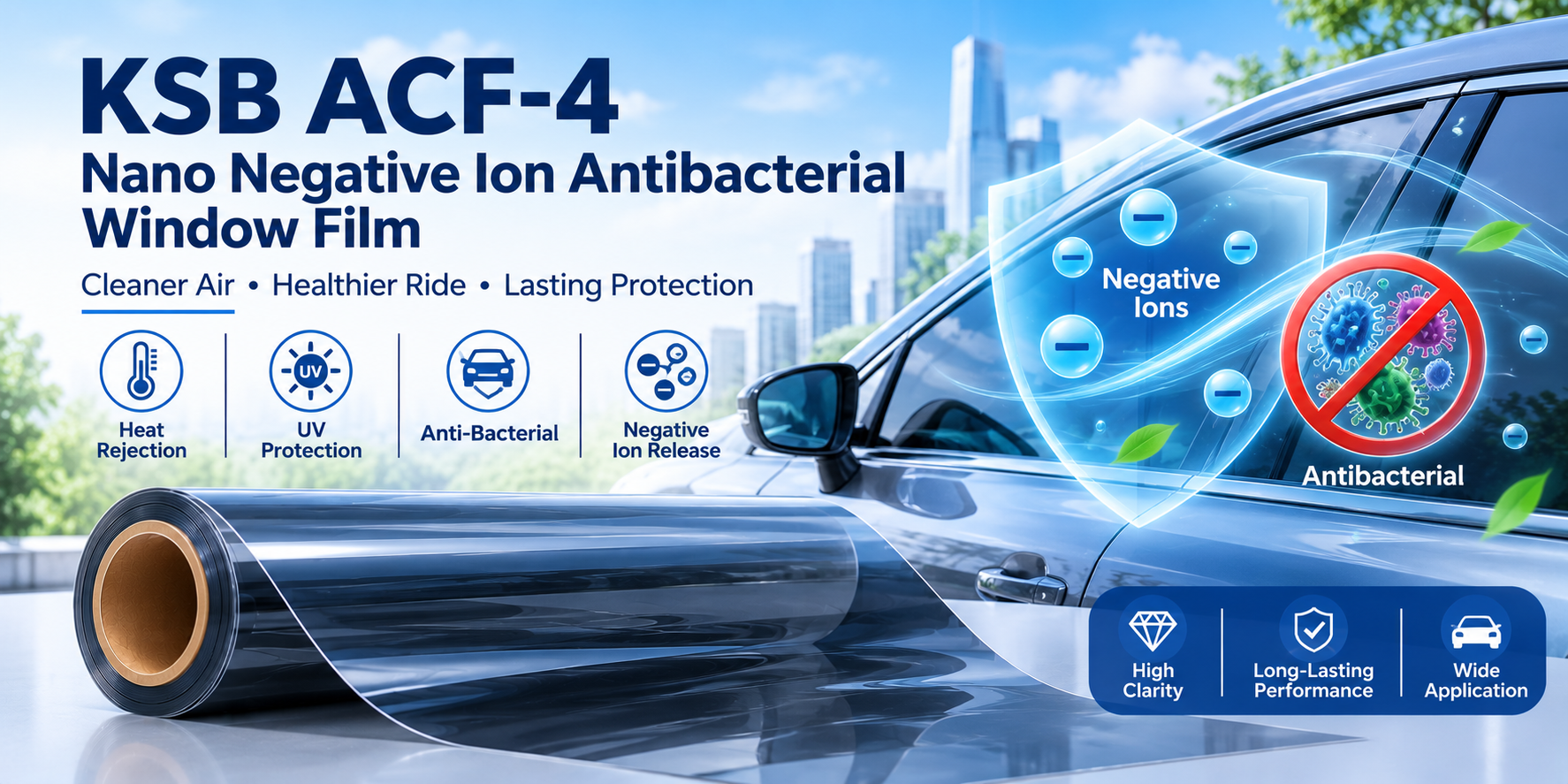
KSB ACF-4 is a 4mil nano negative ion antibacterial automotive window film. It combines nano ceramic materials with negative ion and antibacterial functionality, alongside conventional solar control and UV protection. Its optical and solar performance specifications provide different options for distributors serving various market requirements.
What Is Negative Ion Antibacterial Window Film?
Negative ion antibacterial window film incorporates negative ion technology and antibacterial functionality into automotive window film. In addition to conventional heat rejection and UV protection, it introduces further functional features that distinguish it from standard solar control films.
For distributors and importers, these features provide additional product characteristics to consider when evaluating functional automotive window films for their markets.
Advanced Material Composition and Patent Information
The ACF-4 series incorporates the following materials and technologies:
- Nano Negative Ion Technology
- Pure Nano Ceramic
- Tungsten Oxide
- Nano Titanium Nitride
These materials and technologies form part of the product’s composition, combining functional features with the optical and solar performance of automotive window film.
KSB holds Chinese Utility Model Patent No. ZL201920332997.9.
Functional Performance and Technical Validation
ACF-4 combines negative ion and antibacterial functionality with conventional automotive window film performance. Supporting test documentation provides additional information for buyers evaluating these functional features.
KSB has relevant testing documentation covering:
- Negative ion concentration
- Antibacterial performance
- Formaldehyde removal
- PM2.5
- Mold resistance
Available reports can be requested for review. Buyers can examine the tested samples, testing methods, scope, and reported results to understand the evidence available for each functional feature.
Product Specifications and Performance Comparison
The ACF-4 specifications cover different levels of visible light transmission and solar performance. The following table provides a comparison of the main technical parameters.
| Parameter | ACF85-4 | ACF75-4 | ACF40-4 | ACF35-4 | ACF18-4 |
|---|---|---|---|---|---|
| VLT | 85% | 73% | 38% | 34% | 17% |
| IRR 950nm | 56% | 95% | 91% | 93% | 89% |
| IRR 1400nm | 64% | 98% | 95% | 97% | 93% |
| UVR | 99% | 99% | 99% | 99% | 99% |
| TSER | 38% | 55% | 76% | 86% | 74% |
| Total Solar Transmittance | 0.62 | 0.45 | 0.24 | 0.14 | 0.26 |
| Internal Reflectance | 08% | 08% | 08% | 08% | 08% |
| Shading Coefficient | 0.70 | 0.51 | 0.27 | 0.16 | 0.29 |
| Haze | 0.20 | 0.58 | 0.20 | 0.62 | 0.65 |
| Scratch Resistance | 3H | 3H | 3H | 3H | 3H |
| Thickness | 4mil | 4mil | 4mil | 4mil | 4mil |
| Color Decay Time | 10 years | 10 years | 10 years | 10 years | 10 years |
All specifications share a thickness of 4mil, UVR of 99%, and scratch resistance of 3H. The listed color decay time is 10 years across the series. The main variations are in VLT, IRR, TSER, and haze.
Model Configuration and Performance Characteristics
The different specifications offer varying combinations of visible light transmission and solar performance:
- ACF85-4: With 85% VLT, it provides the highest visible light transmission in the series.
- ACF75-4: Features 73% VLT and 98% IRR at 1400nm, combining high light transmission with strong infrared rejection at the specified wavelength.
- ACF40-4: Provides 38% VLT and 76% TSER, offering a balance of light transmission and total solar energy rejection.
- ACF35-4: Achieves the highest TSER in the series at 86%, with a VLT of 34%.
- ACF18-4: Has the lowest VLT at 17%, providing the darkest appearance among the available specifications.
When comparing these options, buyers should consider VLT, IRR at the specified wavelengths, TSER, and haze together. These parameters represent different aspects of optical and solar performance. A lower VLT does not necessarily indicate a higher TSER, as demonstrated by the comparison between ACF35-4 and ACF18-4. Local automotive window tint regulations should also be taken into account.
Manufacturing Support
KSB operates a 50,000 m² manufacturing facility equipped with 3 production lines and an annual production capacity of 80 million m². The company holds ISO 9001 and IATF 16949 certifications, supporting its manufacturing and quality management processes.
KSB provides product specifications, available technical documentation, and wholesale supply support for distributors and business customers.
Frequently Asked Questions
1. What testing documents are available for ACF-4?
KSB has relevant documentation covering negative ion concentration, antibacterial performance, formaldehyde removal, PM2.5, and mold resistance. Available reports can be requested for review.
2. Does KSB support wholesale orders?
Yes. KSB welcomes wholesale inquiries from distributors and business customers. Product specifications and available technical documents can be provided for evaluation.
3. Does ACF-4 have patent protection?
KSB holds Chinese Utility Model Patent No. ZL201920332997.9.
Further Reading
On this site:
- KSB AC Series Negative Ion Antibacterial Window Film | 7 Model Options — Explore another negative ion antibacterial film range with seven model options.
- NDC Series Magnetic Negative Ion Antibacterial Window Film | KSB — Learn about a product combining multi-layer magnetic and negative ion technologies.
- What Is Nano Ceramic Window Film? — Understand the materials and basic principles behind nano ceramic film.
- How Nano Ceramic Window Film Is Made — Explore the manufacturing process behind nano ceramic window film.
Conclusion
KSB ACF-4 Nano Negative Ion Antibacterial Window Film combines nano ceramic materials with negative ion and antibacterial functionality in a 4mil automotive window film. Its optical and solar performance specifications provide different configurations for buyers serving varied market requirements.
With established manufacturing facilities and supporting technical documentation, KSB offers a functional automotive window film option for distributors and wholesalers. Contact KSB for product specifications, available testing reports, and wholesale supply inquiries.
Get a Free Sample or Quote
Looking for a reliable window film supplier? Contact us today for fast response and professional support.