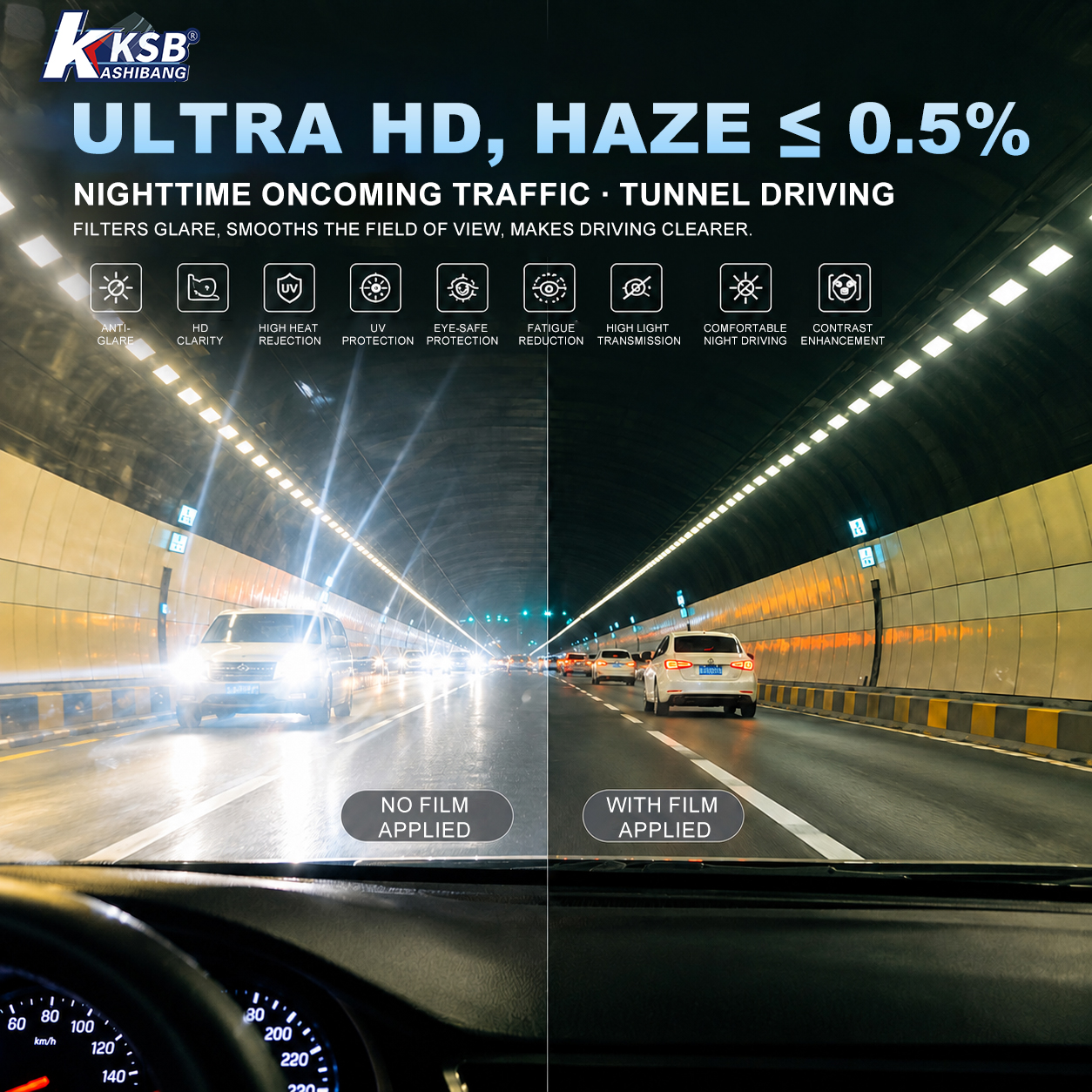
When comparing automotive window films, buyers usually focus on familiar specifications such as VLT, IR rejection, UV rejection and TSER.
But there is another specification that can have a noticeable effect on what you actually see through the glass:
Haze.
A window film can have high visible light transmission and strong heat rejection, yet still look slightly cloudy or less crisp when viewed through the windshield.
That is because light transmission and optical clarity are not the same thing.
For automotive applications—especially windshields and front side windows—haze is an important part of understanding how clearly a driver can see through the installed film.
So what exactly is window film haze, what causes it, and how should you compare it?
What Is Haze in Window Film?
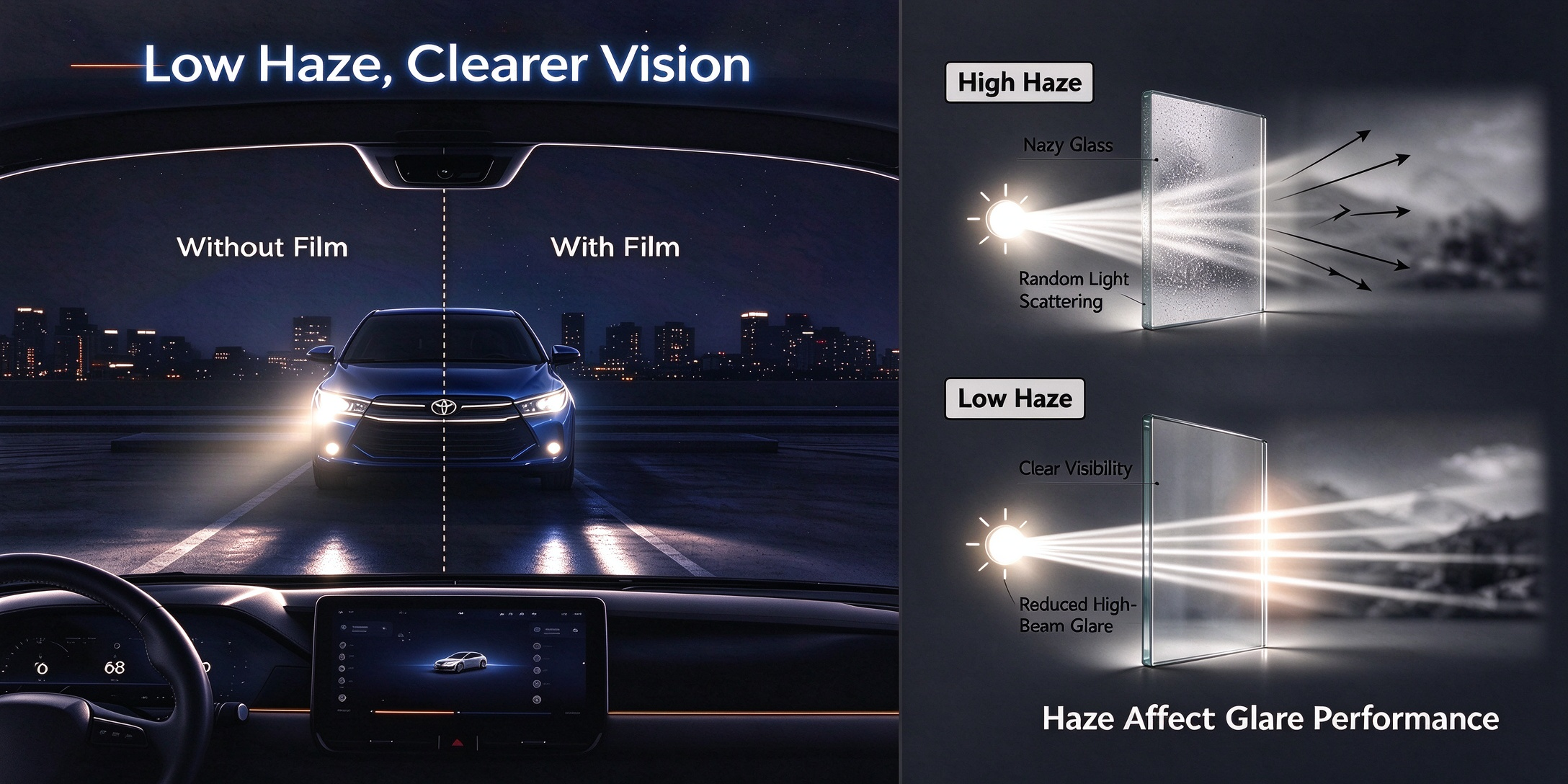
Haze describes the scattering of light as it passes through a transparent material.
When light enters automotive glass fitted with window film, most of the transmitted light should continue in a relatively direct path.
However, a portion of that light can be scattered in different directions.
This scattered light contributes to what we perceive as haze.
In practical terms:
Lower haze → less light scattering → clearer appearance
Higher haze → more light scattering → more noticeable cloudy or foggy appearance
Haze is normally expressed as a percentage.
For example, a window film with 0.5% haze has less measured light scattering than a film with 1.0% haze, assuming the values are obtained using comparable test methods and conditions.
The difference may sound small on paper, but optical imperfections can become more noticeable when a film is installed across a large windshield and viewed under challenging lighting conditions.
What Does Haze Look Like Through a Car Window?
Haze does not necessarily mean that the window film looks obviously “foggy.”
With automotive film, the effect can be more subtle.
You may notice that:
- Road signs appear slightly less crisp
- Distant objects lose some definition
- Bright lights seem to spread more
- The view through the windshield feels slightly milky
- Headlights become more distracting at night
Under normal indoor lighting, two films may look almost identical.
The difference can become easier to notice when looking through the film toward strong sunlight, streetlights, headlights or high-contrast objects.
That is why evaluating optical clarity only by holding a small film sample inside a showroom does not always tell the full story.
What Causes Haze in Automotive Window Film?
A finished automotive window film is a multi-layer optical product.
Haze therefore does not come from one component alone.
Several factors can contribute.
1. PET Substrate Quality
The PET substrate forms the optical foundation of the film.
If the PET itself has relatively high haze, the finished window film starts with a disadvantage that cannot simply be corrected by adding a better coating.
For high-clarity automotive films, manufacturers may use optical-grade PET with very low base haze.
For example, selected ultra-clear film constructions can use optical PET substrates with haze below 0.25% before the other functional layers are added.
However, PET haze should not be confused with the haze of the finished window film.
Once coatings, adhesives and other functional layers are added, the final haze value can change.
This is why professional buyers should ask:
Is this the haze of the PET substrate or the haze of the finished film?
The distinction matters.
2. Functional Particles
Nano ceramic window film uses functional materials to achieve solar-control properties.
The size, concentration and optical characteristics of these particles can influence how light passes through the coating.
Larger particles or particle clusters may increase light scattering.
This is one reason nano-scale functional materials are used in high-clarity ceramic film constructions.
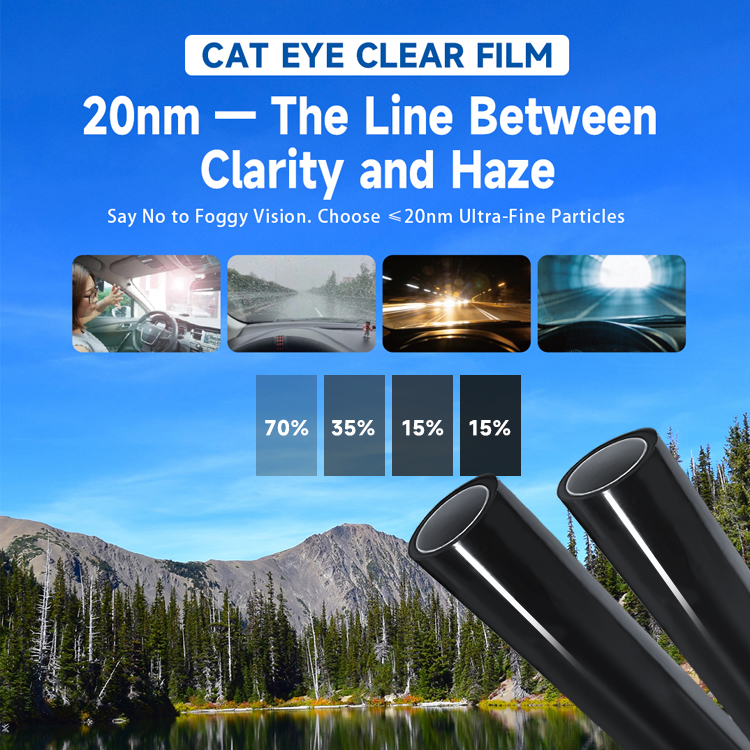
In selected KSB constructions, functional particles can be below 20 nm in size.
But smaller particles alone do not guarantee lower haze.
Their distribution throughout the coating matters just as much.
3. Particle Dispersion
Imagine adding very fine powder to a liquid.
Even if every individual particle is extremely small, poor mixing can cause those particles to collect into larger clusters.
A similar principle applies to nano-scale materials used in functional coatings.
If nano particles agglomerate instead of remaining uniformly dispersed, those clusters can increase light scattering and affect optical consistency.
This is why nano dispersion technology is important.
Good dispersion helps distribute functional materials more evenly throughout the coating, supporting both solar-control performance and optical clarity.
So when evaluating nano ceramic window film, the statement:
“Our particles are 20 nm.”
does not tell the whole story.
A better question is:
How well are those particles dispersed in the finished coating?
4. Coating Uniformity
Automotive window film is manufactured over large areas, so coating consistency matters.
Uneven coating thickness, inconsistent material distribution or defects in the coating process can affect optical performance.
For high-clarity films, precision coating helps maintain a more uniform functional layer across the roll.
This is particularly important for professional installers and distributors.
A small laboratory sample may look excellent, but commercial products also need consistent optical performance from:
roll to roll
and
across the width and length of each roll.
For B2B buyers, consistency can be just as important as the best haze number shown on a specification sheet.
5. Adhesive and Other Film Layers
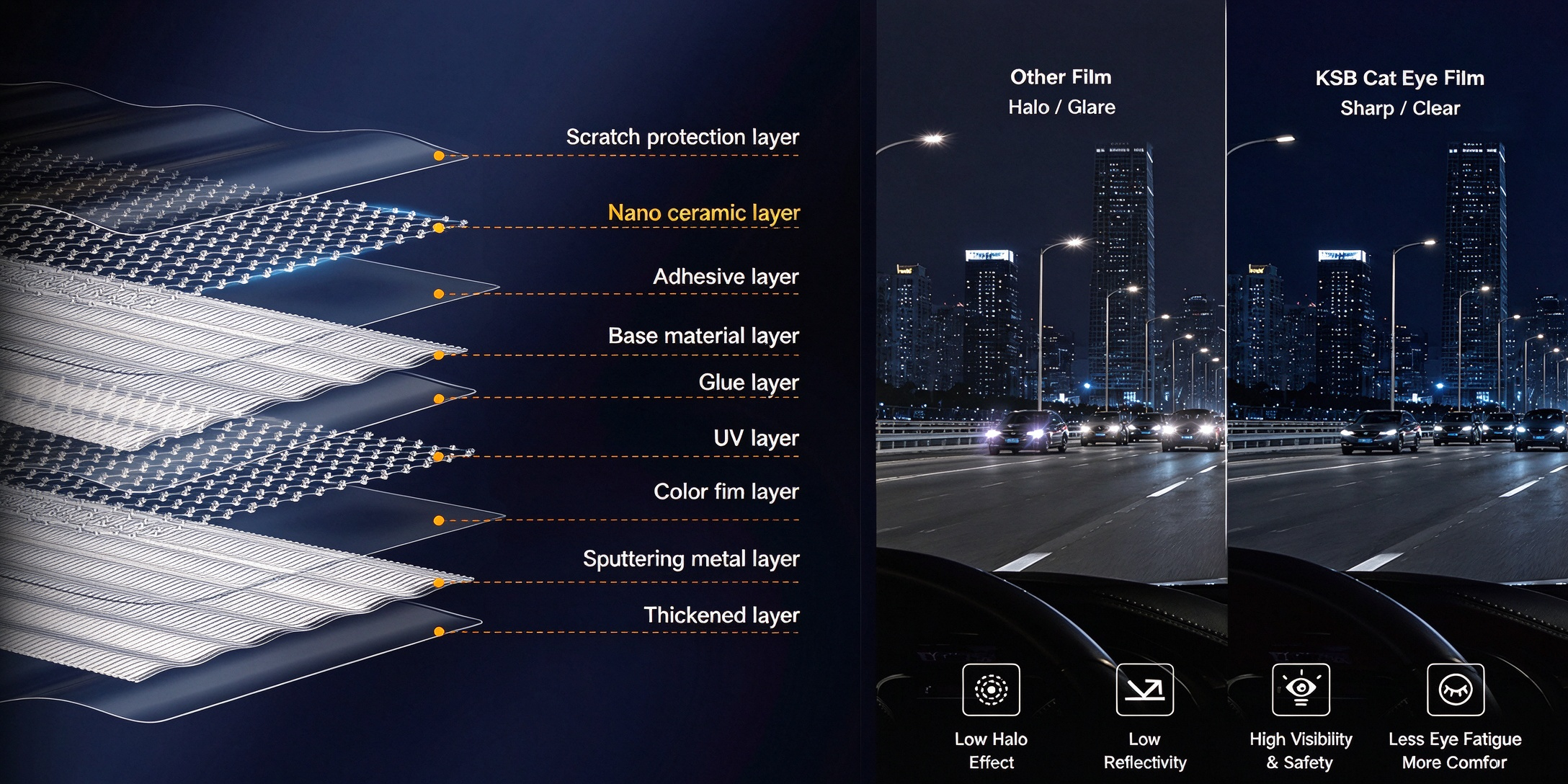
The adhesive system can also affect the optical appearance of the finished film.
Automotive window film is not simply a piece of PET with ceramic particles added to it.
Depending on the construction, it may include:
PET substrate + functional coating + adhesive + protective layers + hard coat
Each interface can influence how light passes through the final product.
This is another reason the haze of the complete finished film is more meaningful than the haze of one individual raw material.
Haze vs. VLT: What’s the Difference?
This is one of the most important distinctions when reading an automotive window film specification sheet.
VLT = How much visible light passes through.
Haze = How much transmitted light is scattered.
They measure different things.
Consider two hypothetical films:
| Specification | Film A | Film B |
|---|---|---|
| VLT | 70% | 70% |
| Haze | 0.4% | 1.2% |
Both films allow approximately the same percentage of visible light to pass through.
But they do not necessarily provide the same visual experience.
Film A has lower measured haze, meaning less transmitted light is being scattered under the applicable test conditions.
This is why:
High VLT does not automatically mean high clarity.
A film can transmit plenty of visible light and still have noticeable haze.
Likewise, a darker film can still have good optical clarity.
For buyers comparing high-VLT windshield films, looking at VLT and haze together provides much more useful information than looking at VLT alone.
Is Haze the Same as Glare?
No.
These terms are related to visual quality, but they describe different phenomena.
Haze is associated with transmitted-light scattering.
Glare describes visual discomfort or reduced visibility caused by excessive brightness or strong contrast.
Internal reflection refers to light reflected from the inside surface or film/glass system, which can make dashboards, screens or interior objects appear as reflections on the window.
A film may therefore have:
low haze but noticeable internal reflection,
or
low internal reflection but higher haze.
For high-clarity automotive applications, these optical characteristics should be considered together rather than treated as a single specification.
Why Is Haze More Noticeable at Night?
During daylight, the human eye receives a large amount of ambient light, and minor differences in optical clarity can sometimes be difficult to notice.
Night driving creates a different visual environment.
There are bright point sources—such as:
oncoming headlights, streetlights and illuminated road signs
surrounded by much darker areas.
Light scattering becomes more noticeable around these high-contrast light sources.
A driver may perceive this as a slight glow, softness or loss of sharpness around bright objects.
Rain can make the situation more challenging because water on the windshield, reflections from wet roads, glass condition and other optical effects are added to the viewing system.
This does not mean haze is the only factor affecting nighttime visibility. Windshield condition, installation quality, moisture, contamination, scratches and the vehicle’s glass itself can also influence what the driver sees.
But for a film intended for windshield use, low haze is one important optical specification to evaluate.
Why Can Haze Be More Noticeable in Strong Sunlight?
Strong sunlight creates another high-contrast viewing condition.
When the driver is looking toward a bright sky or low-angle sun, scattered light can reduce perceived contrast.
This can make an optically poor film feel less clear even when its VLT specification looks good on paper.
That is one reason professional evaluation should include more than a light meter.
A VLT meter can tell you how much visible light passes through the film.
It does not tell you everything about how clearly objects can be seen through it.
What Is Considered Low Haze for Automotive Window Film?
There is no single haze number that should be used in isolation to declare one automotive film “good” and another “bad.”
The appropriate value depends on the film construction, application and test method.
However, for products specifically developed around ultra-clear optical performance, manufacturers may target finished-film haze around 0.5% or lower.
This is particularly relevant for high-visibility applications.
But buyers should be careful with marketing claims.
If a supplier advertises:
“Haze <0.25%”
ask whether that number refers to:
the raw PET substrate
or
the complete finished window film.
Those are not necessarily the same measurement.
For example, an optical PET substrate may have haze below 0.25%, while the finished automotive film has a higher value after the functional coating, adhesive and other layers are added.
For product comparison, finished-film haze is generally the more relevant figure.
Does Nano Ceramic Film Always Have Low Haze?
No.
“Nano ceramic” describes the type of technology used in the film. It does not automatically guarantee a particular level of optical clarity.
The final haze can be influenced by:
PET quality
particle size
particle dispersion
coating formulation
coating uniformity
adhesive
and the complete film structure.
This is why two products both sold as “nano ceramic window film” can look different when installed on the same type of glass.
For buyers, the term nano ceramic should be the beginning of the technical evaluation—not the end of it.
What About Sputtered Window Film?
Low-haze automotive film is not limited to nano ceramic technology.
Sputtered films can also be engineered for high optical clarity.
In sputtered constructions, functional materials are deposited onto the film substrate in controlled layers rather than dispersed in the same way as ceramic particles in a coating.
The manufacturing approach is different, but the buyer should still evaluate the final optical result.
That means checking specifications such as:
Haze + VLT + Reflectance + TSER + IRR
rather than assuming one technology automatically provides better clarity.
This is also why some Cat Eye Window Films use nano ceramic technology while others use sputtered constructions.
→ Related: What Is Cat Eye Window Film? A Guide to Ultra-Clear Automotive Window Film
这里链接回你上一篇核心文章。
How Should You Compare Window Film Clarity?
If you are a distributor, window film brand or professional installer evaluating a new automotive film supplier, do not rely only on product names such as:
HD
Ultra Clear
Crystal Clear
or
Nano Ceramic.
These are marketing descriptions, not complete optical specifications.
Instead, request measurable data and test physical samples.
A useful evaluation should include:
| Specification | What to Check |
|---|---|
| Haze | Light scattering through the finished film |
| VLT | Visible light transmission |
| VLR | Visible light reflection |
| IRR | Infrared rejection under stated test conditions |
| TSER | Overall solar energy rejection |
| UVR | Ultraviolet rejection |
| PET Quality | Optical consistency of substrate |
| Coating Quality | Uniformity across the film |
| Finished Film | Actual optical performance after all layers |
Then install a sample on glass.
View it under:
normal daylight, direct sunlight, nighttime conditions and bright point-light sources.
For distributors, it is also worth comparing multiple samples from different rolls—not just one carefully selected sample.
That tells you more about manufacturing consistency.
Why Haze Matters for Window Film Distributors
For an end customer, haze is mainly about visual experience.
For a distributor or private-label brand, it becomes a product-quality issue.
If you are building an automotive window film range, particularly a premium or high-VLT line, optical consistency affects:
customer satisfaction, installer feedback, product positioning and repeat orders.
A product with impressive IR rejection but inconsistent clarity can create problems that are difficult to explain after the film has already been installed.
For this reason, professional buyers should consider optical specifications early in the sourcing process.
Ask for the data.
Test the samples.
Compare the installed film.
And make sure the specification refers to the product you are actually purchasing—not only the raw material used to manufacture it.
Frequently Asked Questions About Window Film Haze
What does haze mean in window tint?
Haze describes the scattering of transmitted light through the film. Lower haze generally means less light scattering and a clearer visual appearance.
Is lower haze better for automotive window film?
For applications where optical clarity is important, lower haze is generally desirable. However, haze should be considered together with VLT, reflectance, solar-control performance and the intended application.
Is 0.5% haze good for window film?
A finished-film haze around 0.5% or lower can be relevant for products positioned around high optical clarity. Comparisons should use consistent test methods and should distinguish between PET-substrate haze and finished-film haze.
Does higher VLT mean lower haze?
No. VLT and haze measure different optical properties. A high-VLT film can still have relatively high haze.
Can nano ceramic particles cause haze?
Functional particles can contribute to light scattering depending on their size, concentration, dispersion and coating system. Good nano dispersion and coating uniformity are therefore important in high-clarity ceramic film construction.
Can sputtered window film have low haze?
Yes. Both ceramic and sputtered window films can be engineered for high optical clarity. Buyers should compare the finished film specifications rather than judging clarity solely by the manufacturing technology.
Why does window tint sometimes look hazy after installation?
Immediately after installation, residual installation moisture can temporarily affect appearance. If haziness remains after the appropriate curing period, other factors such as film construction, adhesive, contamination, installation quality or the glass itself may need to be considered.
Looking for Low-Haze Automotive Window Film?
For professional buyers, haze is only one part of the specification—but it is an important one.
If you’re sourcing high-clarity automotive window film for wholesale, distribution or private labeling, compare the finished-film haze together with VLT, reflectance, IRR and TSER, and test samples under real viewing conditions before selecting a series.
KSB offers nano ceramic and sputtered automotive window film constructions with different VLT and solar-control specifications.