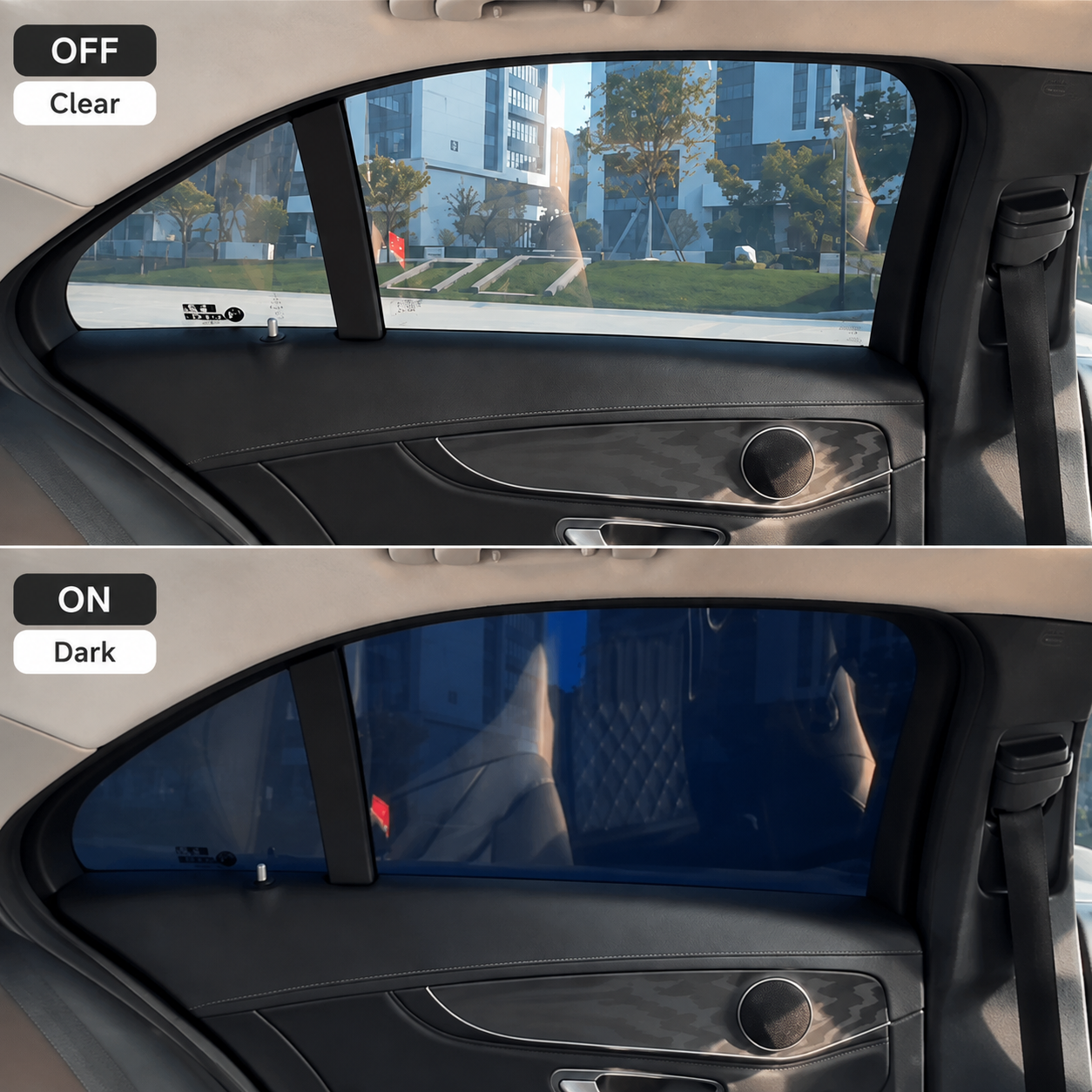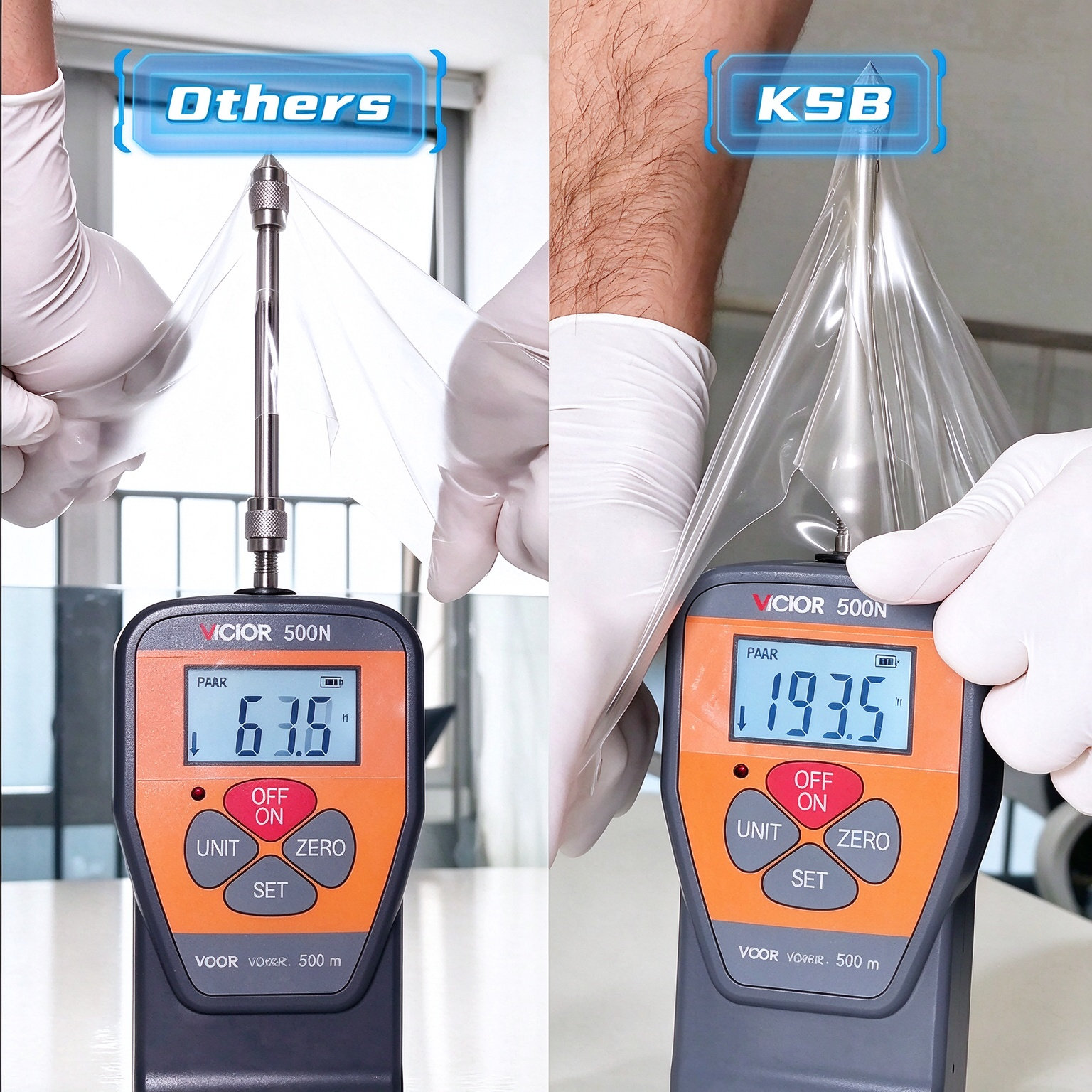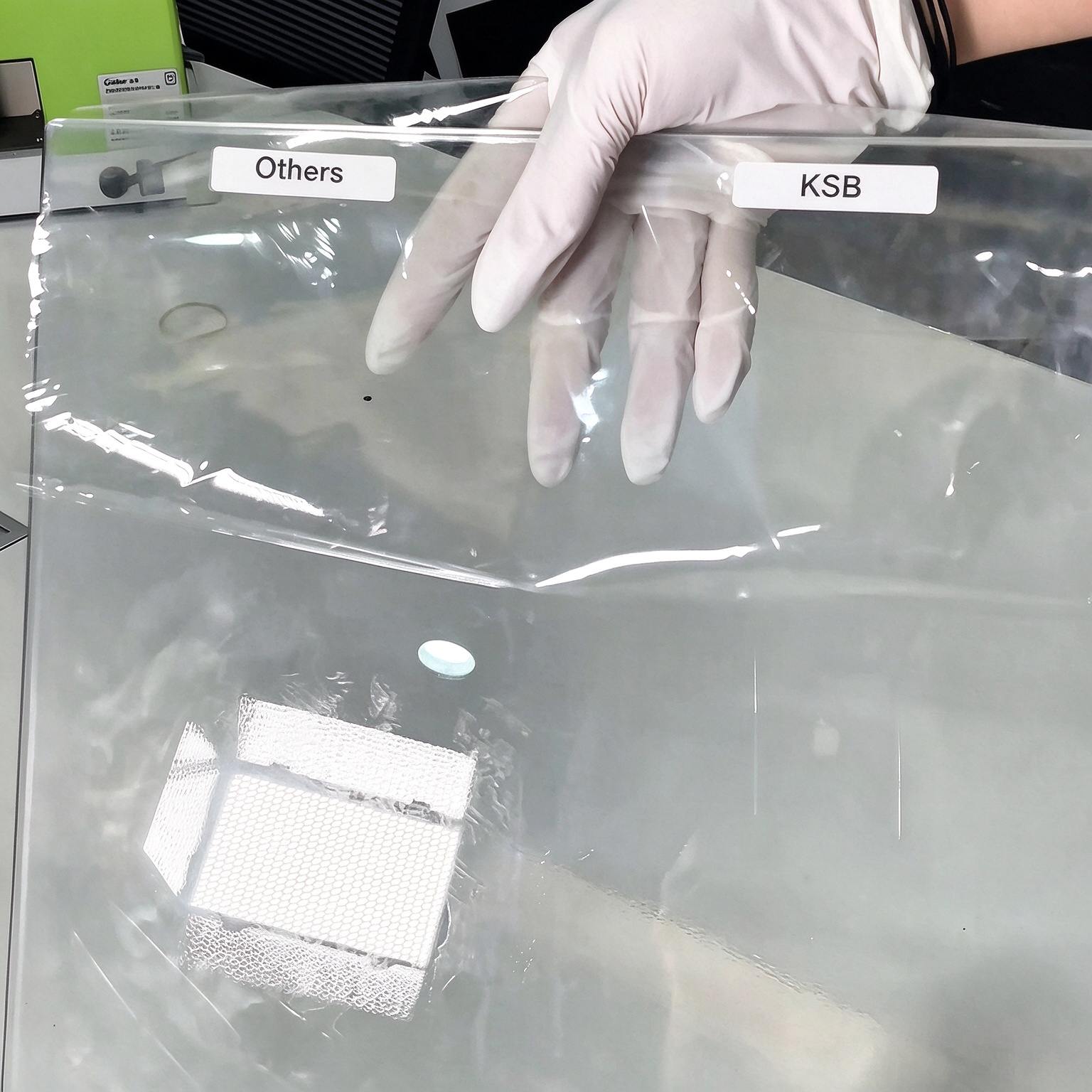
Two automotive window films can have the same VLT and similar heat-rejection specifications, yet look noticeably different once installed.
One looks almost invisible through the glass.
The other may appear slightly cloudy, soft or reflective—especially when looking toward headlights, road signs or strong sunlight.
Why?
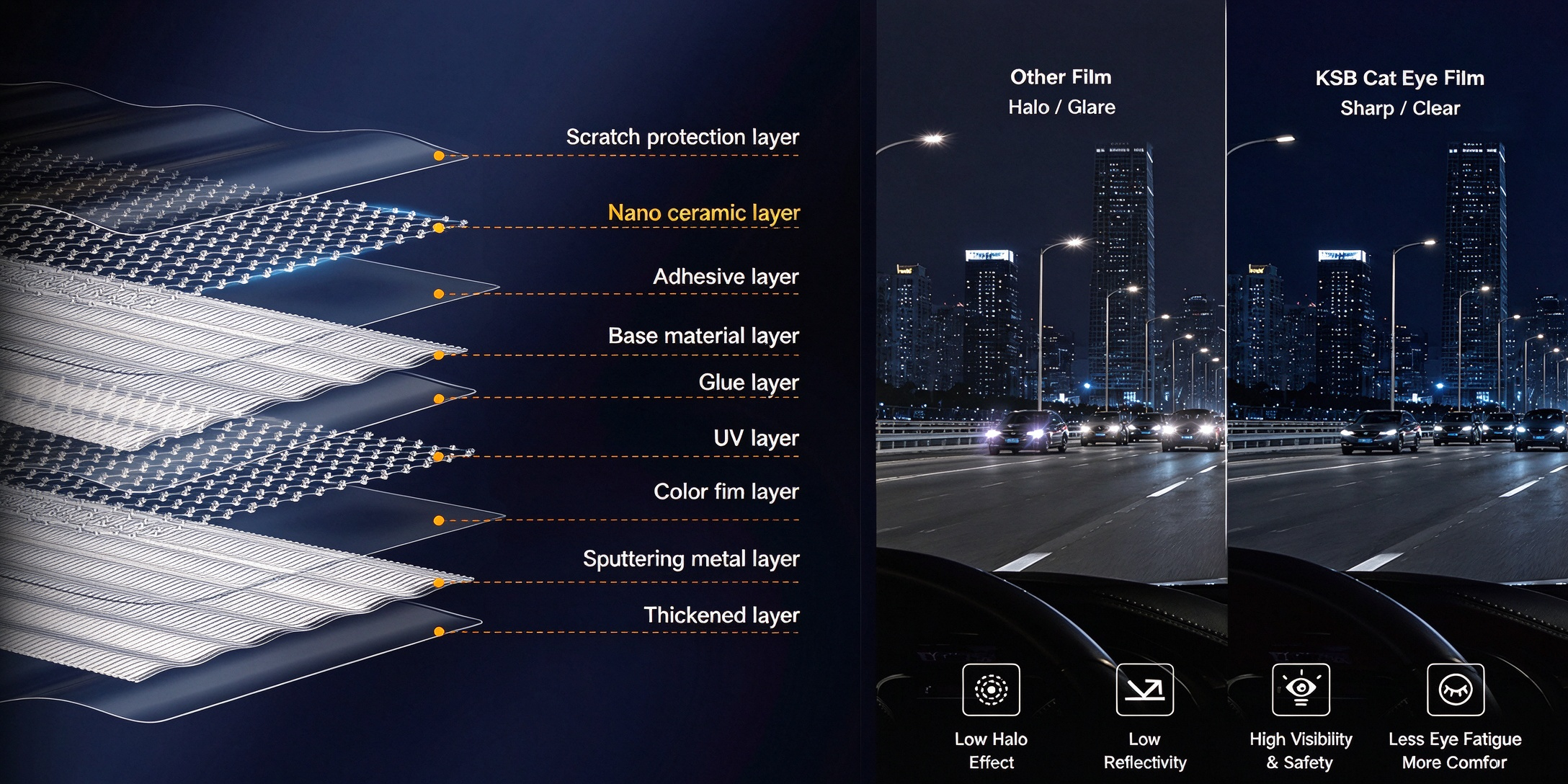
Optical clarity is not determined by one specification.
It starts with the PET substrate, but it is also influenced by functional materials, particle dispersion, coating uniformity, adhesive quality and the way the complete film controls transmitted and scattered light.
For high-clarity automotive window film, these factors have to work together.
A simplified way to understand the process is:
Optical-Grade PET
↓
Nano-Scale Functional Materials
↓
Controlled Dispersion
↓
Precision Coating
↓
Optical Transmittance Control
↓
Reduced Light Scattering
↓
Low Haze
↓
High Clarity
Let’s look at what happens at each stage.
What Does “Ultra Clear” Mean in Window Film?
“Ultra clear,” “HD” and “crystal clear” are common terms in automotive window film marketing.
But they are not, by themselves, technical specifications.
When we talk about an ultra-clear automotive film, we are usually describing a combination of optical characteristics, including:
low haze
good visible-light transmission for the intended VLT
controlled internal reflection
low optical distortion
and consistent appearance across the film
This distinction matters.
A film can have a high VLT and still look less clear because of haze or other optical effects.
Likewise, a film can achieve high infrared rejection without automatically providing high optical clarity.
So rather than asking:
“Is this an HD window film?”
a professional buyer should ask:
“What makes this film optically clear, and what finished-film data supports that claim?”
1. Optical-Grade PET: Where Clarity Begins
Most automotive window films are built on a PET substrate.
For high-clarity products, the optical quality of that PET matters.
PET is not simply a carrier for the functional coating. Light must travel through it every time a driver looks through the glass.
If the substrate itself introduces excessive light scattering, impurities or optical inconsistency, the finished product starts with a disadvantage.
This is why selected ultra-clear constructions use optical-grade PET.
For example, KSB uses PET with substrate haze below 0.25% in selected high-clarity film constructions.
That number refers to the PET itself.
It should not be confused with the haze of the finished window film.
Once coatings, functional materials, adhesive and other layers are added, the optical properties of the complete film change.
For selected constructions, the finished-film haze can be controlled to approximately 0.5% or lower.
This distinction is important:
Low-haze PET is the starting point. Finished-film haze is the result that matters to the buyer.
2. Why Nano Particle Size Matters
For nano ceramic window films, functional materials are used to control solar energy while maintaining visible-light transmission.
The size of these materials can influence optical performance.
When particles interact with visible light, their size, optical properties and distribution can affect how much light is scattered.
For selected KSB nano ceramic constructions, functional particle sizes can be below:
20 nm
Using very fine functional materials helps manufacturers develop coatings that combine solar-control performance with high optical clarity.
But there is an important caveat.
Smaller particles do not automatically mean clearer film.
A supplier cannot prove optical quality simply by saying:
“Our particles are under 20 nm.”
Why?
Because what happens to those particles after they enter the coating system matters just as much.
3. Nano Dispersion: Small Particles Need to Stay Small
Imagine putting an extremely fine powder into a liquid.
The individual particles may be tiny, but if they gather together into clusters, the effective size of those clusters becomes much larger.
This phenomenon is known as agglomeration.
A similar challenge exists when working with nano-scale functional materials.
If the particles are not properly dispersed, they can form clusters within the coating.
Those clusters can increase visible-light scattering and reduce optical consistency.
This is where nano dispersion technology becomes important.
The objective is to maintain a controlled and uniform distribution of functional materials throughout the coating.
In simplified terms:
Small particles + poor dispersion
can still result in:
particle clusters → more light scattering → higher haze
while:
Small particles + controlled dispersion
can support:
uniform coating → reduced scattering → lower haze
This is why particle size and dispersion should be considered together.
4. Precision Coating: Uniformity Across the Film
Once the functional materials are properly prepared, they still have to be applied to the PET substrate.
This is another critical step.
A laboratory sample only needs to look good over a small area.
A commercial automotive film roll may be:
1.52 m × 30 m
For a manufacturer, maintaining optical consistency across that entire area is a different challenge.
The coating needs to remain controlled across:
the width of the film
the length of the roll
and different production batches.
Variations in coating thickness or material distribution can affect optical performance and appearance.
Precision coating is therefore not simply about making a smooth surface.
It is about maintaining the functional layer within controlled parameters across commercial-scale production.
For distributors, this matters because a specification sheet based on one excellent sample means little if the next production batch performs differently.
5. How Light Travels Through Window Film
To understand clarity, it helps to look at what happens to visible light.
When visible light reaches an automotive window film, several things can happen.
Some light is:
transmitted
some is:
reflected
and some transmitted light may be:
scattered.
For a high-clarity film, the goal is not simply to maximize one number.
The optical system needs to maintain the required VLT while controlling unwanted scattering and reflection.
This is why three specifications are particularly useful:
| Specification | What It Tells You |
|---|---|
| VLT | How much visible light is transmitted |
| Haze | How much transmitted light is scattered |
| VLR | How much visible light is reflected |
These values describe different optical behaviors.
A 70% VLT film, for example, does not automatically have better clarity than another film simply because its VLT is high.
The haze and reflection values still matter.
6. Reduced Light Scattering = Lower Haze
This is where the previous manufacturing steps come together.
A good optical substrate provides a clean foundation.
Well-controlled functional materials help deliver the required solar-control performance.
Proper dispersion reduces particle agglomeration.
Uniform coating helps maintain consistency.
Together, these factors can reduce unnecessary visible-light scattering.
The measurable result is:
Lower Haze
Haze describes the scattering of transmitted light through the film.
For high-clarity automotive applications, selected finished films can achieve haze around:
≤0.5%
But haze should never be viewed as a standalone “quality score.”
It is one optical specification among several.
→ Related: What Is Haze in Window Film? Why It Matters for Driving Clarity
→ Related: Low Haze Window Film: What Does ≤0.5% Haze Actually Mean?
这两个地方直接链接你前面的两篇文章。
7. Why Internal Reflection Also Matters
A film can have low haze and still create an undesirable viewing experience if internal reflection is too high.
This becomes especially noticeable at night.
Dashboard displays, infotainment screens and interior lights can reflect from the glass and become visible in the driver’s field of view.
That is why high-clarity film development also needs to consider visible-light reflection.
Selected ultra-clear film constructions can be engineered toward relatively low internal visible-light reflectance, depending on VLT and film structure.
For some KSB high-clarity constructions, internal visible-light reflectance can be around:
6%
The important point is that:
Haze and reflection are different.
Haze describes transmitted-light scattering.
Reflection describes light being reflected from the glazing system.
Both can affect perceived clarity.
8. What About the Adhesive?
The adhesive is easy to overlook because customers rarely see it as a separate component.
Optically, however, it is part of the finished film.
Automotive window film contains multiple material interfaces.
Light has to pass through the complete construction—not just the PET and functional coating.
Adhesive quality, uniformity and compatibility with the rest of the film can therefore affect the final optical appearance.
Installation also matters.
Immediately after wet installation, residual moisture between the film and glass can temporarily make the film appear hazy or uneven.
That temporary appearance should not automatically be confused with the inherent haze of the film.
For accurate comparison, installed samples should be evaluated after an appropriate curing period.
9. Does Higher IR Rejection Reduce Clarity?
Not necessarily.
Heat rejection and optical clarity are different performance dimensions.
A well-engineered automotive film can provide high infrared rejection while maintaining low haze.
But increasing functional-material loading without properly controlling the optical system can create trade-offs.
This is why manufacturers have to balance:
IR rejection
VLT
TSER
haze
reflectance
and appearance.
The goal is not simply to maximize IRR.
For example:
99% IRR does not automatically mean the film is clearer, nor does it mean 99% of total solar heat is rejected.
Professional buyers should review IRR together with TSER and the film’s optical specifications.
10. Is Nano Ceramic the Only Way to Make Ultra-Clear Window Film?
No.
This is an important distinction.
Nano ceramic technology can be used to manufacture high-clarity automotive films, but it is not the only technology capable of doing so.
Sputtered window films can also be engineered for low haze and high optical clarity.
The manufacturing mechanism is different.
Nano ceramic constructions rely on carefully controlled functional materials, dispersion and coating systems.
Sputtered films use vacuum deposition to create very thin functional layers on the substrate.
Both approaches can produce high-performance films.
Therefore:
“Ultra clear” describes the optical result—not one specific manufacturing technology.
→ Related: Nano Ceramic vs. Sputtered Window Film: What’s the Difference?
这个地方直接内链上一篇。
From Raw Material to Ultra-Clear Window Film
If we put the whole process together, the logic becomes easier to understand.
Step 1 — Optical-Grade PET
Start with a substrate that already has low optical haze.
↓
Step 2 — Functional Materials
Select materials capable of delivering the required solar-control performance.
↓
Step 3 — Nano-Scale Control
For ceramic constructions, control functional-material characteristics such as particle size.
↓
Step 4 — Controlled Dispersion
Prevent excessive agglomeration and maintain uniform material distribution.
↓
Step 5 — Precision Coating
Apply the functional layer consistently across commercial production rolls.
↓
Step 6 — Optical Optimization
Balance visible-light transmission, scattering and reflection.
↓
Step 7 — Finished-Film Testing
Measure the complete construction—not only the raw PET.
↓
Result
Low Haze + Controlled Reflection + High Optical Clarity
How Should Professional Buyers Evaluate an Ultra-Clear Window Film?
If you’re sourcing automotive window film for distribution or private labeling, avoid evaluating clarity from marketing terms alone.
“Ultra Clear,” “HD” and “Crystal” are useful product descriptions, but they do not replace measurable specifications.
Ask the manufacturer for:
Finished-film haze
PET substrate haze
VLT
Interior and exterior visible-light reflectance
IRR and measurement conditions
TSER
UVR
Film thickness
Weathering or durability information
Then ask for samples.
A useful sample comparison should include more than looking at film under office lighting.
Install comparable samples on glass and evaluate them under:
daylight
strong sunlight
nighttime point-light sources
and interior lighting.
For wholesale buyers, it is also worth asking for samples from different production batches when moving toward larger-volume purchasing.
The goal is not only to find a film that can achieve good clarity.
The goal is to find one that can achieve it consistently.
Why Manufacturing Consistency Matters for Distributors
For a retail customer, one roll may be enough.
For a distributor, it isn’t.
If you are purchasing hundreds of rolls or building your own window film brand, consistency becomes part of the product specification.
A film that measures 0.45% haze in one sample but varies significantly between production batches can create problems for:
installers
dealers
product positioning
and repeat customers.
This is why B2B evaluation should include both:
Performance
and
Production consistency
The manufacturing process behind the specification matters.
How This Relates to Cat Eye Window Film
KSB’s Cat Eye Film range was developed around this same optical-performance concept.
“Cat Eye” is not a separate material category.
It describes a product positioning focused on characteristics such as:
low haze
high clarity
controlled internal reflection
and solar-control performance.
Depending on the product construction, these characteristics can be achieved using either:
nano ceramic
or
sputtered technology.
→ Read: What Is Cat Eye Window Film? A Guide to Ultra-Clear Automotive Window Film
这里回链到整个题群的 Pillar Page。
FAQ
What makes automotive window film ultra clear?
Optical clarity depends on the complete film construction, including PET substrate quality, functional materials, particle dispersion, coating uniformity, adhesive, haze and visible-light reflection.
Does optical-grade PET improve window film clarity?
Low-haze optical-grade PET provides a good foundation for high-clarity film, but it does not determine the finished-film clarity by itself. Other coatings and layers also affect optical performance.
Are smaller nano particles always better?
Not necessarily. Particle size is only one factor. Dispersion, concentration, coating formulation and overall film construction also influence optical performance.
What does <20 nm mean in nano ceramic film?
It refers to the approximate size of selected nano-scale functional materials used in certain ceramic film constructions. It should not be interpreted as a standalone measure of finished-film quality.
Does low haze mean high VLT?
No. Haze measures transmitted-light scattering, while VLT measures how much visible light passes through the film. They are different specifications.
Can sputtered window film also be ultra clear?
Yes. Both nano ceramic and sputtered window films can be engineered for low haze and high optical clarity.
Why can newly installed window film look hazy?
Residual installation moisture can temporarily affect appearance after wet installation. The film should be evaluated after an appropriate curing period before concluding that the haze comes from the film itself.
What should distributors check when sourcing ultra-clear window film?
Professional buyers should compare finished-film haze, VLT, reflectance, IRR, TSER, UVR, durability and production consistency, then verify performance using installed samples.
Further Reading
On this site:
- Low Haze Window Film: What Does Haze ≤0.5% Actually Mean?— Understanding low-haze specifications and optical clarity
- What Is Haze in Window Film? Why It Matters for Driving Clarity— How light scattering affects automotive visibility
- Nano Ceramic vs. Sputtered Window Film: What’s the Difference?— Comparing ceramic and sputtered film technologies
- How Nano Ceramic Window Film Is Manufactured— Key manufacturing steps from materials to finished film
- How to Test Nano Ceramic Window Film Performance— Key methods for evaluating film performance
Looking for Ultra-Clear Automotive Window Film?
For distributors and private-label brands, the question isn’t simply whether a film is called “HD” or “ultra clear.”
The more useful question is:
How is that clarity achieved—and can it be produced consistently?
KSB manufactures nano ceramic and sputtered automotive window films for different VLT, optical and solar-control requirements.
If you are developing a premium automotive film line, low-haze windshield film or private-label window film range, we can provide technical specifications and samples based on your target requirements.
Tell Us Your Target Specifications
VLT · Haze · IRR · TSER · Reflectivity · Application
Get a Free Sample or Quote
Looking for a reliable window film supplier? Contact us today for fast response and professional support.