Published: August 14, 2026 · 9 min read · Category: Sourcing Guide
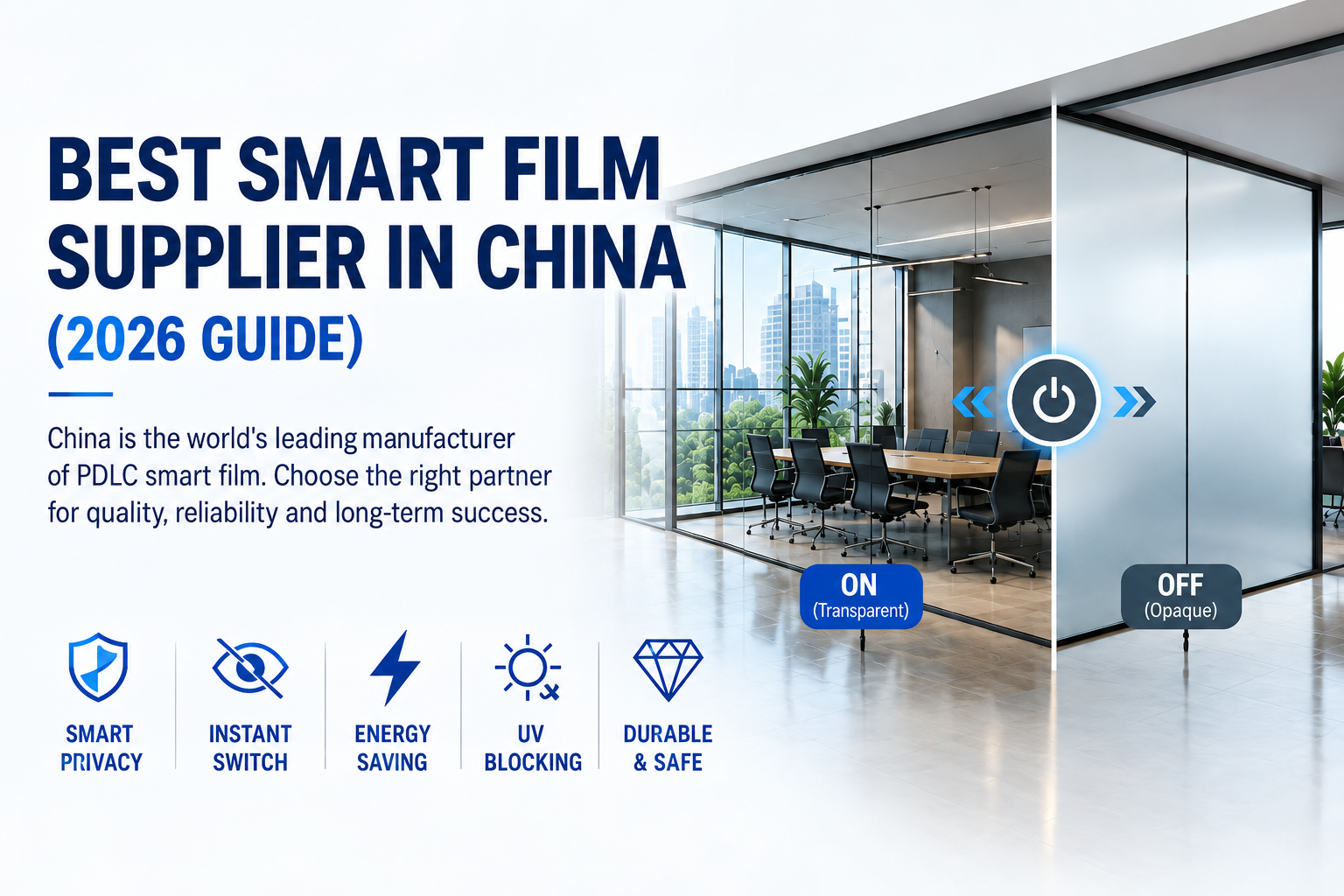
China manufactures the majority of the world’s PDLC smart film. That’s a supply chain reality, not a quality statement — because as with window film and PPF, the gap between the best Chinese smart film manufacturers and the worst is large enough that the country of origin is far less important than which specific factory you’re dealing with.
This guide covers what the Chinese smart film manufacturing landscape looks like, what separates capable producers from the noise, and how to build a supplier shortlist that will hold up when you start placing real orders.
The Market Structure
Smart film manufacturing in China is concentrated in a few industrial hubs, with Shenzhen, Dongguan, and Guangzhou in Guangdong province accounting for the largest share. A secondary cluster exists in Jiangsu (Suzhou, Nanjing).
Unlike window film or PPF, where genuine manufacturing requires significant capital equipment (sputtering lines, precision coating systems), PDLC smart film production has a somewhat lower barrier to entry at the basic tier. This has produced a market with many more suppliers than serious manufacturers — companies that buy PDLC emulsion, basic ITO-coated PET film, and encapsulate them into finished product with varying degrees of quality control.
The practical result: an Alibaba search for “smart film” or “PDLC film” returns hundreds of suppliers, most of whom are either trading companies or low-tier converters. The number of manufacturers with genuine R&D capability, consistent ITO coating quality, and documented performance on commercial projects is substantially smaller.
The verification methodology is the same as for any Chinese film manufacturer. The Window Film Factory Audit Checklist questions translate directly to smart film supplier evaluation — with a few additions specific to the PDLC production process.
What Good Looks Like: Key Evaluation Criteria
ITO Coating Quality and Uniformity
The ITO (Indium Tin Oxide) transparent conductive layer is the component most responsible for switching quality. Non-uniform ITO creates uneven electric fields across the film, resulting in patchy transparency — some areas clear faster or more completely than others. This “patchiness” in the transparent state is the most common quality complaint about budget smart film.
Evaluating ITO quality without a lab isn’t straightforward, but you can test it practically: apply voltage to a sample and examine the transparency uniformity from multiple angles and in consistent lighting. Premium film switches evenly and completely across the entire surface. Budget film often shows subtle areas of differential clarity.
Ask the manufacturer: who supplies your ITO-coated PET? What is the sheet resistance specification of the ITO layer? A manufacturer who can answer this in technical terms is working from a documented material specification. One who can’t is buying whatever they can get.
PDLC Emulsion Chemistry
The liquid crystal/polymer emulsion is the core functional material. Quality varies significantly — better emulsions produce lower haze in the transparent state, faster switching, better contrast between on and off states, and longer cycle life.
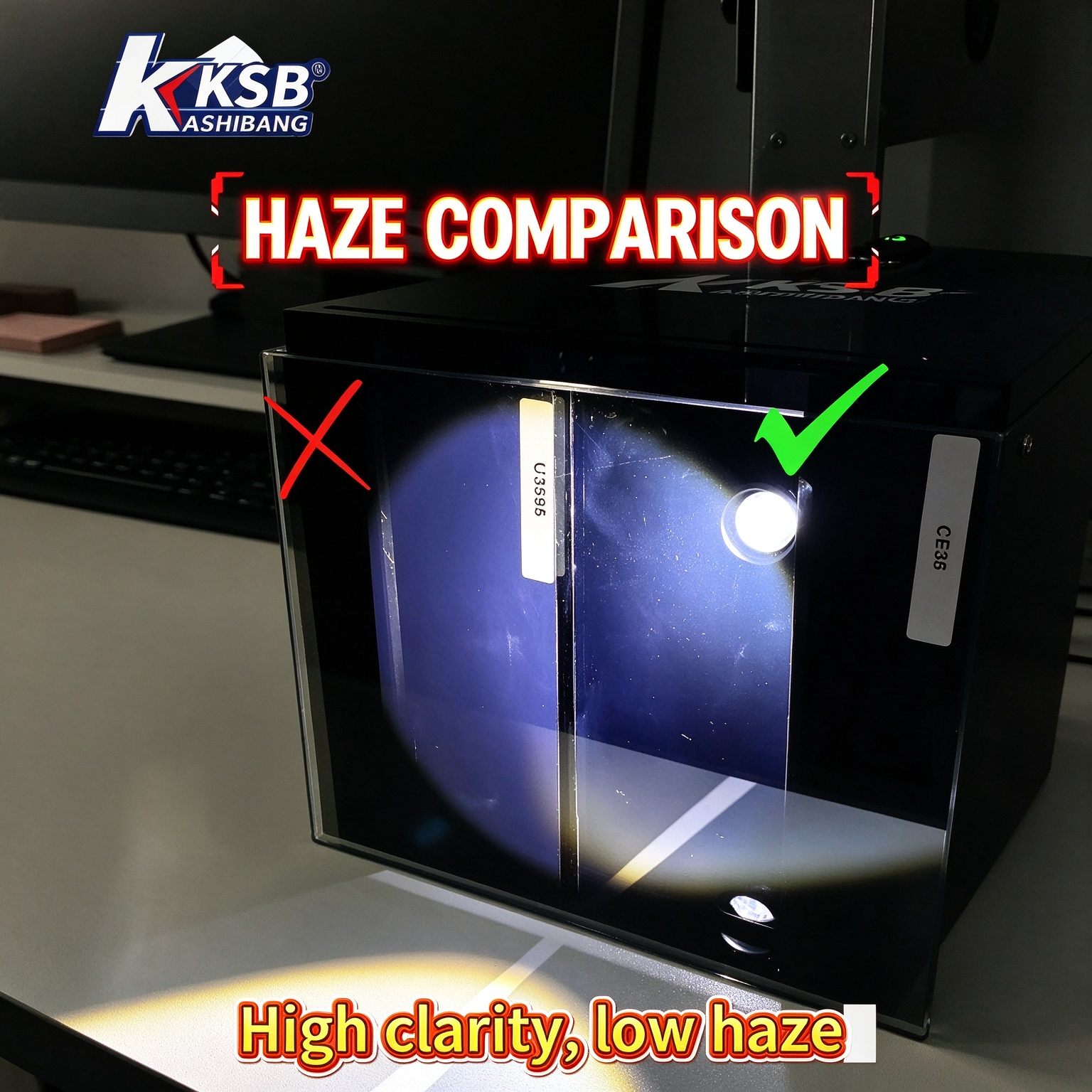
Visible haze in the transparent state is the practical quality indicator. Test this with a haze meter if possible; assess it visually by looking at text through the film with voltage applied. Premium film: text is clearly legible through the film. Budget film: text may be blurred or obscured by residual haze.
Switching Speed and Cycle Life
Quality smart film switches in under 0.5 seconds. Budget film can take 1–3 seconds, which is noticeably slow in office environments. Ask for third-party test data on switching speed.
Cycle life — how many on/off cycles before performance degrades — should be rated at 100,000+ cycles for quality products. Budget products may not have this tested at all.
Bus Bar and Electrical Connection Quality
Poor bus bar design or installation is the leading cause of installation problems with smart film. A quality product has well-designed, reliably bonded bus bar connections that make consistent electrical contact with both ITO layers.
Ask to see how bus bar connections are designed and how the installer makes the electrical connection. Products with unclear or complicated bus bar connection systems create installation problems in the field.
Export Track Record
Smart film exports to commercial project markets in the US, EU, UK, and Australia face specific demands: documentation requirements, certifications (CE for EU, UL or ETL for US electrical components), and buyers who will call with technical questions. Suppliers who’ve shipped commercial projects in your target market understand these requirements. First-timers don’t.
Notable Chinese Smart Film Manufacturers (2026)
Verified production capability, not paid placement. Due diligence remains essential for your specific requirements.
Shenzhen Huake-Tek
Location: Shenzhen, Guangdong Strengths: One of the larger dedicated PDLC film manufacturers; strong commercial project track record across Asia, Middle East, and Europe; full-system offering (film + power supply + controller); active in architectural and interior design channels Known for: Consistent ITO uniformity, low haze products. CE certification for EU market. Good fit for: Distributors and project suppliers targeting commercial architectural markets
Guangzhou Polytronix-Partner (合作品牌)
Location: Guangzhou, Guangdong Strengths: Established supply relationships with interior design firms and glazing contractors; strong documentation and project support capability; range covers standard PDLC through specialty products including fire-rated smart film Known for: Project-focused sales support; ability to handle complex specifications Good fit for: Contract glazing and architectural supply channels
Suzhou Smart Film Technology
Location: Suzhou, Jiangsu Strengths: Manufacturing background in advanced materials; better integration with technical electrical systems; strong for projects requiring BMS/KNX integration; product range includes ultra-clear premium series Known for: Low-haze premium products; more technically rigorous QC process than average Good fit for: High-specification commercial projects; buyers requiring premium optical performance
Shenzhen Chiefway Technology
Location: Shenzhen, Guangdong Strengths: Good mid-range product with competitive pricing; established OEM program; active exporter with documented US and Australian project history; responsive to private label enquiries Known for: Consistent product at value pricing; reliable account management Good fit for: Distributors building a mid-market smart film product range
Certifications to Look For
CE marking (Europe): Required for the electrical components (power supply, controller) sold into EU markets. The film itself isn’t subject to CE marking, but the complete system (film + electrical components sold as a unit) should have appropriate documentation.
RoHS compliance: Restriction of Hazardous Substances — required for electrical products sold in EU markets. Smart film controllers and power supplies should be RoHS compliant.
UL or ETL listing (US): Electrical components for US commercial installations increasingly require UL or ETL listing. Not all Chinese manufacturers pursue this, but those actively targeting the US commercial market often do.
ISO 9001: Quality management system certification. Verify it as you would for any film manufacturer — certificate number, accreditation body, scope statement.
SGS/Intertek performance testing: Third-party test reports on haze, transmittance, switching speed, and UV stability. Request current, product-specific reports.
OEM and Private Label for Smart Film
Smart film is well-suited to private label programs — the product lends itself to differentiation by brand positioning, and several Chinese manufacturers have mature OEM programs.
What OEM smart film typically covers:
- Branded film (your logo/brand on the film packaging)
- Branded power supply and controller units
- Branded installation documentation and warranty certificates
- Optional: proprietary controller design with your branding
MOQ for smart film private label typically starts at 200–500sqm per SKU. Custom controller design requires higher volumes and longer development lead time.
For the full OEM brand building framework, How to Start Your Own Window Film Brand covers the principles that apply equally to smart film.
Import Considerations
Smart film imports involve both the film and the electrical components (transformer and controller). The electrical components may be subject to different import classifications and duties than the film itself.
For US buyers, Section 301 tariffs affect Chinese-manufactured goods including smart film components. Verify the current applicable duty rate for your specific HS codes before calculating landed costs.
For EU buyers, CE marking documentation for the electrical system components is required for legal sale. Confirm your supplier can provide appropriate CE documentation before ordering.
The complete import process is covered in How to Import Window Film from China: Complete Buyer’s Guide — the process is essentially the same for smart film.
FAQ
1. Why is China the main supplier of smart film?
China dominates global PDLC smart film production due to its advanced supply chain, coating technology, and large-scale manufacturing clusters in Shenzhen, Dongguan, Guangzhou, and Jiangsu.
2. What should I check when choosing a smart film supplier?
Key factors include ITO coating uniformity, PDLC emulsion quality, switching speed, haze level in transparent state, bus bar connection design, and third-party test certifications such as SGS or CE.
3. What certifications should a reliable smart film supplier have?
Reliable suppliers should provide CE, RoHS, ISO 9001 certification, and third-party test reports for optical performance, switching speed, UV stability, and electrical safety compliance.
Further Reading
On this site:
- What Is Smart Film? Everything You Need to Know — Product foundation before supplier evaluation
- How to Verify a Window Film Factory Before Placing an Order — Universal verification methodology applicable to smart film
- What Certifications Should a Window Film Manufacturer Have? — Certification evaluation framework
- How to Import Window Film from China: Complete Buyer’s Guide — Import process
- Top 7 Window Film Manufacturers in China (2026 Verified List) — Parallel guide for window film sourcing
External:
- Panjiva Trade Intelligence — Search any Chinese smart film exporter’s actual shipment history
- SGS Factory Audits China — Third-party audit for buyers who can’t visit in person
- KNX Association Certified Products — Verify KNX compatibility for smart home integration products
- UL Product iQ — Verify UL listing status for electrical components
Get a Free Sample or Quote
Looking for a reliable window film supplier? Contact us today for fast response and professional support.