Decoding PPF Coating Film: Self-Healing vs. Instant-Healing Technology
Published: July 20 , 2026 · 8 min read · Category: PPF Technology
About this article:KSB Window Film’s R&D team develops both heat-activated self-healing and instant-healing top coat systems for our PPF range. This guide provides the technical comparison that B2B buyers need to specify the right product for their market.
Heat-activated self-healing and instant-healing PPF coatings offer different recovery speeds, hardness levels, and climate suitability for automotive protection.
“Self-healing” PPF has been a marketing claim for over a decade. More recently, “instant-healing” or “秒修” (second-healing in Chinese) has appeared as a premium descriptor. The distinction between these two technologies is real — but so is the marketing confusion around them. This guide clarifies the mechanism of each, when each performs better, and what buyers should verify before choosing.
Heat-Activated Self-Healing: The Original Technology
The Mechanism
Heat-activated self-healing is based on shape memory polymer (SMP) chemistry or elastic recovery in crosslinked polyurethane top coats.
When the top coat is scratched:
The scratch deforms the polymer network — polymer chains are displaced from their equilibrium configuration
Energy input (heat) provides the thermal energy needed for polymer chain mobility
The polymer network recovers toward its equilibrium state — the displaced material flows back
The scratch closes
The top coat must have two competing properties:
Elastomeric recovery: Sufficient polymer chain mobility to allow recovery
Surface hardness: Sufficient crosslink density to resist re-scratching after healing
These properties pull against each other — higher hardness reduces healing speed and completeness. The engineering challenge is achieving adequate hardness (to resist future scratching) while maintaining adequate recovery rate.
Performance Characteristics
Healing conditions: Typically requires surface temperature of 60°C+ for efficient healing. This is achieved by:
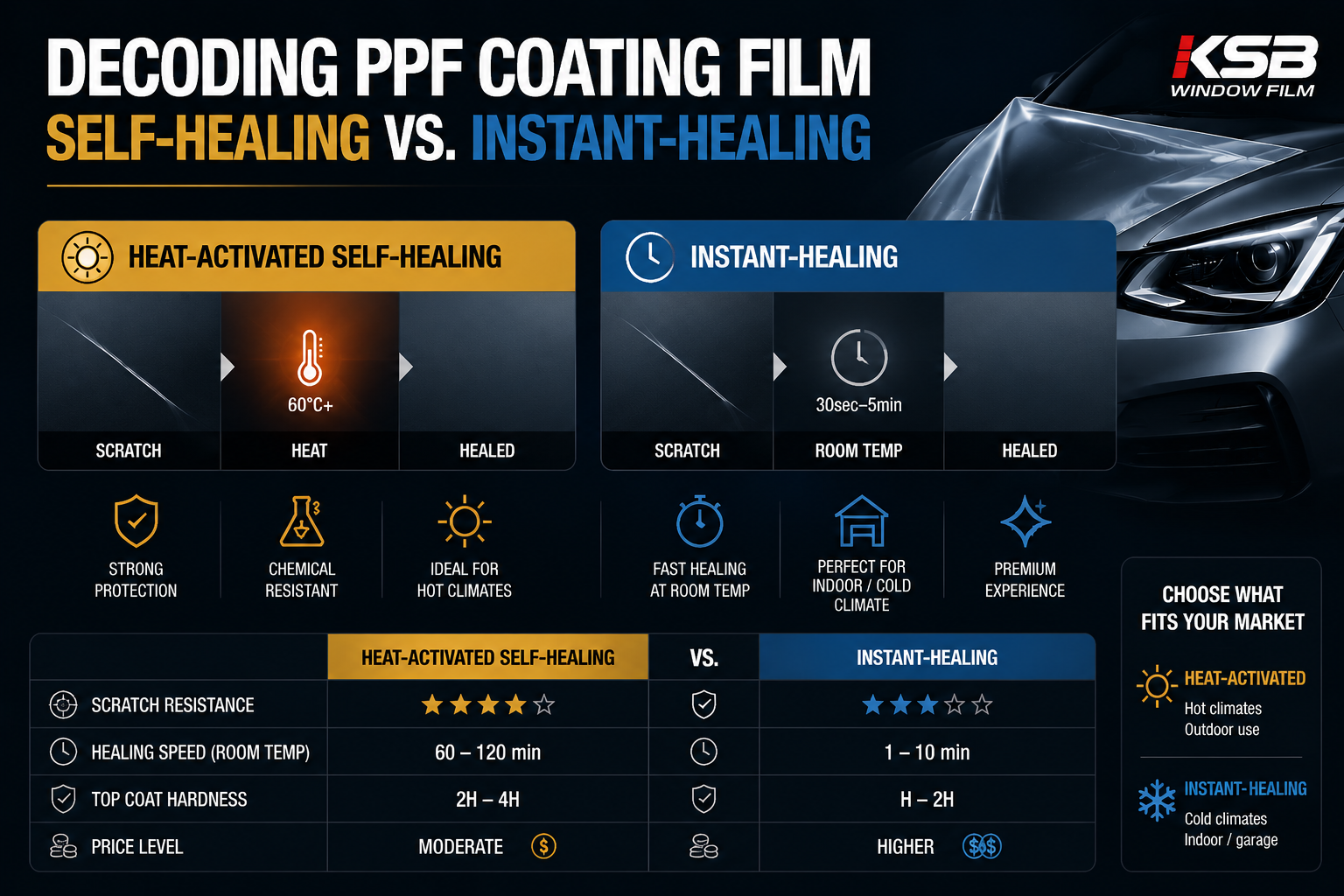
Direct sunlight (car parked outdoors in summer): 20–45 minutes for light scratches
Warm water pour (60°C water): 30–60 seconds
Heat gun (controlled at 60°C surface temperature): 1–2 minutes
What heals: Light surface scratches (fingernail scratches, fine swirl marks, car wash brush contact). Scratches that penetrate below the top coat into the TPU base don’t self-heal from the top coat alone.
What doesn’t heal: Deep scratches (cutting into TPU), rock chips that displace film material, chemical etching.
Instant-Healing Technology: The New Generation
The Mechanism
Instant-healing (sometimes called ambient-healing or room-temperature healing) is a more demanding engineering achievement. The top coat is formulated with either:
Option A — Ultra-soft elastomeric matrix: Extremely low crosslink density in the top coat polymer network, allowing chain mobility at room temperature (20–25°C) rather than requiring elevated temperature. Recovery occurs within seconds to minutes at ambient conditions.
The trade-off: Lower crosslink density = lower hardness = more easily scratched initially. Ultra-soft instant-healing top coats are excellent at recovering light contact marks but have pencil hardness of H–HB rather than 2H–3H for standard self-healing coats.
Option B — Dynamic crosslink chemistry (Vitrimers): Uses dynamic covalent bond chemistry where crosslinks can exchange and reform at ambient or mild temperature conditions. The network flows locally at the scratch location while maintaining overall structural integrity. This approach achieves better hardness-healing balance but is more expensive to formulate.
Option C — Microcapsule healing: Healing agents encapsulated in microcapsules within the top coat are released when the coating is scratched. Released agents fill the scratch and crosslink. Limited to one-time healing per location — once the capsules in an area are ruptured, that area doesn’t re-heal.
Performance Characteristics
Healing conditions: 20–40°C ambient (or below — some formulations heal at 10°C), with no active heat input required.
Healing speed: Light fingernail scratches: 30 seconds to 5 minutes at room temperature.
Hardness: Typically lower than heat-activated products. Pencil hardness H–2H vs 2H–4H for heat-activated.
Performance Comparison: Head to Head
Performance dimension
Heat-activated self-healing
Instant-healing
Top coat hardness
2H–4H (better)
H–2H (lower)
Scratch resistance
Better
Moderate
Healing speed (in summer sun)
20–45 min
1–5 min
Healing speed (indoors, 20°C)
60–120 min (slow)
1–10 min
Healing speed (winter, 5–10°C)
Very slow / incomplete
Moderate
Chemical resistance
Good
Moderate–Good
Bird drop / acid rain resistance
Better (harder surface)
Moderate
Price premium
Moderate
Higher
Which Is Better for Your Market?
Choose heat-activated self-healing for:
Hot climates (Middle East, tropical regions) where ambient temperatures accelerate healing naturally
Customers who primarily use vehicles outdoors where sun exposure provides healing activation
Markets prioritising scratch resistance and chemical resistance alongside healing
Price-sensitive markets where the lower cost is commercially important
Choose instant-healing for:
Cold climate markets (Northern Europe, Canada, Northern US) where summer sun is limited and winter healing from heat is impractical
Urban markets where vehicles park in garages (no sun exposure for heat activation)
Premium market segments where the “hands-free, instant recovery” story has strong consumer appeal
Vehicle detailing studios and PPF installers who want to demonstrate the healing effect in a showroom setting
The combination approach: Some manufacturers offer a dual-technology top coat — a moderate hardness layer with heat-activated primary healing and instant-recovery capability for the shallowest surface marks. KSB’s premium PPF uses this approach.
Evaluating Healing Claims: What to Test
Test 1 — Fingernail scratch at room temperature: Scratch the PPF sample firmly with a fingernail. Wait 5 minutes at room temperature (20–22°C). If the scratch has significantly reduced or disappeared: instant-healing capability. If it remains: heat-activated only.
Test 2 — Heat gun at 60°C: After the room temperature test, apply a heat gun at 60°C surface temperature for 60 seconds to the remaining scratch. If it heals: heat-activated self-healing confirmed.
Test 3 — Repeated scratch test: Scratch the same location 5 times after each healing cycle. Does the film continue to heal on the 3rd and 4th iteration? Quality SMP films heal consistently. Microcapsule designs lose healing capacity after 1–2 cycles.
FAQ
Why do some PPF brands claim “instant self-healing” at 25°C but the healing takes 30 minutes?
“Instant” healing at room temperature is a spectrum. Ultra-soft elastomeric top coats recover light surface marks in 30 seconds–5 minutes at 25°C — that’s genuinely fast. Some products claiming “room temperature healing” actually require 45–90 minutes at 25°C, which is more accurately described as “ambient temperature healing.” Ask for the healing speed specification under defined temperature conditions.
KSB Window Film offers both heat-activated and instant-healing top coat options across our PPF range. Sample rolls with specific top coat designation available.