Why Aliphatic TPU is the Gold Standard for Premium PPF Manufacturing
Published: July 17, 2026 · 9 min read · Category: PPF Technology
About this article: KSB Window Film has manufactured TPU-based paint protection film for over 20 years. Our R&D team works directly with aliphatic TPU compound specifications. This guide shares the materials science behind why aliphatic TPU is the only viable base for premium PPF — with laboratory data to support every claim.
Aliphatic TPU delivers superior UV stability, anti-yellowing performance, and hydrolysis resistance compared to aromatic TPU in premium paint protection films.
Ask any premium PPF manufacturer what their most important raw material specification is, and the answer is consistent: aliphatic TPU, not aromatic. The distinction sounds like chemistry jargon, but it determines whether a film yellows on the car in year two or maintains crystal clarity in year eight. For distributors and installers staking their reputation on the products they recommend, understanding why this material choice matters is essential.
Both aromatic and aliphatic thermoplastic polyurethane (TPU) are produced by reacting a diisocyanate with a polyol. The critical difference is in the diisocyanate component.
Aromatic TPU uses aromatic diisocyanates — specifically MDI (methylene diphenyl diisocyanate) or TDI (toluene diisocyanate). “Aromatic” refers to the benzene ring structure in the molecule.
Aliphatic TPU uses aliphatic diisocyanates — HDI (hexamethylene diisocyanate) or IPDI (isophorone diisocyanate). No benzene rings.
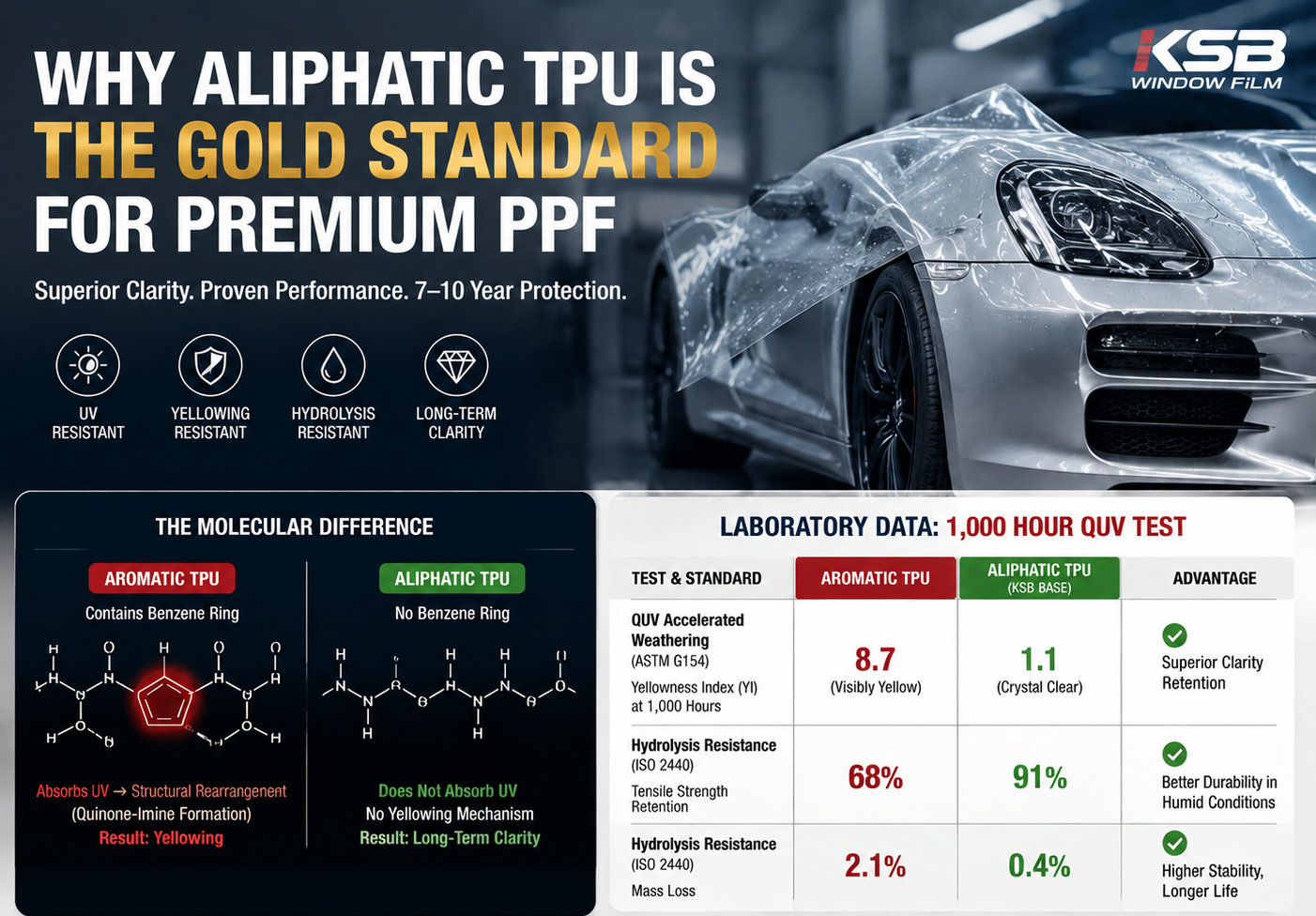
This structural difference has one photochemically decisive consequence: the benzene ring in aromatic diisocyanate absorbs UV radiation and undergoes a structural rearrangement that produces quinone-imine chromophores — yellow-coloured molecular fragments. This is the yellowing mechanism. It’s not a surface phenomenon or a coating failure. It’s a degradation reaction that occurs in the polymer backbone itself, which is why it cannot be reversed or stabilised by surface treatments.
Aliphatic TPU has no benzene rings. Without the UV-absorptive aromatic structure, the yellowing mechanism simply doesn’t exist chemically.
What the Laboratory Data Shows
QUV Accelerated Weathering (ASTM G154)
Both film types were subjected to 1,000 hours of UV-B accelerated weathering per ASTM G154 protocol (0.71 W/m² at 313nm, 60°C black panel temperature, 2-hour water condensation cycle every 8-hour UV cycle).
Results measured by spectrophotometer (Yellowness Index, ASTM E313):
Film type
Initial YI
YI at 500 hrs
YI at 1,000 hrs
Aromatic TPU (standard)
0.8
3.4
8.7
Aliphatic TPU (KSB base)
0.7
0.9
1.1
Yellowness Index above 2.0 is visually detectable under normal conditions. Aromatic TPU crosses this threshold between 200–500 hours of accelerated UV exposure. KSB’s aliphatic TPU remains below 2.0 YI through 1,000 hours — equivalent to approximately 5–7 years of real-world UV exposure.
Hydrolysis Resistance (ISO 2440 Method)
Hydrolysis (water-induced polymer chain cleavage) is the other major degradation mechanism for polyurethane films. Aromatic polyurethanes are generally more susceptible to hydrolytic attack than aliphatics due to the higher electrophilicity of the aromatic urethane linkage.
Testing at 70°C and 95% relative humidity for 1,000 hours:
Property measured
Aromatic TPU
Aliphatic TPU
Tensile strength retention
68%
91%
Elongation at break retention
72%
94%
Mass loss
2.1%
0.4%
For PPF on vehicles in humid tropical climates — Southeast Asia, Gulf States in humid months — hydrolysis resistance directly determines service life.
Why Aromatic TPU Persists in the Market
If aliphatic TPU is clearly superior, why do aromatic-based PPF products exist?
The answer is cost. Aliphatic diisocyanates (HDI, IPDI) cost 50–100% more than aromatic equivalents (MDI, TDI) at the raw material level. This cost flows through to the finished film price. A film manufacturer using aromatic TPU can produce film at lower material cost — which translates to lower ex-works pricing that appears attractive in the initial quotation.
The cost comparison reverses quickly when the customer’s perspective is considered. A film that yellows in year two requires replacement — at the installer’s cost if under warranty, at the customer’s cost if not. The lifetime cost of aromatic PPF on a high-value vehicle is dramatically higher than aliphatic PPF.
The HALS Addition: How Stabilisers Extend Aliphatic TPU Performance Further
Quality aliphatic PPF compounds include HALS (Hindered Amine Light Stabilisers) — radical scavengers that interrupt the photooxidation chain reactions that cause polymer ageing. HALS work in conjunction with aliphatic chemistry rather than against it:
Aliphatic TPU doesn’t yellow through the aromatic mechanism
HALS prevent the broader UV-induced photooxidation that can eventually cause any polymer to degrade
The combination produces the 7–10 year clarity retention that premium PPF promises and aliphatic-with-HALS delivers
Some budget manufacturers add HALS to aromatic TPU and market it as “stabilised.” This slows the yellowing rate but cannot prevent it — the underlying aromatic benzene ring remains photochemically reactive to UV. HALS cannot stabilise what the polymer chemistry makes inherently unstable.
Identifying Aliphatic vs Aromatic TPU: The Buyer’s Tests
For buyers evaluating PPF suppliers, here are field-accessible verification methods:
1. Ask for the TPU compound specification. A manufacturer using aliphatic TPU from a documented source (Covestro, BASF, Huntsman) can provide the compound data sheet confirming HDI or IPDI diisocyanate chemistry. Reluctance to share this information is itself a signal.
2. QUV accelerated yellowing test. The most reliable objective test. A film tested to ASTM G154 for 1,000 hours that shows YI below 2.0 is almost certainly aliphatic-based.
3. UV lamp exposure field test. A 300nm UV lamp (available as a forensic UV inspection lamp) held 10cm from the film surface for 48 hours in a controlled environment will produce visible yellowing in aromatic TPU and none in aliphatic. This is a qualitative field test, not laboratory precision, but it distinguishes between the two.
Why KSB Specifies Aliphatic TPU Without Exception
KSB Window Film uses aliphatic TPU from documented-grade material suppliers across our entire PPF range. We made this specification commitment because our distribution partners in premium automotive markets — where vehicles cost $50,000–$500,000 — cannot afford to recommend a product that yellows. A PPF that changes the appearance of the vehicle it’s protecting is not a protection product.
Our aliphatic TPU compound specification is available on request. Our QUV test data is provided with every sample order.
FAQ
Can HALS stabilisers in aromatic TPU match aliphatic TPU longevity?
No. HALS slows the yellowing rate in aromatic TPU significantly — a HALS-stabilised aromatic film may last 2–3 years before visible yellowing vs. 6–12 months without stabilisation. But the aromatic benzene ring mechanism continues to operate. At 3–5 year exposure levels, HALS-stabilised aromatic TPU still yellows. Aliphatic TPU doesn’t.
Is every film marketed as “TPU” actually aliphatic?
No. “TPU” simply means thermoplastic polyurethane — it says nothing about whether the diisocyanate is aromatic or aliphatic. Some products marketed as “TPU PPF” use aromatic formulations. Request the compound specification or QUV test data to verify.
KSB Window Film provides aliphatic TPU compound documentation and 1,000-hour QUV test data with every sample roll order. See the data before you specify.