Published: July 18, 2026 · 9 min read · Category: Industry Insights
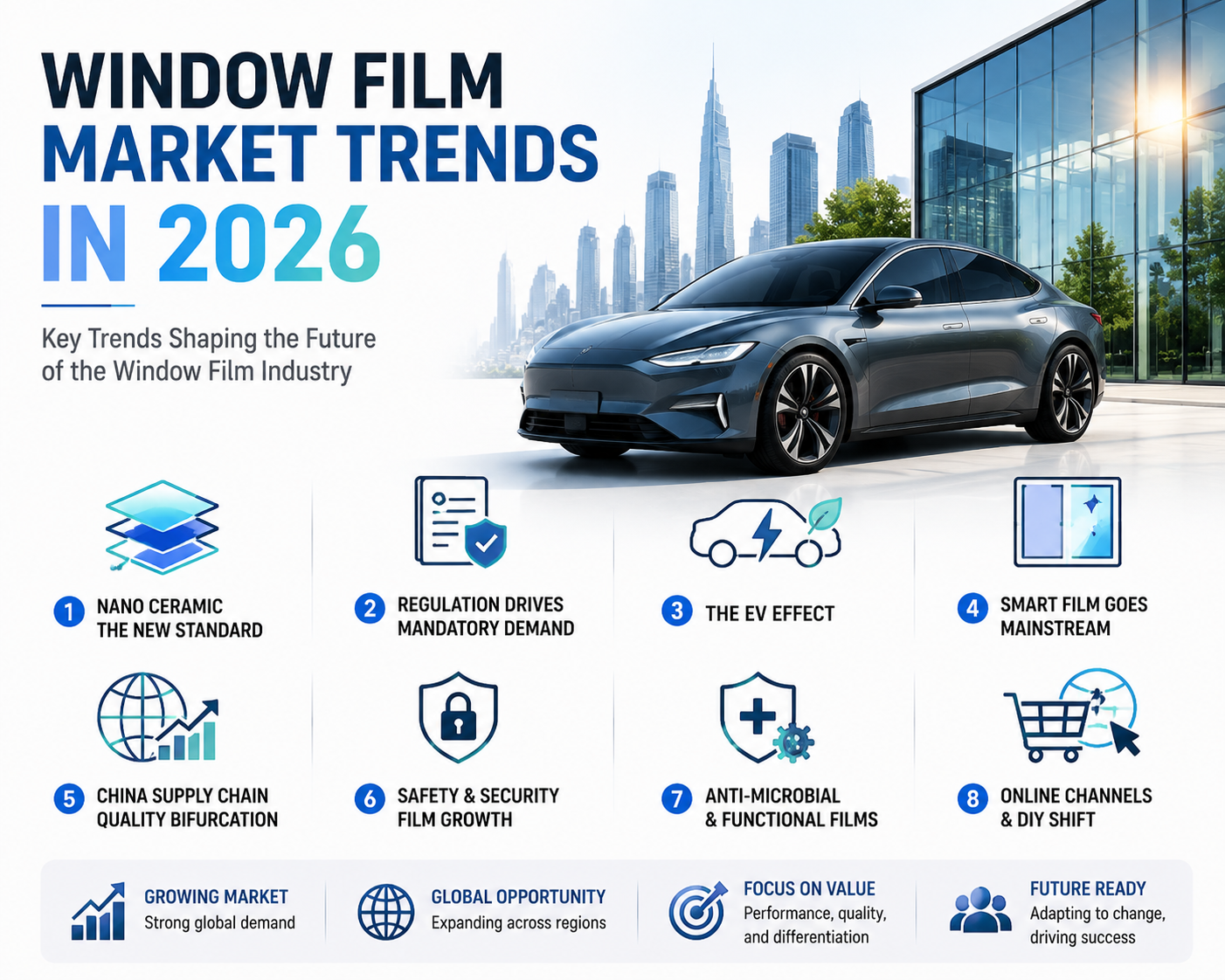
The window film industry has been quietly going through a significant structural shift over the last three to four years. Some of it is technology-driven. Some is regulatory. Some reflects changes in how buildings are designed and how vehicles are spec’d. And some of it is the downstream effect of energy and climate policy working its way through construction and automotive markets globally.
This article covers the trends that are actually moving the market in 2026 — based on what buyers are specifying, what installers are stocking, and what manufacturers are investing in — not the trends that marketing decks claim are emerging.
1. Nano Ceramic Has Become the Professional Standard, Not the Premium Option
Three years ago, nano ceramic was the upgrade conversation in most installer shops. Today, it’s the default recommendation for any customer who isn’t actively price-constrained.
The shift has been driven by a combination of price reduction — genuine ceramic products have come down in cost as manufacturing scale increased, particularly from Chinese producers — and installer education. Professional tinting associations and training programs have done meaningful work communicating the performance advantages of ceramic over carbon and dyed alternatives. Consumers have followed the lead of installers they trust.
The practical market effect: dyed film volumes are declining in professional installer channels. Carbon holds steady in price-sensitive segments. Ceramic is growing. The budget tier has partially migrated online (DIY and budget installers sourcing direct) while professional installer shops differentiate on ceramic quality.
For distributors, this trend has specific implications: the SKU mix that made sense five years ago (heavy dyed volume, some carbon, minimal ceramic) has inverted in many markets. Carrying a deep, quality-verified ceramic range is no longer a premium strategy — it’s a baseline for staying relevant with professional accounts.
2. Energy Efficiency Regulation Is Creating Mandatory Demand
Window film is increasingly being pulled into building energy efficiency frameworks rather than just being sold into them.
In the EU, the Energy Performance of Buildings Directive (EPBD) is driving retrofits across commercial and residential building stock. Window film — particularly solar control ceramic film — is one of the lower-cost interventions available for improving glazing performance without full window replacement. Specifiers who previously wouldn’t have considered film are now evaluating it as part of compliance pathways.
In the US, updated ASHRAE 90.1 standards and state-level building codes in California, Florida, and Texas are embedding solar heat gain requirements that make window film a relevant specification tool for existing buildings.
In the Middle East and Southeast Asia, ESMA requirements (UAE), Singapore’s BCA Green Mark scheme, and equivalent regional frameworks are creating institutional demand for certified solar control film in commercial buildings.
The impact for suppliers: buyers in commercial construction channels are increasingly asking for NFRC certification, SHGC data, and compliance documentation alongside product performance specs. Manufacturers who’ve invested in this certification infrastructure have a significant advantage in commercial specification channels over those who haven’t.
3. The EV Effect on Automotive Window Film
Electric vehicles are changing the value proposition of window film in ways that haven’t yet been fully communicated to consumers.
In an internal combustion vehicle, cabin cooling is effectively “free” — waste heat from the engine runs the A/C with minimal incremental fuel cost. In an EV, A/C is powered directly from the battery, with a measurable impact on range. High-quality window film that reduces heat gain reduces A/C demand, which extends range. For an EV owner experiencing range anxiety, a meaningful range extension from reduced cabin cooling load is a practical benefit.
Studies have quantified this: high-TSER window film can reduce A/C energy consumption in EVs by 20–40% under high-solar-load conditions. Translated to range: this can add 10–30km of range on a hot summer day in a mid-size EV.
This argument has started appearing in installer marketing in markets with high EV penetration (Norway, Netherlands, California, China). The window film category benefits from a new value proposition that’s entirely separate from privacy or aesthetics — energy efficiency and range. For distributors in high-EV markets, technical communication around this benefit is an underexploited opportunity.
4. Smart Film Crossing Into the Mainstream
PDLC smart film has moved from architectural novelty to a mainstream commercial specification in conference room, hotel, and healthcare design. The cost has dropped enough that mid-market commercial projects can include it without being outlier budget line items.
The growth segments in 2026: healthcare (patient room privacy, examination room separation), education (classroom dividers that adapt to different use modes), and commercial office renovation (conference room glass in post-pandemic re-configured offices).
What’s enabling the transition: better installer familiarity, more competitive Chinese manufacturing supply, and building management system integration that removes the friction of manual switching. Smart film integrated with room booking systems — where glass frosts automatically when a meeting is confirmed — has become a standard value-added feature in corporate office fit-outs.
For distributors not yet carrying smart film, the category is approaching the point where absence from the product range is a gap that professional installers will start noticing. See What Is Smart Film? Everything You Need to Know for the full product context.
5. China Supply Chain Quality Has Improved — and Bifurcated
The quality of premium Chinese window film has genuinely improved. The best Chinese manufacturers in 2026 produce nano ceramic film that competes directly with established Western brands on objective performance metrics. The argument that “Chinese = inferior” that was somewhat supportable a decade ago is not defensible when looking at test data from top-tier Chinese producers.
Simultaneously, the low end of the Chinese market has gotten worse in terms of label accuracy. The growth of the nano ceramic label as a premium price signal has led to its application on products that don’t deliver ceramic-tier performance — creating a market where the label is unreliable and buyers have to verify performance independently.
The practical implication for international buyers: the variance in Chinese window film quality is larger than it’s ever been. The ceiling is higher. The floor is lower. The answer isn’t to avoid Chinese sourcing — it’s to apply more rigorous verification to supplier and product selection than the market was demanding five years ago.
6. Safety and Security Film Growing in Commercial Specification
Security film — film designed to hold glass together on impact from forced entry or blast events — is growing in commercial specification globally, driven by increased focus on building security post-COVID and elevated institutional attention to physical security in public buildings (schools, hospitals, government facilities).
This isn’t a high-volume category, but it’s a high-value one. Products certified to EN 12600, GSA blast standards, or equivalent have genuine specification pull in institutional markets that are underserved by most window film distributors. Dealers who can supply certified safety film alongside solar control products have a differentiated offering in the commercial tender process.
7. Anti-Microbial and Functional Films
A post-COVID residual: anti-microbial surface films — applying to glass and non-glass surfaces — saw significant specifier interest in 2020–2021 and have settled into a niche commercial product category. Healthcare, food processing, and public transport applications continue to drive low-volume but consistent demand.
This is a genuine product category rather than a marketing invention. Films with verified anti-microbial properties (typically silver-ion or copper-ion based coatings) have documented efficacy against surface pathogens. The category is small relative to solar control film but worth tracking for distributors serving healthcare or institutional channels.
8. Online Channels and the DIY Shift
Direct-to-consumer window film sales online have grown as a channel, primarily in the dyed and entry-level carbon segments. Consumers buying film for self-installation, short-term rentals, or secondary vehicles are increasingly sourcing online from Amazon, specialist e-commerce retailers, and manufacturer direct-to-consumer channels.
The professional installer channel remains dominant for quality ceramic and PPF products, where installation skill and product quality both matter too much for most consumers to DIY. But the shift is eroding volume at the lower end of the professional market and forcing professional installers to differentiate on quality and service rather than competing on price against direct-to-consumer alternatives.
For distributors: this is less a threat than a market segmentation opportunity. The professional installer segment doesn’t want to compete on DIY film prices. Supplying them with genuinely differentiated, properly verified ceramic product at quality pricing creates a relationship the online channels can’t replicate.
FAQ
Is window film market growth slowing or accelerating?
The overall market is growing, driven primarily by energy efficiency regulation pulling commercial building applications, EV growth creating new automotive value propositions, and ceramic market penetration growing in professional channels. The lower technology tiers (dyed, basic carbon) are flat to declining in mature markets. Growth is in ceramic, PPF, and smart film.
Which geographic markets are growing fastest?
Southeast Asia and South Asia — particularly Vietnam, Indonesia, India, and the Philippines — are showing strong growth in both automotive and commercial building film. The Middle East continues strong demand. China’s domestic market is growing for ceramic and PPF. North America and Western Europe are growing more slowly in terms of volume but upgrading in terms of product tier.
Is PPF cannibalizing ceramic window film sales?
Not directly. PPF and window film serve different primary functions — PPF protects paint from physical damage; window film provides solar control, UV protection, and privacy. They’re typically applied together on premium vehicles. PPF growth has created adjacent market opportunity for ceramic film distributors who can offer both categories.
What’s the outlook for smart film pricing?
Continued gradual decline. Chinese manufacturing scale is increasing, material costs are coming down, and installation familiarity is improving. Smart film pricing in 2026 is roughly 30–40% lower than it was five years ago in equivalent quality tiers. Further gradual reduction is likely but the rate of decline is slowing as the most obvious manufacturing efficiency gains have been captured.
Are there significant regulatory changes affecting window film imports?
US Section 301 tariffs on Chinese goods continue to affect import cost calculations for US buyers — verifying the current applicable tariff for your specific HS codes remains essential before landed cost planning. EU importers face ongoing adjustments to the GSP scheme and associated tariff rates. ESMA in the UAE and comparable frameworks in other GCC countries continue to evolve. Staying current with local compliance requirements in target markets is an ongoing rather than one-time task.
Further Reading
On this site:
- What Is Nano Ceramic Window Film? — The product that’s leading professional market growth
- Wholesale Window Film Buying Guide for Distributors — Adapting distribution strategy to current market trends
- Best Ceramic Window Film for Hot Climate Regions — Serving the fastest-growing regional markets
- How to Start Your Own Window Film Brand — Brand-building strategy in a growing market
- PDLC Smart Film: Applications, Technical Realities, and Regulations by Region — Key applications, performance factors, and regional requirements explained
External:
- IWFA Annual Market Report — Industry association market data for window film
- SEMA Market Research — Automotive aftermarket data including window tinting
- EU Energy Performance of Buildings Directive — Regulatory driver for European commercial building film demand
- Lawrence Berkeley National Laboratory — EV and Window Film Research — Technical research on EV range benefits from solar control glazing
Sourcing nano ceramic window film for distribution or OEM? Contact us — we work with verified ceramic film manufacturers across automotive and architectural categories and can match product specifications to your market requirements.
Get a Free Sample or Quote
Looking for a reliable window film supplier? Contact us today for fast response and professional support.