Published: August 3, 2026 · 7 min read · Category: Smart Film Guide
Smart film’s party trick — going from frosted to clear at the flip of a switch — prompts the same question from almost everyone who sees it for the first time: how does it actually do that?
The answer involves liquid crystals and polymer matrices, which sounds complicated but is actually a clean, elegant mechanism once you understand it. This article explains the physics and engineering behind smart film without assuming any particular technical background.
The Core: PDLC Technology
Almost all commercially available smart film uses PDLC — Polymer Dispersed Liquid Crystal technology. Understanding PDLC means understanding two component materials and what happens when you apply electricity to their combination.
Liquid Crystals
Liquid crystals are materials that sit in a state between solid and liquid. Like a liquid, their molecules can flow and reorient. Like a solid crystal, they have an organized molecular structure when aligned — which gives them the ability to interact with light in a controlled way.
The key property for smart film: liquid crystal molecules are elongated (rod-shaped), and when they align in the same direction, light passes through them with minimal scattering. When they’re randomly oriented, they scatter and diffuse light.
Polymer Matrix
In PDLC film, the liquid crystal molecules aren’t floating freely — they’re encapsulated as microscopic droplets within a solid polymer matrix. Think of it as millions of tiny liquid crystal bubbles suspended in a clear plastic framework.
The Switching Mechanism
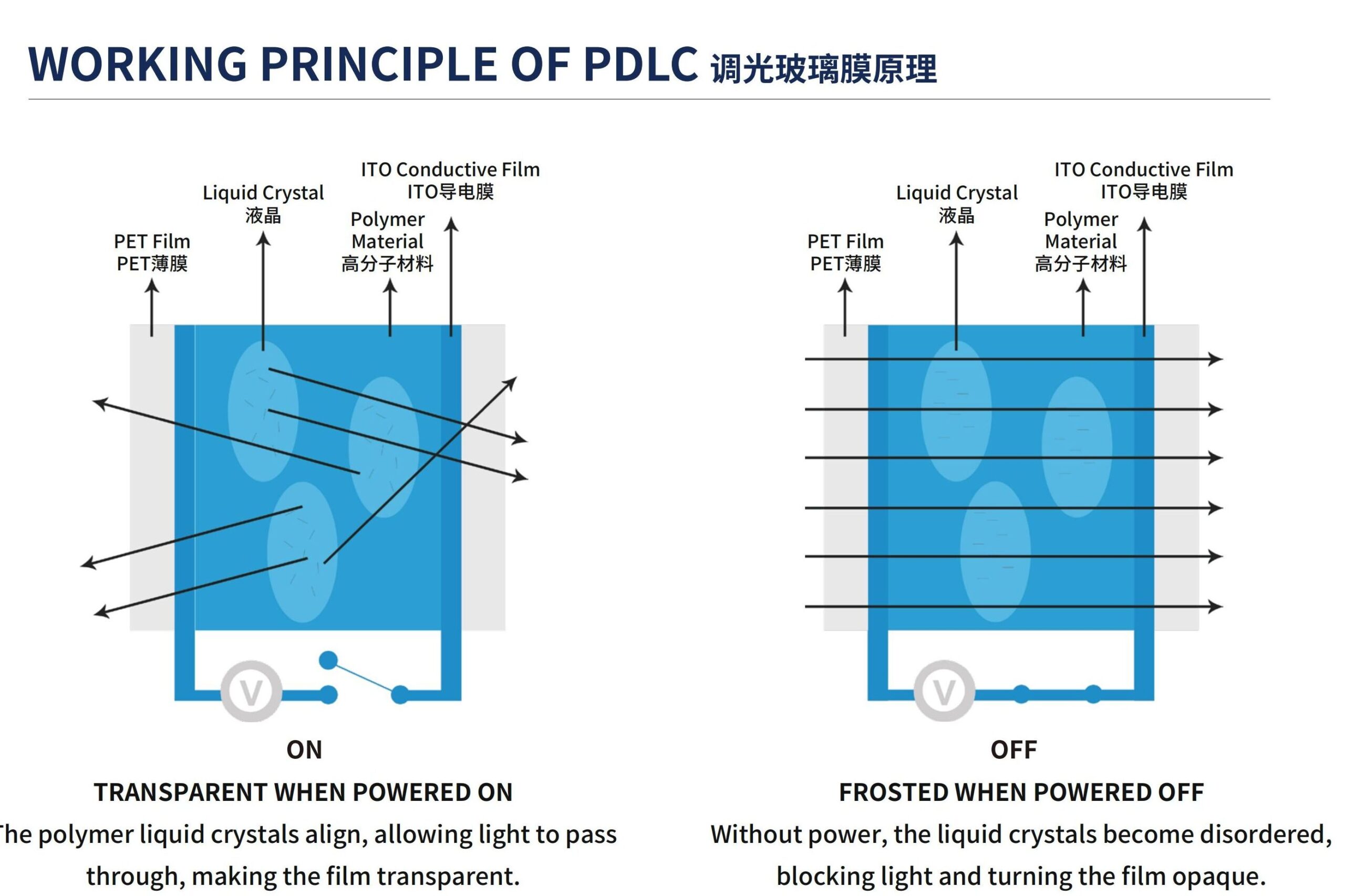
In the off state (no power applied):
The liquid crystal molecules inside each polymer droplet are randomly oriented — pointing in different directions without any external force to align them. Light entering the film encounters these randomly oriented droplet interfaces and scatters in all directions. The result: the film appears opaque or milky-white. You can see diffused light through it but not clear images.
In the on state (voltage applied):
An AC electric field is applied across the film (through transparent conductive coatings on each side of the PDLC layer). The electric field exerts a force on the elongated liquid crystal molecules, causing them to align parallel to the field direction — which is perpendicular to the film surface. In this aligned orientation, the refractive index of the liquid crystal droplets matches the polymer matrix closely, and light passes through with minimal scattering. The film appears clear.
Remove the voltage, and the liquid crystals return to their random orientation (driven by thermal energy and the elastic restoring forces of the polymer droplet walls), and the film returns to its frosted state within a fraction of a second.
The Film Structure
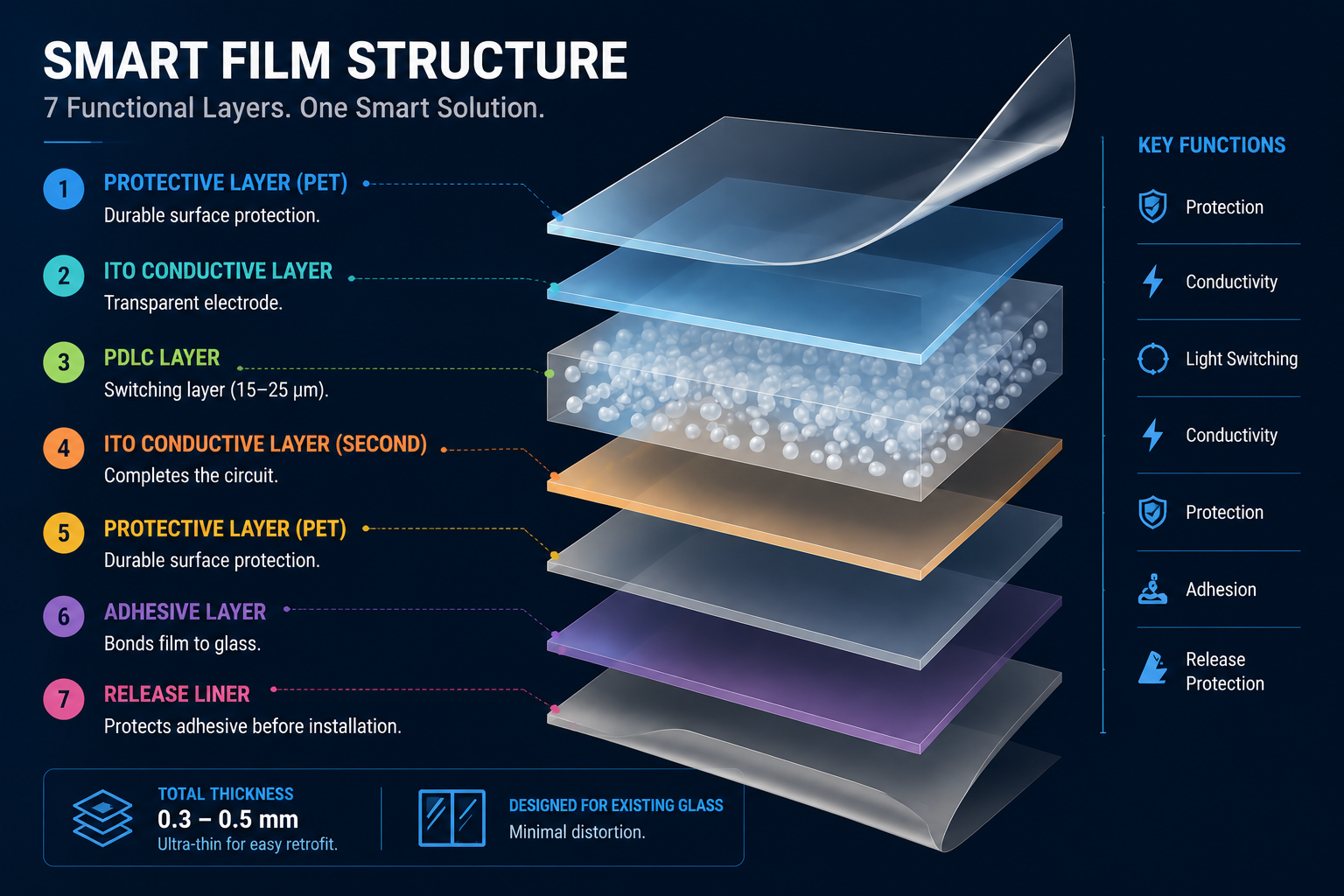
A finished smart film product isn’t just the PDLC layer — it’s a laminated stack of functional layers:
Outer protective layer: Typically a PET (polyethylene terephthalate) film, providing mechanical protection and dimensional stability.
ITO (Indium Tin Oxide) conductive layer: A transparent, electrically conductive coating deposited on the inner surface of the PET. ITO is the standard material for transparent electrodes — it conducts electricity while remaining optically clear.
PDLC layer: The liquid crystal/polymer matrix, typically 15–25 microns thick. This is where the switching happens.
ITO conductive layer (second): A second transparent conductive layer on the opposite side of the PDLC, completing the electrical circuit.
Outer protective layer (second): Second PET layer.
Adhesive layer: Pressure-sensitive adhesive on one face for bonding to glass.
Release liner: Protects the adhesive until installation.
The total stack thickness is typically 0.3–0.5mm — thin enough to be applied to existing glass with minimal optical distortion.
The Role of ITO
Indium tin oxide is a material most people have never heard of despite touching it constantly — it’s the transparent conductive coating on smartphone touchscreens, LCD displays, and solar cells.
In smart film, ITO is essential because the conductive layer needs to be both electrically functional (to apply the field across the PDLC layer) and optically transparent (so the film remains clear in the on state). There’s no other practical material that achieves both.
ITO quality and coating uniformity is a significant differentiator between smart film products. Non-uniform ITO creates areas where the electric field is weaker — resulting in uneven switching, visible patches that are more or less transparent than surrounding areas. This “patchiness” in the transparent state is a common quality complaint about budget smart film products and almost always traces back to ITO layer quality.
Power Requirements
The electric field required to align the liquid crystals is modest but specific:
- Voltage: 48–65V AC is the most common operating range for commercial smart film. Some products operate at lower voltages (24V DC) for specific applications.
- Frequency: 50–60Hz (standard mains frequency)
- Power consumption: 5–7 watts per square meter in the on state. In the off state, power consumption is effectively zero — no power is needed to maintain the frosted state.
This last point is worth noting: smart film is fail-safe to privacy. A power failure returns the film to its frosted (opaque) state automatically. For applications where privacy is the critical requirement — hospital patient rooms, executive offices, legal consultation rooms — this default behavior is a feature, not a bug.
The power supply (a transformer converting mains voltage to the operating voltage) and a controller (handling switching commands from wall switches, timers, or smart home systems) are required components of any smart film installation.
Dimming: Beyond On/Off
Many smart film products support intermediate states — partial transparency between fully frosted and fully clear. This is achieved by varying the AC voltage applied to the film:
- Full voltage → fully aligned crystals → fully clear
- Partial voltage → partially aligned crystals → partial transparency
- Zero voltage → randomly oriented crystals → fully frosted
Dimming allows users to set a specific privacy level rather than choosing between full privacy and full transparency. A meeting room might be set to 50% transparency during informal collaboration (visible presence without clear sightlines) and switched to full frosted for sensitive discussions.
The smoothness and linearity of the dimming response varies by product. Premium smart film maintains even, controllable intermediate states. Budget products often show non-linear response — jumping between states rather than transitioning smoothly.
SPD and Electrochromic: Other Smart Glass Technologies
PDLC is the dominant technology in smart film, but it’s not the only switchable glazing technology:
SPD (Suspended Particle Device): Uses electrically activated particles suspended in a liquid to control light transmission. Common in automotive (Meredes-Benz, BMW have used SPD sunroofs). Better at controlling light levels and tint than PDLC, but remains more expensive and less common in architectural applications.
Electrochromic: Changes color/tint gradually when voltage is applied, rather than switching on/off. Very slow transition (minutes, not seconds). Better for solar control than privacy. Common in aircraft windows (Boeing 787 uses electrochromic windows).
For privacy applications requiring fast switching and clear on/opaque off behavior, PDLC remains the technology of choice.
FAQ
1. How does smart film switch from frosted to clear?
Smart film uses PDLC technology. When electricity is applied, liquid crystals align and allow light to pass through, making the film clear. When power is off, the crystals scatter light, creating a frosted privacy effect.
2. Is smart film safe to touch and use daily?
Yes. Smart film operates at low voltage (typically 48–65V AC), and the conductive layers are fully sealed inside the film structure. Normal surface contact is safe and commonly used in residential, office, and commercial environments.
3. What happens to smart film when the power is turned off?
When power is off, smart film automatically returns to its frosted (opaque) state. This is a built-in feature of PDLC technology and ensures default privacy during power failure or system shutdown.
Further Reading
On this site:
- What Is Smart Film? Everything You Need to Know — Full overview including applications and cost context
- PDLC Film vs Smart Glass: Which Privacy Solution Is Better? — How the technology compares to factory-integrated smart glass
- How Window Film Is Manufactured: From Raw Materials to Finished Rolls — Manufacturing context for understanding film construction
- The Future of Smart Glass and Smart Film Technology
External:
- SPIE Digital Library — Liquid Crystal Technology — Technical papers on PDLC and liquid crystal applications
- Society for Information Display — Technical reference on ITO and transparent conductive coatings
- Nature Materials — Polymer-Dispersed Liquid Crystals — Academic background on PDLC physics
Get a Free Sample or Quote
Looking for a reliable window film supplier? Contact us today for fast response and professional support.