Published: June 9, 2026 · 9 min read · Category: Manufacturing
Most buyers who’ve sourced window film for years couldn’t tell you how it’s actually made. That’s fine — you don’t need to run a factory to run a distribution business. But understanding the manufacturing process at a working level does something useful: it changes the questions you ask suppliers, helps you spot the difference between a real manufacturer and a rebrander, and gives you a framework for understanding why some film costs twice as much as another that looks identical in a catalog photo.
This is a walkthrough of how window film goes from raw materials to the finished roll sitting in your warehouse.
It Starts With the Base Film
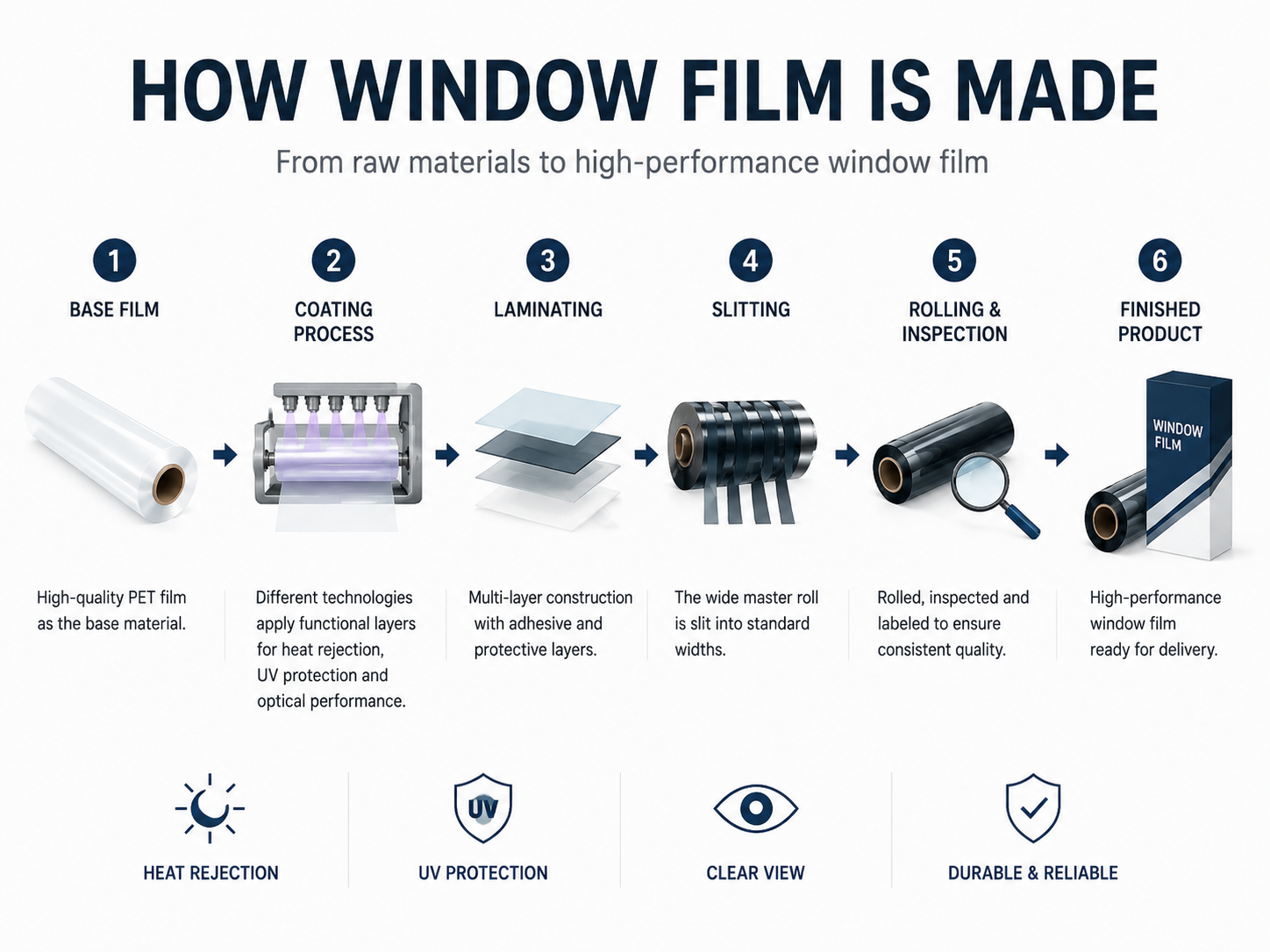
Every window film begins as a PET (polyethylene terephthalate) base film — essentially a very thin, optically clear plastic sheet, typically between 25 and 100 microns thick (a human hair is roughly 70 microns, for reference).
PET film is produced by a separate industry entirely. The major suppliers are companies like Toray (Japan), SKC (South Korea), Mitsubishi Chemical, and several large domestic Chinese producers. The quality of the base film — its optical clarity, dimensional stability, tensile strength, and surface uniformity — sets a ceiling on everything the finished window film can achieve.
This is one of the first places where manufacturers diverge. Budget manufacturers use whatever PET they can source at the lowest price. Premium manufacturers specify particular grades from named suppliers and often have supply agreements in place to ensure consistency. When you ask a manufacturer “what PET do you use?” and they either can’t answer or give you a vague response, that tells you something.
Coating: Where the Performance Comes From
The base PET film does almost nothing on its own — it’s optically neutral and provides no solar control or UV rejection. The functional layers are applied through coating processes, and the type of coating determines what technology tier the finished film belongs to.
Dyed Film: The Simplest Process
Dyed film is produced by passing the PET base through a solution or bath containing colorants and UV absorbers, which are absorbed into the film’s surface layers. It’s the least capital-intensive production process, which is why dyed film is the cheapest product category.
The limitation is durability. Dye molecules in a film exposed to sustained UV and heat will eventually break down — fading, color shifting (often toward purple or brown), and declining performance over time. Quality dyed films from reputable manufacturers include UV stabilizers that slow this process, but the fundamental chemistry limits the lifespan compared to other technologies.
Metalized Film: Magnetron Sputtering
Metalized film is produced using a process called magnetron sputtering — a physical vapor deposition technique where metal atoms (typically aluminum, titanium, or various alloys) are deposited in extremely thin layers onto the PET surface inside a vacuum chamber.
The sputtering line is the piece of equipment that separates real film manufacturers from trading companies. It’s expensive (millions of dollars for a properly configured line), technically complex to operate, and requires ongoing maintenance and expertise. A supplier who claims to manufacture metalized or ceramic film but can’t show you a sputtering line either doesn’t have one or is using a co-manufacturer they haven’t told you about.
The metal layers provide heat rejection and UV blocking through reflection rather than absorption — light and heat bounce off the metallic surface rather than being absorbed. This makes metalized films more durable than dyed films, but the metal content can interfere with mobile signals and GPS, which is why carbon and ceramic technologies have taken significant market share.
Carbon Film: Adding Organic Layers
Carbon-series films incorporate carbon particles into the coating, typically as part of a multi-layer structure. Carbon provides strong infrared absorption without the signal interference of metallic layers — carbon is not electrically conductive in the way metals are.
Production involves more complex multi-layer coating processes, with some manufacturers using both sputtering and additional coating steps to achieve the carbon layer integration. The result is a film with good IR rejection, stable color (carbon doesn’t fade the way dyes do), and compatibility with modern vehicle electronics.
Nano-Ceramic Film: The Premium Category
Nano-ceramic film uses nano-scale ceramic particles — typically titanium nitride or similar compounds — embedded in or applied to the film’s coating layers. The “nano” refers to the particle size: measured in nanometers, small enough that the film remains optically clear even while the particles provide IR absorption and rejection.
The production process is the most complex and the most closely guarded in the industry. It typically involves precision dispersion of ceramic nanoparticles into a carrier, application via sputtering or precision coating systems, and careful process control to ensure uniform particle distribution. Uneven distribution shows up as optical defects — haze, non-uniform tint, or variation in performance across the roll.
This is why not all nano-ceramic films are created equal, and why third-party test reports matter: the manufacturing process is complex enough that the gap between a well-executed and a poorly executed nano-ceramic film is significant. For more on evaluating ceramic film suppliers specifically, see Ceramic Window Film Supplier: What to Look for Before You Order.
Multi-Layer Construction
Most modern window film isn’t a single layer — it’s a laminate of multiple functional layers, each contributing something to the finished product’s performance:
Scratch-resistant hard coat — Applied to the exposed surface (the side facing the vehicle interior or room interior after installation). Protects against cleaning scratches and abrasion.
Functional coating layers — The dye, metal, carbon, or ceramic layers described above, sometimes in combinations.
PET base film — One or more layers. Dual-layer constructions (two PET sheets laminated together) provide better dimensional stability and improved safety performance.
Pressure-sensitive adhesive (PSA) — Applied to the glass-contact side. Adhesive chemistry is one of the most significant quality differentiators in finished film — how the film installs, whether it develops bubbles or lifts at edges over time, and how it performs in extreme temperature variations all trace back to the adhesive.
Release liner — A silicone-coated paper or film that protects the adhesive surface until installation. Quality release liners release cleanly without tearing or leaving residue.
The adhesive and release liner combination is something buyers rarely think about, but professional installers notice it immediately. Film that’s difficult to work with during installation — sticky, prone to tearing, resistant to repositioning — often has adhesive or liner issues that trace back to manufacturing cost-cutting.
Slitting and Rolling
After coating and laminating, the film exists as a wide master roll — typically 1.5–1.6 meters wide and potentially hundreds of meters long. This gets fed through a slitting machine that cuts it to the standard widths sold to the market (most commonly 1.52m, though other widths exist for specific applications).
Slitting sounds simple. It isn’t. Blade alignment, tension control, and edge quality during slitting affect the entire usable width of the roll. Rolls with uneven tension have dimensional problems — they won’t lie flat, they telescope (shift) on the core, or they have edge deformations that cause installation problems at the margins.
After slitting, rolls are wound onto cores (cardboard or plastic), inspected, labeled, and packed. The winding tension matters here too — over-wound rolls put stress on the adhesive layer; under-wound rolls shift and deform in transit.
What a Production Line Visit Actually Tells You
If you ever get the opportunity to visit a window film factory — or review detailed video documentation of their production line — here’s what to look for:
The sputtering chamber. This is the unmistakable piece of equipment for any manufacturer claiming to make metalized, carbon, or ceramic film. It looks like a large horizontal cylindrical vacuum chamber, typically 2–4 meters in diameter and 3–6 meters long. If a factory claiming ceramic film capability can’t show you a sputtering line, the product is almost certainly sourced externally.
The coating line configuration. How many coating stations? Is the process integrated (base film in, finished film out) or are there multiple separate passes? More integrated lines generally produce more consistent product.
The quality control stations. Optical inspection systems, defect detection cameras, sample testing — where in the line are they, and how frequent are they? A factory with QC only at the end of the line catches problems later than one with inline monitoring.
Cleanliness. Film manufacturing is extremely sensitive to contamination. Dust particles, airborne fiber, or contamination in the coating environment creates defects — visible inclusions, haze, or coating irregularities. A clean room or controlled environment for coating operations is a sign of a serious manufacturer.
This is exactly what a factory audit is designed to surface. If you haven’t been through the audit process with your current supplier, the Window Film Factory Audit Checklist gives you a structured framework for the visit.
From Understanding to Better Buying
Knowing how window film is made gives you a sharper lens for evaluating supplier claims. When a manufacturer says their film has “99% IR rejection,” you can ask which wavelength range that measures. When they say “nano-ceramic technology,” you can ask about their sputtering line. When a price seems too low for the technology tier being claimed, you understand why.
The manufacturing process also explains why the cheapest quote rarely survives first contact with a demanding customer — dyed film economics don’t support nano-ceramic film pricing, and the shortcuts that close that gap show up eventually in the field.
FAQ
Q1: What is the base material used in window film manufacturing?
Most window films are made from PET (polyethylene terephthalate) base film, which provides optical clarity, strength, and dimensional stability.
Q2: What is the difference between dyed film and nano ceramic film?
Dyed film uses colorants for shading and UV protection, while nano ceramic film uses ceramic nanoparticles for higher heat rejection, longer durability, and better optical clarity.
Q3: Why is magnetron sputtering important in window film production?
Magnetron sputtering applies ultra-thin metal or ceramic layers onto PET film, improving heat rejection, UV blocking, and overall film performance.
Q4: Why do some window films interfere with GPS or mobile signals?
Metalized films contain conductive metal layers that may affect electronic signals, while carbon and ceramic films are designed to avoid signal interference.
Q5: What layers are included in modern window film construction?
Modern window films typically include hard coat layers, functional coatings, PET base film, pressure-sensitive adhesive, and a release liner.
Q6: How can buyers identify a real window film manufacturer?
A real manufacturer can usually show production equipment such as sputtering lines, coating systems, quality control stations, and detailed factory processes.
Want to understand whether your current or prospective supplier is genuinely manufacturing the product they’re selling you? Send us an inquiry — we help buyers verify manufacturing claims and connect with verified producers.
Further Reading
On this site:
- Inside a Modern Window Film Factory: Production Process Explained — A closer look at factory operations and what to look for on a visit
- How Nano Ceramic Window Film Is Made — Deep dive into the premium product category
- Ceramic Window Film Supplier: What to Look for Before You Order — Evaluating suppliers through a performance lens
- Window Film Factory Audit Checklist — 12 questions to ask before you commit to any manufacturer
- Top 7 Window Film Manufacturers in China (2026 Verified List) — Verified manufacturers across product categories
External:
- Toray PET Films — One of the world’s leading PET base film suppliers; understanding their grades helps evaluate manufacturer claims
- Society of Vacuum Coaters (SVC) — Technical body for PVD and sputtering technology; useful for understanding the science behind metalized and ceramic film production
- AIMCAL — Industry body for coaters and laminators; membership indicates genuine manufacturing capability
Get a Free Sample or Quote
Looking for a reliable window film supplier? Contact us today for fast response and professional support.