How PPF Thickness (6.5mil to 10mil) Affects Impact Resistance: A B2B Buyer’s Guide
Published: July 21, 2026 · 8 min read · Category: PPF Guide
About this article:KSB Window Film manufactures PPF from 6.5mil through 10mil. This guide provides objective, test-based guidance on thickness selection — what the data shows and how to match product to customer application.
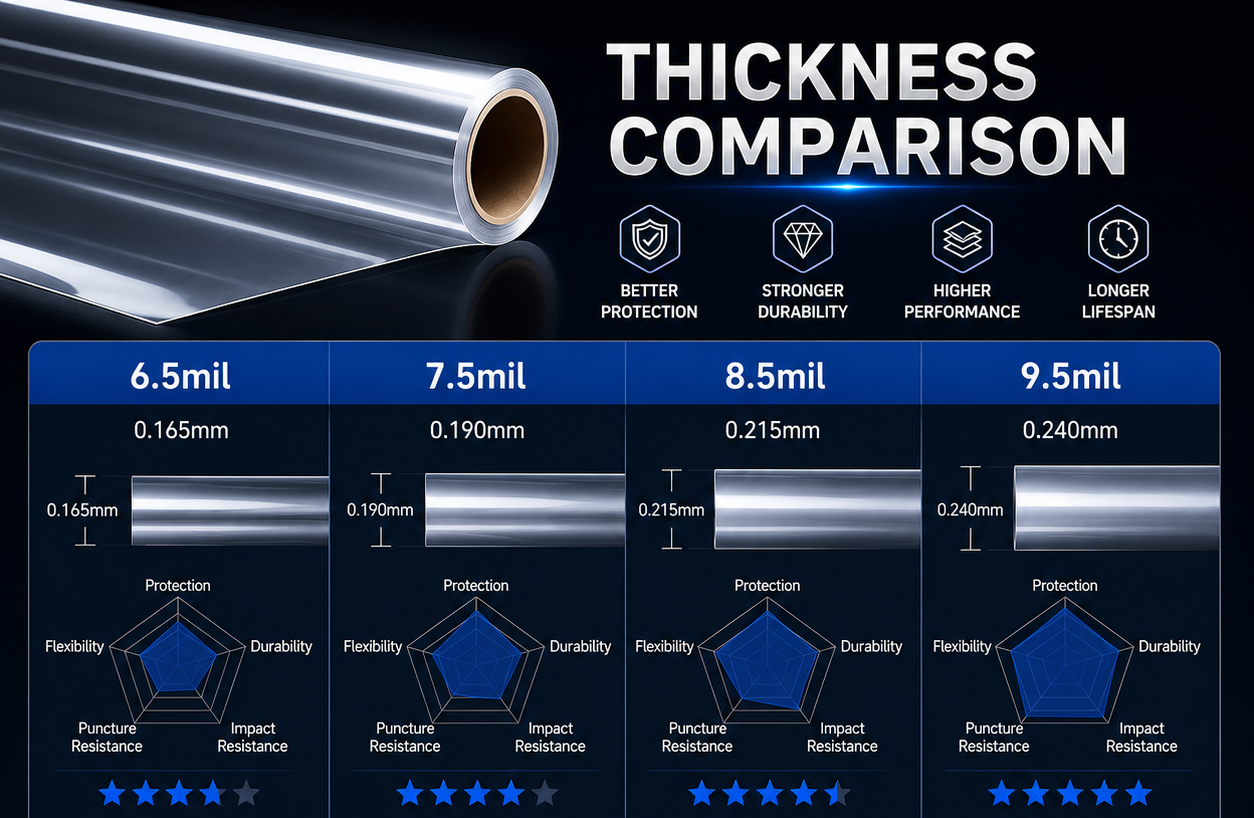
Visual comparison of PPF thickness levels from 6.5mil to 9.5mil showing differences in protection, durability, and performance
PPF thickness is one of the most frequently cited specifications and one of the most frequently misunderstood. “Thicker is always better” is the intuitive assumption — but the relationship between thickness and impact resistance is more nuanced, and the right thickness for any application depends on the use profile.
What Film Thickness Is Made Of
Total film thickness is the sum of three layers:
TPU base film: The primary structural and impact-absorbing layer
Top coat: The self-healing, scratch-resistant surface (typically 15–30 microns)
Adhesive: The bonding layer (typically 25–40 microns)
A “7.5 mil” specification may distribute this thickness as 5.8 mil TPU + 0.7 mil top coat + 0.8 mil adhesive, or as 5.0 mil TPU + 1.2 mil top coat + 0.8 mil adhesive. The distribution matters — more TPU = more impact absorption; more top coat = more self-healing capacity. Ask for the layer breakdown, not just total thickness.
The Physics of Impact Absorption
TPU’s impact resistance mechanism is energy dissipation through viscoelastic deformation. When a stone or debris impacts the film surface:
The kinetic energy of the impact is partially absorbed by elastic deformation of the TPU (stored as strain energy)
The viscoelastic component converts some of this strain energy to heat (dissipation)
The film deforms and rebounds without the stress concentration at the surface reaching the fracture threshold of the glass beneath
The amount of energy that can be absorbed before the film-glass system reaches failure (chip or crack in the glass) depends on:
Film thickness: More material = more deformation capacity
Material stiffness (Young’s modulus): Lower modulus TPU absorbs more energy per unit deformation
Adhesive bond: Strong adhesive distributes impact energy over a larger area
Drop Ball Impact Testing: The Data
KSB conducted controlled drop ball impact tests using a 50g steel ball bearing dropped from increasing heights onto panels with different film thicknesses applied, using automotive clear coat panels as the substrate. Results represent the height at which 50% of test panels showed visible paint damage (H50):
Film thickness
H50 (steel ball, 50g)
Effective chip protection at 100 km/h highway debris
No film (bare paint)
45 cm
Baseline
6.5 mil (165 microns)
78 cm
Good — covers typical road chip events
7.5 mil (190 microns)
98 cm
Very good — covers most highway stone chip scenarios
8.5 mil (216 microns)
120 cm
Excellent — covers aggressive chip environments
10 mil (254 microns)
145 cm
Maximum — for racetrack, gravel road, construction zone exposure
Note: H50 values are comparative rather than absolute — they demonstrate relative protection improvement by thickness, not absolute safety guarantees.
Application Matching: Which Thickness for Which Customer?
6.5 mil — The Value Option
Profile: Urban daily driver, predominantly city roads, standard highway mileage, standard vehicle value. Protection target: Routine stone chip prevention from normal urban and highway driving. Customer type: Practical protection buyer who wants chip prevention at the most accessible price. Market position: Entry-level PPF with credible protection. The right honest specification — don’t oversell thicker to customers who don’t need it.
7.5 mil — The Volume Product
Profile: Mainstream PPF installation on standard to mid-range vehicles. Highway commuting, moderate rural road exposure. Protection target: Comprehensive protection against typical chip events at highway speeds. Customer type: The largest segment — drivers who want proper protection without the premium of maximum specification. Market position: The “standard” specification in most professional PPF install businesses. This is where the majority of volume sits.
8.5 mil — The Performance Standard
Profile: Premium vehicles, higher mileage, frequent motorway driving, regular rural road use. Protection target: Protection against larger stone and gravel impacts that 7.5 mil may allow to penetrate. Customer type: Premium vehicle owners who recognise that the replacement cost of the film is trivial compared to paint repair on a £80,000 car. Market position: The specification upgrade sale — position as the professional’s recommendation for any vehicle above £40,000/$50,000 market value.
10 mil — The Maximum Specification
Profile: Exotic and luxury vehicles, racetrack use, gravel road exposure, commercial fleet in high-debris environments. Protection target: Maximum available impact protection from any film product. Customer type: Ferrari/Lamborghini/McLaren owners, track day participants, fleet operators in mining or construction adjacent operations. Market position: Premium product, premium price, small volume, high margin.
What Thickness Cannot Do
It cannot repair existing damage. PPF is preventive, not corrective. Chips and scratches before installation are not addressed by any thickness.
Thicker film doesn’t improve self-healing. Self-healing is a top coat function, not a base film thickness function.
Thicker film isn’t necessarily better conformability. On complex curved panels, thinner film may conform more readily. 10 mil film on tight compound curves requires more heat and technique than 7.5 mil.
FAQ
My customer has a car worth $30,000. Should they use 7.5 or 8.5 mil?
7.5 mil provides excellent protection for most driving conditions on a vehicle at this value. 8.5 mil is appropriate if the customer regularly travels rural or gravel roads, follows trucks on motorways frequently, or simply wants maximum available protection. For most urban/suburban drivers: 7.5 mil is the appropriate specification.
Is 10 mil always the right choice for exotic cars?
For the bonnet, bumper, and door edges (primary impact zones): 10 mil is justified for exotic vehicles. For full-body protection on an exotic car: many professional installers use 8.5 mil on non-primary zones to maintain better conformability on complex body lines, while using 10 mil on the impact-critical areas.