Bright sunlight can affect driving comfort, especially when strong reflections and glare reduce visual clarity. For automotive window film buyers, heat rejection is important, but glare control and visibility also deserve attention.
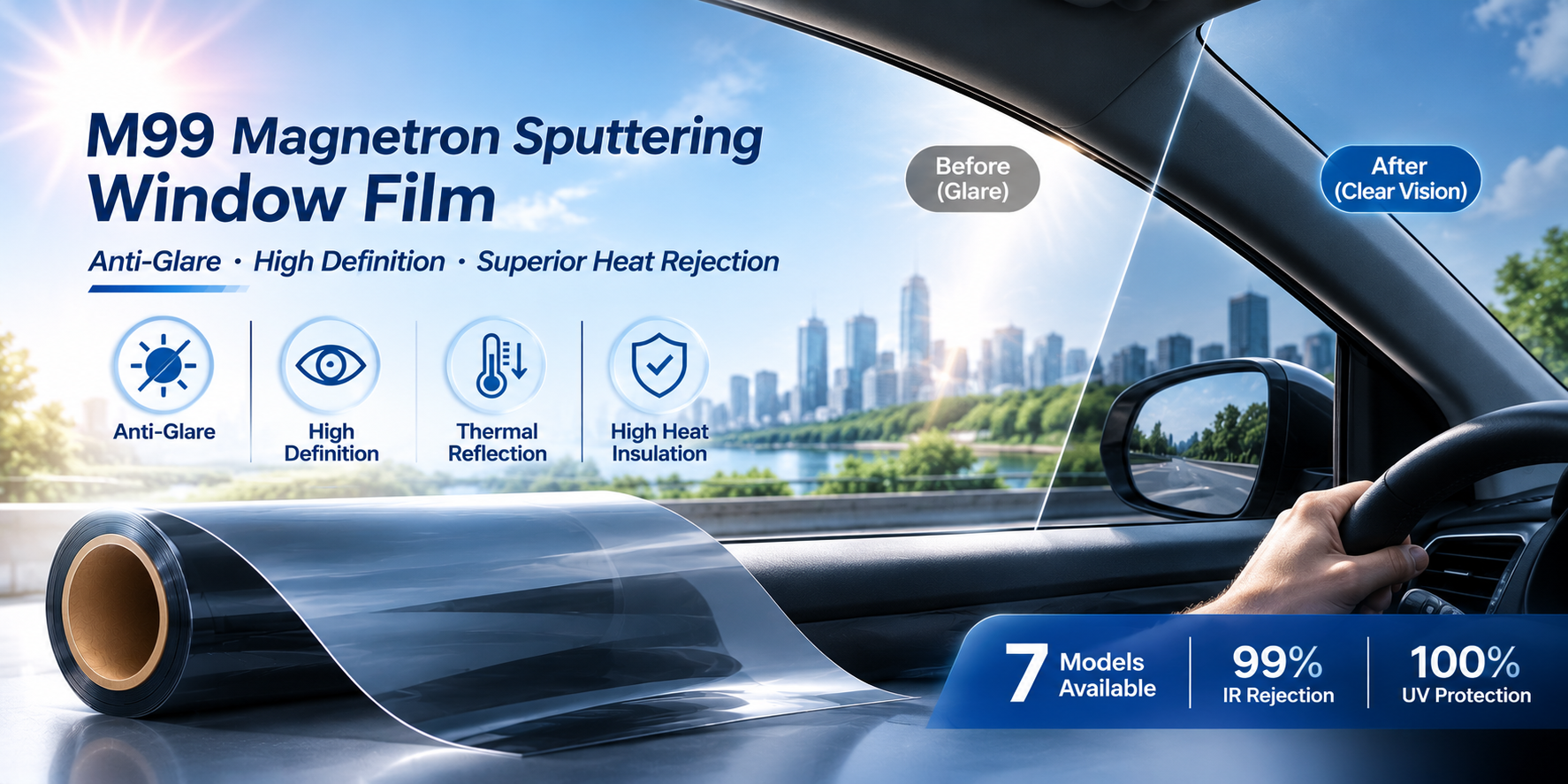
KSB M99 Series combines magnetron sputtering technology with an anti-glare design. Its product positioning focuses on reducing glare, maintaining high definition, reflecting solar heat and providing high insulation.
With seven VLT options, the series offers different levels of light transmission and solar control for various market preferences.
Magnetron Sputtering Meets Anti-Glare Technology
The M99 Series combines several material and technology elements:
- Anti-Glare
- Multi-Layer Magnetic
- Tungsten Oxide
- Nano Titanium Nitride
Its main product features include:
- Anti-Glare: Designed to reduce distracting glare.
- High Definition: Focuses on clear visual performance.
- Thermal Reflection: Helps reflect solar heat.
- High Heat Insulation: Supports solar heat control.
The combination of magnetron sputtering and anti-glare technology gives M99 a different product identity from conventional nano ceramic films. Rather than focusing only on ceramic materials, it emphasizes glare management and thermal reflection.
Seven Models for Different Light Transmission Needs
M99 includes seven models, ranging from 70% to 5% VLT. All models share 99% IR rejection at both 950nm and 1400nm, as well as 100% UV rejection.
| Parameter | M99-70 | M99-50 | M99-35 | M99-25 | M99-15 | M99-10 | M99-05 |
|---|---|---|---|---|---|---|---|
| VLT | 70% | 50% | 35% | 25% | 15% | 10% | 5% |
| IRR (950nm) | 99% | 99% | 99% | 99% | 99% | 99% | 99% |
| IRR (1400nm) | 99% | 99% | 99% | 99% | 99% | 99% | 99% |
| UVR | 100% | 100% | 100% | 100% | 100% | 100% | 100% |
| TSER | 63% | 75% | 80% | 87% | 90% | 94% | 97% |
| Thickness | 2mil | 2mil | 2mil | 2mil | 2mil | 2mil | 2mil |
| Color Decay Time | 8 years | 8 years | 8 years | 8 years | 8 years | 8 years | 8 years |
The main difference between the models is their VLT and TSER:
- M99-70: Highest light transmission at 70%, with 63% TSER.
- M99-50 and M99-35: Middle VLT options with 75% and 80% TSER.
- M99-25, M99-15 and M99-10: Lower light transmission with TSER increasing from 87% to 94%.
- M99-05: Lowest VLT at 5% and highest TSER at 97%.
Buyers should consider both VLT and TSER when selecting a model. IRR describes infrared rejection at specific wavelengths, while TSER reflects the overall solar energy rejection performance. Solar control performance metrics provide further details on these indicators.
How to Evaluate Anti-Glare Window Film
For distributors and professional installers, anti-glare performance should be considered alongside other optical properties.
Glare reduction: Evaluate how the film changes reflections and visual comfort under different lighting conditions.
Optical clarity: Haze and internal reflection are useful reference indicators when assessing film appearance. Actual samples should also be reviewed.
Solar control: Compare VLT, IRR and TSER together rather than relying on a single rejection percentage.
Material technology: Magnetron sputtering, multi-layer magnetic technology and the use of functional materials are important parts of M99’s product positioning.
UnderstandingIR rejection and what it really means can also help buyers evaluate performance claims more accurately.
FAQ
What is the main feature of M99 window film?
M99 combines magnetron sputtering with anti-glare technology. Its key features include glare reduction, high definition, thermal reflection and high heat insulation.
Does every M99 model have the same heat rejection?
All seven models have 99% IRR at 950nm and 1400nm. However, their TSER values vary from 63% to 97%, depending on the model.
What is the difference between M99 and conventional nano ceramic film?
M99 emphasizes magnetron sputtering, multi-layer magnetic technology and anti-glare performance. Conventional nano ceramic film focuses more on its ceramic material composition and solar-control characteristics.
Further Reading
On this site:
- Nano Ceramic vs Metalized Window Film: Pros and Cons — Compare ceramic and metalized film technologies.
- Nano Ceramic vs Carbon Window Film: Which Is Better? — Understand the differences between two common film materials.
- Best Ceramic Window Film for Hot Climate Regions — Explore heat rejection requirements in hot climates.
- How Nano Ceramic Window Film Is Made — Learn about nano ceramic film manufacturing.
A Distinctive Option for Automotive Window Film Distributors
M99 gives distributors another product category to consider when developing an automotive window film portfolio. Its combination of magnetron sputtering, anti-glare technology and seven VLT options provides flexibility for different customer preferences.
KSB manufactures automotive and architectural window films for global distributors, wholesalers and private-label brands. With OEM customization and wholesale supply capabilities, KSB supports customers developing their own window film product lines.
Looking for an anti-glare film with magnetron sputtering technology? Talk with the KSB team about M99 specifications, samples and cooperation opportunities.
Get a Free Sample or Quote
Looking for a reliable window film supplier? Contact us today for fast response and professional support.