Solar Control Film Performance Metrics: TSER, Rejection Rates, and Energy Efficiency
Published: July 2, 2026 · 11 min read · Category: Window Film Technical
About this article: KSB Window Film tests our solar control products to ISO 9050 and provides third-party verified performance data with every product specification. We wrote this guide partly because so much of the performance data in this industry is presented in ways that make products look better than they are.
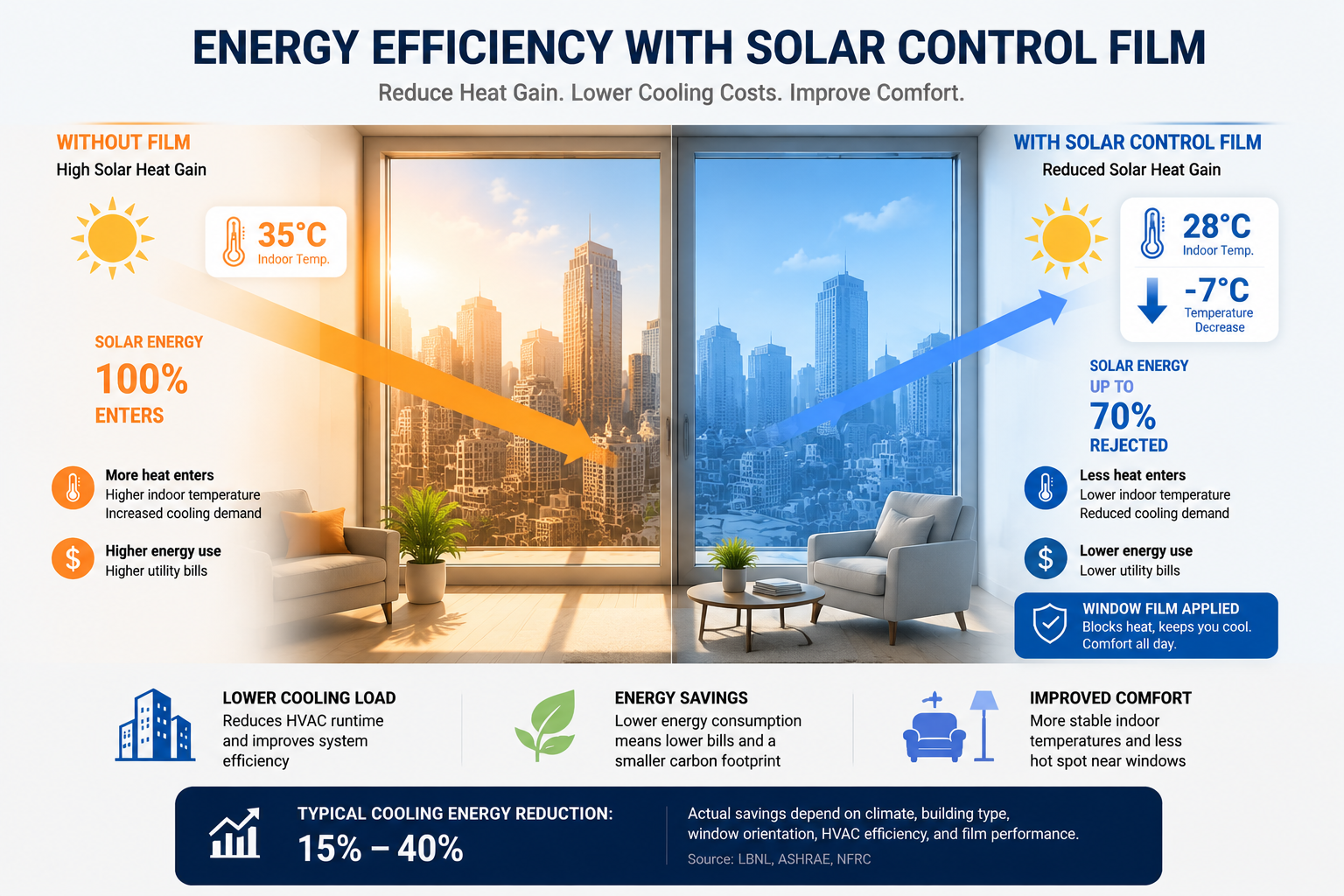
Side-by-side comparison of indoor temperature with and without solar control film, showing reduced heat gain, lower energy use, and improved comfort after window film installation.
The window film industry has a measurement problem. Not a technical one — the underlying physics is well understood and the test standards are rigorous. The problem is that the same underlying physics can produce vastly different-looking numbers depending on what you measure, at what wavelength, on what substrate, using what weighting function. Two products with identical real-world performance can show “TSER 45%” and “TSER 62%” in their specifications if the methodology differs.
This matters for buyers because manufacturers understand this better than buyers do, and some exploit it. Understanding what these numbers actually measure is the first step to evaluating them honestly.
The Solar Spectrum: Starting Point for Everything
Solar radiation reaching the earth’s surface contains energy across a wide wavelength range:
UV (280–380nm): About 5% of total solar energy. Causes photochemical damage to materials and skin.
Visible (380–780nm): About 44% of total solar energy. What human eyes detect; also contributes to heat load.
Near-infrared (780–2,500nm): About 51% of total solar energy. Invisible. The primary source of the “heat” sensation from sunlight.
These percentages matter because every solar performance metric is a weighted average over this spectrum. A product that blocks a lot of UV but passes near-infrared freely will have impressive UV rejection numbers but poor heat performance. A product that’s opaque to near-infrared but transparent to visible light will feel cool while remaining bright.
The weighting function used to calculate aggregate metrics — how much each wavelength “counts” — is defined by the solar spectrum standard referenced in the test. ASTM E891, ISO 9050, and EN 410 use slightly different reference spectra, which is why identical products can show different TSER values when tested under different standards.
TSER: The Most Useful Single Number
TSER (Total Solar Energy Rejected) is the percentage of total incident solar energy that the film-glass system prevents from entering the conditioned space. If TSER = 60%, 60% of the solar energy that would otherwise enter through unfilmed glass is blocked.
What “total” includes:
Solar direct transmittance: The fraction of incident solar energy that passes directly through the glass-film system.
Solar indirect inward heat transfer: The fraction of absorbed solar energy that re-radiates inward from the glass-film system. Glass and film absorb some solar energy and convert it to heat — this heat doesn’t stay in the glass. Some proportion re-radiates toward the interior; some toward the exterior. This fraction (determined by the system’s geometry and emissivity properties) is included in the TSER calculation.
The second component is why a “TSER 60%” film and a film claiming “60% solar transmittance reduction” are not equivalent. Reducing transmittance by 60% sounds the same but ignores the absorbed heat that partly re-enters the space.
What TSER doesn’t capture:
Thermal conductance (U-factor): Heat flow through the glass under a temperature differential (cold outside, warm inside or vice versa). Relevant for winter heating in cold climates. Most solar control films don’t significantly affect U-factor; the exception is low-emissivity films that reduce long-wave IR emission from glass surfaces.
Glare: Visible light reduction relates to glare but isn’t captured in TSER. A film can have high TSER (reducing heat effectively) while still allowing enough visible light for uncomfortable glare.
IRR: Where the Numbers Get Misleading
IR rejection rate (IRR) describes how effectively the film blocks infrared radiation. Since near-IR represents ~51% of solar energy, this should be the most important heat rejection metric. It would be, if it were measured consistently.
The problem: there’s no industrywide standard for how IRR is measured. Manufacturers can choose:
Single-wavelength measurement: Measure transmittance at one specific wavelength and report (1 − transmittance) as the rejection rate. Ceramic nanoparticles and metallic layers often have peak absorption or reflectance around 900–1,000nm. Measuring there produces the highest possible IRR claim. A film claiming “99% IR rejection” measured at a single wavelength can coexist with TSER 45% — the two numbers aren’t contradictory because they’re measuring different things.
Narrow-band measurement: Measure across 900–1,100nm or a similar window. Still cherry-picked relative to the full near-IR range.
Full-spectrum weighted IR: Measure across 780–2,500nm using solar irradiance weighting. This is the measurement that actually correlates with heat performance. It will always be lower than single-wavelength IRR for ceramic products because it includes wavelengths where the ceramic absorption is less than optimal.
The practical implication: when comparing products on IRR, you need to know the methodology. IRR claims that are dramatically higher than you’d expect from the TSER (e.g., IRR 95% alongside TSER 50%) are almost certainly measured at a single wavelength. A full-spectrum IRR at 75% alongside TSER 60% is internally consistent and probably accurate.
VLT and Its Relationship to Everything Else
VLT (Visible Light Transmittance) is the percentage of visible light passing through the system. It correlates with how dark the film appears.
Three things VLT affects that buyers sometimes miss:
Legal compliance. Most road vehicle regulations specify minimum VLT — most commonly 70–75% for front side windows. Architectural glazing in commercial buildings may also have minimum VLT requirements for building permits or occupancy regulations. This is a hard constraint, not a preference.
TSER vs VLT trade-off. For absorption-based films (dyed, carbon), there’s a straightforward trade-off: more absorption = lower VLT = higher TSER. You can’t have both high TSER and high VLT without spectrally selective technology (ceramic, nano-ceramic).
The selective film advantage. This is the fundamental value proposition of ceramic film. By targeting near-IR absorption specifically, ceramic film decouples VLT from TSER. A well-engineered nano-ceramic product at 70% VLT can achieve TSER 60%+ — impossible with dyed or carbon film at the same VLT. If a manufacturer is claiming TSER > 55% at VLT > 65% for a non-ceramic product, the test methodology deserves scrutiny.
SHGC for Architectural Applications
For architectural solar control film, the relevant metric is often SHGC (Solar Heat Gain Coefficient) rather than TSER. SHGC = 1 − TSER (as a decimal), so they contain the same information in different formats.
SHGC 0.25 = TSER 75%. SHGC 0.45 = TSER 55%.
The reason architecture uses SHGC while automotive uses TSER is historical — building energy codes reference SHGC because that’s what glazing specifications have used for decades. Window film specified for commercial projects needs to be expressed as SHGC to be interpretable by architects and building engineers.
Building energy code context:
ASHRAE 90.1 (the US commercial building energy standard) specifies maximum SHGC values for glazing by climate zone and building type. In a hot climate zone, SHGC 0.25 might be required. Window film applied to existing glass can bring the effective SHGC of the glazing system into compliance — but the SHGC needs to be measured on the film-plus-glass system (not the film alone) and referenced to NFRC 300 methodology to be accepted by building officials.
LEED v4.1 (Energy and Atmosphere Credit: Optimize Energy Performance) rewards reduced SHGC through its energy model — lower SHGC means reduced cooling load, which contributes to energy points. The energy model takes film SHGC as an input, so accurate NFRC-method SHGC data from a credible test report directly affects the project’s point count.
U-Factor and Window Film
This is where most solar control film’s performance ends. Standard solar control film doesn’t significantly reduce U-factor (thermal conductance through glass), which means it doesn’t reduce heat loss in winter or reduce heat gain from warm indoor environments facing cold glass.
The exception: Low-emissivity (low-e) window film. Some film products incorporate a thin metallic layer designed to reflect long-wave infrared (LWIR, the thermal radiation from room-temperature objects) back into the space. This reduces the glass’s effective emissivity, which increases thermal resistance — reducing U-factor.
Low-e film achieves measurable U-factor reduction: a standard single-pane window at U-4.5 can reach U-3.2–3.5 with quality low-e film. Not transformative, but meaningful for energy calculations in cold climates.
For buyers in Northern Europe, Canada, or the northern US: asking about U-factor alongside TSER is appropriate if winter heating cost reduction is also a project objective. For hot climates where cooling dominates: U-factor is largely irrelevant, and TSER/SHGC are the metrics that matter.
Calculating Actual Energy Savings
The claimed energy savings from window film vary from “15% cooling cost reduction” to “40% cooling cost reduction.” Both numbers can be true in specific contexts and neither is representative of most installations.
A more useful framework:
Cooling energy reduction scales with: the SHGC reduction achieved (baseline SHGC of unfilmed glass minus new SHGC with film), the window area exposed to direct solar gain, the number of cooling degree days in the climate, and the efficiency of the cooling system.
A rule of thumb from LBNL (Lawrence Berkeley National Laboratory) research: each 0.01 reduction in SHGC across the total building glazing reduces annual cooling energy by approximately 0.5–0.7 kWh/m² of glazing in a hot climate (Phoenix-level) and approximately 0.2–0.3 kWh/m² in a mild climate (San Francisco-level).
For a 1,000m² commercial office building with 200m² of south-facing glazing, improving SHGC from 0.55 (unfilmed glass) to 0.30 (quality solar film) represents a 0.25 reduction. At 0.6 kWh/m² per 0.01 reduction in a hot climate:
200m² × 0.25 × 0.6 kWh = 30 kWh per year per degree cooling day equivalent
In a climate with 2,000 cooling degree days (Phoenix-level), this approach produces order-of-magnitude estimates rather than precise predictions. The actual number varies with occupancy patterns, HVAC scheduling, window shading from adjacent buildings, and many other variables.
The honest position for a distributor or specifier: present energy savings as estimates with clear assumptions, not guarantees. A commissioning energy engineer can model them properly; a window film salesperson shouldn’t be presenting savings figures as if they’re engineering calculations.
Reading a Product Data Sheet
When a supplier provides a data sheet, here’s what to verify before trusting the numbers:
Test laboratory: Third-party accredited (SGS, Intertek, TÜV, or equivalent national accredited lab). Manufacturer’s own test data is less credible than third-party data.
Test standard cited: ISO 9050, EN 410, or NFRC 300. Data without a cited standard is unverifiable.
Glass substrate: Should specify what glass the film was tested on (e.g., “4mm clear float glass per ASTM C1036”). Film measured in isolation produces higher TSER than film on glass.
IRR methodology: For any IR rejection claim above 80%, ask whether it’s single-wavelength or full-spectrum. Single-wavelength IRR above 90% is common; full-spectrum IR rejection above 80% is genuinely impressive.
Internal consistency: TSER should be directionally consistent with IRR. A product claiming TSER 50% and IRR 95% has either a measurement methodology mismatch (single-wavelength IRR) or an error.
FAQ
A competitor is claiming TSER values 10 percentage points higher than ours for what looks like the same product. What’s happening?
Either the products genuinely differ (harder to assess without testing both under identical conditions), or the methodologies differ. The most common methodology differences: testing film alone vs. film on glass, different reference glass thickness, different solar spectrum weighting function, or different inward-absorbed heat fraction assumptions. Request their test report alongside yours and compare the laboratory, standard, and substrate before concluding the product is actually different.
Is there a simple way to verify TSER claims in the field?
Approximately. A handheld solar film meter (devices like the Solar Film Meter 6.5) measures UV, visible, and IR transmittance separately through installed film. It doesn’t produce the solar-weighted TSER calculation, but comparing a product’s measured IR transmittance against its claimed IRR gives a directional check. If a film claims 80% IR rejection and your meter shows 50% IR transmittance reduction, something is inconsistent.
ASHRAE 90.1 Standard — Commercial building energy standard referencing glazing SHGC
Data You Can Actually Compare
KSB Window Film provides ISO 9050-referenced TSER, full-spectrum IRR (780–2,500nm), and NFRC-method SHGC where applicable — from SGS or Intertek accredited laboratories. All methodology specified, all substrates documented.