Why Requesting a Sample Roll is the Safest Way to Switch PPF Suppliers
Published: August 6, 2026 · 6 min read · Category: PPF Sourcing
About this article: KSB Window Film actively encourages prospective buyers to test our samples before placing commercial orders. This guide addresses the psychology of switching suppliers and why the sample roll is the risk-free bridge.
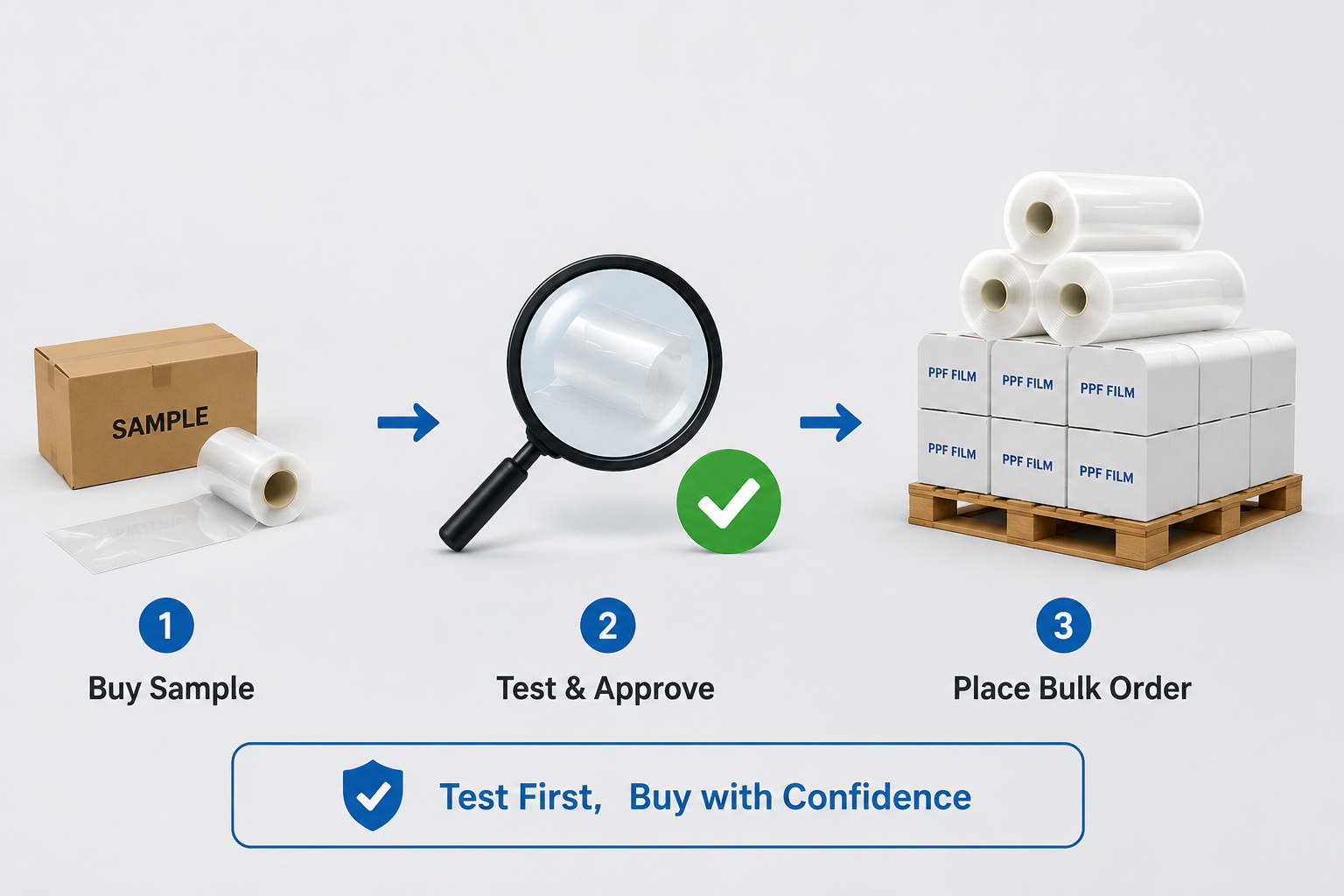
Test small PPF samples before placing bulk orders to reduce risk and ensure quality consistency
Every distributor and installer who’s been burned by a bad PPF switch carries the scar. You find a supplier with a better price, you order 200 rolls, and at month three the callbacks start: yellowing on a client’s Porsche, edge lifting on a customer’s Audi, installation complaints from your best installer.
The damage is commercial (warranty replacements, customer credit), reputational (installers lose confidence in your supply), and financial (200 rolls of marginal product in your warehouse).
The sample roll exists specifically to prevent this. Here’s how to use it properly.
The Psychology of Switching Suppliers
Switching suppliers carries genuine risk. The instinct to stay with a known, acceptable supplier rather than try an unknown one is rational — even if the known supplier has limitations.
The mental barriers to switching:
“What if it’s worse?” You know your current supplier’s failure modes. A new supplier might have different, possibly worse failure modes you haven’t encountered yet.
“Switching is disruptive.” Training your installers on new film behaviour, resetting your specification documentation, explaining to customers why you’ve changed product — all friction.
“The saving might not be worth it.” If the new supplier saves 15% per roll but creates 5% more warranty claims, the saving evaporates.
All these concerns are legitimate — and all of them are addressable through proper sample evaluation.
UV lamp yellowing field test (48 hours, identifies aromatic TPU quickly)
Water beading / hydrophobicity comparison
Edge adhesion tape test after 72-hour cure
Documentation review: While physical testing proceeds, review the supplier’s technical documentation:
QUV test reports (1,000 hours minimum)
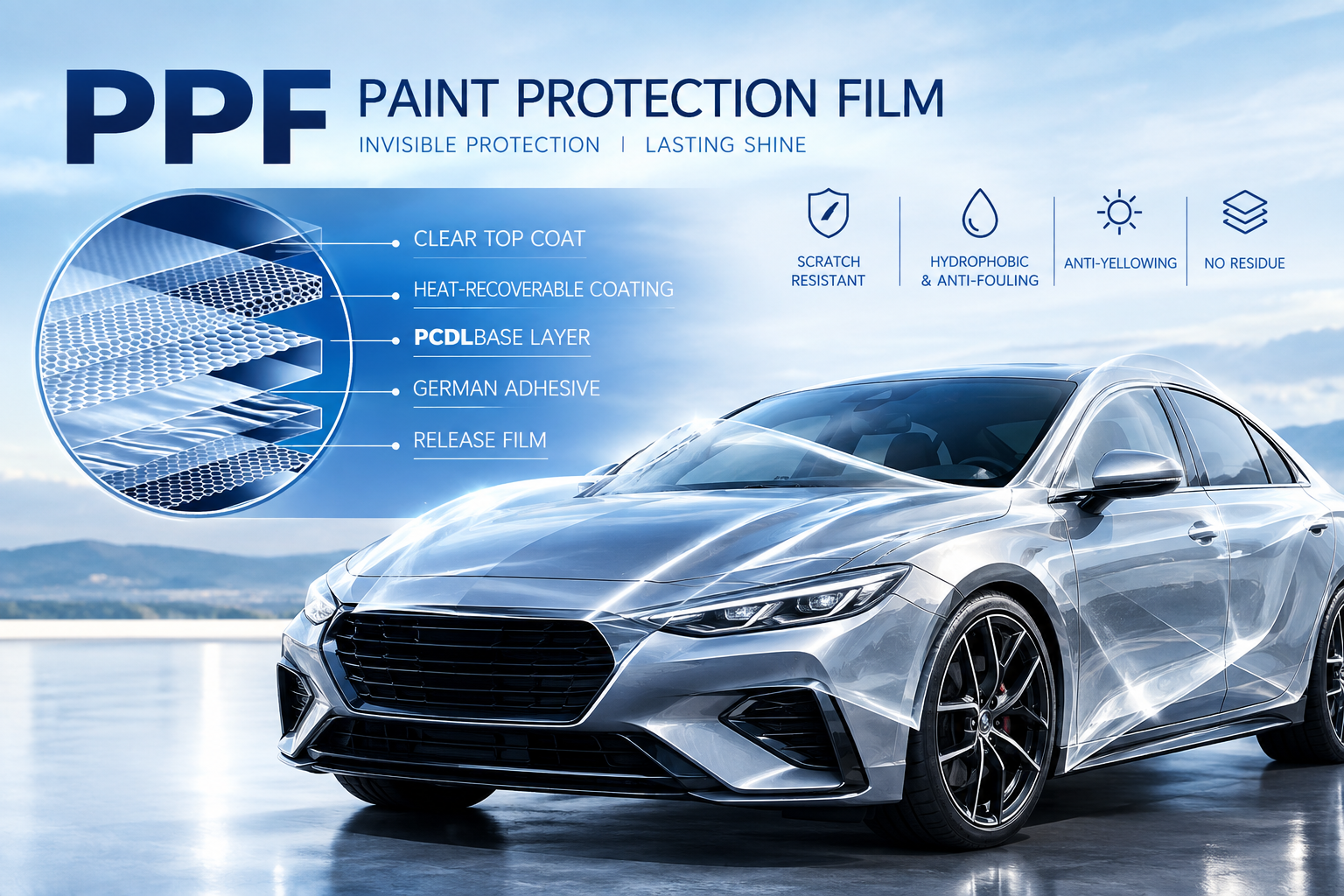
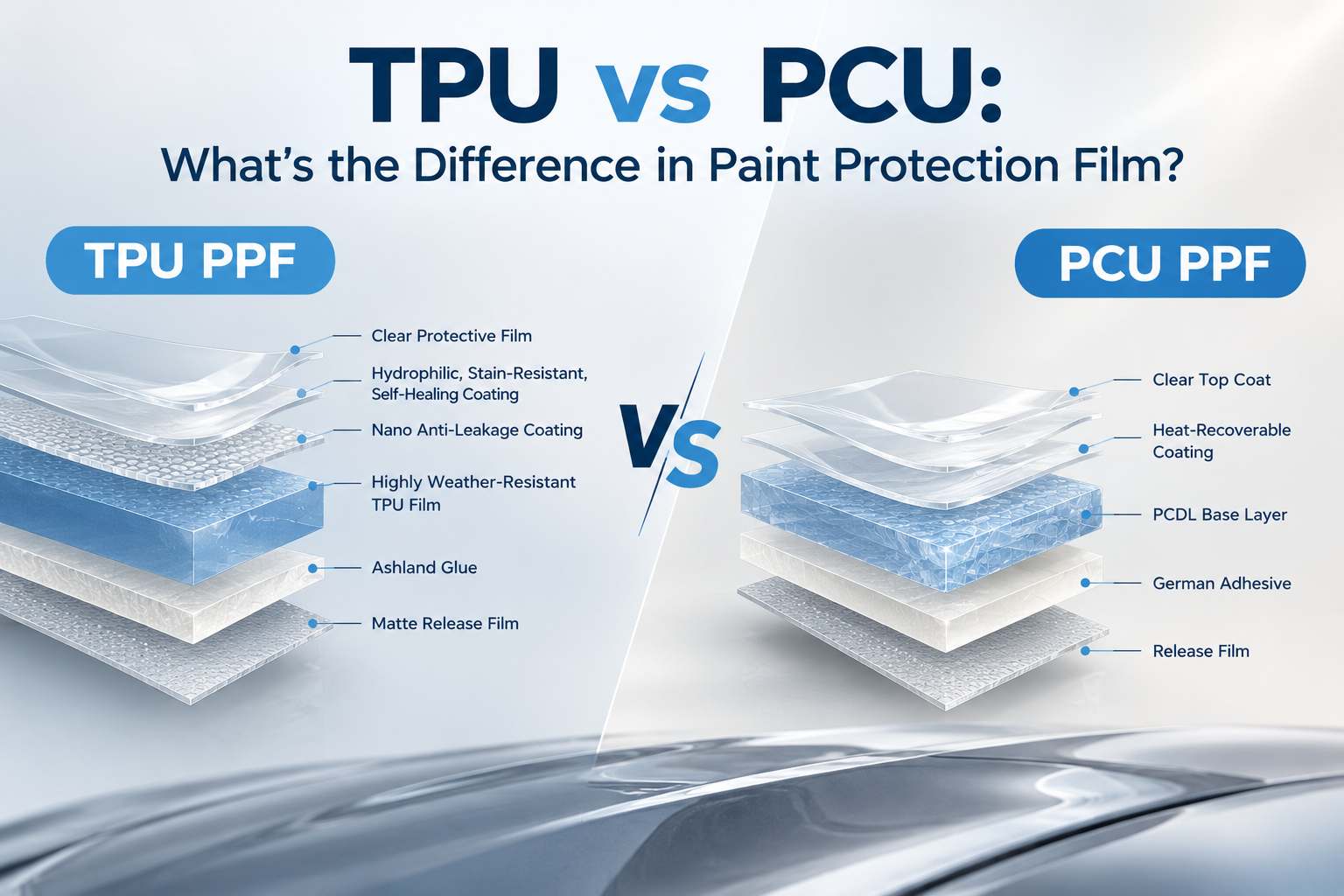
TPU material confirmation
Adhesive specification
Compare against your current supplier: The decisive question is not “is this film good?” but “is this film better than what I have, and by how much?”
The Sample Roll Investment
KSB charges a small fee for sample rolls (typically sample pricing, not production pricing). The fee exists for two reasons: it ensures samples go to genuinely interested buyers rather than speculative requests, and it ensures the buyer has a financial stake in actually testing rather than simply receiving and shelving the sample.
For a distributor whose next commercial order would be 200 rolls: the cost of a proper sample evaluation (2–5 rolls at sample pricing) is the cheapest insurance available against a poor bulk order decision.
How to Make the Switch If Samples Pass
Once your testing confirms the new supplier meets or exceeds your current supplier’s quality:
Step 1: Place a small commercial test order (20–30 rolls) before committing to full volume. Test on real vehicles with real customers (start with lower-stakes installations — not your most valued client’s Ferrari).
Step 2: If the small commercial order performs consistently with the samples, expand to standard volume.
Step 3: Run parallel supply (old and new supplier) for one order cycle before fully transitioning. This provides a backup if any unexpected issue emerges.
Step 4: Communicate the change to your installers with the technical basis — not just “we changed supplier” but “we’ve upgraded to a film with documented aliphatic TPU and 3,000-hour QUV data.”
FAQ
How many sample rolls do I need to evaluate properly?
Minimum 2 rolls (one for installation testing, one to send to an independent installer for blind assessment). 3–5 rolls is better — allows testing on multiple vehicle types and gives you a stock piece for long-term reference.
Should I tell my current supplier I’m evaluating alternatives?
This is commercially sensitive and depends on your relationship. Evaluation of alternatives is standard business practice. If your current supplier improves pricing or service in response to knowing you’re evaluating, that’s a positive outcome from the exercise.
KSB Window Film provides sample rolls for systematic evaluation with full technical documentation. If the film doesn’t meet your standards on testing, you’ve spent the cost of samples — not the cost of 200 rolls.
The Specific Risks of Switching PPF Suppliers — and How to Mitigate Each
Risk 1: “The sample is good but the commercial product is different.”
This is a real risk — some manufacturers use better material for sample rolls than for commercial production. Mitigation: test two rolls from different batches (ask specifically for samples from two different production dates). If both are consistent with each other and with the supplier’s data, the risk of production-quality mismatch is substantially reduced.
Risk 2: “My best installer hates the new film.”
Experienced installers develop fine-tuned preferences for their current film’s installation behaviour. A new film with different working window, conformability, or slip characteristics creates a learning curve. Mitigation: give your best installer the sample roll first, with full awareness that they’re evaluating a new product. Their feedback is more useful than a reluctant acceptance.
Risk 3: “I have existing warranty obligations to honour with my current product.”
You can’t switch mid-warranty without carrying the old supplier’s product for warranty replacement. Mitigation: plan your switch to start with new customer installations. Maintain adequate old-supplier inventory for warranty replacement purposes (typically 10–15% of your annual volume for one full warranty cycle).
Risk 4: “What if quality is inconsistent across orders?”
A two-batch sample evaluation reduces this risk. Additionally: request batch test certificates with your first commercial order and compare the results against the sample data. If the batch data shows the same performance as the samples, you have evidence of consistency. If it varies, you have grounds to investigate before the problem reaches your customers.
Building a Transition Timeline
For a distributor planning a structured transition:
Month 1: Receive and evaluate sample rolls (5-test protocol per How to Test a PPF Sample Roll). Review documentation.
Month 2: Place small commercial test order (20–30 rolls). Install on volunteer customer vehicles with close follow-up.
Month 3: If commercial order performs well, place standard volume order on new supplier. Reduce old supplier order proportionally.
Month 4–5: Run parallel supply (both suppliers). Monitor installer feedback and customer performance from new supplier installations.
Month 6: If new supplier performing consistently, complete transition. Maintain old supplier relationship for warranty fulfilment on earlier installations.
What KSB Offers to Smooth the Transition
Extended sample programme: First-time buyers receive up to 5 rolls across multiple specifications in the Mixed Sample Programme — enough for thorough evaluation across different vehicles and installers.
Technical comparison brief: On request, KSB provides a technical comparison of our product specification against your current supplier’s published data (where public data is available). This gives you an objective basis for the technical comparison before physical testing.
Onboarding call with our technical team: A 30-minute call with KSB’s technical team to discuss your market, installation environment, and specific performance requirements — to confirm which KSB specification is the right match before you order samples.
Transition pricing: First commercial orders are priced with the consideration that you’re transitioning and taking commercial risk. Contact our team to discuss transition pricing structure.
FAQ
How do I tell my current supplier I’m evaluating alternatives?
You don’t have to tell them anything during the evaluation phase — evaluating alternatives is standard commercial practice. If the evaluation leads to a transition decision, some distributors inform their current supplier professionally as a courtesy. A supplier who responds by improving pricing or service has confirmed there was margin available all along.
What if KSB’s product doesn’t match the sample on the first commercial order?
This is exactly why we produce batch test certificates and have a formal batch traceability system. If a commercial batch doesn’t match sample performance, we investigate using the batch production records and resolve through replacement or credit. This process is documented in our commercial terms.
Get a Free Sample or Quote
Looking for a reliable window film supplier? Contact us today for fast response and professional support.
✔ OEM / ODM Customization✔ Fast Global Shipping✔ Professional Technical Support