Reviewed by KSB PPF Product and Quality Control Team
If you’ve been distributing someone else’s PPF brand for a while, you already know the market. You know which thickness sells in your region, what installers complain about, what end customers ask for, and roughly what margin you’re working with. The question at some point becomes: why am I building someone else’s brand instead of my own?
Private label PPF is a reasonable next step for distributors and importers who have market knowledge, an installer network, and the volume to support it. It’s not a shortcut — it requires real decisions about product, packaging, and positioning. But for businesses ready to make those decisions, the upside is meaningful: better margins, brand equity that stays with you, and a product line you control.
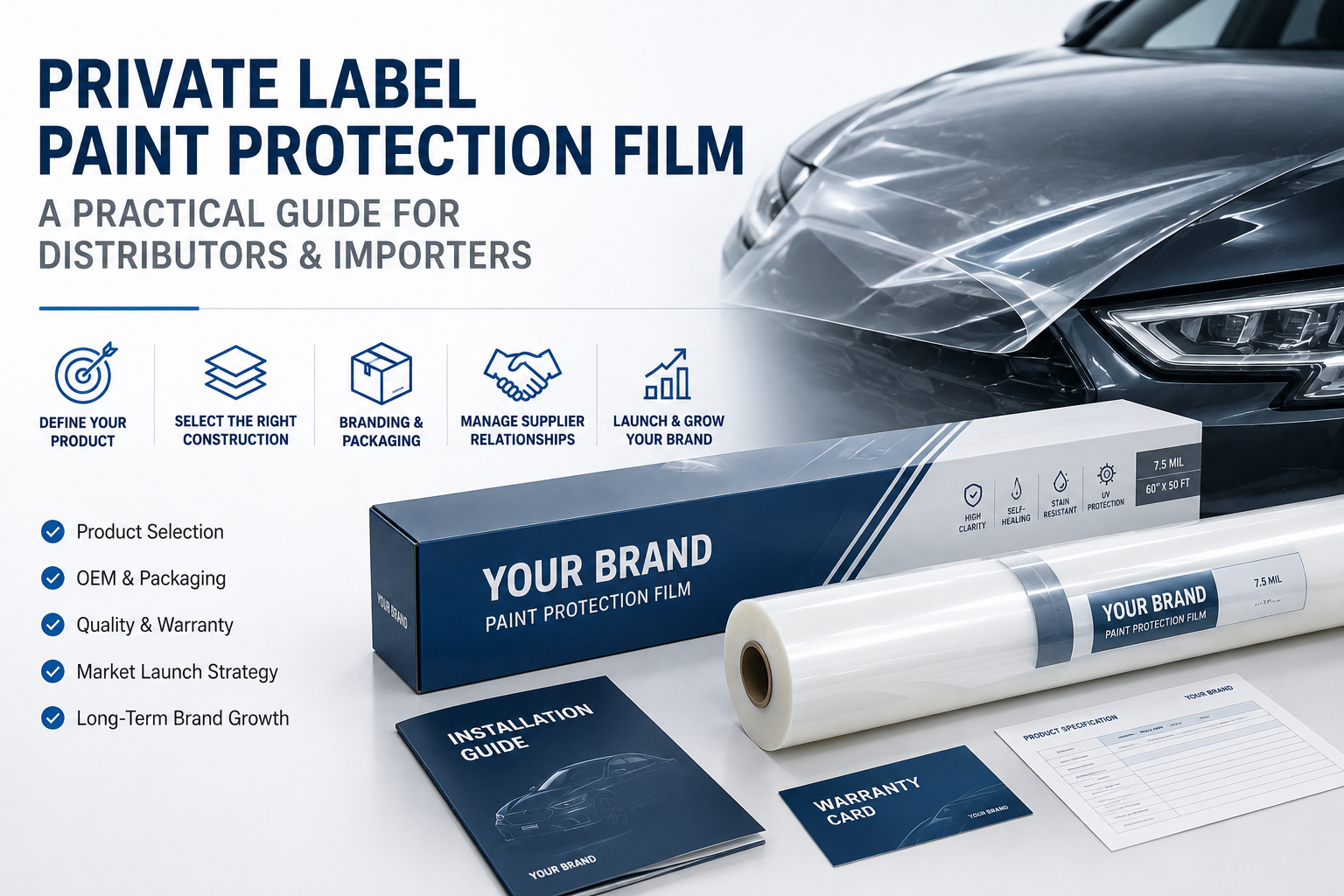
This guide focuses on the decisions that matter most: how to select the right product construction for your market, how to approach packaging and branding, and what to get right before you launch.
Why Distributors Make the Move to Private Label
Distributing a named brand has advantages early on — the product exists, the quality is established, and you’re not carrying product liability alone. But the ceiling is low.
You’re competing with every other distributor of the same brand, often on price. Your margin is set by someone else’s pricing structure. The brand equity you build through installer relationships and marketing investment accumulates to the brand owner, not to you. And if the brand owner changes their distribution terms, adds a competitor in your territory, or discontinues a product line, your business is affected by a decision you had no part in.
Private label changes that equation. Your brand is on the product. The relationships you build, the reputation you earn, and the market position you develop belong to your business. The product can be sourced, adjusted, and eventually switched if a better option exists — without disrupting your brand.
The tradeoff is responsibility. You’re now accountable for the product. That means selecting it carefully, backing it with a warranty you can stand behind, and having a supplier relationship solid enough to handle problems when they arise.
Step One: Define Your Product Before You Source It
The most common mistake distributors make when moving to private label is approaching manufacturers without a clear product brief. You end up evaluating whatever the manufacturer wants to sell rather than what your market actually needs.
Before you contact a single supplier, define the following:
Target market and climate PPF that performs well in a hot, high-UV market like the Middle East or Australia has different requirements from film sold in Northern Europe or Canada. Humidity, UV intensity, and temperature range all affect which film construction is appropriate. If you’re selling across multiple climates, you may need more than one product in your line.
Product tier and warranty period Are you positioning as a premium brand, a value alternative, or covering multiple tiers? Your warranty commitment — 5 years, 7 years, 10 years — needs to match the film you’re putting your name on. A 10-year warranty claim requires a film construction that can actually support it, backed by supplier documentation. Don’t set a warranty period based on what competitors claim; set it based on what your product can deliver.
Thickness and finish Most markets have conventional expectations around thickness. 7.5 mil is a standard full-body PPF specification in many markets; 6 mil is common for entry-level or partial coverage products. Matte and satin finishes have grown significantly and may be worth including depending on your market. Decide upfront rather than letting supplier availability drive the decision.
Roll dimensions Standard roll widths (typically 1.52m / 60 inches) and roll lengths vary by market convention and installer workflow. If your installer base has a preference or your packaging format requires specific dimensions, specify this early.
Getting clarity on these points before approaching suppliers means you’re evaluating whether a manufacturer can meet your requirements — not whether their standard product is close enough.
Step Two: Selecting the Right Film Construction
Once you know what you need, you can evaluate whether a supplier’s film construction is appropriate for your market and warranty commitment.
Aliphatic vs. aromatic TPU For transparent PPF used outdoors, this is the most important material question. Aliphatic isocyanate chemistry resists UV-induced yellowing significantly better than aromatic alternatives. Any PPF you put your brand on for long-term outdoor use should be based on aliphatic TPU. This is standard in quality products — a supplier should confirm it without hesitation.
Soft segment chemistry The polyol backbone of the TPU affects hydrolysis resistance and long-term durability. Polycarbonate diol (PCDL)-based TPU generally performs better in high-humidity conditions than conventional polyester or polycaprolactone (PCL) alternatives. For markets with significant rainfall or humidity, understanding the soft segment chemistry is relevant to your warranty positioning.
Top coat performance Self-healing is a selling point in the PPF market, but “self-healing” covers a wide range of actual performance. Ask at what temperature the self-healing function activates and how completely it recovers. A top coat that requires 60°C+ to heal is not practically useful in most climates. Stain resistance is equally important — the top coat is the surface your customers are actually protecting.
Adhesive system The adhesive affects installation experience and long-term clean removal. Ask whether the supplier has removability data — how the adhesive behaves after several years of outdoor exposure. Poor adhesive is one of the most common sources of field complaints and warranty claims.
Supporting documentation Request accelerated weathering test reports and any hydrolysis resistance data. A supplier who can provide actual test results — not just a certificate — gives you a basis for the warranty claim you’re making to your customers. If a supplier can’t produce aging data, your warranty is based on their assurance rather than evidence.
Step Three: Packaging and Branding Decisions
This is where private label becomes visible. Your packaging is what installers and distributors see when a box arrives. It’s part of how your brand is perceived before the film is even unrolled.
Box design A well-designed box does several things: it communicates product tier, it gives installers the information they need (thickness, finish, roll dimensions, warranty period, installation notes), and it reinforces that this is a professional product. A generic white box with a label stuck on it communicates something different.
Invest in proper box artwork. It doesn’t need to be expensive — a clean, professionally designed box with consistent branding is achievable at reasonable cost. The design file is yours and travels with you if you switch suppliers.
Roll labeling The roll itself should carry your brand, the product specification, and a batch or lot identifier. This matters operationally: when an installer calls with a question or a claim, you need to be able to identify exactly which product they’re using.
Liner printing Some manufacturers offer printed liners — the release paper that installers peel during application. A branded or instructional liner is a small detail that signals quality and supports the installer experience.
Documentation inserts A warranty card, installation guide, and care instructions insert adds perceived value and gives your brand a professional presence at the point of installation. Installers who receive clear documentation from a brand are more likely to recommend it. This material can often be produced by the manufacturer in your brand name or sourced independently.
Language and regulatory requirements If you’re distributing across multiple markets, packaging may need to accommodate multiple languages. Some markets also have specific labeling requirements for chemical products. Confirm these requirements before finalizing packaging artwork.
Step Four: Managing the Supplier Relationship
Private label creates a different supplier relationship than standard distribution. You’re dependent on this manufacturer for your brand’s product. That dependency needs to be managed carefully.
Get quality standards in writing Before your first bulk order, agree on what constitutes an acceptable product, what the process is for quality claims, and how replacement or credit is handled. This is much easier to negotiate before you’re dependent on the supplier than after a problem has occurred.
Establish lot traceability Your supplier should be able to trace any production lot back to its raw material batches. When a quality issue surfaces — and at some point, one will — you need to determine the scope. Lot traceability makes that possible.
Agree on lead time commitments Understand the standard production lead time, the minimum notice required for reorders, and what happens if you need to increase volume quickly. Your product launch and reorder cycle depend on reliable delivery.
Plan for packaging lead time Custom packaging — boxes, labels, printed liners — typically requires its own production lead time, separate from film production. Factor this into your launch timeline. Running out of branded packaging while product is available is a preventable problem.
Protect your design assets Your box artwork, brand guidelines, and product documentation belong to your business, not your supplier. Keep originals and ensure your supplier’s use of them is defined in your agreement.
Step Five: Launching Into Your Market
A private label product launch requires more than having boxes printed. Your installer and distributor network needs to understand the product, the warranty, and what you’re offering that’s different from what they’re already using.
Prepare your technical documentation Your installers will ask questions about the product. Have a product data sheet, warranty document, installation guide, and FAQ ready before launch. These don’t need to be extensive, but they need to exist and be accurate.
Define your warranty process What does a warranty claim look like, how does a customer or installer submit one, and how do you handle it? A warranty program without a clear process is a liability. Design this before your first roll ships.
Seed product with key installers before broad launch Getting a handful of trusted installers to use the product before public launch gives you real feedback, surfaces any issues before they become widespread, and generates early advocates for the brand. Their experience with the film — installation behavior, optical clarity, first impressions — is more valuable than any spec sheet.
Set realistic warranty terms Your warranty should reflect what you can actually deliver and service. A warranty period that stretches what your product can support will generate claims you can’t stand behind. A warranty that’s clearly defined and deliverable builds trust faster than an ambitious number that creates problems.
What Separates Successful Private Label Brands From Those That Stall
Most PPF distributors who move to private label succeed or struggle based on a few consistent factors.
Product-market fit. A film construction that suits the climate and use patterns of your specific market performs better and generates fewer problems than a generic product. The upfront work of matching construction to market pays off in reduced warranty exposure and better installer satisfaction.
Warranty honesty. Brands that claim 10 years on a product that realistically supports 5–6 generate claims they can’t manage and damage their reputation faster than brands with honest, achievable warranty terms.
Installer experience. Installers are your primary channel. A film that installs cleanly, consistently, and without surprises earns loyalty. Installation problems — edge lifting, inconsistent stretch, adhesive contamination — drive negative word of mouth in a tight professional community.
Supply consistency. Running out of product, receiving inconsistent batches, or dealing with packaging errors erodes confidence in a new brand faster than almost anything else. Supply reliability is part of the product.
Frequently Asked Questions
What is a realistic minimum order quantity for private label PPF? This varies by manufacturer and packaging configuration. Some manufacturers offer private label from modest initial quantities on standard film constructions. Custom packaging typically requires higher minimums. Specify your target volume when inquiring — most manufacturers will tell you whether it’s workable.
How long does it take to launch a private label PPF product? From supplier selection to first shipment: typically 6–12 weeks, depending on packaging production time and whether any product customization is required. Allow more time if you’re developing custom box artwork from scratch or specifying non-standard roll dimensions.
Can I use the same packaging across different film constructions? With careful design, yes. A tiered product line — entry, standard, premium — can share brand identity while differentiating clearly on specification and warranty. This requires planning the product line before finalizing packaging design.
What happens if I want to switch manufacturers later? Your brand, artwork, and product documentation belong to you. A manufacturer change is operationally complex but feasible if your agreements are structured correctly. Avoid situations where your supplier owns or controls any of your brand assets.
Do I need to register my brand before launching? Trademark registration in your key markets is advisable before significant marketing investment. At minimum, confirm that your chosen brand name doesn’t conflict with existing trademarks in your target markets. This is easier and less expensive to address before launch than after.
Ready to Launch Your Own PPF Brand?
If you’re a distributor or importer ready to move to private label, we support the full process — product selection by market and warranty requirement, branded packaging, technical documentation, and ongoing OEM supply.
Share your target market, thickness and finish requirements, warranty period, estimated volume, and any packaging specifications. We’ll recommend a suitable film construction and provide samples, technical data, and a private label quotation.
Request PPF Samples | Get a Private Label Quotation | Talk to a PPF Specialist
Reviewed by KSB PPF Product and Quality Control Team.
This article reflects general industry knowledge and KSB’s experience in private label PPF supply. Specific terms, MOQs and lead times vary and should be confirmed directly.
Get a Free Sample or Quote
Looking for a reliable window film supplier? Contact us today for fast response and professional support.