Reflective vs Non-Reflective Window Film for Buildings: When to Use Each
Published: September 4, 2026 · 7 min read · Category: Architectural Window Film
About this article: KSB Window Film manufactures both reflective and non-reflective architectural solar control film. The choice between them is one of the most consequential specification decisions for building facade aesthetics — this guide covers the tradeoffs directly.
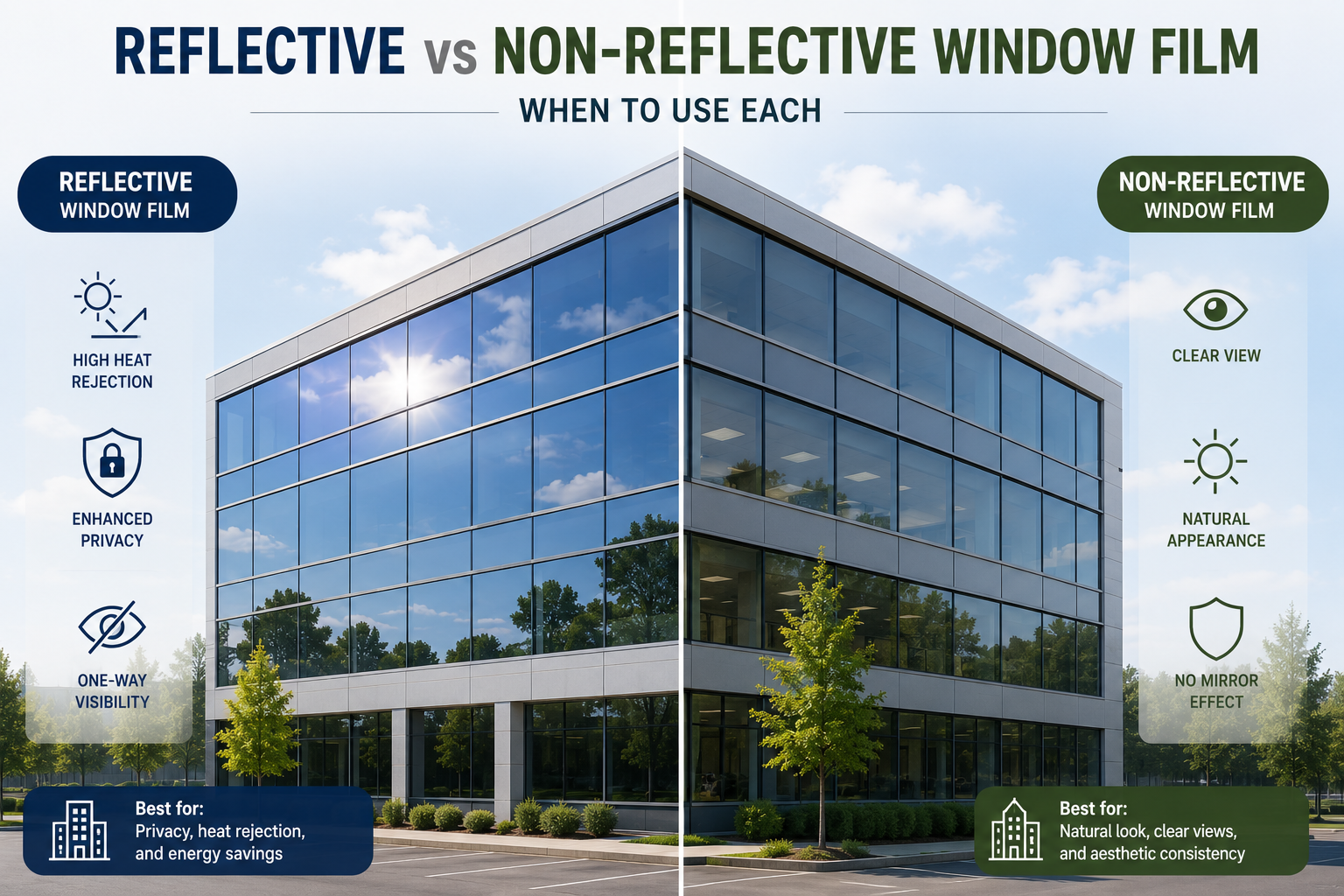
Comparison of reflective and non-reflective architectural window film on a commercial building facade.
Reflective and non-reflective window film are both solar control products. Both reduce heat gain. Both block UV. The difference is how they achieve solar rejection and what they look like — from outside, from inside, and at night.
The aesthetic and practical consequences of this choice affect buildings and their occupants for years. Getting it right from the start matters.
How Each Technology Works
Reflective film uses metallic layers or high-reflectance coatings that bounce solar radiation back outward before it’s absorbed. The reflective surface sends incoming solar energy away from the building — an efficient mechanism that achieves high solar rejection per unit of VLT.
The visible consequence: the exterior surface of the glass appears mirror-like. Passersby see the sky and street reflected in the glazing rather than the building interior.
Non-reflective film (sometimes called neutral film, low-reflectance film, or absorptive film) achieves solar rejection primarily through absorption — the film coating absorbs solar energy and converts it to heat that dissipates through the glass. Modern non-reflective products, particularly nano ceramic, also incorporate a selective reflection component, but at much lower levels than traditional reflective film.
The visible consequence: the exterior surface of the glass appears as a subtly tinted, low-reflectance surface — far closer to the appearance of unfilmed glass.
Performance Comparison
Solar Rejection
Reflective film achieves higher TSER per VLT level. A reflective film at 25% VLT might deliver TSER of 75–80%. A non-reflective nano ceramic at the same 25% VLT delivers TSER of 65–72%.
The performance advantage of reflective film narrows as VLT increases. At 50% VLT, the gap between quality reflective and quality nano ceramic is smaller.
For maximum solar rejection on highly solar-exposed facades where aesthetics are less critical — industrial buildings, certain back-of-house commercial applications, some government buildings — reflective film is the higher-performance option.
Exterior Appearance
Reflective film: The mirror effect. The building facade becomes a reflective surface — attractive in some architectural contexts (curtain wall towers where the reflection creates visual interest), intrusive in others (suburban retail, heritage-sensitive locations, low-rise commercial where the mirror appearance is jarring).
Non-reflective film: Subtle. At most VLT levels, the glass looks like slightly darker glass — visually indistinguishable from lightly tinted glazing at most viewing distances.
Interior View Quality
Reflective film: From inside looking out, view quality is reduced compared to clear glass — the reflective coating creates a slightly murky quality to the view, particularly in lighting conditions where the interior and exterior brightness are similar.
Non-reflective film: Better interior view quality at equivalent VLT. The absorptive mechanism doesn’t introduce the same viewing reduction. Premium nano ceramic film maintains very good view quality even at 30–35% VLT.
Night Behaviour
Reflective film: In daylight, reflective film provides excellent privacy — exterior observers see the mirror reflection, not the interior. At night with interior lights on, the effect reverses: the reflective surface is on the inside, and from outside the building, the interior is more visible than it would be without film. Occupants inside see their own reflections rather than a view.
Non-reflective film: Provides no inherent privacy in either lighting direction — occupants and exterior observers see through the glass approximately equally, with the tinting reducing intensity. Night appearance is essentially the same as daylight appearance — darker than clear glass but no mirror effect.
When to Use Reflective Film
Maximum solar rejection is the priority and appearance can accommodate it. For a high-rise commercial building in a hot climate where every percentage point of TSER is worth money in cooling savings, reflective film’s performance advantage justifies the aesthetic.
The exterior mirror appearance is architecturally appropriate. Many curtain wall office towers look better with reflective glazing — the sky reflection creates visual depth and modernist character. This is a legitimate architectural choice.
Daytime privacy is required. Street-facing offices, ground-floor meeting rooms with exterior visibility, hospitality environments where daytime privacy is a requirement — reflective film provides this as a side effect of the mirror coating.
The building is not occupied in the evenings. For buildings that are unoccupied after dark, the night privacy reversal is irrelevant.
When to Use Non-Reflective Film
Appearance management is important. Heritage buildings, suburban commercial, retail frontages, residential-adjacent commercial — contexts where the mirror appearance would be out of character or face planning objection.
Consistent interior view quality matters. Buildings where the view is a premium feature — hotels with sea views, corporate offices with designed outlooks, residential — non-reflective film preserves the view.
The building is occupied in evenings and privacy is required. Reflective film’s night privacy reversal creates an occupant experience problem. Non-reflective film with frosted privacy film where needed is a better combination.
ADAS radar and sensor compatibility is required. Highly reflective metallic film can, in some configurations, interfere with building-integrated radar sensors or equipment near glazing. Non-reflective nano ceramic film has no such interaction.
FAQ
Can I tell from outside whether a building has reflective or non-reflective film?
Yes, easily. Reflective film produces a mirror-quality reflection — you can clearly see the sky and street reflected. Non-reflective film may produce a subtle darkening of the glass, but no clear reflection of the environment. At most VLT levels, non-reflective film is visually indistinguishable from slightly tinted unfilmed glass at normal viewing distances.
Is the solar performance difference between reflective and non-reflective significant enough to matter?
At equivalent VLT levels, the performance difference is meaningful — roughly 5–15% more TSER from reflective film. Whether that difference matters depends on the climate, building use, and energy cost. In a hot climate where film is the primary solar control strategy, the performance advantage is worth quantifying. In a mild climate where film is supplementary, the difference may be academically interesting but not commercially significant.
My planning authority requires a specific exterior glass appearance. Can non-reflective film help?
Often yes. Many planning conditions specify maximum external glass reflectance or require the building to maintain a specific visual quality. Non-reflective nano ceramic film at VLT 40–50% typically satisfies these conditions — it doesn’t significantly alter the exterior appearance while delivering solar control performance. Confirm with your planning officer and, if necessary, submit a sample panel for approval.
KSB Window Film produces both reflective solar control and non-reflective nano ceramic architectural film. We can provide sample panels of both at your target VLT so your team can assess the appearance difference in your specific building context before committing to a specification.