
Published: June 11, 2026 · 8 min read · Category: PPF Guide
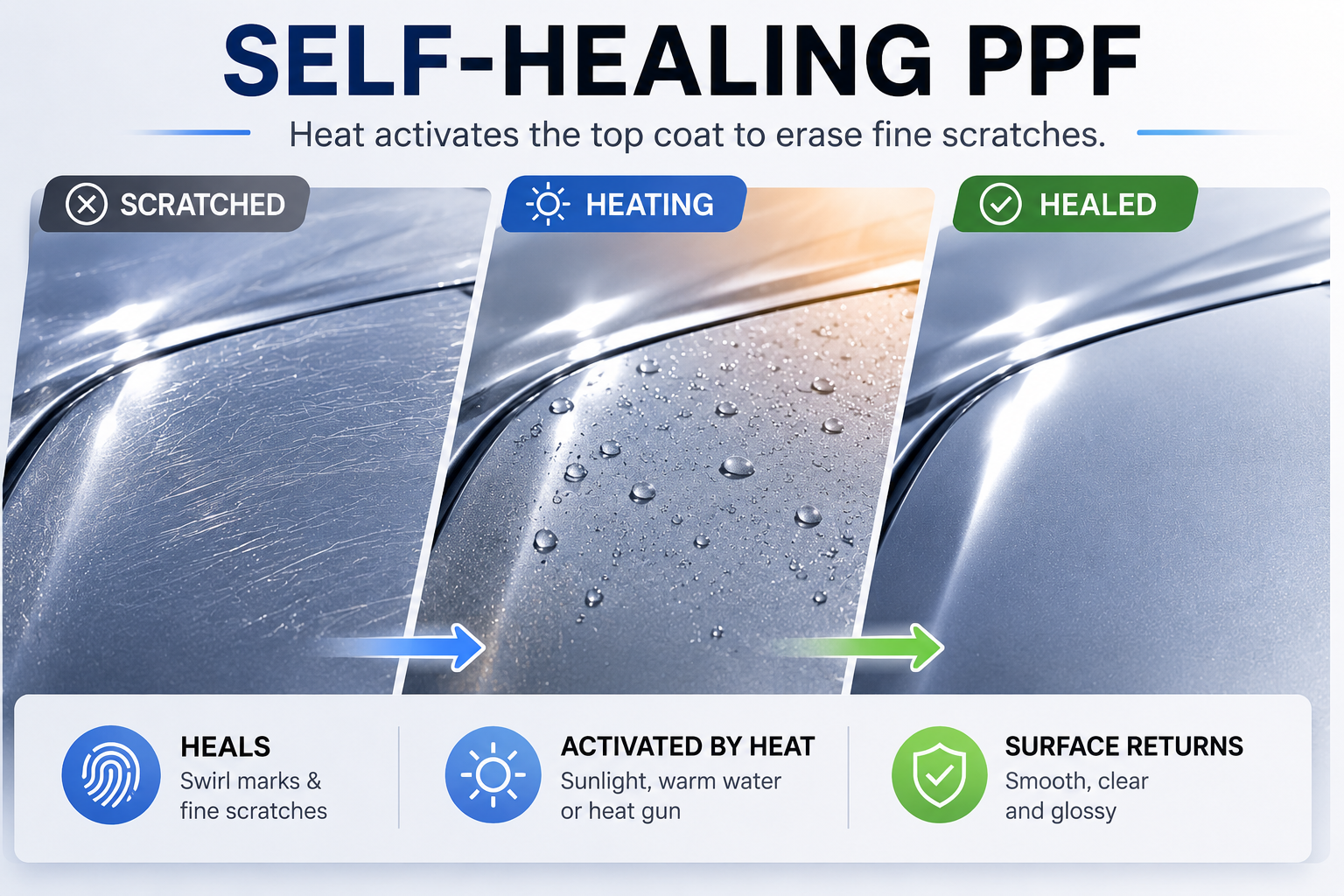
“Self-healing” is one of those product features that sounds too good to be true until you’ve actually seen it happen. Run your fingernail across a fresh piece of quality PPF, leave the car in the sun for twenty minutes, and come back to find the scratch gone. Not faded — gone.
It’s genuinely impressive the first time. It’s also genuinely misunderstood — both overestimated by buyers expecting it to fix serious damage and underestimated by skeptics who assume it’s marketing language.
This article explains what’s actually happening at the material level, what self-healing can and can’t do, and how to evaluate whether a film’s self-healing claim is worth taking seriously.
The Chemistry Behind It
Self-healing in PPF is a property of the top coat layer — not the entire film. The base TPU film doesn’t heal. The adhesive doesn’t heal. The clear coat on top does.
That top coat is formulated with a class of polymers that have elastic memory. The technical term for the mechanism is elastomeric recovery — the ability of a polymer network to return to its original shape after deformation.
Here’s what that means in practice:
The top coat contains polymer chains that are cross-linked in a three-dimensional network. When a sharp object scratches the surface, it forces those chains out of their equilibrium position — you’ve essentially pushed the material aside, creating a groove. The cross-links want to pull the chains back. At room temperature, they don’t have enough energy to overcome the friction holding the deformed chains in place. Apply heat — which gives the molecules more kinetic energy — and the chains return toward their original configuration. The groove closes. The scratch disappears.
This is why self-healing is temperature-dependent. The process needs thermal energy to overcome the barrier between the deformed state and the recovered state. More heat = faster healing.
What Actually Triggers Healing
Direct sunlight: On a clear day, a vehicle surface in direct sun can reach 40–60°C within minutes. For most quality PPF products, this is enough to initiate healing of fine scratches. A light swirl mark from a wash can disappear in 20–30 minutes of sun exposure.
Warm water: Pouring a bucket of warm water (40–50°C) over a scratched section is the fastest field method. The heat transfer is immediate and consistent across the surface.
Heat gun or heat lamp: Used by installers and detailers for more controlled healing, particularly on deeper scratches or in cold conditions. Allows precise heat application without overheating adjacent areas.
Ambient temperature over time: Very fine micro-scratches will often self-heal at ambient temperature given enough time — particularly in warmer months. Slower, but no intervention needed.
What Self-Healing Fixes (and What It Doesn’t)
This is where the marketing-versus-reality gap tends to live.
Will self-heal:
- Swirl marks from automated car washes
- Fine scratches from improper wash technique
- Light fingernail scratches
- Micro-abrasion from dust and grit at low contact force
- Very light key contact (grazes, not deliberate scoring)
May partially heal:
- Moderate scratches that are visible but don’t sharply catch a fingernail
- Scratches in cold conditions — healing may be partial until temperature rises
Will not self-heal:
- Deep scratches penetrating through the top coat into the TPU base
- Cuts or punctures from sharp objects
- Scratches that feel like a groove under a fingernail
- Rock chip impacts or penetrations
- Any damage reaching the adhesive layer
A practical test: run your fingernail lightly across the scratch. If it catches, it’s too deep to self-heal. If your nail glides over it, heat will likely close it.
Healing Speed: Why Products Differ
Not all self-healing PPF heals at the same speed — and the difference matters in practice.
Top coat elastomer formulation: Manufacturers invest in proprietary top coat chemistry precisely because healing speed is a key differentiator. The specific polymer architecture, not just the elastomer content, determines real-world healing behavior.
Cross-link density: More densely cross-linked networks produce harder surfaces (more scratch resistant) but heal more slowly. Less densely cross-linked networks scratch more easily but recover faster. Premium products balance these properties — budget products typically optimize for one at the expense of the other.
Film temperature at time of scratch: A warm film heals faster than a cold one. A scratch on a summer afternoon may close before you park the car; the same scratch in January may persist until the vehicle sits in a warm garage overnight.
Manufacturer claims vs. reality: Some manufacturers quote healing times under ideal laboratory conditions that aren’t representative of daily use. The more useful question: does the film reliably heal fine wash scratches within 30 minutes of sunlight in your climate? Request a demo sample and test it yourself before making any sourcing decision.
The Hardness Tradeoff
There’s a fundamental tension in PPF top coat design that no manufacturer has fully resolved: scratch resistance and healing speed pull in opposite directions.
A harder top coat resists scratches better — but heals more slowly. A softer top coat heals faster — but scratches more easily. Premium products sit at different points on this curve depending on their target market. Some prioritize scratch resistance for aggressive cleaning environments; others prioritize healing speed for daily-driver applications in car-wash cultures.
Neither is the wrong answer. The right position depends on what your customers actually need — and understanding this tradeoff lets you communicate product differences clearly to installers, rather than just repeating the manufacturer’s spec sheet.
Self-Healing Under Ceramic Coating
Many PPF installations get a ceramic coating applied over the film for added hydrophobic protection and gloss depth. The question comes up: does ceramic coating prevent self-healing?
No — with a qualifier. A standard professional ceramic coating (1–2 microns) doesn’t meaningfully inhibit healing of fine PPF scratches underneath. The ceramic layer is hard but extremely thin, and doesn’t prevent the PPF top coat from recovering.
Very thick or multi-layer ceramic applications can begin to stiffen the surface enough to slow healing noticeably. Professional installers working with PPF regularly understand compatible product choices. When in doubt, test on a sample section before full application.
Evaluating a Manufacturer’s Self-Healing Claims
Self-healing claims have been attached to PPF products at every price point, which makes the claim itself nearly meaningless without evidence. Here’s how to cut through it:
Request a demo sample and test it yourself. Scratch it with your fingernail. Put it in direct sun for 30 minutes. Premium film should show clear healing. If nothing happens, the claim is questionable regardless of what the datasheet says.
Ask for third-party test data on healing performance. SGS and Intertek both assess PPF self-healing as part of comprehensive performance testing. A current third-party report that specifically addresses healing behavior puts substance behind the claim.
Ask about healing performance over time. A fresh sample healing quickly doesn’t tell you how the film behaves at year 5. Top coat degradation from UV exposure gradually reduces elastomeric capacity. Premium products with strong UV stabilizer packages maintain healing performance significantly longer. This connects directly to overall lifespan — see How Long Does Paint Protection Film Last? for the full picture.
Ask what pencil hardness rating the top coat achieves. 3H–4H is typical for premium products — hard enough for day-to-day scratch resistance, compliant enough for reliable healing. Significantly above 4H suggests a hardness-prioritized product with slower healing behavior.
FAQ
1. What is self-healing PPF?
Self-healing PPF is a paint protection film with a special elastomeric top coat that can repair light scratches and swirl marks when exposed to heat.
2. How does self-healing paint protection film work?
Heat activates the polymer chains in the PPF top coat, allowing the surface to return to its original smooth state and remove fine scratches.
3. Can self-healing PPF remove deep scratches?
No. Self-healing PPF only repairs light surface scratches and swirl marks. Deep cuts or rock chip damage cannot heal completely.
4. Does sunlight activate self-healing PPF?
Yes. Direct sunlight can warm the film enough to trigger the self-healing process for minor scratches and wash marks.
5. Is TPU PPF better for self-healing?
Yes. Premium TPU paint protection film offers stronger and more reliable self-healing performance compared to PVC-based films.
6. Does ceramic coating affect self-healing PPF?
Most professional ceramic coatings are compatible with self-healing PPF and do not significantly reduce healing performance.
Sourcing self-healing PPF and want to verify which products genuinely perform? Contact us — we help buyers test and validate PPF before committing to distribution or OEM programs.
Further Reading
On this site:
- What Is Paint Protection Film (PPF)? Complete Guide for Beginners — Full PPF overview including where self-healing fits in the product picture
- TPU vs PVC PPF: Which Paint Protection Film Is Better? — Why meaningful self-healing is essentially a TPU-exclusive feature
- How Long Does Paint Protection Film Last? — How top coat aging affects long-term healing performance
- How Paint Protection Film Is Manufactured — The production process behind top coat formulation
- What Certifications Should a Window Film Manufacturer Have? — Certification evaluation framework applicable to PPF suppliers
External:
- Covestro TPU Materials — Technical reference on the polyurethane chemistry behind PPF self-healing
- Society of Plastics Engineers — Resources on elastomeric polymer behavior and recovery mechanisms
- Intertek Automotive Film Testing — Third-party testing including self-healing performance verification
Get a Free Sample or Quote
Looking for a reliable window film supplier? Contact us today for fast response and professional support.