PCU PPF is appearing more often in paint protection film catalogs, technical sheets, and distributor discussions. The name sounds like a separate material category, but it is not used consistently across the market.
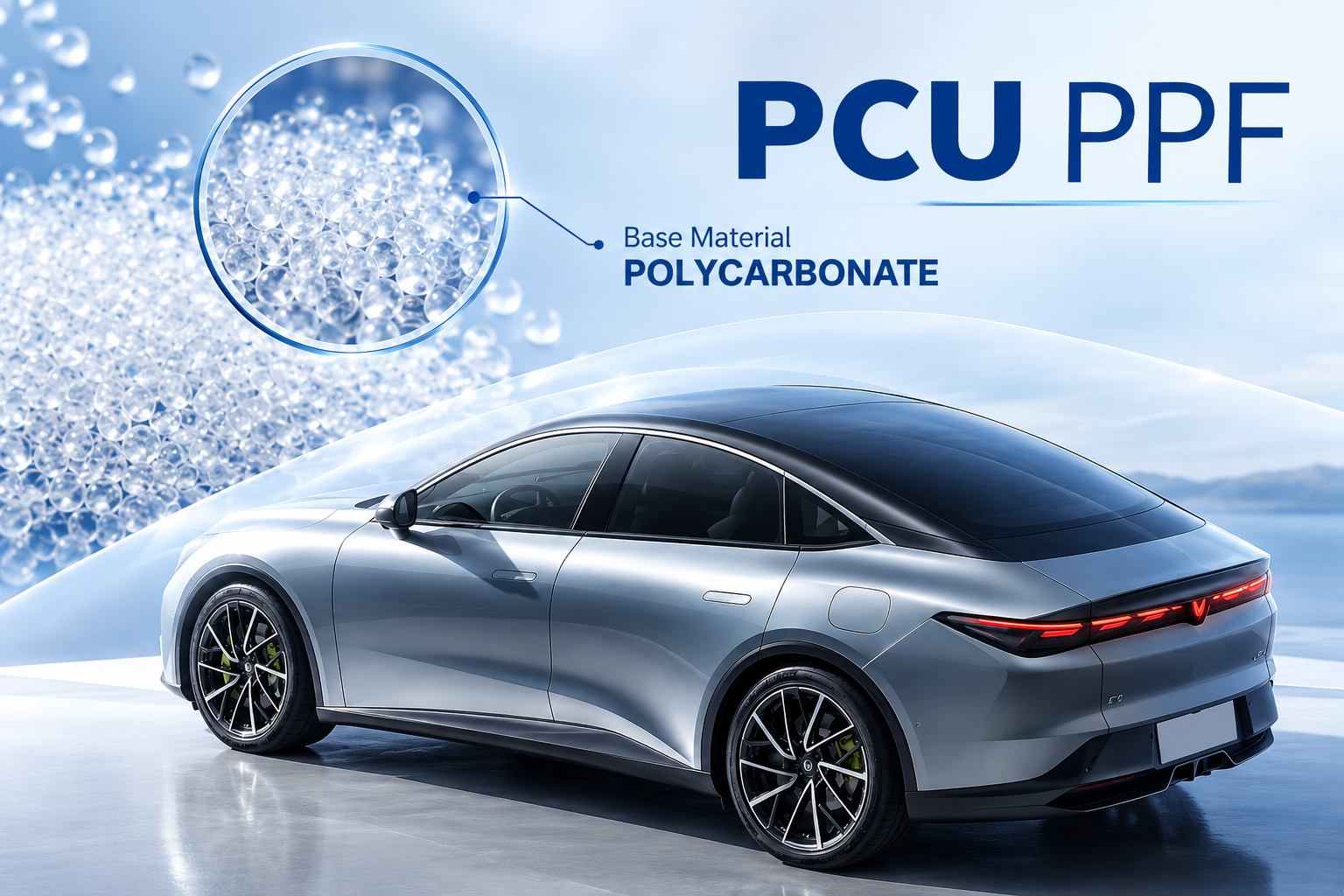
In most PPF contexts, PCU refers to polycarbonate-based polyurethane. The film is still part of the polyurethane family. More specifically, many products described as PCU use polycarbonate diol, or PCDL, in the soft segment of a thermoplastic polyurethane.
That definition matters because the label alone does not identify a complete formulation or guarantee a level of performance. It describes part of the polymer chemistry behind the PPF substrate. The topcoat, adhesive, stabilizers, coating process, and finished-film testing remain separate questions.
This guide explains what PCU means in PPF, how PCDL-based TPU is made, which material properties make it interesting, and what a buyer should verify before treating a PCU claim as meaningful.
What Does PCU Mean
PCU is commonly expanded as polycarbonate urethane or polycarbonate-based polyurethane. Within the PPF industry, suppliers often use the term for polyurethane made with polycarbonate-based soft-segment chemistry.
It should not be confused with rigid polycarbonate sheet. A clear polycarbonate panel and a flexible PCDL-based TPU film are different materials with different structures and processing methods.
It is also important to recognize that PCU is not a universally standardized PPF grade designation. One supplier may use it for a specific PCDL-based TPU formulation. Another may use it as a commercial product name. A buyer therefore needs more detail than the three-letter label.
A useful follow-up question is:
What is the actual polyurethane chemistry behind this PCU PPF, and what finished-film data supports the claim?
That question moves the discussion from marketing terminology to material and product evidence.
PCDL and Polycarbonate Based TPU
PCDL stands for polycarbonate diol. It is a polyol with hydroxyl groups at the ends of the molecule. During polyurethane synthesis, the polyol reacts with a diisocyanate and a chain extender to form a segmented polymer.
TPU contains two broad structural regions:
• Soft segments provide much of the flexibility, elasticity, and low-temperature movement.
• Hard segments contribute strength, abrasion resistance, and physical crosslinking.
PCDL can be used to build the soft segment. The resulting material may be described as PCDL-based TPU, polycarbonate-based TPU, polycarbonate polyurethane, or PCU, depending on the supplier and market.
The soft-segment name is useful, but it is not a complete formulation. PCDL grade, molecular weight, diisocyanate chemistry, chain extender, hard-segment content, stabilizer package, and production conditions all influence the finished TPU.
Research on polycarbonate-diol polyurethane also shows that changing the balance between hard and soft segments changes mechanical and adhesion behavior. Two PCDL-based TPUs can therefore have noticeably different stretch, recovery, hardness, and processing characteristics.
How PCDL Based TPU Is Used in PPF
In a clear PPF, the TPU substrate is the main flexible film layer. It must conform to curved vehicle panels, absorb impact, remain optically clear, and work with both the topcoat and pressure-sensitive adhesive.
A common PPF construction includes:
1. A temporary protective film, used on some products during handling
2. A functional topcoat
3. A TPU substrate
4. A pressure-sensitive adhesive
5. A release liner
When a product is sold as PCU PPF, the PCDL-based chemistry normally refers to item three: the TPU substrate. It does not automatically describe the topcoat or the adhesive.
This distinction explains why two products using similar PCDL-based substrates can perform differently in installation and service. One may have better surface smoothness, stain resistance, or self-healing because of its topcoat. Another may reposition more easily or hold edges more securely because of its adhesive system.
Potential Material Advantages
Polycarbonate diols are used in polyurethane applications that require resistance to water, heat, wear, and chemicals. Raw-material suppliers and published research describe several properties that can make this chemistry attractive for protective films.
Hydrolysis Resistance
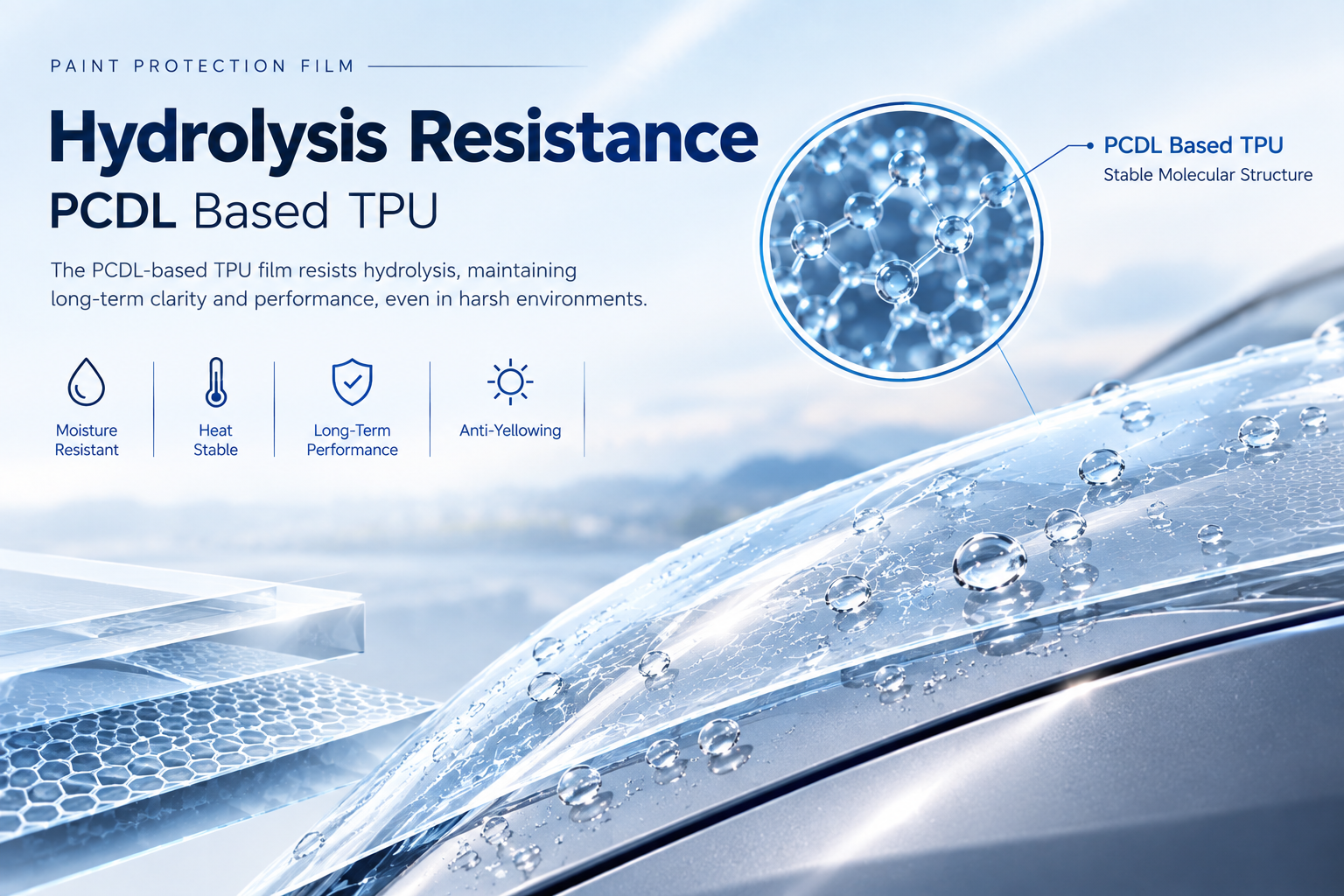
Hydrolysis is chemical degradation caused by reaction with water. Heat and humidity can accelerate it. Polycarbonate-based polyurethane is often selected when hydrolytic stability matters, especially compared with conventional polyester systems that contain more hydrolysis-sensitive ester linkages.
For PPF, this is relevant in humid, coastal, and high-temperature markets. Better resistance at the polymer level may help the substrate retain useful properties under long-term moisture exposure.
The word may is important. The result still depends on the exact PCDL structure and the rest of the TPU formulation. A broad material family cannot guarantee a specific service life.
Chemical and Environmental Resistance
PCDL-based polyurethane can offer a useful balance of water resistance, abrasion resistance, chemical resistance, and mechanical stability. These properties are relevant to a film exposed to washing chemicals, traffic contamination, temperature changes, and outdoor weather.
The substrate is not the first layer that contamination reaches, however. In a finished PPF, the topcoat provides the immediate surface barrier. Chemical-resistance claims should therefore be tested on the complete film, not inferred only from the raw substrate.
Mechanical Property Retention
A PPF must remain flexible enough for installation while retaining adequate strength in service. Polycarbonate-based TPU can be formulated for strong tensile and elongation properties, and it is often considered when long-term retention is a design priority.
Initial tensile strength and elongation are only a starting point. Buyers should also ask how these properties change after heat, humidity, UV, or chemical aging.
Limitations and Trade Offs
PCDL-based TPU is not a shortcut around formulation work. Several trade-offs need to be considered.
First, polycarbonate diols cover many molecular structures and grades. Their flexibility, viscosity, crystallinity, compatibility, and cost are not identical. A general statement about PCDL cannot describe every commercial TPU.
Second, PCDL-based materials can cost more than widely used polyester or PCL-based systems. Whether the added cost is justified depends on the target climate, warranty, product tier, and verified performance difference.
Third, the manufacturer still has to convert the resin into a consistent optical film. Thickness control, extrusion or casting conditions, contamination control, coating uniformity, and layer compatibility can affect clarity and reliability.
Finally, material potential should not be presented as a fixed number of service years. A substrate may resist a degradation mechanism well, but a finished PPF can still age through its topcoat, adhesive, stabilizers, or installation defects.
Does PCU Mean the Finished PPF Is Better
No material label can answer that question by itself.
PCDL-based TPU can be a technically credible substrate choice. It may be especially relevant when moisture resistance and long-term environmental stability are priorities. Yet a well-made PCL-based PPF can outperform a poorly designed PCDL-based product.
Finished PPF quality depends on a system:
substrate chemistry + stabilizers + topcoat + adhesive + optical control + manufacturing consistency
A buyer who considers only the substrate name misses most of the installed product.
How to Evaluate a PCU PPF Product
Ask the supplier to identify the actual substrate rather than repeating the PCU label. Useful documentation may include a material declaration, technical data sheet, finished-product test report, or traceable raw-material information.
Then evaluate the complete film in six areas.
Substrate
Confirm whether the film uses PCDL-based TPU and whether the TPU is designed for clear outdoor use. Ask whether the stated chemistry applies to the production film or only to a proposed sample.
Mechanical Data
Review total thickness, tensile strength, elongation, and the test method. Confirm whether thickness includes the adhesive and whether the values were measured in the machine direction, transverse direction, or both.
Optical Quality
Inspect gloss, haze, transparency, surface texture, and orange peel. Install the film on black and metallic paint under strong lighting. Clear samples can look acceptable on a liner and reveal defects only after application.
Topcoat
Check scratch recovery conditions, stain resistance, hydrophobic behavior, and resistance to common cleaning chemicals. A contact-angle number alone does not describe overall topcoat quality.
Adhesive
Test initial tack, repositionability, squeegee feel, edge holding, glue lines, lift marks, and residue after removal. The substrate cannot compensate for an adhesive that is poorly matched to the film.
Aging Evidence
Ask which accelerated weathering, humidity, heat, hydrolysis, and yellowing tests were performed on the finished PPF. The report should state the standard, cycle, duration, specimen, and result. Test hours should not be converted into years of outdoor service without a validated correlation.
A Practical Buyer Check
Before a larger order, install samples on at least one flat panel and one difficult curved panel. Record installation temperature, slip solution, stretch, repositioning, edge behavior, and appearance after the film has settled.
Recheck the sample after several days rather than judging it only at installation. Edge lift, adhesive marks, moisture pockets, and surface changes may not appear immediately.
For distributors and private-label brands, repeatability matters as much as a strong first sample. Ask how the supplier controls incoming substrate, coating weight, thickness, adhesive batch, and finished-roll inspection.
Frequently Asked Questions
Is PCU PPF a type of TPU PPF
In many PPF listings, PCU refers to polycarbonate-based polyurethane or PCDL-based TPU. It is generally more accurate to view it as a particular polyurethane chemistry than as a completely unrelated material family.
What does PCU material mean
The term commonly points to polycarbonate-based polyurethane. Because the name is not used consistently by every supplier, request the actual substrate description and supporting data.
Is PCU the same as polycarbonate plastic
No. Flexible PCDL-based polyurethane is not the same as rigid polycarbonate sheet. PCDL is a polyol used during polyurethane synthesis.
What is the difference between PCU and PCDL
PCDL is polycarbonate diol, a chemical building block used in polyurethane. PCU is a broader market term that may refer to the resulting polycarbonate-based polyurethane material or to a commercial product name.
Is PCU PPF more resistant to hydrolysis
PCDL-based polyurethane can offer strong hydrolytic stability. The finished PPF result still depends on the precise polymer formulation, stabilizers, topcoat, adhesive, manufacturing process, and test conditions.
How can I confirm that a PPF is PCDL based
As for a material declaration, technical data, or test documentation that identifies the substrate chemistry. Visual inspection alone cannot confirm the polyol used inside the TPU.
Further Reading
On this site:
- TPU vs PCU: What’s the Difference in Paint Protection Film? — Understand how PCU is commonly discussed within the broader TPU family.
- What Is PCDL Based TPU — Learn about PCDL-based TPU and its role in PPF substrates.
- What Makes a High Quality PPF — Review the key material and performance factors that define quality PPF.
- Yellowing Test Standards: What QUV Accelerated Weathering Tells B2B Buyers — See how weathering tests help assess long-term film stability.
- PPF Adhesive Explained: Why Glue Quality Matters — Understand how adhesive quality affects installation and long-term performance.
Get a Free Sample or Quote
Looking for a reliable window film supplier? Contact us today for fast response and professional support.