Yellowing Test Standards: What QUV Accelerated Weathering Tells B2B Buyers
Published: July 23, 2026 · 7 min read · Category: PPF Quality
About this article: KSB Window Film maintains a QUV accelerated weathering laboratory and provides test data with every sample order. This guide explains what QUV testing measures, how to interpret results, and why it’s the most important long-term quality indicator for PPF.
yellowing test standards for PPF QUV accelerated weathering performance comparison
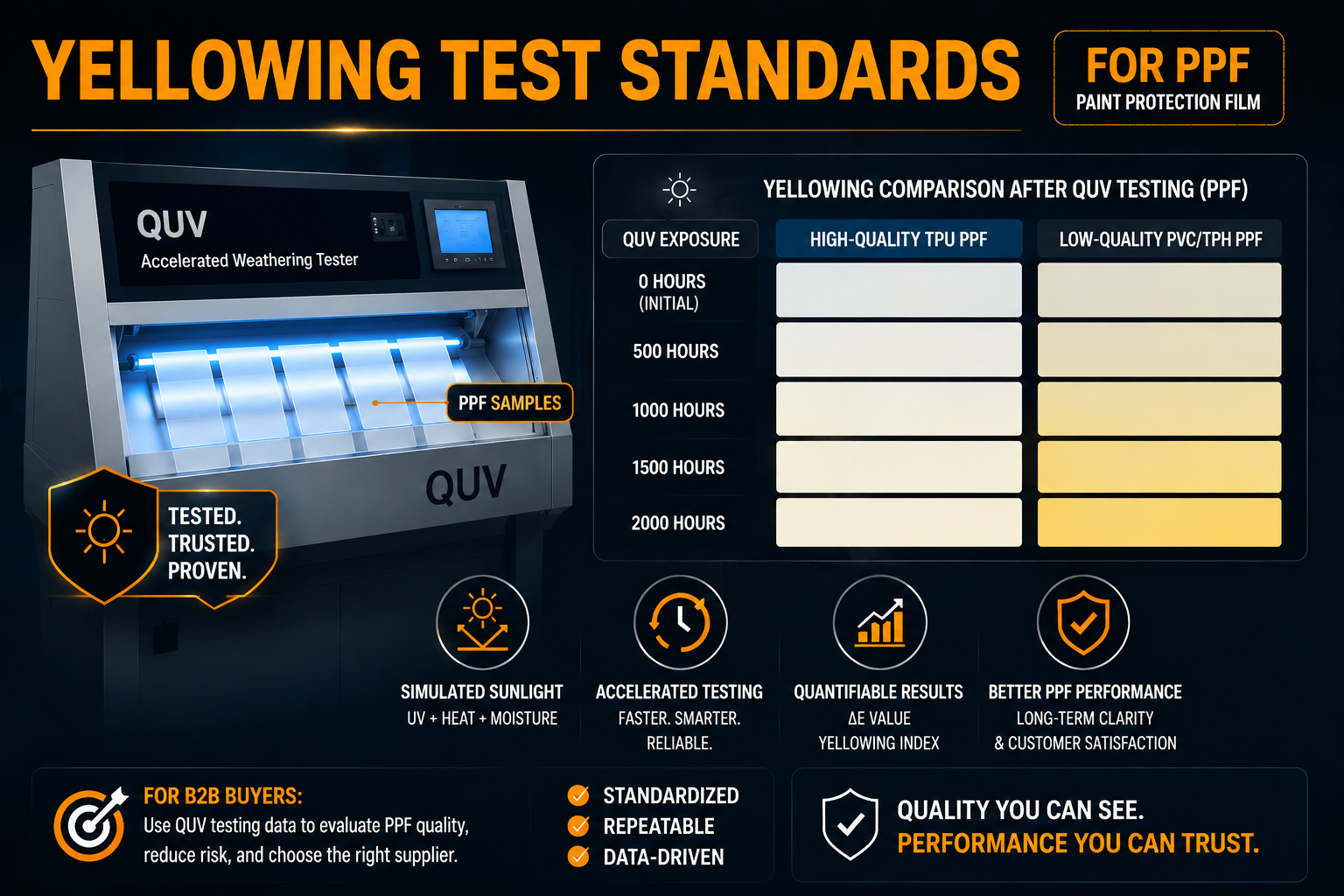
“Anti-yellowing” is claimed by virtually every PPF manufacturer. It’s easy to claim and hard to disprove on a fresh sample roll. QUV accelerated weathering testing is the method that makes the claim verifiable — simulating years of UV exposure in weeks of laboratory time and producing objective, quantified data on yellowing performance.
This guide demystifies QUV testing so B2B buyers can ask the right questions and evaluate the answers.
What QUV Accelerated Weathering Tests
A QUV accelerated weathering tester is a laboratory instrument that simulates solar UV radiation, heat, and moisture at accelerated intensity to compress the weathering effects of months and years into days and weeks.
The standard reference: ASTM G154 — Standard Practice for Operating Fluorescent Ultraviolet (UV) Lamp Apparatus for Exposure of Nonmetallic Materials.
How it works: The test specimen is exposed to alternating cycles of:
UV radiation: Fluorescent UV lamps emitting primarily UV-B (313nm peak) or UV-A (340nm peak) depending on the test specification
Condensation: Water condensation cycle simulating dew and rain
The test parameters specified in ASTM G154 Cycle 1 (relevant for PPF):
UV phase: 0.71 W/m² at 313nm, 60°C black panel temperature, 8 hours
Condensation phase: 50°C, 4 hours
This cycle repeats continuously for the test duration.
What Gets Measured
After defined hours of exposure (typically 500, 1,000, 2,000, and 3,000 hours), samples are removed and measured:
Yellowness Index (YI, ASTM E313)
The primary yellowing metric. YI measures the degree of yellow tint in a transparent or white material:
YI = 0: No yellow tint (perfectly neutral)
YI 1–2: Very slight yellow tint, typically not visible to the naked eye
YI 2–5: Slight yellow tint, visible under specific lighting conditions
YI 5–10: Moderate yellow tint, clearly visible on vehicle glass
YI >10: Significant yellowing, obviously visible
KSB performance benchmark:
Test duration
KSB aliphatic TPU PPF
Industry average claim
Budget aromatic TPU
0 hours (initial)
0.7
0.8
0.9
500 hours
0.8
1.5–2.5
2.5–4.0
1,000 hours
1.1
2.5–4.5
5.0–8.0
2,000 hours
1.5
4.0–7.0
>10
3,000 hours
1.8
6.0–10.0
>15
KSB maintains YI below 2.0 through 3,000 hours — the equivalent of approximately 7–10 years of real-world UV exposure in a typical mid-latitude climate.
ΔE (Colour Difference, CIELAB)
ΔE measures total colour change (including but not limited to yellowing) using the CIE L*a*b* colour space. This captures colour shifts that YI alone might miss.
ΔE interpretation:
ΔE < 1.0: Colour change not perceptible to the human eye
ΔE 1.0–2.0: Colour change perceptible under careful observation
ΔE 2.0–3.5: Colour change obvious to trained observers
ΔE > 3.5: Colour change obvious to any observer
KSB performance: ΔE < 1.5 through 1,000 hours of ASTM G154 testing.
Haze (ASTM D1003)
UV exposure can increase haze in optical films as polymer chains degrade and form scattering centres. For PPF applied to clear paint, haze increase is visible as a loss of gloss and clarity.
Acceptable haze increase: < 1% through 1,000 hours for quality PPF.
Physical Property Retention
Elongation at break (ASTM D882) and tensile strength are measured before and after aging. Quality PPF retains >85% of initial elongation at break through 1,000 hours.
What 3,000 Hours Represents in Real Time
Converting accelerated test hours to real-world exposure depends on geography and climate. As a reference:
Location
Annual UV dose (MJ/m²)
Real years per 1,000 QUV hours
Central Europe (France, Germany)
150
~4 years
Middle East (UAE, Saudi Arabia)
300+
~2 years
Southeast Asia (tropical)
250–300
~2.5 years
Australia (Queensland)
280
~2.5 years
US Southwest (Arizona, California)
230
~3 years
A PPF maintaining YI < 2.0 through 3,000 QUV hours has demonstrated stability equivalent to 6–15 years of real-world service depending on installation geography.
What to Ask Any PPF Supplier
“Can you provide your QUV accelerated weathering test data to ASTM G154?”
A reputable manufacturer with an anti-yellowing claim can provide this. Request:
Test standard (should be ASTM G154 or ISO 4892-3)
Number of hours tested (minimum 1,000 hours; 3,000 hours for premium claim)
Yellowness Index at each measurement point
Laboratory that conducted the test (independent is most credible)
“What is the YI of your film at 1,000 hours?”
YI above 3.0 at 1,000 hours indicates aromatic TPU or inadequate UV stabilisation. YI below 2.0 at 1,000 hours indicates quality aliphatic TPU with HALS stabilisation.