Published: July 8, 2026 · 7 min read · Category: Window Film Guide
Dyed film and nano ceramic sit at opposite ends of the window film quality spectrum. They’re both sold as “window tint.” They both make glass darker. Beyond that, the comparison is more like contrasting a basic umbrella with a technical rain jacket — functionally similar in ideal conditions, meaningfully different when it matters.
This comparison is useful for buyers who’ve been quoted both options and want to understand what they’re actually choosing between — not just the price difference, but the performance difference.
How Each Technology Works
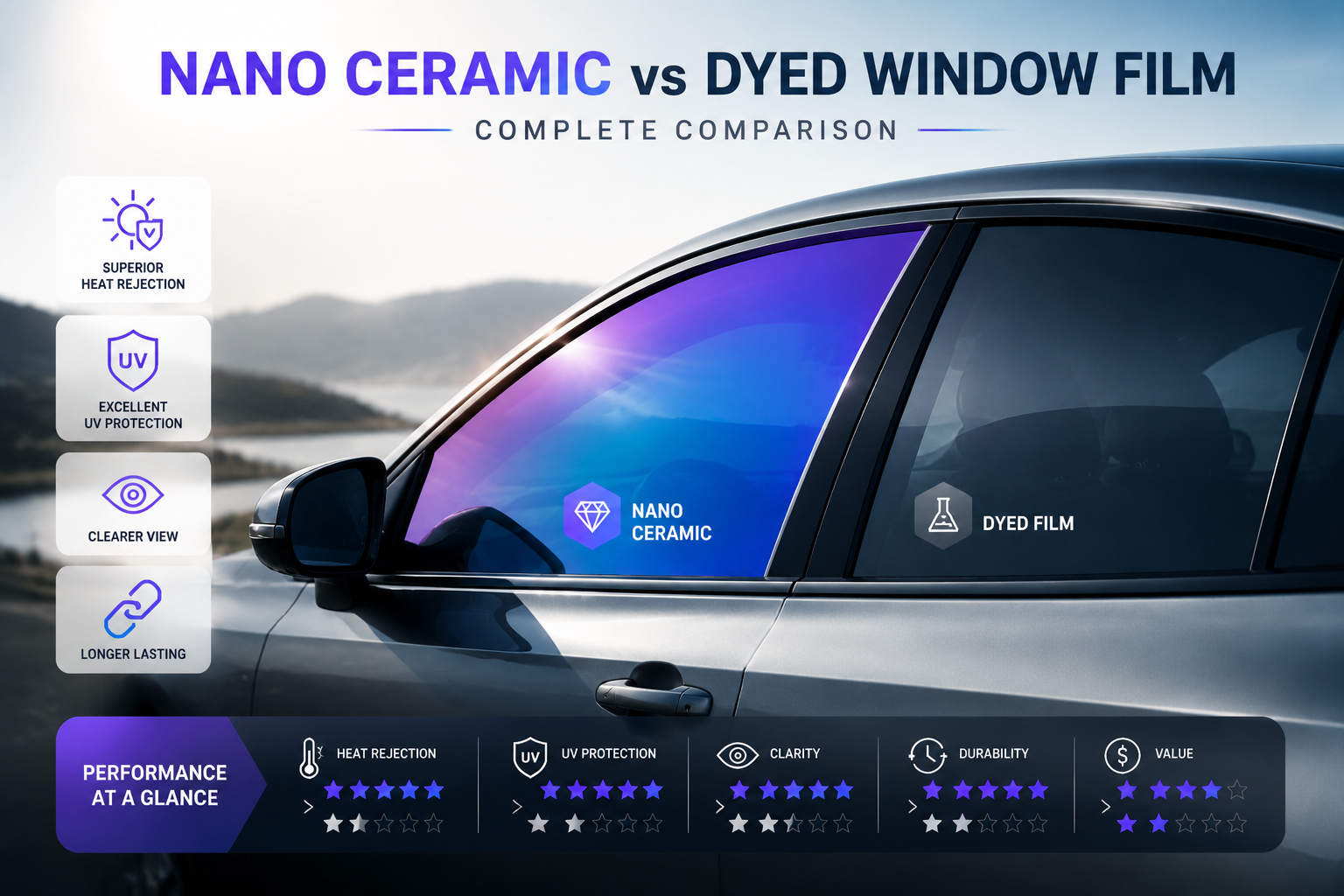
Dyed film uses colorants — organic dyes or pigments — to absorb solar energy. The dye layer intercepts incoming light and heat, absorbing some of it. What gets absorbed heats the film itself, and some of that heat re-radiates inward. The film gets warm in direct sun. It blocks visible light and some UV, and provides modest heat reduction — but it absorbs rather than rejects, which limits how cool it keeps the interior.
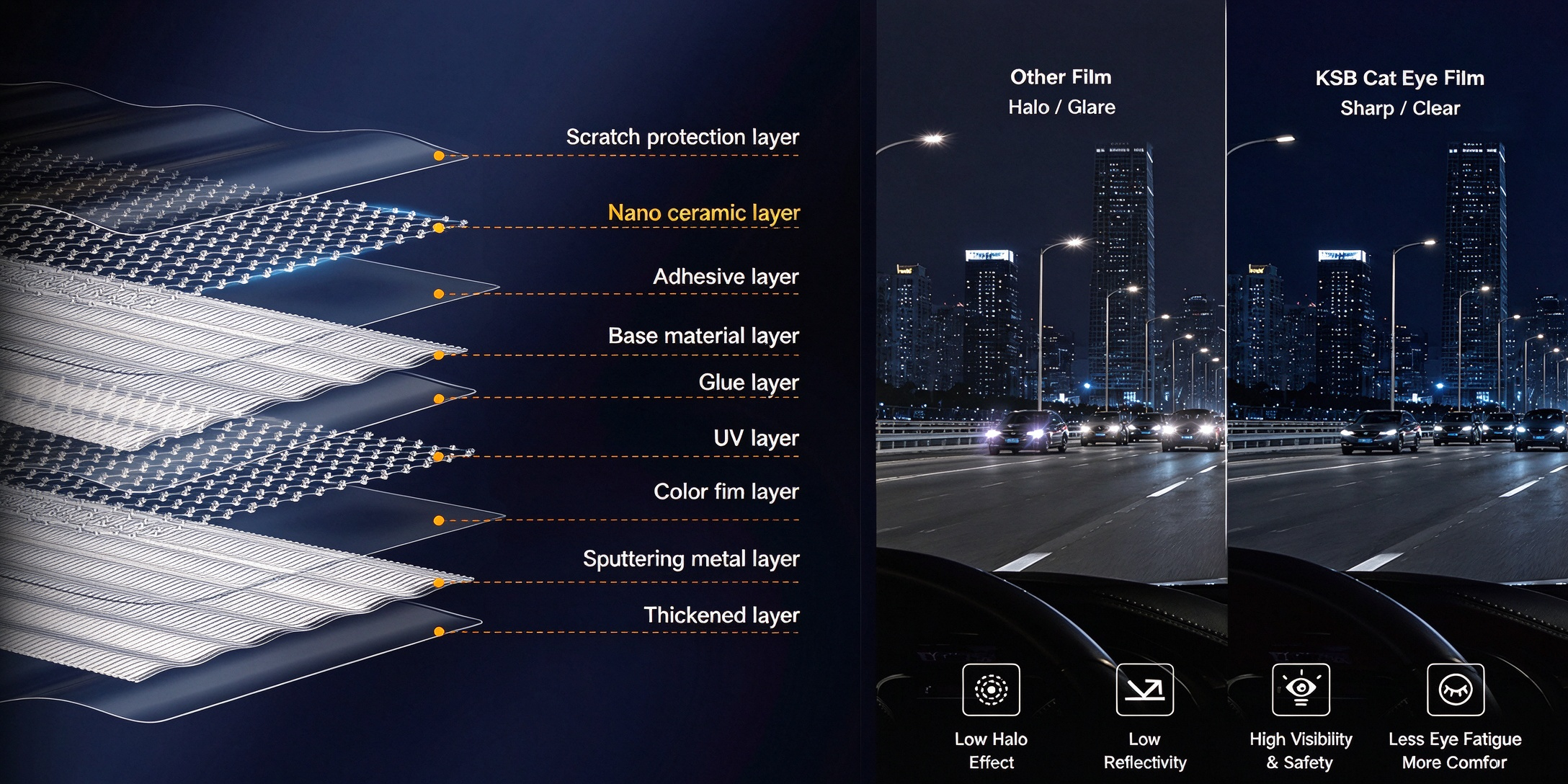
Nano ceramic film uses ceramic nanoparticles to absorb and reflect infrared radiation. The ceramic compounds interact with solar energy at a molecular level, with high selectivity — they block infrared effectively while transmitting visible light efficiently. The result is a film that stays cooler than dyed film in direct sun, rejects significantly more heat, and does so without relying on colorant chemistry that degrades over time.
The Performance Gap Is Large
Heat Rejection
This is where the gap is most significant. A quality dyed film at 35% VLT typically achieves 35–45% TSER. A quality nano ceramic at the same VLT achieves 55–70%+. That gap — roughly 15–25 percentage points of total solar energy rejected — is not theoretical. It translates directly to cabin or room temperature on a hot day.
Dyed film provides genuine heat reduction compared to unfilmed glass. Nano ceramic provides substantially more. On a car parked in direct sun in summer, the difference in interior temperature between a dyed and a ceramic film can be 8–15°C.
UV Blocking
Quality nano ceramic blocks 99%+ UV across both UV-A and UV-B. Quality dyed film also claims high UV blocking — typically 95–99% — but UV protection in dyed films comes partly from the dye itself, which degrades over time. As the dye fades, the UV rejection capability may decline with it. Ceramic UV blocking comes from inorganic compounds that don’t degrade the same way.
Color Stability: The Dyed Film Problem
Organic dyes break down under UV exposure. It’s chemistry, not manufacturing defect. The timeline depends on dye quality, UV stabilizers used, and sun exposure intensity — but most dyed films show visible color shift (fading, browning, or the notorious purple tint) within 3–7 years in moderate climates, sooner in high-UV environments.
Nano ceramic film’s color stability is excellent because the ceramic compounds are inorganic and UV-inert. The film looks the same at year eight as it did at installation.
Signal Interference
Dyed film: none. Nano ceramic: none. Both are transparent to wireless signals.
Price
Dyed film is the most affordable window film category. Nano ceramic is the most expensive. The price gap is real and for some buyers, decisive. For a full car installation, the difference commonly runs $150–$400 depending on market and product.
When Dyed Film Makes Sense
Dyed film is not a bad product — it’s the appropriate product for certain situations:
- Short-term applications (leased vehicle, rental property) where long-term performance isn’t the priority
- Very price-constrained projects where heat rejection improvement over unfilmed glass is the goal, not maximum performance
- Mild climates where high heat rejection rarely matters
- Applications where the film will be replaced every few years as a matter of course
For anything beyond these scenarios — a vehicle the owner plans to keep for 5+ years, a building with significant solar gain, a client who will notice color shift — nano ceramic is the right specification.
What Installers Should Know
Recommending dyed film to a customer who then comes back in three years with a purple-tinged car is a warranty conversation that could have been avoided. The cost difference between dyed and ceramic per job is real but manageable; the cost of a customer complaint and replacement is not.
Professional installers who’ve been around long enough have a clear view on this. Most stopped defaulting to dyed film years ago.
FAQ
Can you tell the difference between dyed and ceramic film just by looking at them?
Initially, usually not. Freshly installed quality dyed film looks clean and neutral. Over time, the color shift in dyed film becomes the visible indicator. Side by side after a few years of installation, dyed film often shows more fading or shift; ceramic remains consistent.
Is dyed film safe for car windows?
Yes, it’s legal and safe where installed within VLT regulations. The limitation isn’t safety — it’s performance and longevity.
Why do some shops still recommend dyed film?
Lower cost creates margin opportunities in price-competitive markets, and some buyers genuinely don’t need ceramic performance. The issue is when dyed film gets recommended to buyers who would have been better served by something more durable.
Can dyed film be upgraded to ceramic later?
The existing dyed film needs to be removed first — film-on-film applications create adhesion problems and compound VLT reduction. Removal of old film is a standard service most professional installers offer.
How do I know if a film being sold as ceramic actually is ceramic?
Request current third-party test reports (SGS, Intertek) for that specific product. Check the TSER value at mid-range VLT — quality ceramic at 35% VLT should achieve TSER above 55%. Below that threshold, the film’s ceramic content probably isn’t the primary performance driver.
Further Reading
On this site:
- What Is Nano Ceramic Window Film? — Complete ceramic film overview
- Nano Ceramic vs Carbon Window Film: Which Is Better? — The mid-tier comparison
- How Window Film Is Manufactured: From Raw Materials to Finished Rolls — Why dyed and ceramic films have fundamentally different cost structures
- Why Do Window Film Prices Vary So Much? — The economics behind the price gap
External:
- IWFA Industry Resources — Performance testing standards for comparing film technologies
- Skin Cancer Foundation — Window Film and UV Protection — Research context on UV blocking performance requirements
Get a Free Sample or Quote
Looking for a reliable window film supplier? Contact us today for fast response and professional support.