Exterior vs Interior Architectural Window Film: Pros, Cons, and When to Specify Each
Published: September 7, 2026 · 7 min read · Category: Architectural Window Film
About this article: KSB Window Film manufactures both interior and exterior-rated architectural film. Exterior film specification is a more specialist decision than interior — this guide clarifies when each is appropriate and what the practical differences are.
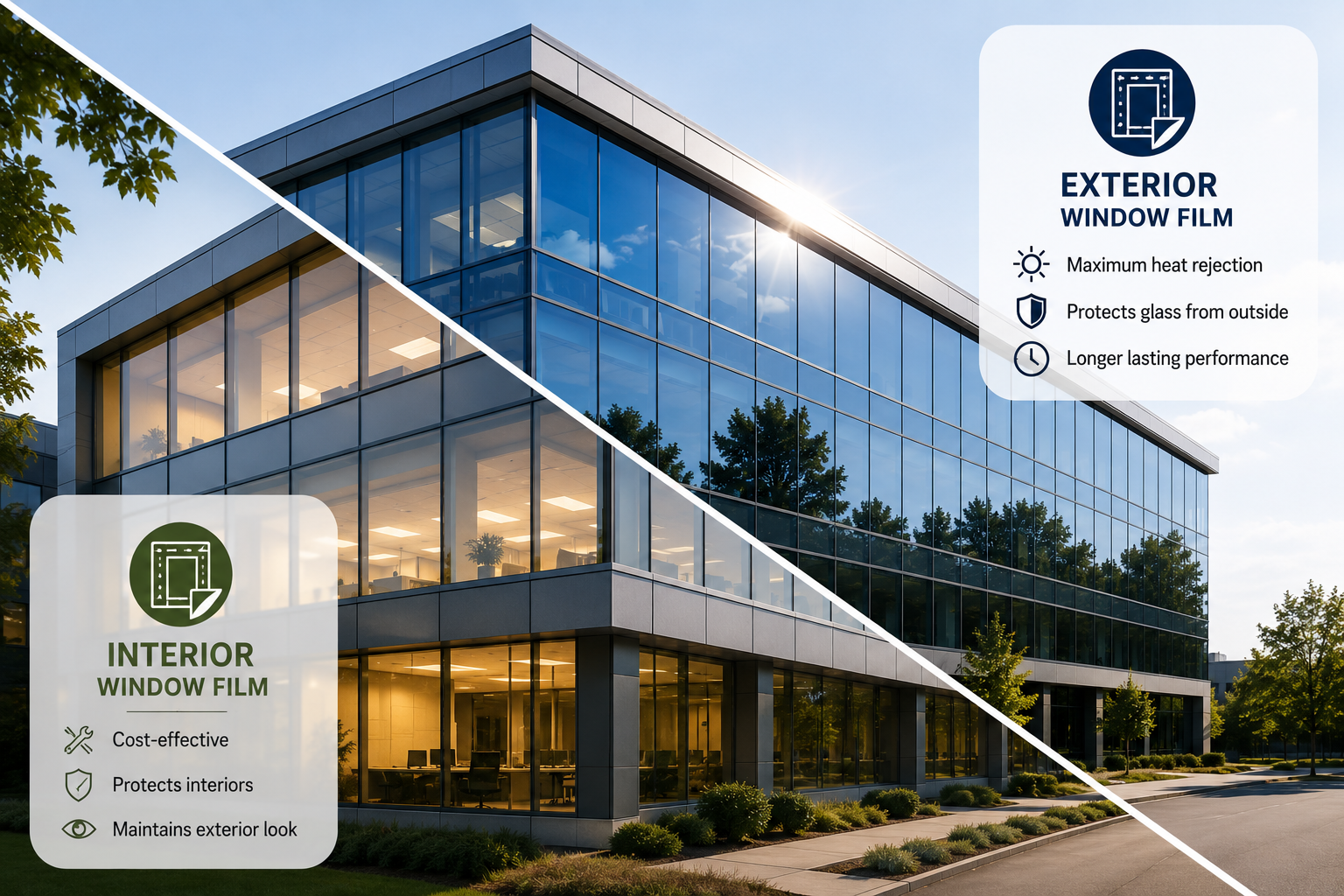
Exterior vs interior architectural window film comparison for commercial buildings.
Most commercial building window film is interior-applied. It’s the standard, the default, and in most situations the correct choice. Exterior film exists for specific situations where interior application doesn’t solve the problem — and it comes with different installation requirements, product specifications, and service life expectations.
Understanding the distinction prevents two common mistakes: applying standard interior film to exterior surfaces (where it fails prematurely), and assuming exterior film is always the “more effective” option (it isn’t, for most buildings).
Why the Application Side Matters
The difference between interior and exterior film goes beyond installation method. It affects:
UV exposure: Exterior film faces full solar UV directly. Interior film is partially shielded by the glass itself (most glass absorbs some UV in the 300–380nm range). Exterior film requires UV stabilizer packages robust enough for direct outdoor exposure over 5–10 year service life.
Weather exposure: Exterior film faces rain, wind-driven particles, temperature cycling from ambient to direct sun, and in some climates humidity, frost, and chemical pollution. Interior film is protected from all of these.
Adhesive chemistry: Interior adhesives are designed for the clean, dry environment of an indoor glass surface. Exterior adhesives must bond to glass that may be contaminated with atmospheric particulate, manage moisture cycling, and resist edge lifting from temperature-driven expansion and contraction.
Solar heat dynamics: This is the key performance difference. Interior film absorbs some solar energy and re-radiates a portion inward. Exterior film intercepts solar energy before it reaches the glass — rejecting it outward before any heat accumulation occurs in the glass or the space behind it. For applications where minimising heat accumulation in the glass is important (double-glazed units where absorbed heat creates thermal stress risk), exterior film has a thermal dynamics advantage.
When Exterior Film Is the Right Choice
Double-Glazed Units Where Interior Film Creates Thermal Stress Risk
The most technically compelling case for exterior film. High-absorption interior film on sealed double-glazed units (IGUs) can create thermal stress cracking — the absorbed heat accumulates in the cavity and creates centre-to-edge temperature differentials that crack the glass.
Exterior film eliminates this risk: the solar energy is intercepted and rejected before it enters the glass, so no heat accumulation occurs in the IGU cavity. For buildings with double-glazed glass where high solar rejection is required but thermal stress compatibility is a concern, exterior film is often the safer specification.
Some building configurations make interior film application impractical: sealed structural glazing systems without interior access, certain curtain wall systems, glass walls adjacent to fixed furniture or equipment, or atriums where the film would need to be applied at significant height without interior access points.
Exterior application via rope access or scaffolding may be the only viable option in these cases.
Maximising Solar Rejection Performance
Exterior film intercepts solar energy before it heats the glass. This provides marginally higher effective solar rejection in some configurations — though the practical difference between well-specified interior and exterior film at equivalent product specification is relatively small.
For buildings in extreme climates where every fraction of TSER is worth capturing, exterior film can be specified for maximum performance.
The Practical Disadvantages of Exterior Film
Higher Installation Cost
Exterior film installation requires scaffolding, cherry picker, or rope access for most commercial buildings. This adds $30–$80/sqm to installation cost compared to interior application. The access equipment hire and safety management requirements are significant on multi-storey buildings.
Shorter Service Life
Exterior film’s direct weather exposure means shorter service life than interior film at equivalent product specification. Quality exterior film: 5–8 years before replacement is typically needed. Interior film: 10–15 years. Over a 15-year period, exterior film may require 2 replacement cycles, compounding the higher installation cost.
More Demanding Maintenance
Exterior film on building facades accumulates atmospheric pollution, industrial fallout, and water mineral deposits. Regular cleaning (more frequent than interior glass maintenance) is required to maintain performance and appearance. Exterior film on tall buildings creates ongoing access requirements for maintenance.
Limited Low-E Glass Compatibility
Low-E coatings are typically on interior glass surfaces (Position 2 or 3 in the IGU). Exterior film cannot reach these coatings and therefore cannot be applied over them. For buildings where a Low-E coating is on the glass surface intended for film application, interior application or a different film strategy is required.
Interior Film: Why It’s the Default
For most commercial buildings, interior-applied film is the correct specification because:
Lower total installed cost (no access equipment for most floors)
Longer service life (10–15 years vs 5–8 years)
Lower maintenance burden
Wide product range and supplier availability
Compatible with most building glass types with appropriate product selection
Accessible for regular inspection and edge maintenance
The product range for interior architectural film is substantially broader than exterior-rated products, and includes the premium nano ceramic and spectrally selective products that deliver the best performance-to-appearance balance.
FAQ
Is exterior film always better at solar rejection than interior film?
No. At equivalent product specification, exterior film provides slightly better effective solar rejection due to the energy-before-glass interception mechanism. But the difference is modest — typically 3–8% better TSER at equivalent film specification. A premium interior nano ceramic film will outperform a basic exterior film on absolute TSER. The application side is a secondary factor after product specification.
Can standard interior film be applied outside?
It will initially appear to work, but it will fail prematurely — typically within 1–3 years. The UV exposure causes accelerated yellowing, delamination, and adhesive failure. Standard interior film is not rated for exterior conditions and should not be applied outside.
Does exterior film provide better privacy?
The privacy effect is similar to interior reflective film — the exterior surface of the glass appears reflective or tinted, blocking sightlines from outside during daylight. The mechanism and visible result are equivalent regardless of application side.
Specify Interior or Exterior Film for Your Building
KSB Window Film manufactures both interior and exterior-rated architectural solar control film. Our technical team can advise on which application method is appropriate for your glass specification and building configuration.