Published: June 18, 2026 · 8 min read · Category: PPF Brand Building
About this article: KSB Window Film operates OEM and private label PPF programs for international distributors and brand builders. This comparison draws on our direct program experience across buyers at different stages of brand development.
The terms OEM and private label get used interchangeably in most PPF sourcing conversations — which causes genuine confusion when buyers discover they’re talking about fundamentally different things. The difference matters because it affects your investment, your timeline, your product differentiation, and ultimately how defensible your brand position is.
What Private Label PPF Actually Is
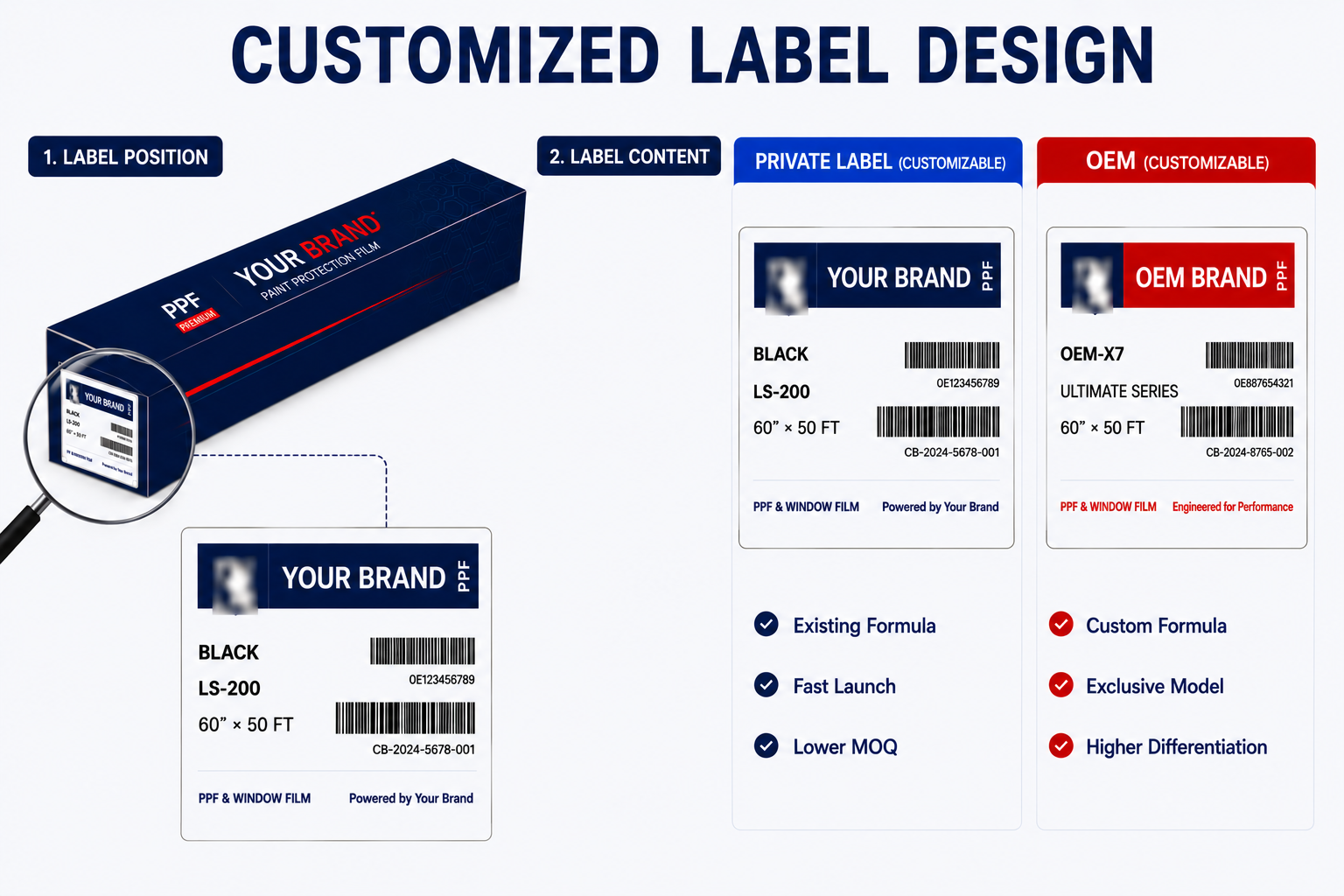
Private label means applying your brand to a product the manufacturer already makes. The TPU formulation, top coat chemistry, adhesive, and thickness have all been developed and tested by the manufacturer. You contribute: your brand name on the label, your logo on the packaging, your warranty terms on the documentation.
The product is the manufacturer’s. You’re licensing the right to brand it.
What this means in practice:
- The film performing under your brand is the same film the manufacturer sells to other brands under different labels — or under their own brand
- If a competitor sources from the same manufacturer and requests the same SKU, they can get essentially the same product
- Exclusivity agreements on private label products are weaker than on OEM products, because the manufacturer is being asked not to sell a product they’ve already built to others — a harder position to hold commercially
The upside: Speed. 6–8 weeks from manufacturer agreement to branded product in your hands. No development cost. Known performance (the product already has a test history). Lower MOQ.
What OEM PPF Actually Is
OEM (Original Equipment Manufacturer) in the PPF context means you’re commissioning the manufacturer to develop and produce film to your specifications. You define — or co-develop with the factory’s R&D team — the product parameters:
- TPU grade and source material
- Top coat formulation (self-healing speed, hardness target, gloss level)
- Adhesive chemistry (tack profile, temperature range, removability)
- Film thickness
- Any proprietary performance targets (minimum haze in cleared state, specific healing time at defined temperature)
The resulting product is engineered to your brief. The manufacturer produces it for your account and, under a proper exclusivity agreement, doesn’t sell the same specification to anyone else.
What this means in practice:
- Your product can genuinely perform differently from competitors’ products
- You have a contractual basis for exclusivity that is more defensible than private label exclusivity
- Your technical data sheets reflect a product that only you sell
- When an installer compares your film to a competitor’s in a head-to-head test, the results can differ meaningfully
The trade-off: Time (8–14 weeks for development plus standard production lead time), higher upfront cost (development samples, testing cycles, potential custom tooling for packaging), and higher MOQ (typically 500–1,000 rolls per SKU for custom formulations).
The Numbers Side-by-Side
| Factor | Private Label | OEM |
|---|---|---|
| Time to first branded product | 6–8 weeks | 16–24 weeks |
| Upfront development cost | Minimal | $3,000–$15,000+ |
| MOQ per SKU | 100–500 rolls | 500–1,500 rolls |
| Product differentiation | Low (shared base product) | High (proprietary spec) |
| Exclusivity strength | Weak to moderate | Strong (with contractual spec lock) |
| Price premium potential | Limited | Significant |
| Risk if manufacturer quality drifts | High (no spec to audit against) | Lower (spec deviation is documentable) |
How Manufacturers Distinguish Between the Two
Not all manufacturers make a clean distinction. Some offer “OEM” programs that are really just private label with custom packaging — the film formulation is unchanged. Ask specifically:
“Will the film under my brand be the same formulation you sell under other brands, or will it be a specification developed specifically for my account?”
A straightforward answer to this question separates genuine OEM from relabeled private label. If a manufacturer hesitates, offers vague answers about “proprietary processes,” or can’t describe what custom development would involve, they’re offering private label regardless of what they call it.
The Hybrid Path Most Brands Take
The most common — and sensible — progression:
- Start with private label to validate the market, build installer relationships, and establish a sales track record
- Identify 1–2 core SKUs that are driving the majority of revenue
- Develop those SKUs as OEM once you have the volume and market insight to justify the specification brief
- Keep private label for tail SKUs that don’t justify OEM minimums
This isn’t a compromise position — it’s a rational capital allocation decision. OEM makes sense when you know what you’re building and why. Private label is the right environment for figuring that out.
FAQ
Can I switch from private label to OEM with the same manufacturer?
Yes, and this is the most natural transition. The manufacturer already knows your brand, your volume, and your market. When you’re ready to develop a custom formulation, the working relationship is already established. Most manufacturers who offer both programs actively encourage this progression — OEM customers have higher switching costs and better long-term economics.
What happens to my private label product if the manufacturer discontinues it?
This is the core vulnerability of private label: the manufacturer controls the formulation. If they discontinue, reformulate, or change the base product, your branded product changes with it — without your input. OEM agreements give you contractual rights around formulation changes. Private label agreements typically don’t. Mitigate this risk by building relationships with backup suppliers for your key SKUs.
Is OEM worth it for a brand doing under 1,000 rolls per month?
At under 1,000 rolls/month, the economics of OEM development need careful analysis. At 500 rolls/month of a SKU with a $2/roll premium over private label at comparable product quality, the annual premium revenue is $12,000. If OEM development cost is $8,000 and the formulation is exclusive, the ROI is positive within a year. The calculation depends heavily on whether the OEM spec actually commands a price premium — which requires honest market assessment.
Further Reading
On this site:
- How to Start Your Own PPF Brand — Brand launch context for this decision
- How to Choose a Reliable PPF Manufacturer — Manufacturer selection that supports both models
- OEM vs Private Label PPF: What’s the Difference? — OEM models
- PPF Factory Audit Checklist for Importers and Distributors
External:
- SEMA Brand Building Resources — Automotive aftermarket brand development context
Explore KSB’s OEM and Private Label Programs
KSB Window Film offers both private label (branded KSB-developed film) and OEM development (custom formulation to your brief) for TPU PPF. Our export team can walk you through the specific economics of each for your target volume and market.
→ Request a program comparison and indicative pricing from KSB — we respond within one business day.
Get a Free Sample or Quote
Looking for a reliable window film supplier? Contact us today for fast response and professional support.