Anti-Fouling vs. Heavy Pollution: Why Cities Need Advanced Hydrophobic PPF
Published: July 30, 2026 · 7 min read · Category: PPF Technology
About this article: KSB Window Film develops hydrophobic top coat technology for our PPF range. This guide addresses the increasing demand from urban markets where air quality and acid rain are persistent challenges for vehicle paint protection.
A structured checklist for evaluating PPF manufacturers, covering production capacity, materials, certifications, OEM capability, and quality assurance systems.
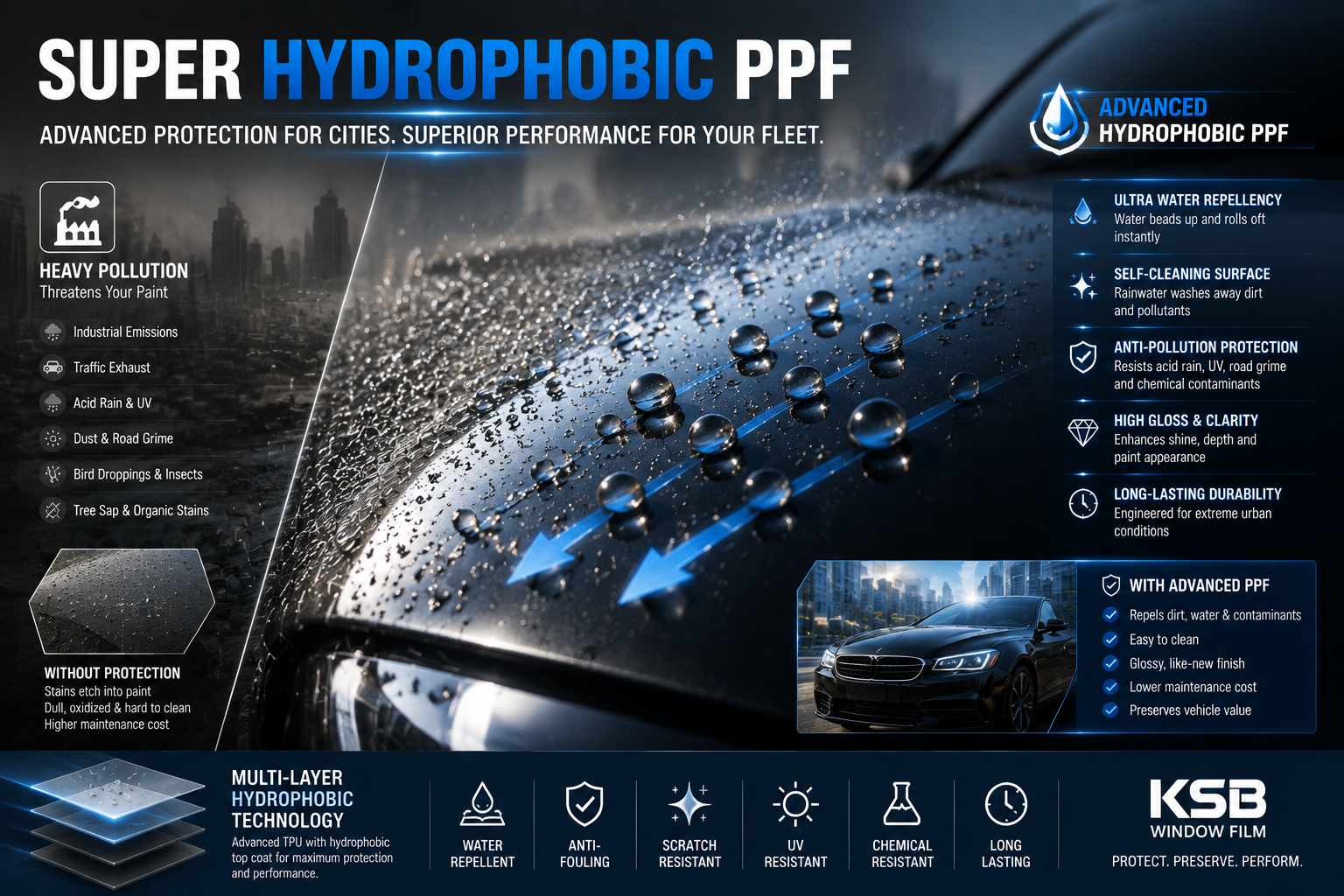
Clean air activism aside, the reality for vehicles in major urban and industrial centres is persistent chemical attack on paint surfaces. Industrial particulates, acidic rain from NOx emissions, bird acid deposits, iron fallout from brake dust — urban vehicles face a sustained corrosive environment that rural vehicles don’t. Hydrophobic PPF is the appropriate response.
The Urban Contamination Profile
Acid rain: Combustion of fossil fuels produces SO₂ and NOx, which react with atmospheric water to form sulfuric and nitric acid. Urban acid rain pH of 4.5–5.0 is common in industrialised cities across Europe, Asia, and North America. Each rain event deposits acid onto vehicle surfaces. Between events, the residue concentrates as water evaporates.
Industrial fallout: Metal fabrication, cement plants, and chemical processing facilities produce fine particulates that deposit on vehicle surfaces. Iron particulates from brake and rail dust are chemically reactive and etch into paint and coating surfaces over time.
Bird acid deposits: Avian digestive acid (uric acid, pH 3.5–4.5) deposits on vehicle surfaces are highly concentrated and can etch into unprotected paint within hours in summer heat.
Water mineral deposits: In cities with hard municipal water, washing and rain events leave mineral deposits (calcium, magnesium carbonates) that concentrate on vehicle surfaces.
What “Hydrophobic” Means in Coating Chemistry
Hydrophobicity describes a surface’s resistance to wetting by water. It’s measured by water contact angle (WCA):
Hydrophilic surface (WCA < 90°): Water spreads on the surface, creating a sheet that carries and deposits contaminants
Hydrophobic surface (WCA 90–120°): Water beads but rolls slowly; reduced spreading but contaminants still deposit
Highly hydrophobic surface (WCA > 120°): Water beads aggressively and rolls off rapidly, carrying contaminants with it
Superhydrophobic / lotus effect (WCA > 150°): Near-zero contact area between water and surface; extreme self-cleaning behaviour
KSB’s premium PPF top coat achieves WCA 110–120° — in the highly hydrophobic range. This is achieved through:
Fluoropolymer surface chemistry (fluorine atoms create the lowest surface energy of any organic material)
Micro/nano surface texture optimisation (surface geometry amplifies the hydrophobicity of the underlying chemistry)
How Hydrophobicity Protects Against Each Urban Contaminant
Acid Rain
Without hydrophobic coating: Rain droplets spread on the surface, maximising contact area between acid and coating. As the water evaporates, the acid concentrates. Dwell time is high.
With hydrophobic coating: Rain droplets bead immediately and roll off at low angles (typically <10° tilt for WCA >110°). Acid contact time is measured in seconds rather than hours. Residual mineral deposits are dramatically reduced.
Bird Acid Deposits
Without hydrophobic coating: Bird acid spreads into a large-area deposit. In summer heat, it quickly concentrates and etches.
With hydrophobic coating: Bird acid is more likely to bead rather than spread. Reduced contact area means reduced etching. Importantly: bird acid should still be removed promptly — hydrophobicity reduces damage risk but doesn’t eliminate it for prolonged exposure.
Iron Fallout
Without hydrophobic coating: Iron particles adhere to the surface and begin oxidising immediately. Removal becomes more difficult as oxide bonds form.
With hydrophobic coating: Reduced surface adhesion of iron particles. They remain on the surface but with weaker adhesion — more easily removed by washing without having chemically bonded to the coating.
Water Mineral Spots
Without hydrophobic coating: Water spreads into a large droplet footprint. When it evaporates, minerals deposit across the full spread area.
With hydrophobic coating: Small bead area means smaller mineral deposit area when each droplet evaporates. Most of the droplet rolls off before evaporating entirely.
Measuring the Anti-Fouling Performance
KSB conducts anti-fouling tests alongside standard PPF quality testing:
Acid drip test: 2ml of pH 4.0 buffer solution deposited on test panels at 70°C for 1 hour, then assessed for visible staining/etching.
Standard top coat: Visible etch ring at droplet perimeter
KSB hydrophobic top coat: No visible staining after IPA wipe
Mineral water spot test: 2ml of hard water (500ppm dissolved minerals) deposited and evaporated at 60°C, 10 cycles.
Standard top coat: Visible mineral ring deposits
KSB hydrophobic top coat: Minimal mineral deposits, fully removed by light rinse
Maintenance to Preserve Hydrophobicity
Hydrophobic PPF performance degrades with surface contamination (wax, silicone, mineral build-up) that fills the nano-texture features responsible for the high WCA. Maintenance:
Wash with pH-neutral car shampoo (avoid strong alkaline detergents)
Do not apply traditional wax or silicone-based sealants over PPF — they degrade surface energy
Hydrophobic topper sprays compatible with PPF (PPF-safe sealants) can be applied periodically to refresh surface performance
Avoid automatic car washes with high-pH chemical treatments
FAQ
Does hydrophobic PPF replace the need for ceramic coating on top?
KSB’s hydrophobic PPF achieves WCA >110°, which matches or exceeds many entry-level ceramic coatings. For buyers who want the convenience of one-step protection without additional ceramic coating, hydrophobic PPF is an adequate solution. For buyers who want maximum anti-fouling performance, a compatible ceramic coating applied over the PPF provides incremental improvement.
KSB Window Film’s hydrophobic top coat PPF (WCA >110°) with acid and mineral spot resistance is the right specification for urban distributors and city-focused installation businesses.