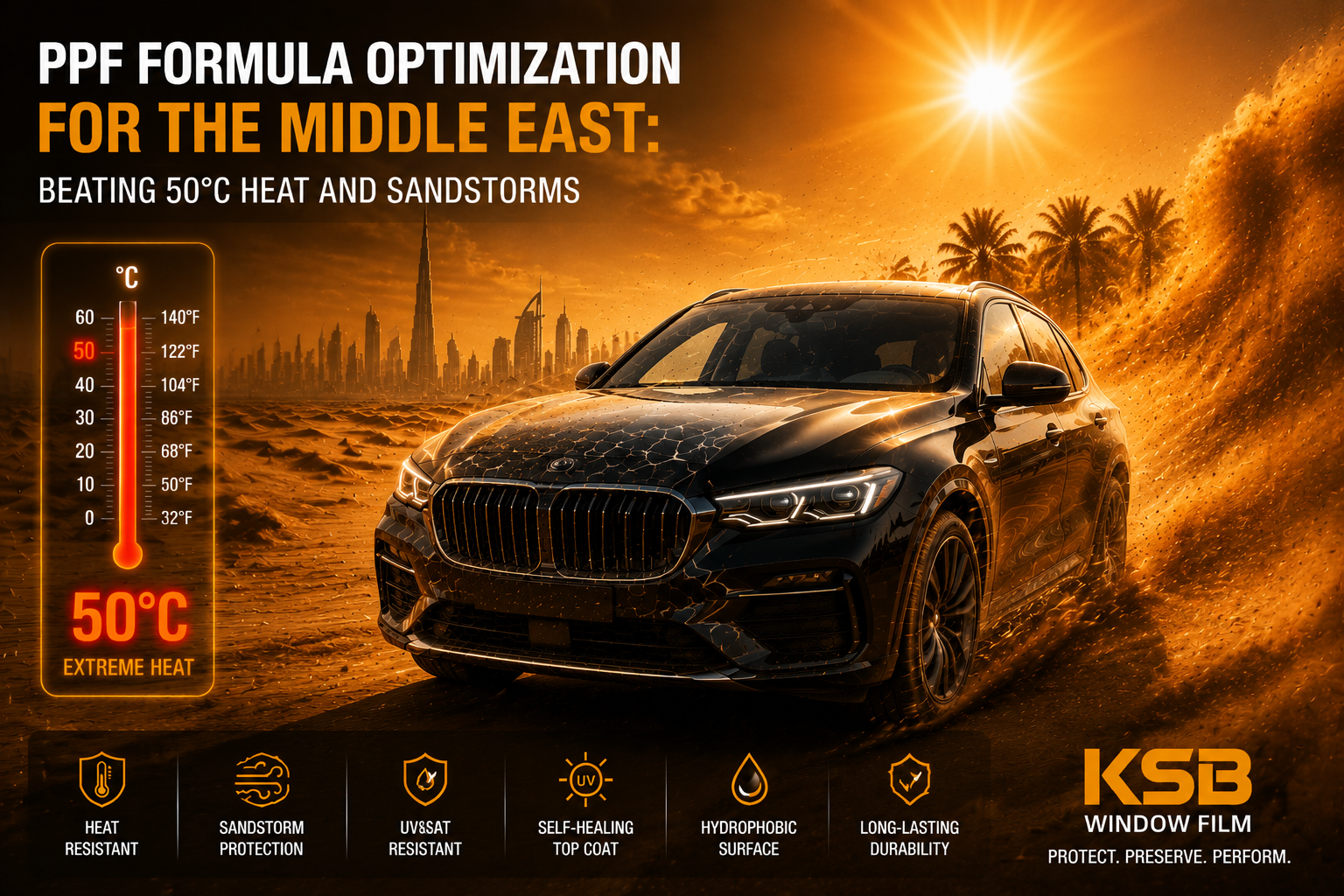
PPF Formula Optimization for the Middle East: Beating 50°C Heat and Sandstorms
Published: July 27, 2026 · 7 min read · Category: PPF Regional
About this article: KSB Window Film supplies PPF to distributors across the UAE, Saudi Arabia, Kuwait, Qatar, and Bahrain. Middle Eastern climate conditions are among the most demanding in the global automotive film market — this guide explains how we engineer specifically for them.
High-performance PPF engineered to withstand 50°C heat and heavy sandstorms in Middle Eastern climates.
The Middle East is not like any other automotive film market. Ambient temperatures of 45–50°C are common in summer. Dashboard surface temperatures exceed 90°C on parked vehicles. Fine silica particulates in dust storms abrade surfaces at elevated temperatures. The combination of extreme UV, extreme heat, and abrasive environmental exposure places demands on PPF that standard formulations weren’t designed to handle.
KSB has served the Middle Eastern market long enough to know what fails and what survives — and we’ve adjusted our formulation accordingly.
Problem 1: High-Temperature Adhesive Failure (Degluing)
What Happens
At 85–90°C glass transition temperatures, standard PSA adhesive softens to a flowable state. On a vehicle parked in direct summer sun in Dubai or Riyadh, panel temperatures routinely reach 80°C and can exceed 90°C on dark-coloured bonnets. An adhesive with Tg below these values:
Softens and begins to flow at the film edges
Creates visible ooze at seam lines
Loses the bond strength needed to resist edge lift when hot
Can transfer adhesive to paint when peeled, leaving residue
The KSB Solution
KSB’s Middle East specification uses PSA formulated with Tg above 95°C. At this Tg, the adhesive remains in the elastic (non-flowing) regime at all standard Middle Eastern temperature exposures.
Verification: 72-hour oven aging at 85°C with film applied to painted panel. Post-aging: no visible edge ooze, no adhesive transfer on removal, peel adhesion retention above 85% of initial value.
This specification is KSB’s standard adhesive for the Middle East supply chain — not a custom add-on.
Problem 2: UV-Induced Yellowing in Extreme Solar Conditions
What Happens
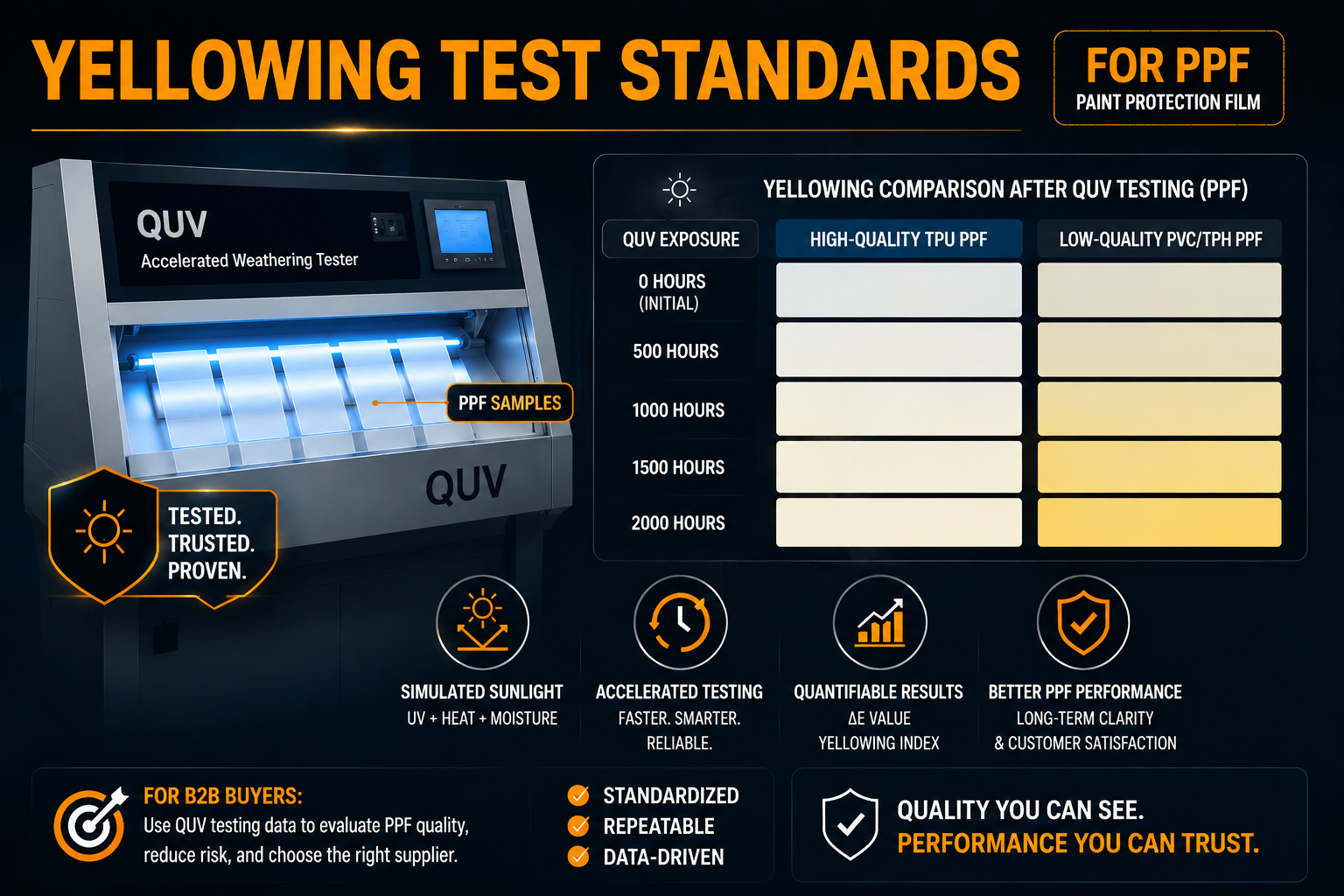
The Middle East receives the highest UV dose of any major automotive market — exceeding 300 MJ/m² annually in Saudi Arabia and UAE. This represents approximately double the UV exposure of Northern European markets. Standard PPF formulations designed for 7-year European service life may yellow visibly within 3 years in Gulf conditions.
The KSB Solution
KSB’s Middle East specification uses aliphatic TPU base (as discussed in Why Aliphatic TPU is the Gold Standard) combined with elevated HALS loading — 30–40% higher HALS concentration than our standard European specification.
The HALS radical-scavenging mechanism provides additional protection against photooxidation. Our QUV testing at 0.83 W/m² (higher than standard 0.71 W/m² to simulate more intense UV) shows YI below 2.5 through 3,000 hours — the equivalent of approximately 8–10 years under Middle Eastern solar conditions.
Problem 3: Sandstorm Surface Abrasion
What Happens
Gulf sandstorms deposit fine silica particles (particle size 20–200 microns) onto vehicle surfaces. Wind-driven silica at these particle sizes and at sandstorm velocities (30–70 km/h) creates an abrasive event on the film surface. Standard soft top coats with pencil hardness of 2H or below can be micro-scratched by these particles — accumulating surface haze that dulls the film’s gloss over time.
The KSB Solution
KSB’s Middle East specification uses a harder top coat formulation (pencil hardness 4H, ASTM D3363) compared to our standard 3H specification. The harder surface reduces the depth of micro-scratching from silica particle contact.
Trade-off acknowledgement: Higher top coat hardness reduces the rate of self-healing recovery at equivalent temperatures. KSB’s Middle East spec balances this by designing for faster healing at higher temperatures — the activation energy for healing is calibrated to the 60–70°C ambient conditions in the Gulf summer rather than the 40–50°C conditions more relevant in European climates.
Problem 4: Intense UV Causing Top Coat Degradation
What Happens
The top coat’s crosslinked polymer network also absorbs UV energy. Without adequate UV stabilisation in the top coat specifically (in addition to the TPU base), the top coat can yellow, craze, or lose scratch resistance faster than the TPU base degrades.
The KSB Solution
KSB’s top coat formulation for the Middle East market incorporates UV absorbers (UVA — specifically benzotriazole and triazine class) in addition to HALS. The dual-mechanism stabilisation (UVA absorbs incident UV before it reaches the polymer chain; HALS quenches radical species after they form) provides better protection than either mechanism alone.
Regional QC Specification
When KSB ships PPF to Middle Eastern distributors, the product specification includes:
Aliphatic TPU base with elevated HALS loading
Ashland PSA at Tg >95°C
Top coat hardness 4H minimum
Dual UV stabilisation (UVA + HALS)
These specifications are listed on our technical data sheet for Middle East supply, not on standard export TDS. Middle Eastern distributors should request the region-specific product.
FAQ
Can standard PPF survive Middle Eastern conditions?
Standard global-specification PPF applied in the Middle East typically shows: increased yellowing by year 3–4 (vs. year 7+ for regional-spec), edge lifting in summer peak months for adhesives not rated for 90°C, and faster top coat haze development from sandstorm abrasion. The performance degradation is real and represents a warranty exposure for distributors.
Is the Middle East specification significantly more expensive?
The cost premium for the elevated HALS loading, higher-Tg adhesive, and harder top coat is approximately 8–12% above standard specification. Given the performance impact in this market, the premium is almost universally justified.
KSB Window Film’s Middle East specification PPF is used by distributors across the UAE, Saudi Arabia, and Gulf region. Formulation documentation and regional test data available.