Understanding PPF Private Labeling: How to Launch Your Own Branded Film
Published: August 4, 2026 · 7 min read · Category: PPF Sourcing
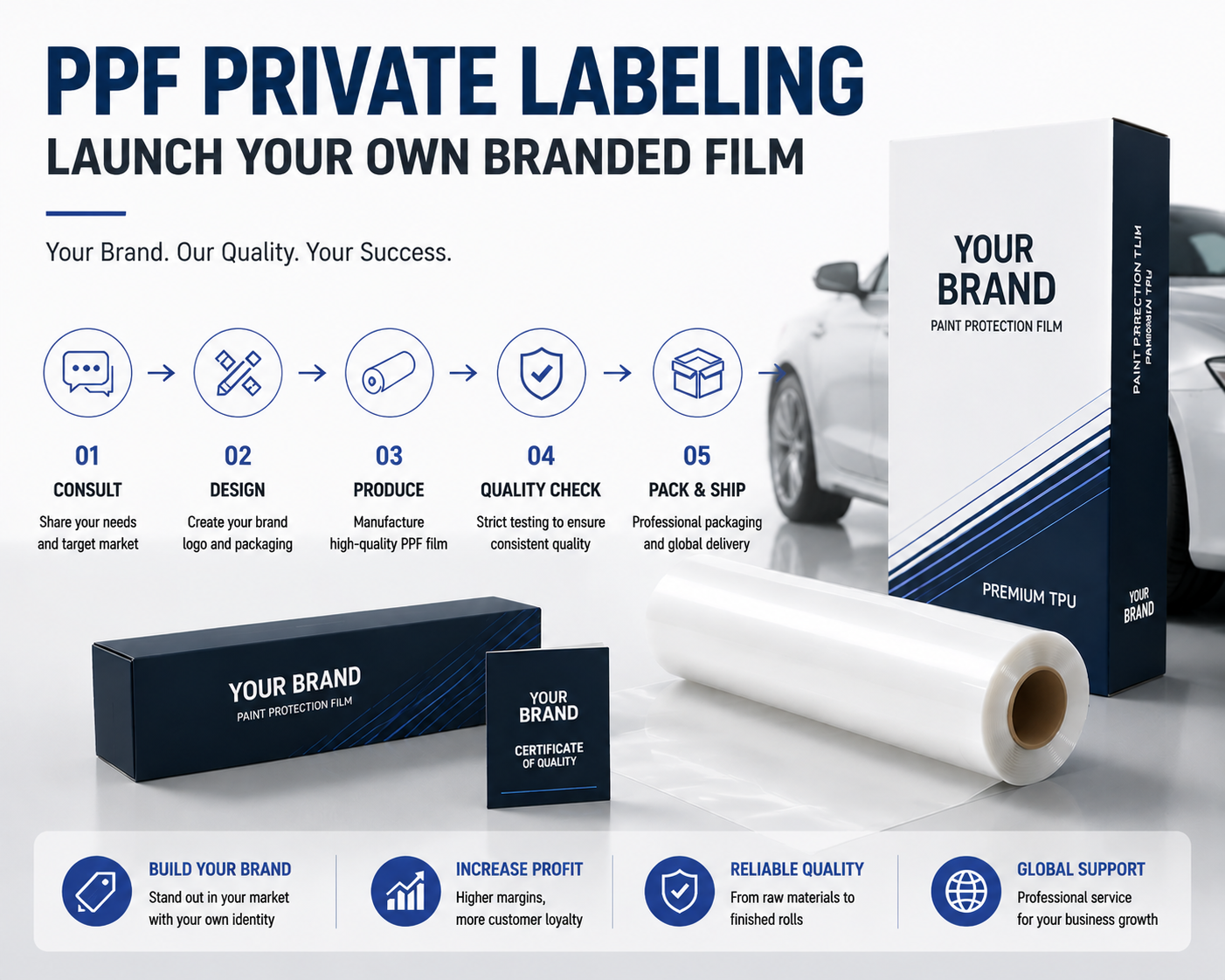
About this article: KSB Window Film operates a structured private label programme for regional distributors worldwide. This guide explains the complete process for building a branded PPF line.
Factory PPF rolls packaged for private label branding and global distributor supply.
Regional distributors who’ve built their business on someone else’s PPF brand have a commercial vulnerability: the brand owner can open competing distribution, adjust pricing, or terminate the agreement. Private label eliminates this dependency by placing the brand equity with the distributor.
What Private Label PPF Actually Involves
Private label means the manufacturer (KSB) produces film to defined specifications, packages it in your brand’s packaging, and ships it as your product. Your customers see your brand, not KSB’s.
What you own: The brand, the customer relationship, the margin. What KSB handles: Manufacturing, quality control, batch documentation, packaging production.
The product quality is KSB’s — your brand is the commercial layer on top.
The Four Components of a Private Label PPF Programme
1. Product Specification
Select the specifications you want under your brand:
Thickness (7.5mil, 8.5mil, 10mil — or multiple)
Top coat type (standard self-healing, premium instant-healing, or both)
Regional formulation (Middle East, tropical, cold climate, or standard)
Roll dimensions (typically 1.52m × 20m or 1.52m × 15m)
These selections define your “product range” — the SKUs under your brand.
2. Packaging Design
Core label (required): Contains product name, thickness, dimensions, VLT-equivalent if applicable, warranty reference, batch number, and country of origin. Label format per your brand guidelines.
End cap stickers: Brand name and product line name on both roll ends.
Outer carton (optional): Full-colour branded carton for retail or premium presentation.
Quality certificate card: Optional warranty card or quality certificate included with each roll.
KSB provides: Blank dieline templates, packaging size specifications, and packaging review before production. You provide: logo files (vector format), colour specifications, product names.
Production timeline: 3–4 weeks for label production from approved artwork.
3. Documentation Package
Under your brand name, KSB provides:
Product data sheet (technical specifications)
Installation guide
Warranty card template (your warranty terms, your service contact)
Regional TDS variants if applicable
These documents allow your installer network to receive fully documented products under your brand.
4. Supply and Logistics
MOQ for private label: 100 rolls per SKU per colour/specification.
Lead time: 6–8 weeks from purchase order to shipment (including label production for first orders).
Ongoing orders: 3–4 weeks lead time once packaging inventory is established.
Exclusivity: Geographic exclusivity available on OEM (custom formulation) products. For private label on standard specifications, exclusivity is by negotiation.
Common Private Label Mistakes to Avoid
Launching too many SKUs too fast. Start with two core products (e.g., 7.5mil standard and 8.5mil premium). Prove demand before expanding to 6+ SKUs and their associated MOQ commitments.
Under-investing in packaging. The packaging is the customer’s first impression of your brand. Digital print labels at $0.20 each look like digital print labels. Offset-printed labels at $0.08 each (at volume) look professional. Budget accordingly.
Not matching packaging to product quality. A premium private label brand with budget-grade film is exposed the moment any customer does a QUV test or compares to a genuine aliphatic product. Align your brand positioning with genuine quality.
Skipping the warranty design. Define what you warranty, for how long, and how customers claim before you launch. Undocumented warranties create unpredictable liability.
FAQ
How long does it take to launch a private label PPF brand?
From programme agreement to branded product in your warehouse: 10–14 weeks for the first order (accounting for packaging design, approval, production, film production, and shipping). Subsequent orders: 6–8 weeks.
Is there a design fee for packaging development?
KSB provides dielines and packaging specifications at no charge. You (or your designer) produce the artwork. Label printing is included in the label MOQ pricing.
The Installer Programme: How to Build a Network Around Your Brand
A private label brand without an installer network is a warehouse full of rolls. The commercial value of private label is in the loyalty dynamic between your brand and the installers who recommend it to their customers.
Installer onboarding materials your brand should provide:
Technical spec sheet (your brand, KSB data): Every installer selling your film needs to be able to answer customer questions about performance. A one-page technical sheet covering thickness, UV rejection, TSER, self-healing technology, and warranty terms gives installers the information they need without calling you.
Warranty card design: Customers buying PPF want warranty assurance. Design a warranty card in your brand’s style that specifies: duration (e.g., 5 years or 7 years), what’s covered (yellowing, delamination, edge lifting), and how to claim. KSB provides guidance on commercially sustainable warranty terms based on product specification.
Installation video (optional but high-value): A short-form video showing your branded film being installed on a vehicle builds installer confidence and gives them shareable content for their own customer marketing.
Product comparison sheet: Position your brand against the market. Which specification tier are you targeting? What makes your film better than the next option? Give your installers a reason to recommend your product over alternatives.
Trade pricing to installers:
Private label allows you to set your own installer trade pricing independently of what competitors are charging for their own brands. This is the margin control advantage: you set the floor and the ceiling.
Typical structure: Installer buys from you at 2.5–3× your landed cost. Consumer pays installer 3–5× your landed cost (installer’s gross margin). You retain the difference between your landed cost and your trade price.
The Brand Name Decision
The brand name you choose for your PPF line is a long-term asset. Consider:
Descriptive names (“ShieldTech PPF,” “ArmorCoat”) — easy to understand but generic, harder to differentiate over time.
Abstract/premium names (“Vertex,” “Obsidian,” “Apex”) — distinctive and ownable, require more marketing investment to build meaning.
Geographic brand anchoring (“London Shield,” “Pacific Armor”) — builds regional identity, may limit international expansion later.
Avoid: Anything that could be confused with existing major brands (3M, XPEL, SunTek) — creates both legal risk and consumer confusion.
Once chosen and on your packaging, the brand name is expensive to change. Take the time to check trademark availability in your key markets before committing to production.
Common Questions About Private Label PPF
Can I sell my private label PPF online (e-commerce)?
Yes. Private label PPF is sold through e-commerce in all major markets. The product data sheet and warranty card become your listing content. QUV test data and material certifications build trust with technically sophisticated buyers online.
What happens if KSB changes the underlying formulation of my private label product?
KSB notifies programme partners in advance of any formulation changes that affect product performance. Your private label spec sheet locks the specification — any change requires your agreement and updated documentation.
Can I expand my private label range from PPF to window film over time?
Yes. KSB’s private label programme covers our full range: PPF, automotive window film (including ceramic, chameleon, sunroof film), architectural window film, and safety film. Many of our distribution partners have built multi-product brands on KSB manufacturing.