Published: July 3, 2026 · 8 min read · Category: PPF Brand Building
About this article: KSB Window Film manages OEM packaging production for private label PPF brands. Packaging development is one of the areas where first-time brand builders most commonly make avoidable mistakes — this guide is the brief we wish more buyers read before we start working together.
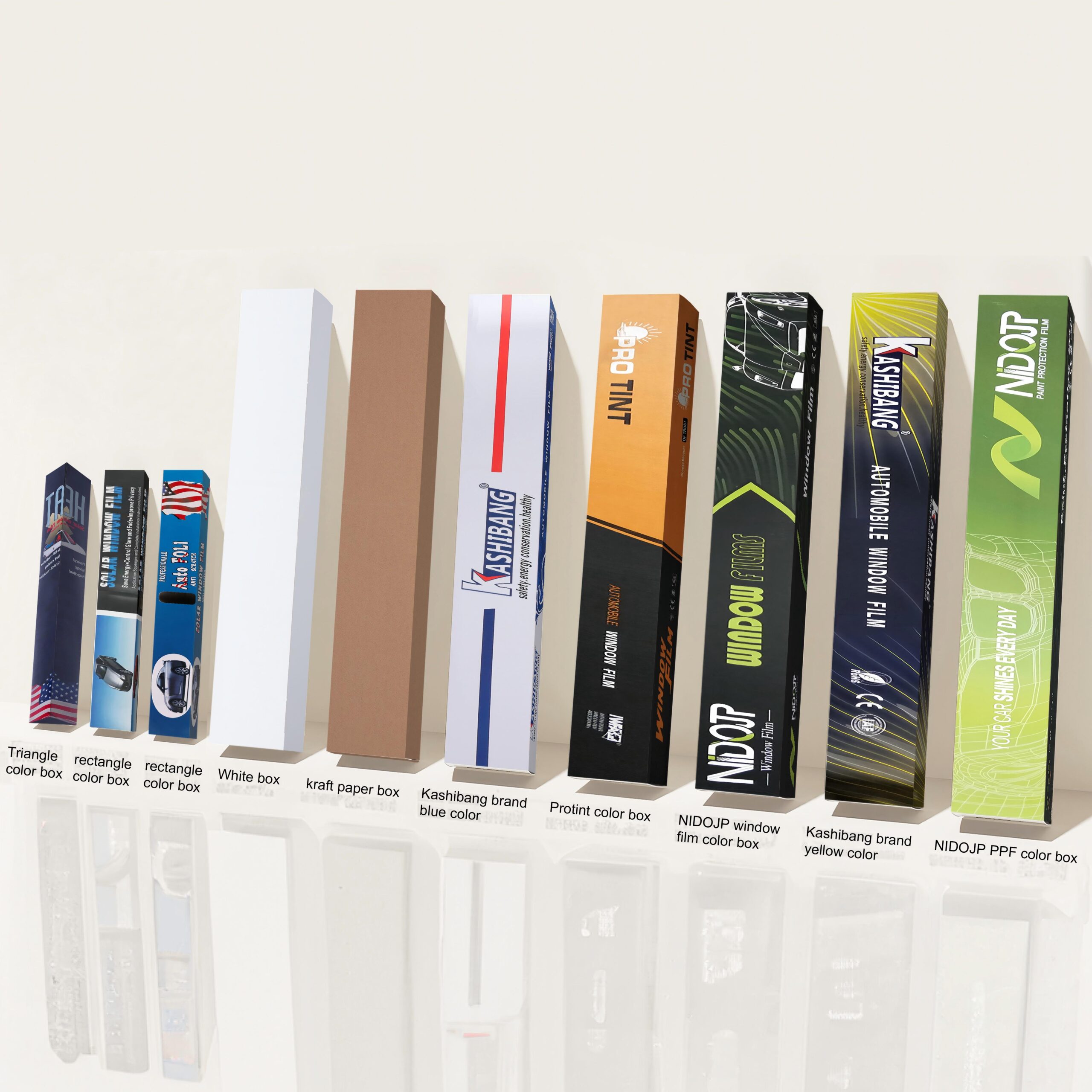
various packaging styles available for customization and brand presentation.
PPF packaging is the first thing an installer touches before the film reaches a vehicle. How professional it looks, how clearly it communicates performance specs, and how it holds up in a van toolbox over six months — all of this shapes how installers perceive and sell your brand.
Getting packaging right isn’t complicated, but it requires understanding what each component is for and specifying it with the installer experience in mind.
The Five Components of PPF Packaging
1. The Roll Core Label
The core label is the most important packaging element. It travels with the roll through the entire supply chain and is what the installer reads at the point of use.
What must be on the core label:
Product identification:
Brand name and logo
Product line name (e.g., “ProShield Ultra”)
SKU or model number
Film dimensions (e.g., 1.52m × 15m)
Thickness (e.g., 7.5 mil / 190 microns)
Finish (Gloss / Matte / Satin)
Performance data:
Self-healing temperature reference (e.g., “Heals in direct sunlight within 20 min”)
UV blocking (e.g., “Blocks 99% UV”)
Haze specification (e.g., “< 1.5% haze”)
Compliance and traceability:
Country of origin (“Made in China” — required in most export markets)
Production date or date code
Batch / lot number (enables traceability if a quality issue arises)
Label material: Self-adhesive polypropylene (PP) or polyethylene (PE) with UV-resistant print. Paper labels yellow and delaminate in UV-exposed storage environments — installers notice this and it reflects on brand perception.
2. End Caps
End caps protect the exposed film ends from edge damage during handling and shipping. For premium brands, printed end cap stickers (with brand name and logo) add visual brand presence even when the roll is out of its box.
Specification options:
Plain cardboard caps (functional, low cost)
Foam caps with cardboard backer (better protection, slightly more cost)
Custom-printed stickers on cardboard caps (brand-building step, add ~$0.15–0.30 per pair)
For a brand positioning at mid-market or above, custom-printed end caps are a worthwhile investment — the cost is negligible per roll and the visual impact in an installer’s workspace is real.
3. Individual Roll Wrap
Most PPF rolls are wrapped individually in polyethylene or polybag before boxing. This protects the roll surface from dust, moisture, and minor abrasion during handling.
Options:
Clear poly bag (functional, no branding)
Printed poly bag (brand name/logo on the outer surface of the bag — visible when box is opened)
Kraft paper sleeve with brand printing (more premium feel, slightly higher cost)
For premium brand positioning, a printed poly bag or sleeve is the right investment. For value-positioned products, clear poly is adequate.
4. The Outer Box
The outer box is your brand’s most visible physical touchpoint at the point of sale and in installer workshops.
Structural specification:
Inner dimensions must allow the roll with end caps to fit with 15–25mm clearance on all sides
Corrugated grade: single wall (B-flute or E-flute) for most rolls ≤15m
For longer rolls or heavy film: double wall corrugated
Orientation marking: indicate “This Side Up” to prevent storage on end
Print specification:
Value-tier: Flexo print on kraft corrugated. Typically 1–2 colour print. Cost-effective. Functional appearance.
Mid-tier: Full-colour offset print on white corrugated. Requires 400–800 unit minimum print run for reasonable per-unit economics. Significantly more professional appearance.
Premium-tier: Full-colour offset with spot UV varnish on key brand elements, or soft-touch lamination for a premium tactile finish. Higher cost, used by brands where packaging is part of the quality signal to professional installers.
What must be on the box exterior:
Brand name and logo (all visible faces)
Product name and SKU
Roll dimensions and thickness
Barcode (if distributing to retail or through scan-based inventory systems)
Country of origin
Batch number or traceability code
5. The Master / Export Carton
For distribution and export, individual branded boxes are packed into a master carton.
Specification:
Standard: 4–6 individual rolls per master carton
Double-wall corrugated for international shipping
Clear labeling: product code, total quantity, gross weight, dimensions
“Fragile” or “Handle with Care” marking
ISPM 15 heat-treated wood pallets for export (required by most markets)
The Artwork Briefing Process
What your factory needs from you:
Vector logo files (.AI, .EPS, .SVG — not JPEG or PNG). If your designer works in Illustrator, these are straightforward to produce.
Brand colour specifications in CMYK and Pantone. Screen colours (RGB/HEX) are useless for print specification — always specify Pantone for brand-critical colours.
Dielines for each packaging component. Your factory should provide blank dielines for their standard packaging formats. You (or your designer) fill them with your brand assets.
Complete copy deck — all text that appears on every packaging element, final and proofread. Do not leave text decisions to the factory.
Performance data — the actual haze %, UV %, self-healing specification. These must match your current test reports. Don’t round up or use aspirational numbers.
Market-specific compliance text — country of origin, any market-specific required statements.
Approval process: Specify how many rounds of physical samples you want before mass production approval. Standard: one round of printed samples for approval, then production. Premium programs: full sample set of all components before any packaging production.
Common Packaging Mistakes
Using JPEG logos. Pixelated logos on packaging are an immediate credibility signal that the brand isn’t serious. Always vector files.
Skipping the approval sample. The print colour on your monitor is not what will appear on printed PP label material. A physical approval sample catches colour and layout issues before they appear on 500 rolls.
Inaccurate performance data. Performance claims on packaging that don’t match your test reports create a mismatch that installers will notice when they check the spec sheet. Accuracy is non-negotiable.
Underspecifying label material. Paper labels peel and yellow in UV-exposed storage. PP labels last the life of the roll.
Ignoring batch number. The batch number enables traceability if a quality issue affects a specific production run. Omitting it from packaging means you can’t efficiently identify and recall affected product if you ever need to.
FAQ
Can I reuse packaging from my private label supplier’s standard design and just add my logo?
Yes — this is the simplest private label path. Many manufacturers offer “semi-custom” packaging where their standard box design is personalised with your logo and brand colour. Lower cost, faster lead time. Trade-off: the packaging design is not fully yours, and other brands may use similar-looking boxes from the same manufacturer.
How long does packaging production take?
Printed roll labels: 7–14 days from artwork approval. Custom outer boxes (offset print): 15–25 days. Full sample cycle (print, review, revise, approve, production): add 2–3 weeks. Plan 6–8 weeks for complete packaging development before production rolls ship.
What’s the minimum budget for decent-quality private label PPF packaging?
For 300 rolls, one SKU, mid-range print quality: core labels ($200–$400), end cap stickers ($120–$200), poly bags ($100–$200), outer boxes ($600–$900 for offset print). Total: $1,000–$1,700 for packaging components at 300-roll scale.
KSB Window Film handles packaging design coordination, dieline provision, print production, and quality approval for our OEM and private label PPF programs. We’ve done this for brands in multiple markets and know what causes delays — so you don’t have to learn the hard way.