How We Handle Quality Control: From Raw TPU Resins to Finished PPF Rolls
Published: August 7, 2026 · 8 min read · Category: PPF Manufacturing
About this article:KSB Window Film’s QC system covers every stage from raw material receipt to outbound shipment. This guide provides transparency into our quality management process — the practical basis for B2B buyers trusting our product consistency.
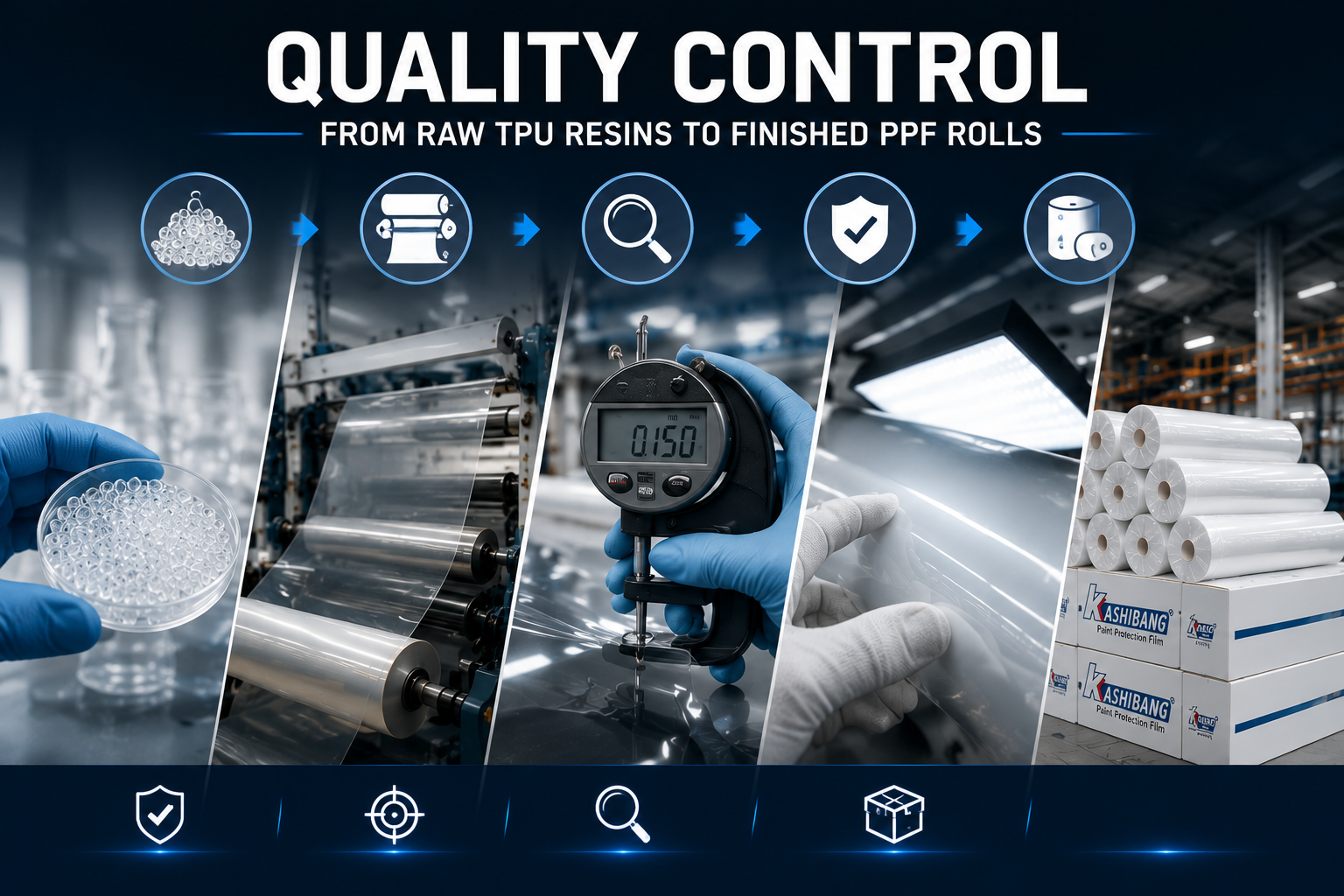
from raw materials to final rolls, every stage is strictly tested to ensure consistent ppf quality
Quality claims are easy to make. Quality documentation is harder to fake. KSB’s quality control system produces verifiable, batch-traceable records at every production stage — because for B2B buyers who stake their distribution business on our film, “we check quality” isn’t enough. This is what we actually check, and how.
Stage 1: Raw Material Incoming Inspection
Every incoming batch of key raw materials is inspected before entering production.
Liner peel force measured (ASTM D3330 method) — must be within specification range (too easy = risk of liner separation in storage; too hard = difficult installation)
Visual inspection for adhesive voids or coating gaps
Stage 4: Final Roll Inspection — “Lighting Chamber” Check
Every production roll before slitting passes through human visual inspection in a dedicated lighting chamber:
Rolls inspected under both direct and transmitted light
Inspectors look for: gel specs, fisheyes, coating streaks, any visible defect
Any roll with defects is marked and either downgraded or rejected
Defect rate tracked per production shift and reviewed weekly
KSB defect standard: Maximum 1 gel spec visible under installation lighting per 10sqm. Any roll exceeding this is rejected from first-quality stock.
Stage 5: Finished Product Testing (Batch Basis)
From each production batch, samples are taken for full product testing:
Test
Standard
Acceptance Criterion
Frequency
VLT
ASTM D1003
Within ±3% of spec
Every batch
Haze
ASTM D1003
< 1.0%
Every batch
Peel adhesion
ASTM D3330
> 15 N/25mm
Every batch
Tensile strength
ASTM D882
> 45 MPa
Weekly
Elongation at break
ASTM D882
> 400%
Weekly
UV rejection
ISO 9050
> 99%
Monthly
TSER
ISO 9050
Within ±3% of TDS
Monthly
Accelerated weathering (QUV): Annual product validation. Results retained and available to customers.
Stage 6: Slitting and Packing
Slit rolls inspected for edge quality (clean slit, no delamination at slit edge)
Packaging check: correct label for product, batch number on label, correct quantity in outer carton
Outbound shipment inspection: packaging integrity before container loading
Batch Traceability
Every finished roll is traceable to:
The production batch record (coating date, equipment used, process parameters)
The incoming raw material batches (TPU lot, PET lot, PSA lot)
The QC results for that batch
If a quality issue is reported from the field, KSB can trace the affected roll’s entire production history within 2 business days. This enables root cause analysis and targeted corrective action rather than speculative response.
FAQ
Can buyers access batch QC records?
Yes. B2B buyers who request batch-level QC data for an order can receive the batch test results for the specific lots shipped. This is standard for our major distribution partners and available on request for any commercial order.
KSB provides batch test certificates with commercial orders and makes full QC records available to distribution partners. Transparency is the foundation of commercial trust.