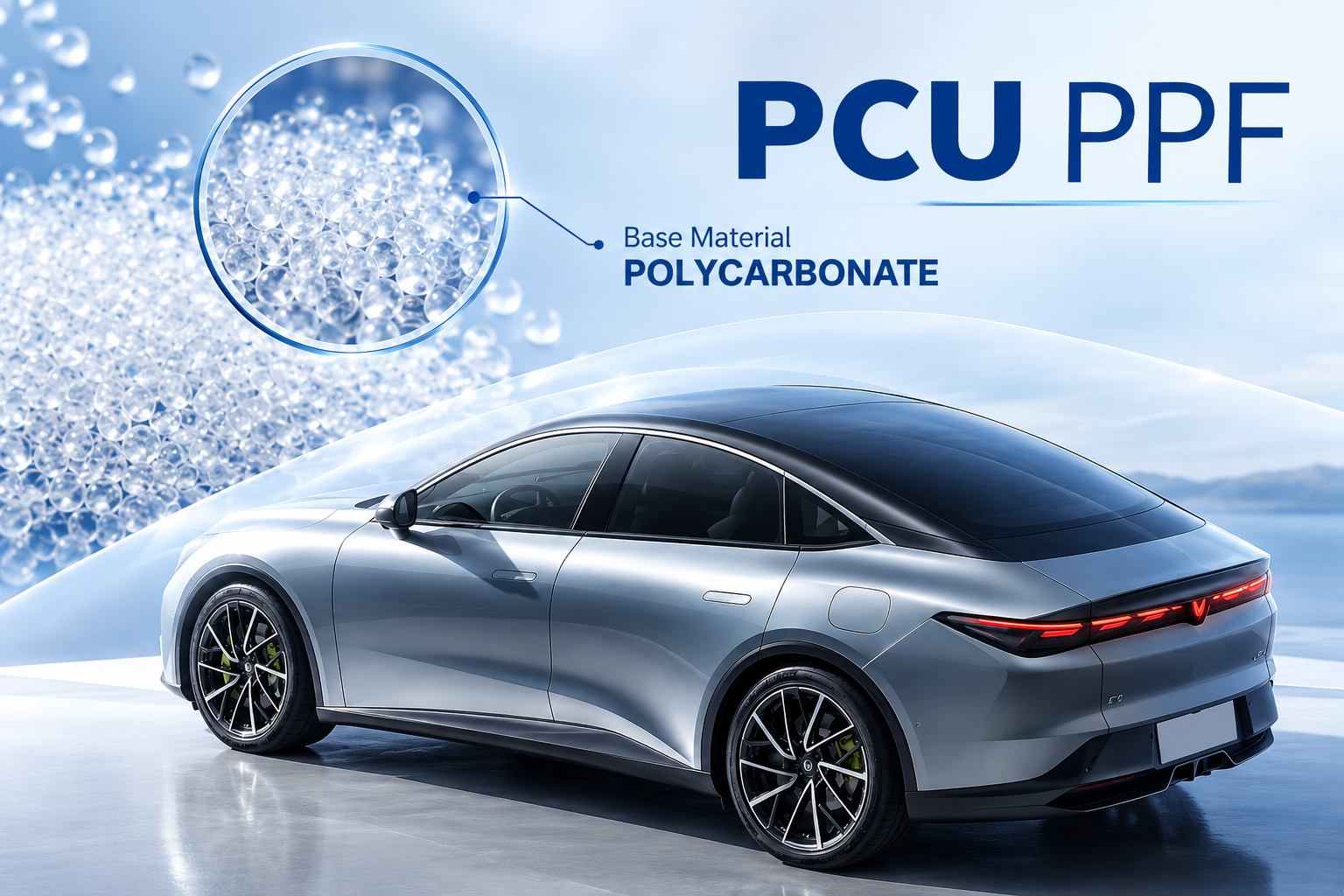
If you source or sell paint protection film (PPF), you may have noticed more products being marketed as “PCU PPF.”
This raises an obvious question: What is the difference between TPU and PCU, and is PCU actually better for paint protection film?
The answer is not as simple as the names suggest.
TPU is a broad family of thermoplastic polyurethane materials. In the PPF market, PCU commonly refers to polycarbonate-based polyurethane, often associated with TPU made using polycarbonate diol (PCDL) chemistry.
So, instead of treating TPU and PCU as two completely unrelated materials, it is more useful to understand the chemistry behind them — and how that chemistry affects the finished PPF.
What Is TPU in Paint Protection Film?
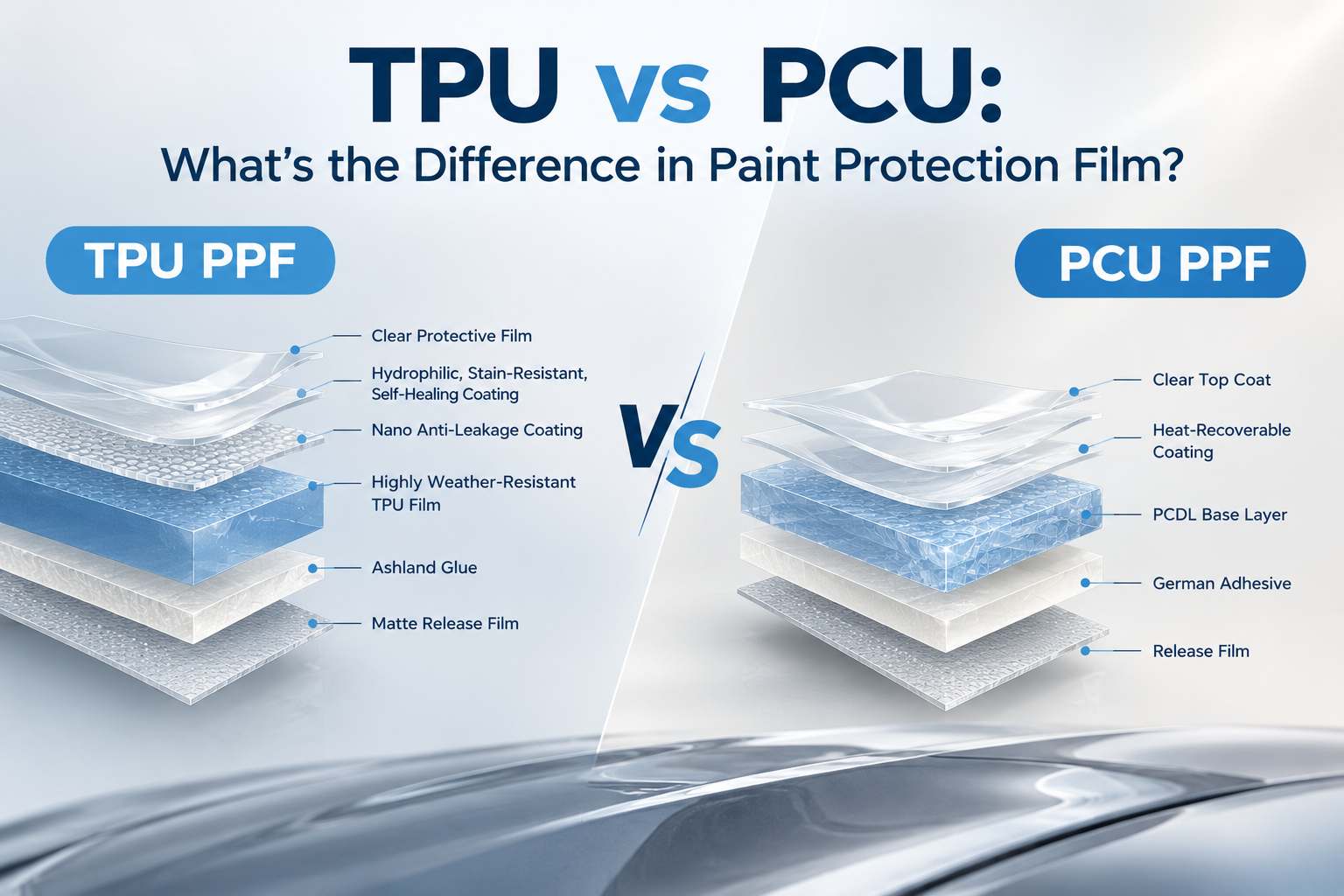
TPU stands for Thermoplastic Polyurethane.
It is widely used as the base film for premium PPF because it combines flexibility, elasticity, abrasion resistance and mechanical strength.
TPU consists of two main structural regions:
- Soft segments — mainly influence flexibility, elasticity and elongation.
- Hard segments — contribute to strength, abrasion resistance and structural stability.
But TPU is not one single formulation.
Different polyols can be used to form its soft segments, including polyester, polyether, polycaprolactone (PCL) and polycarbonate diol (PCDL).
This means that simply knowing a PPF is made from “TPU” does not tell you everything about its performance.
What Is PCU in Paint Protection Film?
The term PCU is used somewhat differently across the PPF market.
It commonly refers to polycarbonate-based polyurethane. In many PPF products marketed as PCU, the underlying material is associated with PCDL-based TPU.
PCDL stands for Polycarbonate Diol, a polyol that can be used to form the soft segment of polyurethane.
This is why a more technically useful comparison is often:
PCL-based TPU vs. PCDL-based TPU
rather than simply:
TPU vs. PCU
PCDL-based polyurethane has attracted interest because this chemistry can provide a strong combination of hydrolysis resistance, weather resistance, heat resistance and abrasion resistance.
However, these material characteristics should not be confused with the guaranteed performance of a finished PPF.
PCL-Based TPU vs. PCDL-Based TPU
PCL and PCDL represent two different soft-segment chemistries used in polyurethane.
Both can be used to produce high-performance TPU, but they offer different balances of properties.
| Property | PCL-Based TPU | PCDL-Based TPU |
|---|---|---|
| Material family | TPU | TPU |
| Soft segment | Polycaprolactone | Polycarbonate Diol |
| Flexibility | Excellent | Formulation dependent |
| Hydrolysis resistance | Strong | Particularly strong potential |
| Chemical resistance | Strong | Strong |
| Abrasion resistance | Strong | Strong |
| Weather resistance | Strong | Strong potential |
| Finished PPF quality | Depends on complete construction | Depends on complete construction |
The important point is that soft-segment chemistry is only one variable.
Polymer formulation, hard/soft segment ratio, additives, film processing and coating technology can all influence the final properties of TPU.
For buyers who want a deeper technical comparison, see our guide to PCL vs. PCDL TPU for paint protection film.
Is PCU Better Than TPU for PPF?
Not necessarily.
From a PPF manufacturing perspective, asking only “Is this TPU or PCU?” leaves out too much information.
Two films can both use PCDL-based TPU and still behave very differently after installation.
A typical PPF construction includes:
Self-Healing Topcoat
↓
TPU Substrate
↓
Pressure-Sensitive Adhesive
↓
Release Liner
The substrate provides the mechanical foundation, but the finished performance also depends heavily on the topcoat, adhesive and manufacturing process.
For example, the topcoat affects properties such as:
- self-healing
- hydrophobicity
- stain resistance
- gloss retention
- surface durability
The adhesive affects:
- initial tack
- repositionability
- edge stability
- installation ease
- long-term adhesion
- clean removal
So even if two PPF products use similar TPU substrates, their real-world performance can be very different.
What Actually Determines PPF Quality?
When evaluating PPF, we recommend looking beyond the material label.
1. Substrate Chemistry
Don’t stop at:
“This is TPU.”
Ask what type of TPU is being used.
Is it PCL-based, PCDL-based, polyester-based or another formulation?
2. Mechanical Properties
Check measurable specifications such as:
- thickness
- tensile strength
- elongation
These values provide useful information about how the film may behave during stretching and installation.
However, they should always be interpreted together with the test method and actual installation performance.
3. Topcoat Performance
A high-quality topcoat can improve:
- self-healing
- hydrophobicity
- stain resistance
- chemical resistance
- surface smoothness
- gloss retention
4. Adhesive Performance
For professional installers, adhesive quality is just as important as the substrate.
A premium TPU substrate cannot compensate for poor repositionability, weak edge adhesion or an unstable adhesive system.
5. Optical Quality
Because PPF is installed directly over automotive paint, buyers should also evaluate:
- transparency
- haze
- gloss
- orange peel
- surface uniformity
6. Weathering and Aging
If a supplier claims excellent anti-yellowing or long-term durability, ask for the actual test conditions.
For example:
How many hours was the accelerated weathering test? What test method was used? Was the complete PPF tested, or only the raw material?
Specific test data is more useful than a simple claim such as “PCU lasts longer.”
A Real Example: KSB PL75 PCDL-Based PPF
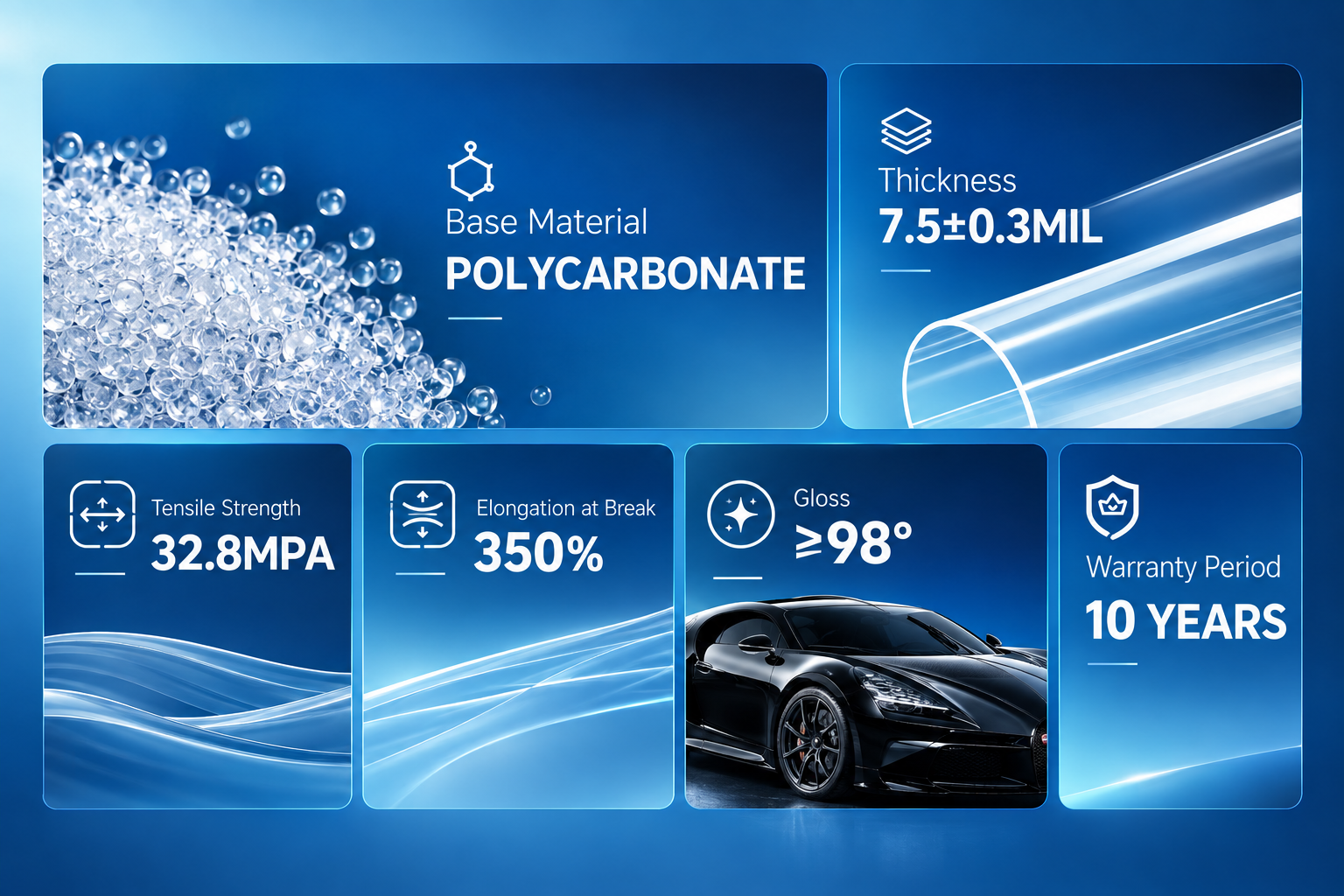
KSB PL75 is a useful example of why we prefer to describe the actual film construction rather than relying only on the term “PCU.”
PL75 uses a PCDL-based TPU substrate combined with a self-healing topcoat and automotive adhesive.
Its construction is:
Protective Film → Self-Healing Topcoat → PCDL-Based TPU → Automotive Adhesive → Release Liner
Current product specifications include:
| Specification | PL75 |
|---|---|
| Thickness | 7.5 ± 0.3 mil |
| Tensile Strength | 32.8 MPa |
| Elongation | 350% |
| Gloss | ≥98 |
| Surface | Hydrophobic |
| Healing | Heat/Self-Healing |
| Warranty | 10 Years |
These numbers provide much more information to a professional buyer than the material name alone.
They also illustrate an important point:
PCDL-based TPU describes the substrate. It does not describe the entire PPF.
The topcoat, adhesive, optical quality and manufacturing consistency still need to be evaluated together.
Be Careful With PCU Marketing Claims
As PCU becomes more visible in the PPF market, buyers may encounter claims such as:
“3× more durable”
“Next-generation PPF”
“Much better than TPU”
“15-year material”
Instead of accepting or rejecting these claims immediately, ask for the supporting data.
If a supplier claims 3× better hydrolysis resistance, ask:
Compared with what material?
If a product claims 15-year durability, ask:
Is that based on outdoor exposure, accelerated aging, raw-material data or a product warranty?
If it claims better anti-yellowing performance:
What test method was used, and what was measured before and after aging?
For professional PPF sourcing, measurable data is more useful than a material buzzword.
What Should PPF Buyers Ask Before Ordering?
For distributors, wholesalers and private-label brands, these questions are more useful than simply asking whether the film is TPU or PCU:
- What is the exact TPU substrate chemistry?
- What is the total film thickness?
- What are the tensile strength and elongation values?
- What topcoat system is used?
- How does the adhesive perform during installation and repositioning?
- What weathering or aging tests have been performed?
- How is yellowing resistance evaluated?
- What does the warranty actually cover?
Whenever possible, test a sample on a real vehicle panel before making a larger order.
A real installation can reveal stretch behavior, adhesive feel, repositionability, surface appearance and installation marks that are difficult to understand from a technical data sheet alone.
TPU vs PCU: The Bottom Line
The difference between TPU and PCU in paint protection film is often oversimplified.
TPU is a broad family of thermoplastic polyurethane materials. In the PPF market, PCU commonly refers to polycarbonate-based polyurethane and is often associated with PCDL-based TPU.
PCDL chemistry can offer attractive material properties, particularly for hydrolysis and environmental resistance.
But PCDL-based TPU does not automatically mean better PPF.
For professional buyers, the better approach is to evaluate:
Substrate + Topcoat + Adhesive + Mechanical Properties + Optical Quality + Weathering Data + Installation Performance
Don’t choose a paint protection film based on the “TPU” or “PCU” label alone.
Find out what the substrate actually is, review the technical data, and evaluate the complete film.
Frequently Asked Questions
Is PCU a type of TPU?
In the PPF market, PCU commonly refers to polycarbonate-based polyurethane and is often associated with PCDL-based TPU. It should not necessarily be understood as a completely separate material family from TPU.
What does PCDL mean?
PCDL stands for Polycarbonate Diol. It is a polyol that can be used in the soft segment of polyurethane and TPU.
Is PCDL the same as polycarbonate plastic?
No. PCDL is a chemical building block used to manufacture polyurethane. PCDL-based TPU should not be confused with rigid polycarbonate plastic.
Is PCU PPF better than TPU PPF?
Not automatically. The substrate chemistry is important, but the finished PPF also depends on the topcoat, adhesive, formulation, manufacturing quality and actual test performance.
What should I check when buying PCU PPF?
Check the substrate chemistry, thickness, tensile strength, elongation, topcoat, adhesive, optical quality, weathering data and warranty. For B2B sourcing, sample installation testing is also recommended.
Further Reading
On this site:
- What Is PCU PPF — A closer look at PCU, PCDL-based TPU, and its role in PPF
- PCDL vs PCL TPU — How two different TPU soft-segment chemistries compare
- What Is PCDL Based TPU — Understanding PCDL chemistry and its use in PPF substrates
- Aliphatic TPU vs Aromatic TPU PPF — How TPU chemistry influences clear-film durability
- Is PCU PPF Better Than TPU — A closer comparison of PCU and TPU performance in PPF
Get a Free Sample or Quote
Looking for a reliable window film supplier? Contact us today for fast response and professional support.